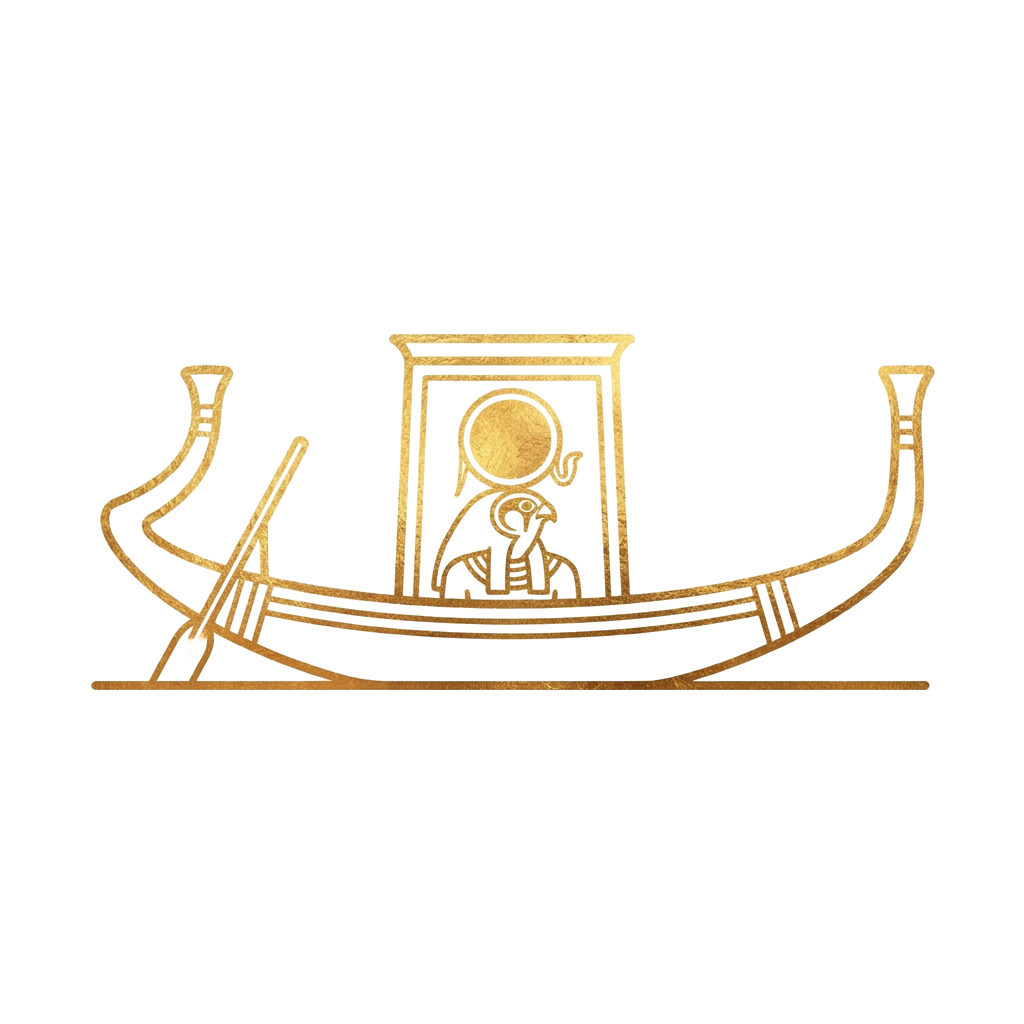
Atet (Solar Barque)
The Atet (Mandjet) is Ra's day-boat, the vessel in which the sun sails across the heavens from sunrise to sunset — paired with the Mesektet night-boat that carries Ra through the twelve underworld hours to his dawn rebirth.
About Atet (Solar Barque)
The Atet is the boat of the sun. In Egyptian solar theology the sun does not fly across the sky or sit in a chariot — it sails. Every morning Ra boards a boat at the eastern horizon, travels west across the dome of heaven for twelve hours, disembarks at the western horizon, and transfers to a second boat that carries him through the twelve hours of the underworld until he reaches the east again at dawn. The day-boat is called Mandjet (also Atet). The night-boat is called Mesektet. Together they form the full solar cycle.
The Egyptians treated the sun's movement as a navigation problem, not a flight problem. This distinguishes Egyptian solar imagery from Greek and Indo-European parallels, where the sun is pulled across the sky in a chariot by horses (Helios, Surya). Egypt imagined a long, flat-bottomed papyrus-or-cedar boat with a curved prow and stern, crewed by multiple gods, poled or towed through the cosmic waters above and below the earth. Ra stands or sits in a small cabin amidships. Around him a company of deities — Thoth, Maat, Horus, Hu, Sia — carry out defined navigational and protective duties. At the sixth hour of the night-boat's voyage, Ra merges with Osiris in the depths of the Duat, and this merging is the power that restarts the next sunrise.
This page covers the Mandjet and Mesektet as the two solar barques, the twelve-hour day and twelve-hour night cycles, the transformations of Ra across the course of the day (Khepri at dawn, Ra at noon, Atum at sunset), the Ra-Osiris merging at midnight, the battle with the chaos serpent Apep, and the physical solar boats buried beside the pyramids — most spectacularly Khufu's 1,224-fragment cedar ship now in the Grand Egyptian Museum.
Visual Description
The Atet in Egyptian art is a long, flat-bottomed boat with a high curved prow and stern, a small central cabin or naos, and a steering oar at the rear. The hull is usually rendered in profile, showing the full length of the deck. Details vary by period.
On tomb walls and funerary papyri the boat is drawn in clear, schematic line-work with Ra seated inside the cabin, usually in his falcon-headed form with the solar disk (and often a uraeus) on his head. Standing around him is a crew: Thoth at the stern with his ibis head writing the voyage, Maat with her feather assuring truth, Horus at the prow as navigator and protector, Hu (authoritative speech) and Sia (perception) as secondary helpers, and Set with a spear at the bow fighting Apep the chaos serpent. The boat is sometimes shown under tow by a line of lesser deities walking ahead along a cosmic tow-path.
The night-boat, the Mesektet, is visually darker in tone. In the Amduat and Book of Gates papyri and tomb walls, the Mesektet is drawn in a lower register of the wall, sometimes with a serpent-shaped ram-headed Ra inside the cabin rather than the falcon-headed day-form. The water under the boat may be drawn as a wavy band or as linked Nu-lines representing the subterranean cosmic ocean. At the sixth hour of the night, in the Book of the Amduat, Ra's body lies horizontal in the cabin while his ba-soul unites with Osiris; this moment is given its own distinct iconographic register across the full width of the tomb wall.
Physical solar boats were also constructed. Khufu's Fourth Dynasty solar ship, excavated from a sealed pit beside the Great Pyramid in 1954 by Kamal el-Mallakh and reconstructed from 1,224 disassembled cedar pieces by restorer Ahmed Youssef Moustafa, is 43.6 metres long, with a shell-first hull built of Lebanon cedar lashed together with Halfah grass rope. It is now in the Grand Egyptian Museum. A second buried Khufu boat, from the adjacent pit, is undergoing restoration.
Esoteric Meaning
The solar boat is Egypt's answer to a theological problem every sun-worshipping culture faces: how does the sun get from where it sets to where it rises? Other cultures resolved this by making the sun go around the earth, under the earth, through a tunnel, or back through the sky at night invisible. Egypt gave the sun a second boat, a second crew, and a separate mythology for the return half of the journey. The Mesektet is not just the Mandjet flipped backward. It is a different vessel with a different crew doing different work in a darker medium.
This doubling matters. The Egyptians read the day-boat and the night-boat as complementary halves of one continuous act of navigation, and they read the two cannot be skipped. If the night-boat fails, there is no dawn. If Ra does not merge with Osiris at midnight, the cycle breaks. The solar barque as symbol carries this commitment to the hidden half of existence: the light at noon depends on work done in the dark at midnight, where the worshipper cannot watch. Egyptian theology treats the invisible work as the decisive work.
The Ra-Osiris merging at the sixth hour is the heart of the esoteric reading. Ra is the active sun; Osiris is the silent ruler of the dead. They are, in ordinary Egyptian theology, opposite principles: light and dark, motion and rest, above and below. The Amduat shows them becoming the same figure at midnight — 'Ra is Osiris; Osiris is Ra.' This is not a loss of distinction. It is the moment at which opposites touch each other long enough to generate the next day. The same theological move appears in later traditions as the coincidentia oppositorum in Nicholas of Cusa, or the Taoist Yin-Yang's interpenetration at their innermost points; Erik Hornung argues in The Valley of the Kings that the Egyptian version precedes all of them and gave the Hermetic and alchemical traditions their underground template.
The crew of the barque also matters. Ra does not pilot himself. He is surrounded by specialised gods: authoritative speech, perception, truth, writing, navigation, weaponised protection. The sun rises not by brute force but by organised effort. Egyptian solar theology is administrative: a staffed office keeps the cosmos running. Reading the barque as symbol, the reader is invited to see the solar cycle as team-work rather than as inevitability.
Exoteric Meaning
At the literal level the Atet is the sun's boat, the way the sun travels. Egyptians living by the Nile saw boats as the normal way to move across large bodies of water (the Nile itself, the annual flood plain, the Delta marshes), and projecting boats into the sky was a straightforward act of imagination. The sky was the body of Nut, a goddess arched over the earth, and under her was a cosmic river that the sun-boat sailed. This is why Egyptian sky-writing often shows small boat-glyphs floating in the upper register of tomb walls: the sun's boats, drifting through the painted equivalent of the heavens.
For the ordinary Egyptian, the solar barque also had personal-eschatological weight. The dead hoped to join the crew. Book of the Dead Spell 100, 'Chapter for Causing the Deceased to Join Ra's Barque,' instructs the deceased on how to board the Mandjet at sunrise and travel with the sun-god through the day, an image preserved in vignettes throughout the late New Kingdom and later. The barque becomes the afterlife vehicle as well as the cosmic one. A properly equipped tomb, a well-memorised spell, and an accepted ka were what a dead person needed to get on board.
Royal burials made the metaphor physical. The pharaoh's pyramid complex often included pits for actual ships, buried near the tomb so that the king could sail with Ra in the afterlife. Khufu's pit produced the 43-metre cedar ship now in the Grand Egyptian Museum. Khafre's pit yielded fragments of a similar vessel. Senusret III's complex at Dahshur produced several cedar boats now in museums in Cairo, Chicago, and Pittsburgh. These were not just metaphors. They were literal ships, full-sized, buried assembled or disassembled, intended for actual use by the royal ka.
Usage
The Atet and Mesektet saturate Egyptian religious material from the Old Kingdom onward.
In Pyramid Texts, the earliest royal funerary corpus (late 5th and 6th Dynasties, c. 2350–2150 BCE), the king is repeatedly described joining Ra in his solar boat. Pyramid Texts utterances speak of the king boarding the Mandjet at sunrise and sailing with Ra across the sky. The imagery is already fully formed in the earliest royal writing.
In Coffin Texts (First Intermediate Period and Middle Kingdom, c. 2100–1650 BCE), the boat-joining imagery extends to non-royal dead. Coffin Texts spells repeatedly address the deceased as 'boarding the solar barque' and give specific navigational instructions.
In the Book of the Dead, Spell 100 ('Chapter for Causing the Deceased to Join Ra's Barque') and Spell 130 ('Chapter for Making Perfect the Spirit in the Sun-Barque') are the core solar-boat chapters. Book of the Dead papyri illustrate these with vignettes showing the deceased aboard Ra's boat.
In New Kingdom royal tomb programmes, the night-journey of the Mesektet is depicted in three major compositions: the Amduat ('Book of What Is in the Underworld'), the Book of Gates, and the Book of Caverns. Each follows the Mesektet hour-by-hour through the twelve night-hours. The Amduat is the oldest and appears in complete form for the first time in the tomb of Thutmose III (KV34, c. 1425 BCE). The Book of Gates becomes standard from Horemheb onward (KV57, c. 1295 BCE). The Ramesside tombs — Seti I (KV17), Ramesses II (KV7), Ramesses III (KV11), Ramesses VI (KV9) — carry the fullest decorated versions. The sarcophagus of Seti I in Sir John Soane's Museum (London) is inscribed on the interior with the complete Amduat, one panel per hour.
In royal ship-burials, pharaohs were interred with actual ships to use in the afterlife. Khufu's two solar ship pits at Giza produced the cedar vessels now under restoration. Khafre's pyramid complex contains similar pits. Senusret III's Dahshur complex yielded several Middle Kingdom wooden boats. These ships were functional-scale — Khufu's is 43.6 metres long — and used Mediterranean maritime construction techniques (Lebanon cedar, shell-first hull, lashed not pegged). Whether they had been sailed before burial or built specifically for the tomb is still debated; the cedar pegs and mortises suggest they were capable of floating.
In temple ritual, processional boats of the gods were paraded through the temple and out to the Nile during major festivals. These were sacred barques carried on poles, containing the cult image of the god inside a small naos. The Opet Festival at Karnak-Luxor each year moved Amun, Mut, and Khonsu in their three barques along the processional way and by river between the two temples. While not themselves the solar Mandjet, these festival barques drew their imagery from solar-barque iconography, framing all divine movement as boat-travel.
In Architecture
Solar-barque imagery shaped several distinct building types in Egypt.
Pyramid ship-pits. Royal Old Kingdom pyramid complexes incorporated sealed stone-lined pits for actual ships. Khufu's pyramid at Giza had at least five pits; two contained the dismantled cedar ships now known as the Khufu solar boats. Khafre's pyramid has similar pits, as does Menkaure's. The architecture anticipated the king's afterlife navigation: the burial chamber lay inside the pyramid, the ship-pit lay just outside, and the theology said the king's ka would emerge from the first and board the second. The pits are architectural elements in service of the solar-barque theology.
Royal tomb programmes in the Valley of the Kings. From the Eighteenth Dynasty onward, the decorated programme of royal tombs followed the structure of the Amduat: each chamber or corridor corresponded to one or more hours of the night-boat's journey, and the deceased king walked through architecture that re-staged the Mesektet's passage. In Seti I's tomb (KV17) the longest royal tomb yet discovered, the architectural sequence and the painted programme are tightly fused: passing through the gates of the tomb is passing through the gates of the Duat. The sarcophagus chamber corresponds to the sixth-hour meeting of Ra and Osiris. The architecture is the solar barque rendered as a building.
Temple barque-shrines. Large temples of the New Kingdom included a specific room, the barque-shrine, where the god's portable sacred boat was kept between festivals. The barque-shrine at Karnak's main axis, the Red Chapel of Hatshepsut (reassembled in the Open Air Museum), and the central sanctuaries of Luxor, Edfu, and Dendera all contain these shrines. The room itself is architecturally modelled on the boat it houses: often elongated, sometimes with a raised pedestal where the barque rested.
Temple river-landings and processional ways. Temples were oriented to face the Nile or were connected to the river by a canal and a stone-paved processional way, so that the god's barque could travel by water from one temple to another during festivals. Karnak and Luxor are linked by a ram-lined processional way and were also connected by a river route for the Opet Festival. Edfu and Dendera held a reciprocal festival in which Hathor's barque sailed from Dendera to Edfu for the annual reunion with Horus. The architecture assumed that the gods travelled by boat.
Significance
Religious meaning. The solar barque is the core image of Egyptian solar theology. The sun is not an abstract fire or a chariot-pulled disk; it is a god sailing a boat through cosmic water, requiring a crew, a destination, and a return journey. Every element of Egyptian sun-worship downstream — the dawn hymn, the sunset rite, the royal funerary ascent, the twelve hours — presumes the barque as its vehicle. Erik Hornung, in The Ancient Egyptian Books of the Afterlife (Cornell, 1999), argues that the barque is Egypt's irreplaceable solar image because it carries the theology's commitment to navigation-as-work: the sun does not simply shine, it is sailed.
The Ra-Osiris merging. The midnight meeting of Ra and Osiris at the sixth hour of the Mesektet's journey is one of the most influential theological images in any ancient religion. Ra is activity, Osiris rest; Ra is light, Osiris the buried dead; Ra is above, Osiris below. Their merging at midnight — 'Ra is Osiris; Osiris is Ra' — is the pivot on which the next sunrise turns. Carl Jung read this fusion as an early formulation of the reconciliation of opposites in his Mysterium Coniunctionis; Mircea Eliade treated it as the archetypal coincidentia oppositorum. Whether or not later traditions drew directly on Egyptian models, the Mesektet's sixth hour is arguably the earliest fully developed account of the integration of opposites in recorded religious literature.
Architectural translation. The full Valley of the Kings programme is the Amduat built. The royal tomb is not a tomb decorated with the night-boat; it is the night-boat rendered in stone. This is an extraordinary architectural commitment — an entire burial industry built around the assumption that the king's body must pass through the same twelve hours Ra passes through, in a building laid out to match. Jan Assmann in The Search for God in Ancient Egypt (Cornell, 2001) traces the reading of the Valley as a textual landscape.
Physical solar boats. Khufu's cedar ship — 1,224 fragments assembled into a 43.6-metre vessel after a decade of reconstruction — is the oldest largely-intact ship in the world. It is not symbolic. It was a real boat, built with Mediterranean shell-first technique from Lebanon cedar lashed with Halfah grass rope. Some scholars hold that it had been used in life, perhaps for Khufu's funeral procession; others argue it was built for the tomb. Either way, its existence pushes the solar-barque concept out of pure iconography into physical commitment. The Egyptians buried a real ship of that size for the king to sail with Ra.
Comparative mythologies. Sun-vehicles appear in many traditions, but most choose a different conveyance. Greek Helios rides a quadriga. Vedic Surya rides a seven-horse chariot. Norse Sol is pulled by two horses, pursued by a wolf. Chinese Xihe carries the sun-children in a carriage. Egyptian solar travel is almost uniquely a boat. The difference tracks geography: Egypt was a river civilisation whose principal road was water, and its cosmology mirrored its transport. The barque is therefore an unusually direct case of lived geography becoming theology.
Connections
Deities. Ra is the central figure of both barques; he boards the Mandjet at dawn as the falcon-headed sun-god and transfers to the Mesektet at sunset in his ram-headed form. Horus serves as prow-navigator and protector. Thoth is the stern-scribe recording the voyage. Maat provides truth and cosmic order as crew-member. Set paradoxically stands at the prow as spear-wielder against Apep the chaos serpent, a rare positive role for Set in later Egyptian theology. Osiris is the midnight partner whom Ra merges with at the sixth hour of the night-boat. Khepri (the scarab) is the dawn-form of Ra, Atum the sunset-form; together they form the tripartite day-cycle with Ra at noon. Hu (authoritative speech) and Sia (perception) complete the crew.
Texts. The Pyramid Texts contain the earliest solar-barque references. The Coffin Texts develop the boarding-the-barque imagery for non-royal dead. The Book of the Dead preserves the classic solar-barque spells (100, 130, 136A, 136B). The Amduat, Book of Gates, and Book of Caverns document the Mesektet's twelve-hour night-journey in full. The Litany of Ra addresses the sun-god in 75 forms, many associated with specific hours of the barque's course.
Other symbols. The scarab is Khepri pushing the morning sun-boat up through the eastern horizon. The winged sun disk is the sun-boat abbreviated to its essential passenger. The Benben stone is the primordial mound from which the first sunrise first launched its boat. The Akhet is the horizon-threshold the barques cross at dawn and dusk. The uraeus frequently appears on the prow of the solar boat, projecting flame against threats.
Further Reading
- Erik Hornung, The Ancient Egyptian Books of the Afterlife, trans. David Lorton (Cornell University Press, 1999). The standard survey of the Amduat, Book of Gates, Book of Caverns, and related solar-barque afterlife texts.
- Erik Hornung, The Valley of the Kings: Horizon of Eternity (Timken, 1990). The royal necropolis as the architectural translation of the Mesektet's twelve-hour night-journey.
- James P. Allen, The Ancient Egyptian Pyramid Texts (Society of Biblical Literature, 2005). Complete modern translation; see utterances addressing the king's boarding of Ra's barque.
- Jan Assmann, The Search for God in Ancient Egypt, trans. David Lorton (Cornell, 2001). The solar cult's theological structure and its temple-and-tomb translations.
- Raymond Faulkner, The Ancient Egyptian Book of the Dead (British Museum Press, 1985). Standard English translation; see Spells 100, 130, 136A-B.
- Cheryl Ward, Sacred and Secular: Ancient Egyptian Ships and Boats (Archaeological Institute of America, 2000). Technical survey of surviving Egyptian boats including the Khufu and Dahshur vessels.
- Paul Lipke, The Royal Ship of Cheops (BAR International Series 225, 1984). Detailed study of the Khufu ship reconstruction.
- Stephen Quirke, The Cult of Ra: Sun-Worship in Ancient Egypt (Thames & Hudson, 2001). The solar theology within which the barque operates.
Frequently Asked Questions
What is the Atet solar barque?
The Atet is an Egyptian name for the day-boat of the sun-god Ra, the vessel in which Ra sails across the sky from sunrise to sunset. Its more common name is Mandjet, sometimes translated 'the Boat of Millions of Years.' It is paired with a second boat, the Mesektet, which carries Ra through the twelve hours of the underworld at night. Together the two barques form the complete solar cycle: the Mandjet/Atet for the twelve hours of day, the Mesektet for the twelve hours of night, and a transfer between them at each horizon. The Atet is not just a vehicle; it is crewed by a team of gods — Thoth at the stern, Maat as truth, Horus as navigator, Set at the prow fighting the chaos serpent Apep — and the sun's daily rising is presented as a feat of organised navigation rather than as a natural inevitability.
What's the difference between the Mandjet and the Mesektet?
Mandjet (also called Atet) is the day-boat. It carries Ra across the sky from dawn at the eastern horizon to dusk at the western horizon, following the twelve hours of the day. Ra appears on the Mandjet most often in his falcon-headed form with a solar disk on his head. Mesektet is the night-boat. It carries Ra through the twelve hours of the underworld (the Duat) from sunset to the next dawn. Ra on the Mesektet is more often shown ram-headed or as a ba-bird, marking his transformed underworld aspect. Beyond the visual distinction, the two boats do different theological work. The Mandjet brings light to the world of the living; the Mesektet does the hidden work of regeneration, including the crucial sixth-hour merging of Ra with Osiris that restarts the next sunrise. Egyptian theology treats both halves of the journey as necessary. A dawn without a night-voyage would have no fuel.
Is the Khufu solar boat the Atet?
Not exactly — but it is designed for the same theology. Khufu's solar boat, a 43.6-metre cedar ship excavated from a sealed pit beside the Great Pyramid of Giza in 1954 and reconstructed from 1,224 fragments by Ahmed Youssef Moustafa, was built for the king to sail with Ra in the afterlife. Whether the Egyptians called this specific ship the Atet or simply a solar barque intended for the king's personal use in Ra's company is not fully clear from the texts. What is clear is the theological logic. The pyramid complex was designed to launch the king into the solar cycle: the king's ka would emerge from the pyramid and board a real ship to join the Mandjet. Khufu's pit produced two such ships; one is now in the Grand Egyptian Museum, the other is being restored. Khafre's and Menkaure's pyramid complexes have similar pits. Senusret III's complex at Dahshur yielded several Middle Kingdom royal boats, some of which are now in museums in Cairo, Chicago, and Pittsburgh.
What is the sixth hour of the Mesektet and why does it matter?
The sixth hour is the midnight moment of Ra's night-journey, and it is where the Egyptian solar theology does its most demanding theological work. At the sixth hour, in the account preserved in the Amduat (the Book of What Is in the Underworld), Ra's body lies at rest in the cabin of the Mesektet while his ba-soul unites with Osiris. Ra and Osiris are normally opposites: Ra is the active sun, Osiris the silent ruler of the dead. For one hour at the pivot of night, they become the same figure. The Amduat captions state this explicitly: 'Ra is Osiris; Osiris is Ra.' This merging is what allows the solar cycle to restart. The sun does not rise again because it never stopped — it rises because opposites touched each other at midnight long enough to generate the next day's light. Later religious thought, from the alchemical coincidentia oppositorum of Nicholas of Cusa through Jung's Mysterium Coniunctionis, returns to this image again and again. The sixth hour of the Mesektet is arguably the earliest fully worked account of the integration of opposites in recorded religious literature.