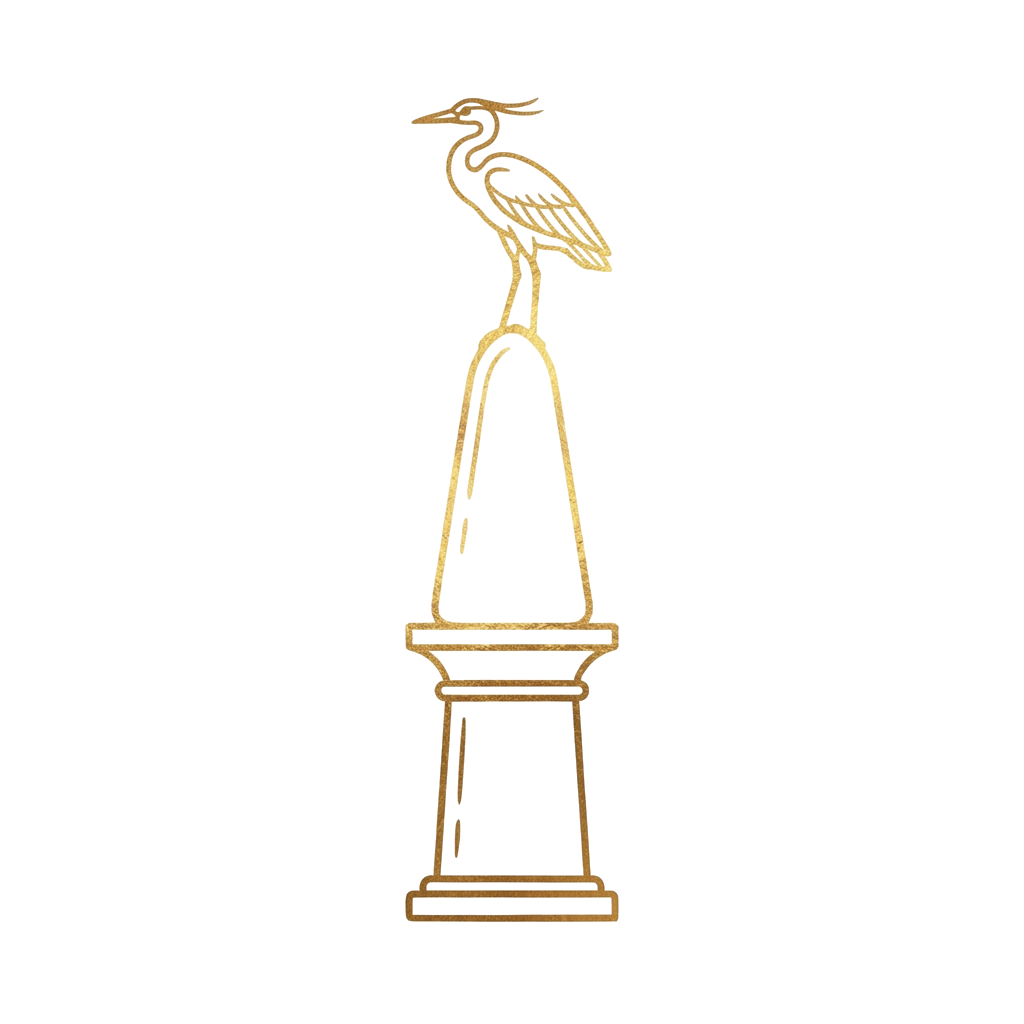
Benben Stone
The primordial mound of Heliopolitan creation. The sacred stone where Atum first stood above the waters of Nun, and the architectural source-form of every pyramidion and obelisk tip in ancient Egypt.
About Benben Stone
The Benben is the first solid thing. In the Heliopolitan creation account, the world begins as Nun, a dark undifferentiated ocean with no inside or outside, no day, no land. Out of that water rises a single mound. The creator god Atum stands on it. From that one foothold he generates the air, the moisture, the earth, the sky, and the rest of the gods. The mound is the Benben.
There were two Benbens. The cosmic Benben is the mound of creation itself, named in the Pyramid Texts as the place Atum first appeared. The physical Benben was a sacred stone kept in the great solar temple at Heliopolis, the cult center of Atum-Ra, called Iunu in Egyptian and later 'the City of the Sun' by Greek visitors. The original stone is gone. The temple is gone. What survives is the form: the pyramidion that crowned every pyramid, the pyramidal cap of every obelisk, and arguably the pyramid itself, all of them descendants of that one lost shape.
This page is about the stone, the cosmology behind it, the meteorite hypothesis (real but contested), the architectural theology that turned an entire civilization's tomb-and-temple program into echoes of one mound, and what got lost when Heliopolis fell.
Visual Description
The original Heliopolis stone is lost, so its exact shape has to be reconstructed from later descendants and ancient descriptions. Sources describe it as conical or pyramidal: a tapering, roughly pointed stone tall enough to be set up on a pillar inside the temple's open court so the first rays of dawn would strike its tip. The surviving architectural Benbens (pyramidions from Middle Kingdom royal tombs) are smooth four-sided pyramids in dark, hard stone. The pyramidion of Amenemhat III, the most famous example, is polished black granite covered in inscriptions to Ra. Old Kingdom pyramidions were typically white limestone or fine diorite, often sheathed in gold or electrum so the cap blazed at sunrise. In iconography, the Benben appears as a small pyramid, sometimes with the Bennu (a heron-like bird) perched on top, its long crest and luminous plumage echoing the sun's first ray.
Esoteric Meaning
The Benben is the moment that something is. Before it, only Nun: undifferentiated water, the unmanifest. The mound is the first event in which the unmanifest produces a here. Everything else (gods, sun, light, time, direction) needs that here to stand on. The Benben is the cosmic axis in its earliest form, the point at which up and down become possible because there is now a surface.
The pyramid form develops this. A pyramid is a Benben at architectural scale: a solid mass rising from the desert floor to a single point, with the pyramidion (a small Benben) marking the tip. An obelisk is the same idea stretched vertical, a stone shaft topped by a pyramidal cap, often gilded, designed to catch the dawn. The Egyptians read obelisks as petrified sun-rays, and during the Amarna period the cap was understood as a frozen ray of the Aten. So the obelisk is a Benben on a stem, and the pyramid is a Benben grown to mountain scale.
The primordial-mound idea is not unique to Egypt. The Sumerians built ziggurats: stepped artificial mountains housing a god at the top, rising from the flat plain like the first land out of Apsu, the freshwater abyss beneath the earth. In Hindu cosmology Mount Meru is the cosmic axis at the center of the universe, imitated in the rising peaks (shikharas) of temple architecture and in the layout of Angkor Wat. Mircea Eliade catalogued these as variants of the same archetype: the axis mundi, the world-mountain, the place where heaven and earth meet because the first land made meeting possible. The Benben is Egypt's version, with one local twist. The Egyptians had a specific stone they pointed to as the original, not just a mountain in a story.
Exoteric Meaning
Plainly: the Benben is the sacred stone of Heliopolis, the source-shape of the pyramid's capstone, and the model for the pyramidal tip of every Egyptian obelisk. Anywhere you see a small pyramid in Egyptian art or architecture (on a pillar, atop a tomb, above a god), you are seeing a Benben.
Usage
The physical Benben was housed in the great solar temple at Heliopolis. The temple's inner sanctuary was called Hwt-Bnw, the Mansion of the Phoenix (also called the Mansion of the Benben), an open-roofed court so the rising sun could touch the stone first. Pyramid Texts Utterance 600 (§1652) addresses Atum directly: 'as you rose up, as the benben, in the Mansion of the Bennu in Heliopolis.' The Bennu, a heron-like bird, was said to perch on the Benben at the moment of creation; later Greek writers folded this image into the phoenix legend.
Architecturally, the Benben was reproduced wherever a pyramidal point was used. Every pyramid was capped with a pyramidion (Egyptian benbenet, 'little Benben'), often gilded so the apex flashed at dawn. Every obelisk carried a small pyramidal cap. Stelae and tomb markers sometimes ended in a pyramidion. The form was so saturated with creation-symbolism that to set up a pyramid-topped stone was to plant a Benben, to enact in miniature the rising of the first land.
In Architecture
The Heliopolis temple itself is gone. Centuries of stone-robbing for medieval Cairo have left the site as scattered foundations under the suburbs of Matariya and Ain Shams. One Middle Kingdom obelisk of Senusret I still stands on its original site (the oldest surviving obelisk in Egypt), but the Benben stone that topped its sacred precinct is not among the recovered fragments.
What survives is the descendants. The pyramidion of Amenemhat III, recovered in 1900 from the foot of his Black Pyramid at Dahshur, sits in the Egyptian Museum in Cairo: polished black granite, four faces inscribed, the most complete monumental Benben we have. The pyramidion of Khendjer (Thirteenth Dynasty, also Dahshur) is in the same hall. Smaller private pyramidions from New Kingdom non-royal tombs survive in some number, including the well-known pyramidion of Amenhotep called Huy. Most Old Kingdom pyramidions, including the one that capped the Great Pyramid of Khufu, are lost: stripped, broken, or carried off in antiquity. The pyramid form itself, repeated at every scale from royal tomb to private chapel, is the largest surviving Benben architecture on earth.
Significance
Religious meaning. The Benben anchors the entire Heliopolitan theology. Atum is self-created; the Benben is what he created on. Every later cosmic event (the production of the Ennead, the daily sunrise, the pharaoh's ascent into the sky) is a re-enactment of that first standing-up. The Pyramid Texts use the verb root bnbn (related to bn, 'to swell, to rise') for both the mound's emergence and the sun's. The same word covers both events because the Egyptians read them as the same event repeating.
Architectural theology. Egypt did something unusual with this myth: it built it. A pyramid is not a metaphor for the Benben. It is a Benben, full-size, made of limestone. The pharaoh's body inside the pyramid is placed at the base of a vast first-mound so his soul can rise from the apex into the circumpolar stars. James P. Allen, in Genesis in Egypt (Yale, 1988), reads the entire pyramid program as architectural cosmology: the king dies, his tomb becomes the primordial mound, and his ascent recapitulates Atum's. Read that way, the Old Kingdom pyramid field at Giza and Saqqara is the largest theological diagram ever constructed.
Cross-tradition parallels. The primordial mound is one of the most widely distributed cosmological images. The Sumerian ziggurat (Etemenanki at Babylon, the great ziggurats of Ur and Uruk) rises from the alluvial plain as artificial mountain, and the Sumerian creation accounts speak of dry land emerging from Apsu. Indian cosmology centers Mount Meru as the axis of the universe, repeated in temple shikharas and in the Khmer rebuilding of Meru as Angkor Wat. Mesoamerican pyramid-platforms (Teotihuacan, Tikal) place the temple on top of a mountain made by hand. Eliade gathered these under the name axis mundi: the place where heaven, earth, and underworld meet, because solid ground made meeting possible. The Benben is the Egyptian variant, with the Egyptian distinctive. The original was a specific stone in a specific city, not just a mountain in a story.
The meteorite hypothesis. A live but contested theory. In 1989, Robert Bauval published in Discussions in Egyptology 14 the proposal that the original Benben was an oriented iron meteorite, a chunk of nickel-iron that fell at high angle, ablated to a roughly conical shape during atmospheric entry, and was recovered and enshrined at Heliopolis. The case rests on three points. The Egyptians prized meteoric iron: the 3,200 BCE Gerzeh beads, predating any terrestrial iron-smelting in Egypt, are confirmed meteoric. The Pyramid Texts call iron bja and locate it in the sky. And the Benben's described shape (conical, tapering, dark) matches the morphology of an oriented iron meteorite better than it matches any local Egyptian stone. Most academic Egyptologists treat the proposal as plausible but unproven; no fragment of the original survives to test, and the surviving pyramidions are clearly carved local stone, not meteorite. Treat the hypothesis as a serious minority position, not consensus.
Modern reception. The pyramidion-on-an-eye image, a glowing capstone above a truncated pyramid, surfaces in Hermetic, Masonic, and esoteric iconography from the eighteenth century onward, most visibly on the reverse of the United States one-dollar bill. The historical line from Heliopolis to that image runs through Renaissance Hermeticism's reading of the Corpus Hermeticum as Egyptian wisdom and then through eighteenth-century Egyptomania. Whether the modern symbol still carries the original creation theology is a separate question; what is clear is that the pyramidal cap, as a symbol, has had remarkable staying power for a stone whose original is lost.
Connections
Deities. Atum, the self-created one who first stood on the Benben. Ra, the sun, whose first rays touched the stone each dawn. The Bennu, a heron-like bird who perched on the Benben at the moment of creation, the Egyptian original behind the Greek phoenix. Khepri, the dawn-form of the sun rising fresh from the horizon. Texts. The Pyramid Texts (Utterance 600, §1652 names the Benben directly), the Coffin Texts, the Egyptian Book of the Dead, and the Bremner-Rhind Papyrus, which preserves a long Late Period creation hymn from Atum's mouth. Other symbols. The scarab as Khepri's form of the rising sun, the ankh as the life that flows from the first creation, the djed pillar as the cosmic axis Osiris-style, the uraeus and atef crown as solar emblems descended from the same Heliopolitan complex.
Further Reading
- James P. Allen, Genesis in Egypt: The Philosophy of Ancient Egyptian Creation Accounts (Yale Egyptological Studies 2, 1988). The standard scholarly treatment of Heliopolitan and other Egyptian creation accounts.
- Erik Hornung, Conceptions of God in Ancient Egypt: The One and the Many (Cornell, 1982). Definitive on the structure of Egyptian theology, including the Heliopolitan Ennead.
- Richard H. Wilkinson, The Complete Gods and Goddesses of Ancient Egypt (Thames & Hudson, 2003). Entries on Atum, Ra, Bennu, and the Heliopolitan cycle.
- Mark Lehner, The Complete Pyramids (Thames & Hudson, 1997). Reference work on pyramid architecture, including pyramidion construction and surviving examples.
- Stephen Quirke, The Cult of Ra: Sun-Worship in Ancient Egypt (Thames & Hudson, 2001). The Heliopolis cult in archaeological and textual context.
- Robert Bauval, 'Investigations on the Origins of the Benben Stone: Was It an Iron Meteorite?' Discussions in Egyptology 14 (1989). The original meteorite hypothesis paper.
- R. O. Faulkner, The Ancient Egyptian Pyramid Texts (Oxford, 1969). Standard English translation; see Utterance 600.
- Mircea Eliade, The Sacred and the Profane: The Nature of Religion (Harcourt, 1959). The axis mundi framework that situates the Benben among parallel primordial-mound traditions.
Frequently Asked Questions
What is the Benben stone, in one paragraph?
The Benben is the sacred stone at the heart of ancient Egypt's Heliopolitan creation account. In that account, the world begins as Nun, an undifferentiated primordial ocean, and the first solid thing to emerge is a mound. The creator god Atum stands on that mound and from there generates the rest of creation. The physical Benben was a conical or pyramidal stone kept in the great solar temple at Heliopolis (Egyptian Iunu, modern Matariya in Cairo), set up on a pillar inside an open-roofed sanctuary called the Mansion of the Phoenix so the rising sun would strike its tip first. The original stone is lost. The shape survived: every pyramidion atop an Egyptian pyramid and every pyramidal cap atop an obelisk is a small Benben, and the pyramid form itself can be read as the Benben built at architectural scale.
Was the Benben stone really a meteorite?
It might have been. The proposal is real and serious but not consensus. In 1989 the Egyptian astronomer-engineer Robert Bauval published in the academic journal Discussions in Egyptology the argument that the original Benben was an oriented iron meteorite, a chunk of nickel-iron that fell at high angle, ablated during atmospheric entry to a roughly conical shape, and was recovered and enshrined at Heliopolis. Three things support the case. The Egyptians clearly worked meteoric iron long before they smelted any: the 3,200 BCE iron beads from Gerzeh have been confirmed as meteoric. The Pyramid Texts use the word bja for iron and locate it in the sky. And ancient descriptions of the Benben's shape match an oriented iron meteorite better than any local Egyptian stone. Against the case: no fragment of the original survives to test, and the surviving pyramidions are obviously carved local granite, basalt, and limestone, not meteorite. Most academic Egyptologists treat the meteorite hypothesis as plausible but unproven. Treat it as a serious minority view, not a settled fact.
How is the Benben connected to the Bennu bird and the phoenix?
The Bennu is a heron-like Egyptian deity associated with the sun, creation, and the daily renewal of light. In the Heliopolitan account it was the Bennu who alighted on the Benben at the moment of creation, a long-legged, long-crested bird perched on the first mound while Atum brought the world into being. Pyramid Texts Utterance 600 places Atum's rising 'as the benben, in the Mansion of the Bennu in Heliopolis,' fusing bird, stone, and creator god in one event. Centuries later, Greek visitors to Egypt heard about a sacred bird at Heliopolis that was reborn from itself in cycles of fire, and they called it the phoenix; phoinix in Greek may itself come from bnw. So the Bennu is the original of the phoenix legend; the Benben is the mound it stood on; and the Heliopolis cult is the source for both. Note: the Egyptian Bennu is not described as dying and being reborn from ashes; that is a Greek elaboration. The Egyptian original is a sun-bird that perpetually returns, perched on the stone that started everything.
Why does the pyramid shape matter, and what does it have to do with the Benben?
Because the pyramid is the Benben at architectural scale. The Egyptian word for the pyramidion that capped each pyramid was benbenet, literally 'little Benben.' The capstone wasn't decoration. It was a small primordial mound set at the apex of a much larger one, often gilded so the tip flashed at sunrise. The whole pyramid was meant to recapitulate the rising of the first land out of Nun, with the dead pharaoh inside ascending from base to apex into the circumpolar stars. James P. Allen, in Genesis in Egypt, reads the Old Kingdom pyramid program as built theology: each tomb is a Benben, each pharaoh's burial a re-enactment of Atum's first standing-up. The same shape repeats at every scale. An obelisk is a Benben on a stem: a stone shaft topped by a small pyramidal cap, gilded to catch the sun, read by the Egyptians as a petrified sun-ray. A private tomb stela might end in a pyramidion. A god in temple iconography might be shown standing on a small Benben. So when you look at the Egyptian skyline, ancient or restored (pyramids at Giza, obelisks at Karnak, the relocated Cleopatra's needles in London, Paris, and New York), you are looking at descendants of one mound, and arguably one lost stone.