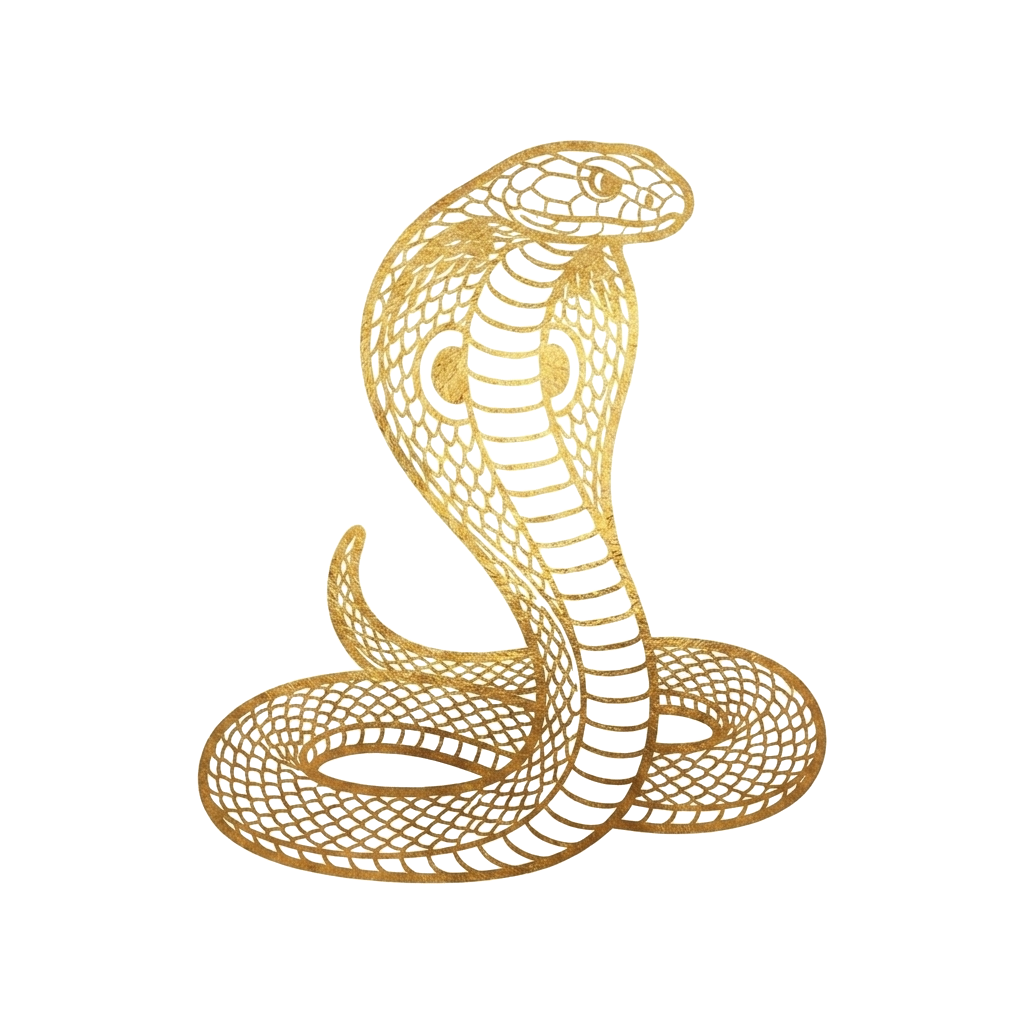
Uraeus
The rearing cobra on the pharaoh's brow: the goddess Wadjet manifest as a fire-spitting guardian, worn as the king's most active piece of divine armor.
About Uraeus
The Uraeus is the rearing cobra fixed to the brow of Egyptian kingship: the goddess Wadjet of Per-Wadjet (Buto), coiled into striking position, mounted as the king's living guardian. It is one of the oldest royal insignia known from the Nile Valley, present on royal iconography from the First Dynasty and continuous through the Ptolemaic and Roman periods, a span of roughly three thousand years.
The word "uraeus" comes from the Greek ouraios, a Hellenized rendering of the Egyptian iaret, meaning "the rearing one" or "the risen one." That is the cobra at the moment it lifts its forebody and spreads its hood to strike. That moment, frozen in gold, is what the king wears.
Unlike most royal symbols, the Uraeus is not a metaphor for a goddess. It is the goddess. Wadjet takes cobra form and places herself on the pharaoh's forehead, where she sees what the king cannot see, faces what the king cannot face, and spits fire at anyone who approaches with hostile intent. Egyptologist Geraldine Pinch describes her as one of several deities given the title Eye of Ra, the wrathful, projected aspect of the sun-god, deployed against his enemies. When you see the Uraeus on a crown, you are looking at solar wrath worn as a piece of jewelry.
This is the central distinction. The cobra on the pharaoh's brow does not stand for divine authority — it carries the active presence of a goddess whose specialty is killing what threatens the king.
Visual Description
The Uraeus is a cobra in the moment of striking. The lower body coils tightly against whatever surface it is mounted on; the upper body lifts vertical; the hood spreads; the head faces forward. Egyptian artisans worked the iconography with anatomical precision. The Egyptian cobra (Naja haje) flares a distinctive hood when threatened, and that flare is what the goldsmiths reproduced.
Placement is fixed. The Uraeus sits at the front of the royal headdress, directly above the king's forehead, projecting outward. On the Nemes, the striped headcloth most familiar from Tutankhamun's death mask, the cobra rises from a small brow-band and arches forward. On the Khepresh (the blue "war crown"), it sits flush against the deep blue surface and projects with even greater visual aggression. On the Atef and the double Pschent crown of unified Egypt, the Uraeus is fitted into the front of the white crown of Upper Egypt, often paired iconographically with the vulture head of Nekhbet beside it.
Materials are royal-grade. Surviving examples are gold, sometimes inlaid. The famous gold Uraeus discovered at Senusret II's pyramid complex at Lahun (Twelfth Dynasty, c. 1880 BCE, now Cairo Egyptian Museum, JE 46694) has a head of deep lapis lazuli, eyes of granite, a flared hood inlaid with carnelian and amazonite, and a body of solid gold. Smaller faience uraei in turquoise or blue glaze were produced for non-royal amulet use.
What the Uraeus is not: it is not the same as generic Egyptian snake imagery. The serpent Apep (Apophis), enemy of Ra, is also a cobra-form being but is depicted differently, usually horizontal, often pierced by knives. The benevolent harvest snake Renenutet appears with a different posture. The Uraeus is the upright, hood-spread, brow-mounted cobra, and that combination is reserved iconographically for the goddess on the king.
Esoteric Meaning
The deepest layer of Uraeus symbolism is the goddess as wrathful protective force concentrated at a specific point on the body: the brow, the place where attention focuses outward and where, in the king's case, the power of the state is projected.
In the Pyramid Texts (Old Kingdom, c. 2400-2300 BCE), the oldest substantial body of religious writing from the Nile Valley, a cluster of utterances known as the serpent charms (Utterances 226-243 in Faulkner's 1969 translation) handle the relationship between the dead king and various serpentine powers. Utterance 240 begins "The uraeus-serpent belongs to heaven," placing the cobra in the sky as a celestial body, not merely a creature of the earth. The Uraeus is a star, a flame, an outward-facing eye of the sun.
This is where the identification with the Eye of Ra becomes structurally important. In Egyptian myth, the Eye is sent out from the sun-god to act on his behalf: to find his lost daughter, to scorch his enemies, to enforce his will at distance. The goddess who carries out this function appears under multiple names depending on context. Hathor when she becomes Sekhmet. Tefnut in the Distant Goddess myth. Mut in Theban contexts. Wadjet is one of these. The Uraeus on the king's brow is therefore the Eye of Ra repositioned, placed on the pharaoh's forehead so that the king himself can act as the sun-god acts.
The Coffin Texts (Middle Kingdom) extend this. Spell 364, in Faulkner's translation, has the deceased say "I am the living uraeus which came forth from the Eye of Re," identifying the speaker himself with the cobra-as-eye. The wearer is not separate from the goddess. He becomes her.
The fire-spitting iconography belongs to this same complex. The cobra strikes from the hooded, upright position; Wadjet projects flame from the same posture. In texts and amuletic spells the Uraeus is described as Neseret, "the flaming one," and her job is to incinerate the king's enemies before they reach him. The Egyptian word for the cobra's venom and for fire share semantic territory in religious texts. Both are hot, projected, deadly substances that issue from the head.
R. A. Schwaller de Lubicz, working at Luxor Temple in the 1940s and 50s, proposed that the Uraeus on the Egyptian forehead corresponds structurally to the kundalini-as-third-eye in Indian yoga: serpent-power risen up the spine and emerging at the brow, where it functions as both vision and weapon. Schwaller is heterodox in academic Egyptology and his correspondences are inferential rather than textual, but the parallel is hard to dismiss outright. Both traditions place a serpent at the same anatomical location, both treat it as awakened or risen, and both link it to a faculty that is more than ordinary sight. Whether this is convergence or shared substrate is a question Egyptology cannot answer from inside its own evidence base.
What the texts do support is this. The Uraeus is the goddess's body, the king's protection, the sun's projected eye, and a fire-weapon, all at the same point on the same forehead.
Exoteric Meaning
On the surface, the Uraeus signals three things to anyone who saw the king or his image: legitimacy, divine protection, and the right to use lethal force. A figure with a cobra on the brow is a pharaoh. A figure without one is not. The symbol functions as a credential.
For the pharaoh's subjects, the Uraeus communicated that the king was sanctioned by Wadjet personally, that any attack on him would be answered by the goddess directly, and that his rule extended at least over Lower Egypt — and, in combination with the Nekhbet vulture, over the unified Two Lands.
For non-royal Egyptians, scaled-down versions of the Uraeus circulated as amulets, especially in faience. These were affordable, mass-produced, and worn around the neck or wrapped into mummy bandages. The amulet borrowed protective power from the royal symbol while respecting the boundary: the small uraei worn by ordinary people did not claim kingship, only a portion of the cobra's general protective force. The Met Museum and the Petrie Museum hold large collections of these from the Late and Ptolemaic periods.
Usage
The Uraeus appears across nearly every category of royal Egyptian material culture for three thousand years.
Royal regalia. Every standard pharaonic crown carries one. The Nemes headcloth (Tutankhamun's gold mask, Cairo Egyptian Museum, JE 60672, c. 1323 BCE) carries the Uraeus paired with the Nekhbet vulture head: the cobra over the king's left brow, the vulture over his right, together making the Two Ladies physically present on the king's skull. The Khepresh blue war crown of the New Kingdom (worn famously by Amenhotep III and Ramesses II, including in royal battle scenes) mounts a single Uraeus at the front. The double Pschent crown of unified Egypt fits the cobra into the white inner crown of Upper Egypt.
Funerary masks and coffins. The cobra protects the deceased king's face and head through the journey to the afterlife. The Tutankhamun mask is the most famous example, but every royal mummy of the New Kingdom that retains its mask retains the Uraeus.
Discrete jewelry pieces. The Uraeus of Senusret II from Lahun (Twelfth Dynasty, c. 1880 BCE, Cairo JE 46694) is a stand-alone gold cobra with lapis-lazuli head and garnet eyes, evidently designed to be fixed to a crown. The diadem of Princess Sit-Hathor-Yunet, the king's daughter, was found in 1914 by Petrie and Brunton at Lahun. It combines a gold band with a single rearing Uraeus and is now in the Cairo Egyptian Museum. The Met Museum in New York holds much of the rest of her treasure.
Statuary. Royal statues from the Old Kingdom onward show the Uraeus carved into the front of the headdress. The seated Khafre statue (Fourth Dynasty, c. 2520 BCE, Cairo Egyptian Museum) has it. Every kingly statue of Ramesses II carries it. The Sphinx of Giza, despite weathering, retains the broken stub where the Uraeus was once mounted on the brow of the limestone face.
Amulets. Tens of thousands of small faience uraei survive from Late Period and Ptolemaic burials, used by non-royal Egyptians for general protection.
Foreign appropriations. Roman emperors who claimed Egyptian rule (Augustus, Caligula, Hadrian) are shown in Egyptian-style portraits with the Uraeus on the brow. The Meroitic kings of Nubia (third century BCE through fourth century CE) developed a distinctive double-Uraeus crown, two cobras side by side on a cap-crown, signaling rule over Upper and Lower Egypt simultaneously without requiring the vulture pairing.
In Architecture
The Uraeus enters Egyptian architecture as the cavetto cornice frieze: a row of erect cobras carved or painted along the top edge of temple walls, shrines, and the upper rim of doorways. This is one of the most recognizable architectural decorations from the Nile Valley, and it survives wherever a major temple's upper walls survive.
The frieze treats the goddess as multiplied. Instead of one cobra on one king, the temple wall is crowned by dozens or hundreds of identical uraei in a continuous row, each rearing, each hooded, each facing outward. The reading is straightforward. Every threshold of sacred space is guarded by Wadjet's body, and the wall itself becomes a perimeter of fire-spitting goddesses.
Edfu (Temple of Horus, Ptolemaic, begun 237 BCE under Ptolemy III) preserves uraeus friezes along the outer walls and on the upper edges of the pylon and inner courts. Because Edfu is one of the best-preserved Egyptian temples standing, its cornices give the clearest surviving sense of how the friezes looked when complete and painted.
Dendera (Temple of Hathor, late Ptolemaic and Roman, c. 54 BCE forward) carries the same vocabulary across its outer walls and roof structures. The Hathor temple's emphasis on solar-feminine deities makes the uraeus frieze especially appropriate. Hathor herself is one of the goddesses identified with the Eye of Ra.
Karnak (Theban temple complex, expanded continuously from the Middle Kingdom through the Ptolemaic period) retains uraeus friezes on multiple shrines, gates, and upper wall registers. The Sacred Lake area and the Ptolemaic gateways are particularly intact.
Philae (Temple of Isis, Ptolemaic) and Kom Ombo (Ptolemaic, dual temple of Sobek and Haroeris) carry the same conventions.
Beyond cornices, the Uraeus appears on royal thrones (carved into chair sides), on the breastplates of sphinxes, on canopic chest lids, on shrine doorways, and on the edges of scarab pectorals. Wherever protection was wanted at a boundary, the cobra was placed.
Significance
Royal ideology. The Uraeus is the most concentrated single image of pharaonic kingship the Egyptians produced. The crown, the throne, the Horus name, and the cartouche all proclaim the king's status. The Uraeus does something different. It places a goddess on his body and makes the king's protection an active divine presence rather than a claim. This is why it appears unbroken from the First Dynasty through the Roman period. Of the standard royal symbols, it is the one Egyptian kingship would not let go of, even as crowns evolved, dynasties rose and fell, and the political center moved between Memphis, Thebes, and Alexandria.
Religious meaning. The Uraeus encodes a specific theology. Protection is a feminine, wrathful, projected force. The goddess and her body are continuous with one another (she does not send a cobra, she is the cobra). And the Eye of Ra is not metaphorical but a real operational power that can be transferred onto a human being's forehead. The cobra-on-brow image insists that wrath in service of order is a divine function and that a king without it is not protected.
Comparative serpent symbolism. The Uraeus belongs to a wider ancient Mediterranean and Indian pattern of serpents at the head as marks of charged power. The Greek Gorgoneion, with its hair of serpents, is its closest western Mediterranean cousin: also brow-facing, also apotropaic, also identified with a wrathful feminine power. In India the kundalini, awakened through yoga, is described as a serpent that rises up the spine and emerges at the brow as the third eye; Schwaller de Lubicz drew the explicit Uraeus-kundalini parallel from his work at Luxor. In the Hebrew Bible, the bronze serpent (Nehushtan) raised by Moses on a pole in Numbers 21 is a healing serpent set on a vertical axis, and Aaron's rod-into-serpent in Exodus 7 is performed in pharaoh's court as a confrontation in the cobra's own iconographic language. None of these is a borrowing from Egypt in the strict sense, but together they form a recognizable cluster: serpent, elevation, head-position, concentrated power.
Transformation through Coptic and Christian Egypt. When Egypt became Christian in the third and fourth centuries CE, the Uraeus disappeared from royal use (there were no more pharaohs to wear it), but the underlying pattern of a protective serpent did not vanish. Coptic art continued earlier Egyptian visual vocabulary in modified form, and the snake remained a protective and healing symbol in Egyptian magical and folk practice well into the Islamic period. The cobra at the brow as a state symbol ended; the cobra as protective force did not.
Modern reception. The Uraeus is one of the most reproduced Egyptian symbols in modern jewelry, esoteric literature, and popular culture. It appears on the modern Egyptian presidential seal in stylized form. Its presence on the Tutankhamun mask (the most photographed Egyptian object in the world) has fixed it in global visual memory more firmly than almost any other ancient symbol.
Connections
Deities. Ra (the sun-god whose Eye Wadjet embodies), Hathor and Sekhmet (other goddesses identified with the Eye of Ra and capable of taking uraeus form), Horus (whose royal protection Wadjet shares), Isis (often shown with a uraeus on her brow in later periods, especially at Philae), and Wadjet herself, plus her counterpart Nekhbet, vulture-goddess of Upper Egypt. Mut, Tefnut, and Bastet also appear as Eye-of-Ra goddesses in different contexts and can wear or take uraeus form.
Texts. Pyramid Texts serpent charms, especially Utterances 226-243 (Faulkner translation, 1969); Coffin Texts Spell 364 ("I am the living uraeus which came forth from the Eye of Re"); Egyptian Book of the Dead spells dealing with transformation into a serpent for safe passage in the afterlife.
Other symbols. Set against the Eye of Horus: the Eye of Horus heals and restores, while the Uraeus (as Eye of Ra) wounds and burns; the two are complementary aspects of divine sight. The Ouroboros, the self-devouring serpent, shares the snake's link to cosmic time but functions in a wholly different register. The Winged Sun Disk often appears flanked by two uraei, fusing the symbols. The Scarab, by contrast, is a solar emblem of becoming, neither wrathful nor brow-mounted.
Cross-cultural parallels. The Greek Gorgoneion (the Medusa-head apotropaion mounted at brow, breast, or shield) is the closest Mediterranean analog. The Indian kundalini-as-third-eye is the closest Asian analog: serpent power risen to the brow as awakened sight. The Hebrew Bible's bronze serpent of Moses (Numbers 21:8-9) and Aaron's serpent-rod (Exodus 7:8-12) belong to the same broad serpent-as-divine-power complex.
Further Reading
- Wilkinson, Richard H. The Complete Gods and Goddesses of Ancient Egypt. Thames & Hudson, 2003. The standard one-volume reference; Wadjet entry covers her cobra form and the Uraeus.
- Pinch, Geraldine. Handbook of Egyptian Mythology. ABC-CLIO, 2002 (also published by Oxford University Press as Egyptian Mythology: A Guide to the Gods, Goddesses, and Traditions of Ancient Egypt, 2004). Strong on Wadjet's relationship to the Eye of Ra.
- Hornung, Erik. Conceptions of God in Ancient Egypt: The One and the Many. Translated by John Baines. Cornell University Press, 1982. Essential for understanding how a goddess can be a body part of another god.
- Faulkner, R. O. The Ancient Egyptian Pyramid Texts. Oxford University Press, 1969 (corrected reprint Aris & Phillips, 1985). The serpent charms (Utterances 226-243) are the oldest textual material on the Uraeus.
- Faulkner, R. O. The Ancient Egyptian Coffin Texts. Three volumes. Aris & Phillips, 1973-1978. Spell 364 for the deceased-as-uraeus identification.
- Wilkinson, Richard H. Reading Egyptian Art: A Hieroglyphic Guide to Ancient Egyptian Painting and Sculpture. Thames & Hudson, 1992. Visual decoding of the Uraeus and related royal insignia.
- Andrews, Carol. Amulets of Ancient Egypt. British Museum Press, 1994. The non-royal faience uraeus amulet tradition, with photographs of Met and British Museum holdings.
- Schwaller de Lubicz, R. A. The Temple of Man. Translated by Robert and Deborah Lawlor. Inner Traditions, 1998 (originally Le Temple de l'Homme, 1957). The Uraeus-as-kundalini reading: heterodox but originating, drawn from his roughly fifteen years at Luxor Temple.
Frequently Asked Questions
What does the cobra on the pharaoh's headdress mean?
The cobra on the pharaoh's headdress is the Uraeus: the goddess Wadjet of Per-Wadjet (Buto) in cobra form, mounted on the king's brow as his personal protector. It is not a metaphor or an emblem of authority. Egyptian religious texts treat the cobra as the goddess herself, present in gold on the king's forehead, ready to spit fire at anyone who threatens him. Wadjet is also identified with the Eye of Ra, the wrathful, projected eye of the sun-god, so the cobra at the brow positions the king to act with the sun-god's destructive power. Every standard royal crown carried one from the First Dynasty (c. 3000 BCE) through the Roman period, almost three thousand years of unbroken use.
What is the difference between the Uraeus and the Eye of Ra?
They overlap heavily but are not identical. The Eye of Ra is the wrathful, sent-out, projected eye of the sun-god, which acts as a goddess in her own right and appears in Egyptian myth under multiple names (Hathor, Sekhmet, Tefnut, Mut, Wadjet, Bastet) depending on the story. The Uraeus is the specific cobra-form of that Eye, especially as Wadjet, fixed onto the pharaoh's forehead. So the Eye of Ra is the broader theological concept; the Uraeus is the physical, brow-mounted, cobra-shaped manifestation of it on the king. Coffin Texts Spell 364 makes the equation explicit: "I am the living uraeus which came forth from the Eye of Re." The cobra is the Eye, repositioned onto a human head.
Why was the Uraeus believed to spit fire?
Two layers. First, biological: the Egyptian cobra (Naja haje) projects venom by striking from a reared, hood-spread posture, and Egyptian religious imagination read the venom itself as a fire-substance — hot, deadly, issued from the head of a creature that lifts itself to eye level before it acts. Second, theological: as the Eye of Ra, the Uraeus carries the sun-god's destructive heat. In the Pyramid Texts and later magical literature, Wadjet is called Neseret, "the flaming one," and her stated function is to incinerate the king's enemies before they reach him. The fire is solar fire, the same heat that scorches the desert and burns the eyes of those who look at the noon sun, concentrated and aimed. So when the Uraeus is described as spitting fire, the image fuses cobra-venom with sun-flame, and both are understood to come out of the goddess's mouth at her targets.
Was the Uraeus only worn by pharaohs?
In its full crown-mounted form, yes. The Uraeus on the brow was reserved for the king and for queens regnant or great royal wives in certain periods. Hatshepsut, Nefertiti, and Cleopatra VII are shown with it. But scaled-down versions circulated widely. Small faience cobra amulets in the Uraeus posture were mass-produced from the Late Period (c. 664-332 BCE) through the Ptolemaic period and worn by ordinary Egyptians for general protection and for safe passage to the afterlife. Tens of thousands of these survive in collections worldwide, including the Met Museum, the British Museum, and the Petrie Museum at UCL. Goddesses also wear the Uraeus: Isis, Hathor, Mut, and others appear in temple reliefs with a cobra on their crowns. So the strict royal insignia was for the king alone, but the underlying protective symbol was available to everyone.