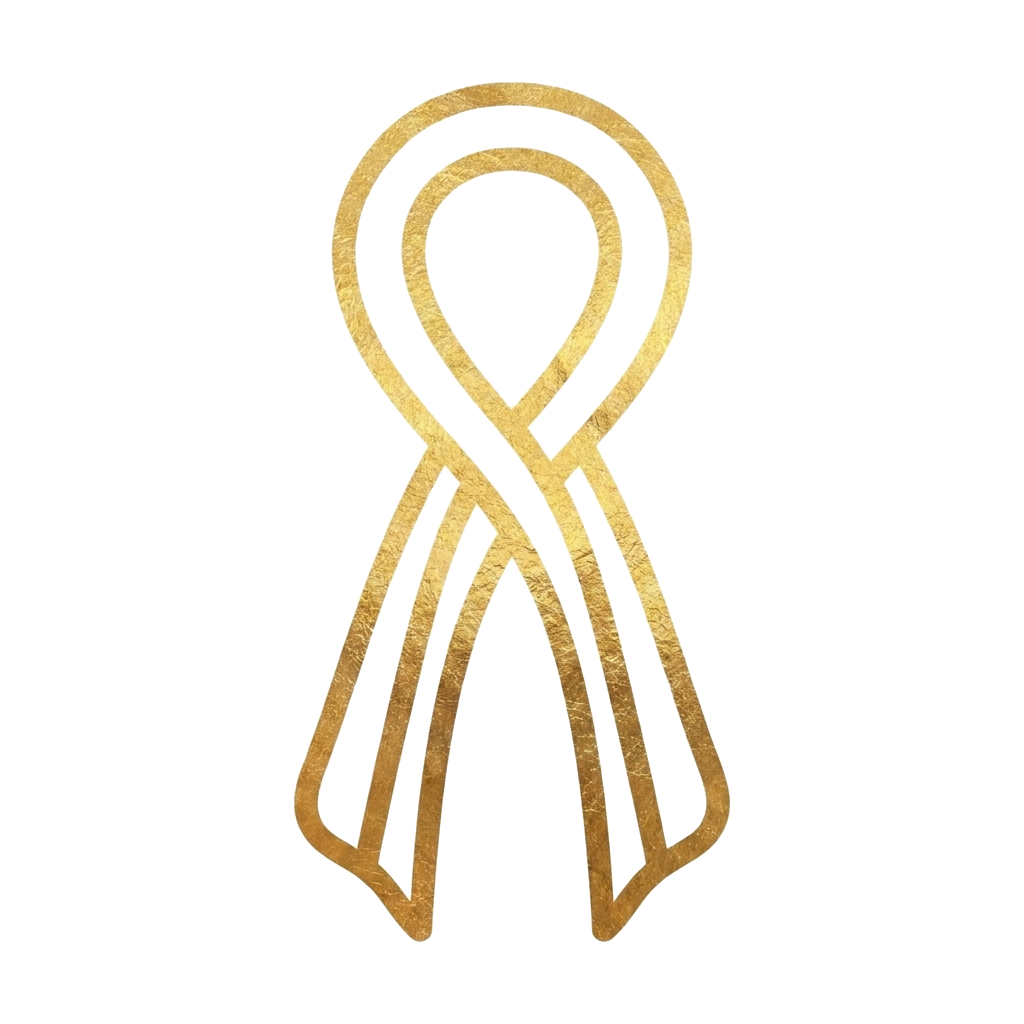
Tyet (Knot of Isis)
The Tyet, or Knot of Isis, is an ancient Egyptian looped-knot amulet placed at the throat of the mummy in red jasper to channel the protective blood of Isis.
About Tyet (Knot of Isis)
The Tyet is the looped knot of Isis. Egyptian scribes wrote it as Gardiner sign V39: a tall oval loop with two arms folded down at the sides and a tapering shaft below. It is close in silhouette to the ankh, but with the crossbar arms collapsed against the body rather than thrown wide.
Its Egyptian name is usually transliterated tjt (sometimes tit or tyt), and the word it writes carries the sense of "welfare" or "life." That is the same semantic field as ankh, read through Isis rather than through the breath of the gods.
The knot's earliest life is decorative. By the Third Dynasty it appears as an ornament on monuments and cylinder seals, and a knotted-cloth motif at First Dynasty Helwan is sometimes read as its ancestor. Its life as a named amulet of Isis comes later. The first burials that include a tyet amulet at the throat date to the reign of Amenhotep III in the mid-Eighteenth Dynasty, and from that point until the close of dynastic Egypt almost no body of any standing was wrapped without one.
What the Tyet does in the world of the dead is fixed by a single text: Spell 156 of the Book of the Dead. The spell names the amulet, names its material, names the plant-water it must be washed with, names the thread it must be strung on, names the place on the body where it is set, and names the goddess whose force it carries. Everything else written about the Tyet (every museum label, every modern devotional revival, every comparative reading) leans on those few verified lines.
This page works through what the Tyet looked like, where it sits in the long Osirian myth, why it was almost always red, what Spell 156 says line by line, and where the knot-as-protection idea shows up in other traditions that had no contact with Egypt.
Visual Description
Form. A standing loop with its arms folded down. The top is a closed oval, the head of the knot. From the base of that loop, two narrow bands hang at the sides, parallel to the central shaft, like sleeves pinned against the body. Below them the shaft tapers slightly and rests on a narrow base. In the cleanest hieroglyphic form, the side arms read as the loose ends of a folded sash, tied off at the waist of the knot.
Distinguishing it from the ankh. The ankh and the Tyet share the upright shaft and the closed loop on top. The difference is in the arms. On an ankh, the crossbar projects horizontally: open arms, breath of life, the cross of the gods extended outward. On the Tyet, the arms hang. The motion is inward and downward, a sash drawn closed and knotted at the body. Some scholars read the contrast as gendered: the ankh given, the Tyet bound and held.
Distinguishing it from the shen ring. The shen is a closed circle of rope tied off at a horizontal bar: protection by encirclement, by drawing a perimeter. The Tyet protects by knotting, not by enclosure. The two share the magic of binding but draw it differently.
Materials. Spell 156 calls for jasper, and surviving amulets are most often red jasper or carnelian. Red glass and red faience also appear when stone was unavailable. Green faience tyets exist as well, and these read into the second great amulet color of Egypt: the green of renewal, of new growth out of the body of Osiris. The British Museum holds a red jasper thet-girdle amulet (EA 20639), incised with the name of a man called Nefer, of the type Spell 156 describes. Gold tyets, sometimes worked into pectorals and broad collars, are attested in elite burials of the Eighteenth Dynasty onward.
Scale. Most surviving tyets are small, under five centimeters, sized to be threaded on a cord and laid against the throat. Decorative tyets in temple wall registers and on sarcophagus borders run far larger and are usually paired with the Djed pillar in alternating sequences.
Esoteric Meaning
The knot as sealed container. Egyptian magic worked heavily through binding. To tie was to fix a force in place; to untie was to release it. The Tyet is the high feminine form of that magic, a knot set at the throat to seal the breath, the voice, and the life-channel of the body inside the protection of Isis. The amulet is not a sign of Isis. The amulet is Isis's act of binding, made portable.
Blood of Isis. The recurring Egyptological reading is that the red of the Tyet stands for the blood of Isis: life-giving blood, the same blood that revived Osiris and conceived Horus. Wolfhart Westendorf and others have followed E. A. Wallis Budge in reading the knot as the belt or girdle of Isis, with the menstrual association sitting underneath the symbolism of the red stone. That reading is one of several. There is no decisive philological proof, but the consistent specification of red material in Spell 156 and the consistent siting of the amulet at the throat of the mummy give it weight. The Tyet asks the goddess's living blood to seal a body that has no blood of its own anymore.
Pairing with the Djed. The deeper esoteric reading of the Tyet runs through its pairing with the Djed pillar of Osiris. Djed is the spine, the standing axis, the masculine principle of stability raised upright. Tyet is the knot, the binding, the feminine principle of containment that holds the standing axis in place. On the borders of late sarcophagi (most famously the sarcophagus of Nectanebo II) and on Tutankhamun's chests, the two signs alternate in unbroken rows: pillar, knot, pillar, knot, pillar, knot. The Osirian mystery is written as a rhythm of standing and binding, axis and knot, husband and wife, resurrection and protection. Neither sign is whole alone.
Cross-tradition parallels. The knot-as-protection theology is not unique to Egypt, though the Tyet's particular shape is. The Minoan sacral knot, a looped cloth with two trailing fringed ends named by Arthur Evans at Knossos, is worn at the back of the neck of priestesses and goddess figures and may carry a related protective meaning. The Buddhist shrivatsa or endless knot is a different geometry but the same theology: closed line, no beginning, no end, tied life-force. The Jewish kesher of the tefillin knot binds sacred text to the body at head and arm. The Celtic interlace knots of the early medieval Insular tradition braid life into a closed continuous line. The Tyet sits inside this wider human grammar of knotted protection, and reads as Egypt's particular contribution to it.
Exoteric Meaning
Funerary amulet of Isis. In ordinary use, the Tyet is the amulet of Isis's protection laid on the dead. It sits at the throat or upper torso of the mummy, threaded on a sycamore-fibre cord per Spell 156, and it asks the goddess to watch over the body until rebirth. In life it appears as protective jewelry, particularly on women, and as a decorative sign on objects associated with rebirth: beds, headrests, mirrors, cosmetic boxes. The exoteric reading is the simple one Egyptians lived with. The knot of Isis is the safety of Isis, and you wear it because she is the one who finds the scattered pieces and makes the body whole again.
Usage
Book of the Dead Spell 156. The Tyet's primary ritual setting is Spell 156 of the Book of the Dead, attested from the mid-Eighteenth Dynasty onward in the Papyrus of Nu (British Museum EA 10477) among others. The spell is short and prescriptive. It opens with an address to the goddess: "You have your blood, O Isis; you have your power, O Isis; you have your magic, O Isis. The amulet is a protection for this Great One which will drive away whoever would commit a crime against him." The rubric specifies a tyet-knot of jasper, sprinkled with water of the ankh-imy plant, strung on a fibre of sycamore, and placed at the neck of the blessed dead on the day of burial. The promise is direct: the powers of Isis will be the protection of the body, and Horus the son of Isis will rejoice over the deceased when he sees him.
Material. Red jasper is the canonical stone. Carnelian is the most common substitute, with red glass and red faience appearing in less elite burials. Green faience tyets enter the record as well, reading the amulet through the second great Egyptian color of resurrection. Gold tyets appear in elite contexts, including the burial assemblage of Tutankhamun.
Placement. Always at the throat or upper chest of the mummy, almost always in a stack of amulets that includes the Djed pillar of Osiris. The pairing on the body mirrors the pairing in the architectural record.
Architectural use. Alternating Djed-Tyet borders run along the upper register of late sarcophagi. The sarcophagus of Nectanebo II, the last native Egyptian pharaoh, is a clean example. Funerary furniture and shrines carry the same pairing. A famous gilded box from Tutankhamun's tomb has the alternating Djed-Tyet motif standing on the neb (gold) sign at its base.
Jewelry and personal use. Tyet pendants and pectorals are attested for living women as well as for the dead, particularly in royal and elite contexts. They functioned the way protective amulets function in most cultures: worn at the throat or chest, given at moments of vulnerability (childbirth, illness, travel), and not removed at death.
In Architecture
Alternating Djed-Tyet friezes. The signature architectural use of the Tyet is its pairing with the Djed in unbroken alternating rows. The motif is best known from the sarcophagus of Nectanebo II (Thirtieth Dynasty), where Djed pillars and Tyet knots run along the upper margin of the lid, but the pattern is older and recurs through the Late Period and Ptolemaic temple decoration.
Tutankhamun's furniture. The tomb of Tutankhamun (Eighteenth Dynasty) preserves several pieces of funerary furniture decorated with the Djed-Tyet pairing. The clearest is a gilded box on which the two signs stand on the neb (gold/totality) hieroglyph in alternating registers, reading as a continuous prayer for the king's stability and protection.
Temple wall registers. The Djed-Tyet pairing also appears in temple decoration of the New Kingdom and later, often as a framing border around scenes of offering or coronation. The combined sign reads as an architectural blessing: stability and binding, axis and knot, the structural integrity of the ritual space written into its decoration.
Significance
The feminine half of the Osirian mystery. The Tyet's deepest meaning sits inside its pairing with the Djed. Egyptian religion did not separate the masculine standing-axis of Osiris from the feminine binding-knot of Isis. Resurrection in the Osirian story is a two-part act: Osiris must be raised (Djed) and Isis must hold the raised body together (Tyet). One symbol writes the standing. The other writes the holding. The two signs alternating along the upper margin of a sarcophagus tell the deceased that both halves of the act are present. The body will be raised like Osiris, and it will be bound and held like Isis bound and held him. Neither sign is decorative.
Blood-of-Isis theology. The repeated specification of red stone in Spell 156, together with the consistent placement of the amulet at the throat, anchors a particular reading of what the Tyet does. It is not generic protection. It is the goddess's own blood asked to fill the channel that no longer carries blood. The amulet asks the wearer's throat to remain a living throat, capable of speech and breath in the next world, by drawing on Isis's living substance. Western readers sometimes find the menstrual undertone of the imagery uncomfortable; Egyptian funerary religion did not. Life-giving blood was life-giving blood, and the body in the wrappings needed all of it that could be summoned.
Knot-magic theology. The wider context is Egypt's pervasive ritual use of knots. Spells were tied into cords. Curses were undone by untying. The seven knots of certain protective threads are cousins of the Tyet's logic. To bind something into a knot in Egyptian magic is to lock its force in place, the way you would lock a treasure in a chest. The Tyet is the highest form of this: a knot tied by a goddess on the threshold between worlds, sealing a body inside her protection.
Comparative knot symbolism. The Tyet is the most theologically articulated of the protective knot symbols, but it is not isolated. The Minoan sacral knot, worn at the back or side of priestesses' garments at Knossos and elsewhere from MM II through LM IIIA, sits in similar visual and ritual territory. Whether there is contact between the two motifs or only a shared human intuition about cloth and binding is debated. The Buddhist shrivatsa, the Celtic interlace, the Jewish kesher, and the various "knot of love" motifs of later European folk magic all share the underlying grammar: a closed line that cannot be undone keeps what it holds.
Modern reception. Contemporary Isis-devotional practice, both inside organized neo-pagan currents (Fellowship of Isis, various Kemetic reconstructionist groups) and outside them, has taken the Tyet up as the primary wearable sign of the goddess. Where the ankh has spread broadly and lost much of its specifically Egyptian shape, the Tyet has stayed close to its ritual origin. Almost everyone who wears one knows it is the knot of Isis, knows the amulet was meant for the dead, and chooses it for that reason. The modern revival has also returned attention to the menstrual reading of the symbol, which sits more comfortably in contemporary devotional language than it did in nineteenth-century Egyptology.
Connections
Deities. Isis (primary; the knot is hers, and Spell 156 invokes her by name), Osiris (paired through the Djed-Tyet motif as the masculine axis the knot binds), Nephthys (Isis's sister and co-mourner, present at the wrapping of Osiris and at the rituals the Tyet underlies), Horus (named in Spell 156 as the one who rejoices over the protected body), Hathor (the broader feminine protective principle the Tyet's symbolism touches).
Texts. The Egyptian Book of the Dead, Spell 156 (the tyet-amulet spell, load-bearing source for the entire ritual life of the symbol), as part of a sequence of amulet rubrics (Spells 155-160) that also covers the gold Djed pillar, vulture collar, and gold collar. Earlier resonances appear in the Coffin Texts and the Pyramid Texts, though the named tyet-amulet spell itself is a New Kingdom development.
Other symbols. The Djed pillar (the canonical paired counterpart, Osiris's axis to Isis's knot), the ankh (the visual cousin with arms thrown wide rather than folded down), the shen ring (the parallel logic of protection-by-encirclement rather than protection-by-knotting), the cartouche (the elongated shen, a name protected inside a closed loop), the uraeus (the cobra at the brow as protective feminine power on the living body), the scarab (the other principal funerary amulet, paired with the Tyet on many bodies).
Further Reading
- Faulkner, Raymond O., trans. The Ancient Egyptian Book of the Dead. Edited by Carol Andrews. London: British Museum Press, 1985. The standard English translation, includes Spell 156 with notes on the tyet-amulet rubric.
- Andrews, Carol. Amulets of Ancient Egypt. London: British Museum Press, 1994. The reference work on Egyptian amulet typology, with extended treatment of the Tyet's materials, dating, and placement.
- Pinch, Geraldine. Magic in Ancient Egypt. London: British Museum Press, 1994. Chapter-length treatment of knot magic and the ritual logic the Tyet sits inside.
- Wilkinson, Richard H. The Complete Gods and Goddesses of Ancient Egypt. London: Thames & Hudson, 2003. Entry on Isis with discussion of her associated symbols including the Tyet.
- Wilkinson, Richard H. Reading Egyptian Art: A Hieroglyphic Guide to Ancient Egyptian Painting and Sculpture. London: Thames & Hudson, 1992. Entry on the Tyet sign (Gardiner V39) in its decorative and architectural contexts.
- Assmann, Jan. Death and Salvation in Ancient Egypt. Trans. David Lorton. Ithaca: Cornell University Press, 2005. The Osirian mystery as the framework that gives the Djed-Tyet pairing its meaning.
- Mohamed, Ghada. "'Und das Isis-Blut hat seine Arme in meine Richtung gereicht'. Darstellung, Bedeutung und Funktion des anthropomorphisierten Tit-Knotens im alten Ägypten." Journal of the American Research Center in Egypt 60 (2024): 227–246. Recent scholarly treatment of the anthropomorphized Tyet and the blood-of-Isis reading.
- Westendorf, Wolfhart. Essays on Egyptian symbolic vocabulary, including the line of scholarship behind the Isis-girdle reading of the Tyet.
Frequently Asked Questions
What does the Tyet (Knot of Isis) symbolize?
The Tyet is the looped knot of the goddess Isis, and it stands for her protection of the body, particularly the body of the dead. The Egyptian word it writes, tjt, sits in the same semantic field as ankh and carries the sense of welfare or life. Worn at the throat of the mummy in red jasper or carnelian, the Tyet asks Isis to seal the wearer inside her protection the way she sealed and reassembled the body of Osiris. The deeper symbolism is binding-as-magic: in Egyptian ritual practice a knot fixes a force in place, and the Tyet is the highest form of that magic, a knot tied by a goddess at the threshold between worlds. Paired with the Djed pillar of Osiris in alternating friezes, it writes the feminine half of the Osirian mystery: the standing axis of resurrection held in place by the binding knot of protection.
What's the difference between the Tyet and the ankh?
The two signs share the upright shaft and the closed loop on top, and the Egyptian words they write share a semantic field around life and welfare. The difference is in the arms. On an ankh, the crossbar projects horizontally: open arms, breath of life given outward, the cross of the gods. On the Tyet, the arms hang down at the sides, folded against the body like the loose ends of a sash drawn closed and knotted at the waist. The motion is inward and binding rather than outward and giving. The ankh is the life the gods extend; the Tyet is the life the goddess ties around you and holds. The two signs sometimes appear side by side in the same scene, and in some readings the Tyet is the explicitly feminine counterpart of the ankh, though the linguistic and ritual evidence for that pairing is suggestive rather than decisive.
Why is the Knot of Isis always red?
Spell 156 of the Book of the Dead specifies a tyet-knot of jasper, and surviving amulets are overwhelmingly red jasper or carnelian, with red glass and red faience as substitutes when fine stone was unavailable. The standard Egyptological reading is that the red stands for the blood of Isis: her life-giving blood, the same blood that revived Osiris and conceived Horus. Worn at the throat of the mummy, the red Tyet asks the goddess's living blood to fill the channel that no longer carries blood of its own. Some scholars (Wallis Budge, Westendorf, more recently Ghada Mohamed) have followed the imagery further into a menstrual reading, the knot as the goddess's girdle, the red as the blood of fertility and life-power. That reading is one interpretation rather than settled fact, but the consistent specification of red material in the canonical spell, and the consistent placement of the amulet at the throat, give it weight. Green faience tyets also exist and read into Egypt's other great resurrection color, the green of new growth out of the body of Osiris.
How was the Tyet amulet used in Egyptian funerary practice?
The Tyet enters the funerary record as a named amulet of Isis in the mid-Eighteenth Dynasty, around the reign of Amenhotep III, and from then to the close of dynastic Egypt almost no embalmed body of any standing was wrapped without one. Spell 156 of the Book of the Dead gives the full procedure: a tyet-knot of jasper is sprinkled with water of the ankh-imy plant, strung on a fibre of sycamore, and placed at the neck of the deceased on the day of burial, while the priest recites the address to Isis: "You have your blood, O Isis; you have your power, O Isis; you have your magic, O Isis." The amulet was almost always paired with a Djed pillar of Osiris, often laid in a stack along the throat and upper torso. The same pairing appears decoratively along the borders of late sarcophagi (Nectanebo II is the showpiece example) and on funerary furniture from Tutankhamun's tomb, so the protection asked at the body is also written into the architecture of the burial.