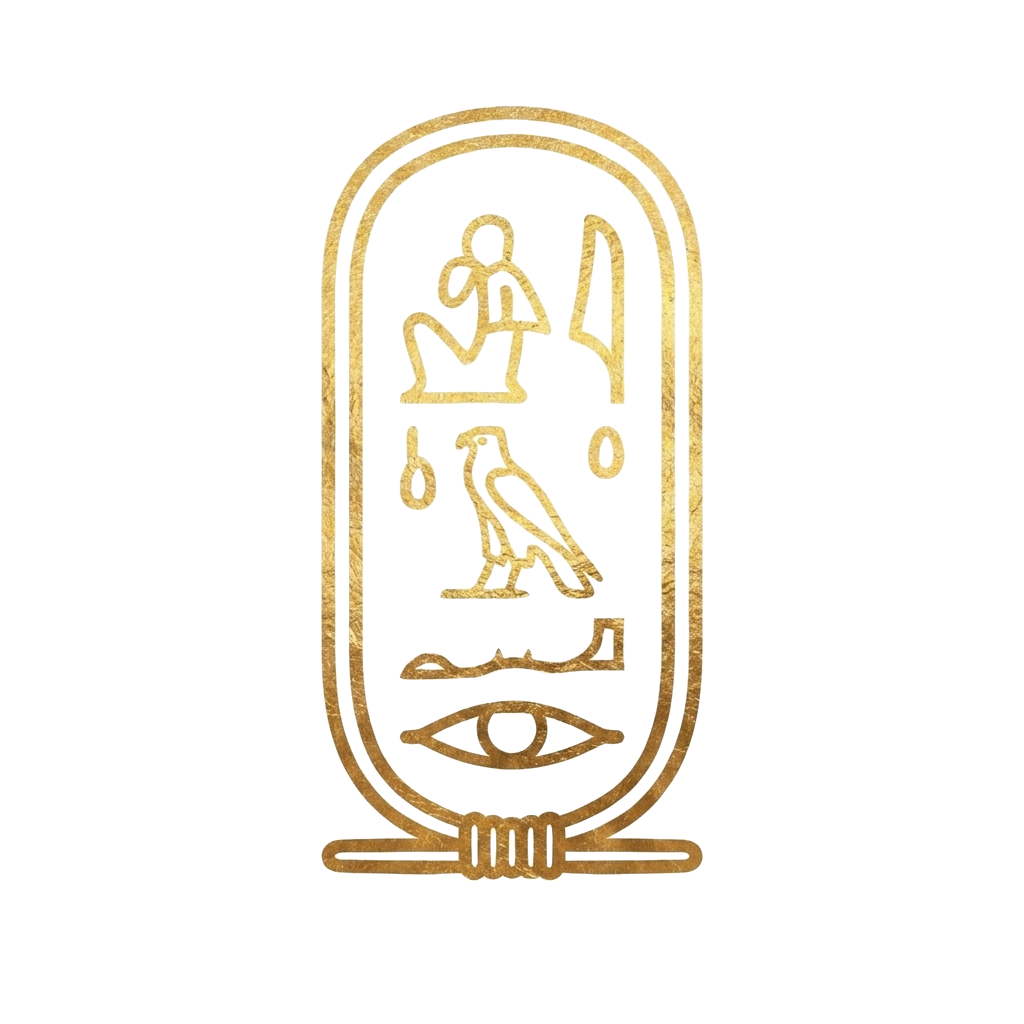
Cartouche
The shenu rope-loop the Egyptians drew around royal names so that the king's identity, written inside, would be carried by the same eternity the gods themselves wore.
About Cartouche
A cartouche is the elongated oval enclosing the name of an Egyptian king, queen, or god in hieroglyphic writing. The Egyptians called it shenu, from the verb sheni, "to encircle." The line at one end (sometimes top, more often bottom) is the knot in the looped rope, drawn out into an oval long enough to hold the signs of a royal name.
The shape is not decoration. It is the shen ring stretched. The shen, a doubled rope tied in a closed loop, marked endless duration. When scribes lengthened that loop around the king's name, they wrapped the king's identity in the same eternity the gods carried. To erase the cartouche was to dissolve the king; to write it was to keep him alive.
This is why the cartouche dominates Egyptian temples, tombs, jewelry, sarcophagi, and seals from the Old Kingdom into the Roman period — and why the European decipherers of the 1810s and 1820s recognized it as the key that would open hieroglyphic Egyptian after fourteen centuries of silence.
Visual Description
An elongated oval drawn around a vertical or horizontal column of hieroglyphs, closed at one end by a short tangent line representing the knot of a doubled rope. The two long sides of the oval are the rope itself; the perpendicular bar at the base is where the loop is tied off. Most cartouches read top-to-bottom, with the knot at the bottom; on monumental architecture and some columns the knot can sit at the top. Inside the loop the king's name is written in standard hieroglyphic order, often with the sun-disk of Ra placed first by honorific transposition even when it is read last. On painted tomb and temple walls cartouches are typically outlined in black or red against pale plaster; on gilded coffin and shrine surfaces they are inlaid in colored glass, faience, carnelian, lapis lazuli, and turquoise; on royal jewelry the oval itself is worked in solid gold with the interior signs in cloisonné. Two cartouches usually appear side by side, holding the king's prenomen on the right and nomen on the left.
Esoteric Meaning
The cartouche is name-magic made architectural. In Egyptian thought a person had several spiritual components, and the ren — the name — was one of them, alongside the ka (life-force), the ba (mobile personality), the akh (transfigured spirit), and the sheut (shadow). The ren was not a label attached to a person from outside. It was part of the person, and as long as the ren was spoken or read, the person continued to exist. To strike out a name was to perform a kind of post-mortem killing.
Wrapping the ren inside the shenu loop did two things at once. It identified the name as royal, and it placed the name inside the symbol of unending circuit — the same shen ring the falcon-god Horus and the vulture-goddess Nekhbet are shown clutching in their claws as they fly above the king. The cartouche turned the king's name into a living thing held in the gods' protection.
This is one expression of a wider pattern across the ancient world. The Greek magical papyri preserve long strings of nomina barbara, untranslatable divine names whose power lives in their sound and shape. Jewish mysticism centers on the shem ha-mephorash, the explicit Name, guarded so carefully that pronouncing it incorrectly was thought to risk catastrophe. Indian tantra works through bija mantras, single-syllable seed sounds that contain a deity in compressed form. The Egyptian cartouche is the architectural cousin of these traditions — a container that treats the name as an active force needing both display and protection.
Exoteric Meaning
On the public side, the cartouche is the visible mark of royal identity. It tells anyone walking through a temple which king built it, which king restored it, and which king's offerings the priests are bringing. It functions as legal identification on royal seals and foundation deposits, as decoration on personal jewelry given by the king to his officials, and, in the Late Period and onward, as a luxury good in its own right — a gold pendant carrying the bearer's name in royal style. Modern tourism kept that last function alive: from the 19th century onward, jewelers in Cairo and Luxor have made personalized cartouche pendants for visitors, turning a 4,500-year-old royal device into the most common souvenir of Egypt.
Usage
Cartouches sit on almost every surface a king's name could occupy. They were carved into temple walls, tomb chapels, sarcophagi, and the granite of obelisks; painted on ostraca and papyri; stamped into mud-brick foundation deposits; pressed into wax seals and clay sealings; inlaid into gold and faience jewelry; and worked into the throne backs, shrines, and coffin lids of royal burials. Tutankhamun's intact tomb, opened by Howard Carter in 1922, gave the clearest single survey: his prenomen Nebkheperure ("The lordly manifestations of Re") and his nomen Tutankhamun heqa-iunu-shema ("Living image of Amun, ruler of Southern Heliopolis") appear together on the gold throne, the gold mask, the inner coffins, the canopic shrine, and dozens of smaller objects. Ramesses II's cartouches cover the facade and inner halls of Abu Simbel, the Hypostyle Hall at Karnak, and statues across the Delta. Royal scarabs — small carved seal-amulets — often carried only the king's prenomen inside its cartouche, making a portable version of the same protective device.
In Architecture
On stone monuments the cartouche tends to appear in three positions. It runs as a frieze across lintels, architraves, and the upper drums of papyrus-bundle columns, where the king's two names alternate with the names of the gods being honored. It sits in the central panel of pylon walls — the great battered gateways at the front of New Kingdom temples — usually paired with images of the king smiting enemies. And it forms vertical bands down the shafts of obelisks and the sides of statue bases. The Karnak temple complex carries cartouches of nearly every New Kingdom ruler, from Hatshepsut and Thutmose III to the late Ramessides. The Luxor Temple pylon is fronted by Ramesses II's cartouches at colossal scale. At Abu Simbel, the four seated colossi of Ramesses II carry his cartouches on the chest and the upper arm, and his throne names line the doorway of the Great Temple. On obelisks, the cartouches were typically carved in deeply sunken relief so the rising and setting sun threw sharp shadow lines across them — a practical solution that doubled, in Egyptian thought, as a daily renewal of the king's ren by the light of Ra.
Significance
Dynastic ideology. The cartouche is one of the clearest signs that Egyptian kingship was conceived as a continuous office. The pharaoh wore five names — the Horus name, the Nebty (Two Ladies) name, the Golden Horus name, the prenomen, and the nomen — and the last two were always written inside cartouches. The prenomen, taken at coronation, identified the king as the latest occupant of the throne of Horus. The nomen, given at birth, identified the man. Drawing both inside identical ovals stitched the divine office and the human person into a single visible unit.
Magical theology. By enclosing the ren inside a loop of shen-rope, scribes did not merely note the name; they protected it. The cartouche was a working ritual object. Pyramid Text utterances addressed to the dead king call him by name repeatedly because each utterance of the name was an act of preservation, and writing the name inside the cartouche extended that act in stone. Robert Ritner's analysis of Egyptian magical practice treats encircling — the binding of a thing inside a closed line — as one of the foundational mechanics of Egyptian ritual, and the cartouche is the most visible royal application of that mechanic.
The Champollion breakthrough. The cartouche is the reason the world can read hieroglyphic Egyptian today. By the early 1800s scholars had agreed, on the strength of Greek and Latin sources, that the ovals on Egyptian monuments held royal names. On the Rosetta Stone (discovered 1799), the cartouche of Ptolemy V was visible in the hieroglyphic register and his name was given in Greek at the bottom. Thomas Young, working through the late 1810s, identified phonetic values for several signs inside the Ptolemy cartouche but stopped short of claiming a full alphabet. Jean-Francois Champollion took the second step. Working from a copy of an obelisk inscription brought from Philae that paired Ptolemy with Cleopatra, he matched signs across the two cartouches, confirmed phonetic values for letters shared by both names, and on 14 September 1822 ran to his brother's office shouting "Je tiens mon affaire!" before collapsing. His Lettre a M. Dacier, read at the Academie des Inscriptions et Belles-Lettres in Paris on 27 September 1822, announced a working phonetic hieroglyphic alphabet. The date is treated by Egyptologists as the founding moment of their field. Without the cartouche — a visible frame telling the decipherer "a name is here" — the puzzle would have been far harder to enter.
Erasure as weapon. Because the cartouche was understood to keep the king alive, destroying it was the strongest available political and religious act against a predecessor. After Hatshepsut's death her stepson and successor Thutmose III, late in his own reign, ordered her cartouches systematically chiseled off temple walls at Deir el-Bahri and Karnak. After the Amarna interlude, Horemheb and the early Ramessides erased the cartouches of Akhenaten, Smenkhkare, Neferneferuaten, Tutankhamun, and Ay from monuments across Egypt, and Akhenaten's name was omitted from later king lists entirely. The cartouches survived in places the iconoclasts missed — sealed tomb fill, hidden quarry marks, and outlying provincial temples — which is the main reason modern scholarship can reconstruct the Amarna sequence at all.
Comparative name-magic. The cartouche belongs to a wider human pattern in which the name is treated as a live component of the person. Greek magical papyri from Roman Egypt drop strings of "barbarous names" into spells, and scribes sometimes set them off with framing devices; scholars including Robert Ritner and Hans Dieter Betz have noted the broader Egyptian background to PGM ritual practice. Jewish mystical writing surrounds the divine Name with elaborate guards. Tantric Buddhism uses bija syllables enclosed in geometric frames. The cartouche is the oldest fully-architectural version of the same intuition: name something, draw a circle around it, and you have done something to it.
Modern reception. Since the 19th century, cartouche-style pendants made for tourists in Cairo's Khan el-Khalili have spelled out modern names — Sarah, Michael, Marie — using the phonetic values Champollion recovered. The device has outlived its religion, its language, and its empire, and is still used by living people to do exactly what it was invented to do: hold a name inside a loop.
Connections
Deities. Ra stands above all other gods inside Egyptian cartouches; the sun-disk often opens both the prenomen and the nomen by honorific transposition, identifying the king with the daily renewal of the sun. Horus is the king-on-earth whose office the cartouche protects, and the falcon clutching the shen-loop above the king is the closest iconographic relative of the cartouche. Isis, mistress of magical names — her great myth turns on tricking Ra into revealing his secret name — is the goddess most directly associated with the theology of the ren. Thoth, scribe of the gods, records cartouches in the divine registers and is shown on Karnak and Ramesside temple reliefs writing the king's name on the leaves of the ished tree of Heliopolis, an act that fixes the length of the reign.
Texts. The Pyramid Texts, the oldest religious corpus in the world (5th-6th Dynasty, c. 2400-2200 BCE), repeatedly invoke the king by name and use that naming as the engine of his ascent to the gods. The Coffin Texts of the Middle Kingdom extend name-protection to non-royal dead, who borrow royal logic by writing their own names in protective enclosures. Spells in the Egyptian Book of the Dead address the preservation and pronunciation of names, including spells aimed specifically at preventing the deceased's name from perishing. The Rosetta Stone (196 BCE, now in the British Museum) is the most famous bilingual cartouche-bearing object in the world.
Other symbols. The cartouche is the shen ring elongated; the two are the same symbol at different scales. Djed often appears beside cartouches on coffin sides, pairing the king's named identity with the column of cosmic stability. Ankh is sometimes drawn inside or beside the cartouche, putting the sign of life directly into the protective loop. Scarabs carry royal cartouches on their flat undersides, turning the king's name into a portable amulet. The winged sun disk is the canopy under which cartouches most commonly sit on temple lintels.
Further Reading
- James P. Allen, Middle Egyptian: An Introduction to the Language and Culture of Hieroglyphs, 3rd ed. (Cambridge University Press, 2014) — standard university grammar; treats the cartouche in the context of royal titulary.
- Antonio Loprieno, Ancient Egyptian: A Linguistic Introduction (Cambridge University Press, 1995) — the linguistic frame for understanding hieroglyphic writing inside the cartouche.
- Richard H. Wilkinson, Reading Egyptian Art: A Hieroglyphic Guide to Ancient Egyptian Painting and Sculpture (Thames and Hudson, 1992) — the working reference on shen, shenu, and other encircling signs.
- Richard H. Wilkinson, Symbol and Magic in Egyptian Art (Thames and Hudson, 1994) — companion volume on the magical logic of Egyptian visual signs.
- Robert K. Ritner, The Mechanics of Ancient Egyptian Magical Practice, Studies in Ancient Oriental Civilization 54 (Oriental Institute of the University of Chicago, 1993) — definitive study of encircling, binding, and other ritual mechanics behind devices like the cartouche.
- Geraldine Pinch, Magic in Ancient Egypt, rev. ed. (British Museum Press / University of Texas Press, 2006) — accessible scholarly survey including the magic of the ren.
- Lesley and Roy Adkins, The Keys of Egypt: The Race to Read the Hieroglyphs (HarperCollins, 2000) — narrative history of the Champollion-Young decipherment, with the cartouche at its center.
- Andrew Robinson, Cracking the Egyptian Code: The Revolutionary Life of Jean-Francois Champollion (Oxford University Press, 2012) — the standard modern biography of Champollion.
Frequently Asked Questions
Why are pharaohs' names written inside an oval?
The oval is a stretched shen ring — a closed loop of doubled rope that the Egyptians used as the sign for unending duration. The Egyptians believed a person's name (ren) was a real component of the self, on the same level as the ka, ba, akh, and sheut. As long as the ren was spoken or read, the person kept existing. Wrapping the king's ren inside the shenu loop did two jobs at once. It marked the name as royal, distinguishing it from every other line of hieroglyphs around it, and it placed that name inside the same protective circuit the gods themselves carried. The cartouche turned the king's identity into a living object held in unending divine guard. That is why erasing a cartouche was the strongest political weapon a successor had against a predecessor — chiseling out the loop was understood as undoing the king.
How did the cartouche help decipher hieroglyphs?
By the early 1800s scholars knew, from Greek and Latin sources, that the ovals on Egyptian monuments enclosed royal names. That single fact gave decipherers a starting point. On the Rosetta Stone (discovered 1799), the hieroglyphic cartouche of Ptolemy V could be matched directly to the Greek 'PTOLEMAIOS' at the bottom of the same stone. Thomas Young identified phonetic values for several Ptolemy signs in the late 1810s. Jean-Francois Champollion took the next step using a second inscription, an obelisk from Philae, that paired Ptolemy with Cleopatra. Letters shared by the two names — p, t, o, l — should appear in both cartouches, and they did. From that handful of signs Champollion built out a working phonetic alphabet, announced in his Lettre a M. Dacier on 27 September 1822. Without the cartouche flagging where names sat, the puzzle would have been almost impossible to enter.
Did only pharaohs have cartouches?
No, though kings were the original and primary users. Great Royal Wives could be given cartouches, especially when they held unusual political weight. Nefertiti, wife of Akhenaten, had her name written inside a cartouche on equal footing with her husband's — a striking elevation. Hatshepsut, who took the full kingship in her own right, used cartouches in standard royal style. Cleopatra VII, the last Ptolemaic ruler, used cartouches in standard royal style, as did the earlier Cleopatra III, whose name on the Philae obelisk gave Champollion his second test case alongside Ptolemy. Certain gods were also given cartouches. The Aten under Akhenaten received cartouches in the same style as the king's, marking the sun-disk as supreme deity. In the Greco-Roman period, divine names occasionally appear in cartouches as well, especially for syncretic forms of Amun and Isis. By the Roman period the cartouche had become a flexible mark of high status rather than a tight royal monopoly.
What's the difference between a cartouche and a shen ring?
They are the same symbol at different proportions. The shen is a tight closed loop of rope — a circle with a short tangent line marking the knot. It signified eternal duration, encircling protection, and the renewal of the sun's circuit. Falcons and vultures are shown clutching it in their talons above the king's head. The cartouche is the same loop pulled long. Egyptian scribes called it shenu, the same root as shen, and the only structural difference is that the loop has been stretched into an oval long enough to hold the signs of a royal name. The shen wraps abstract eternity around the king from above; the cartouche wraps that same eternity around the king's actual name on the page. One is the symbol; the other is the symbol put to a particular job. Both first appear in the Old Kingdom, and the shen is older — its earliest depictions go back to the 1st Dynasty, while the cartouche standardizes under Sneferu in the 4th Dynasty.