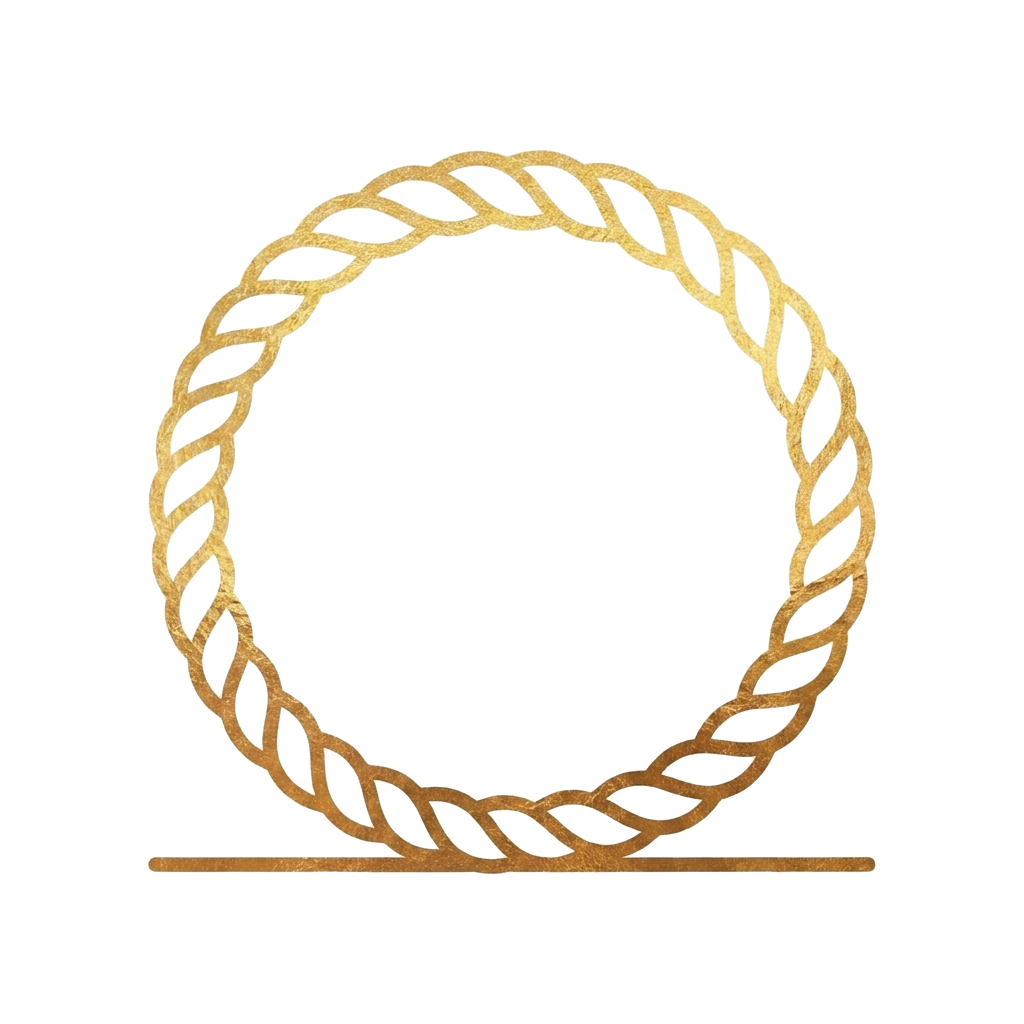
Shen Ring
A closed rope-loop with a tangent base, gripped in the talons of Horus and Nekhbet to wrap the pharaoh in eternal encircled protection.
About Shen Ring
The shen is a tight circular loop of cord with a short straight tangent drawn across its bottom, like a rope tied off at a single horizontal knot. In Gardiner's sign list it is V9. The word it writes, šn, means 'to encircle,' and by the Old Kingdom that encircling had already collected a second meaning: protection. A closed line has no opening. Nothing hostile can cross it.
You almost never see a shen alone. It appears in the talons of the Horus-falcon hovering above a king's head, in the claws of Nekhbet the vulture goddess stretched across a temple ceiling, in the hands of Isis or Heqet, wrapped around the sun on the horizon. It is an object handed down from the divine to the royal. The meaning is not that the king holds eternity. The meaning is that a god is holding eternity around the king.
Stretched along its long axis, the shen becomes the cartouche, šnw, the oval that encloses a pharaoh's name. The cartouche is not a separate sign. It is the same rope, pulled longer to fit the hieroglyphs inside it. This is the shen's most consequential role in Egyptian visual language: the magical boundary that wrapped a king's name for three thousand years is a shen ring stretched to fit.
This page is about the loop itself, the unbroken line, and why the ancient Egyptian imagination treated a closed curve as a weapon against disorder.
Visual Description
A circle of rope with a short horizontal line drawn tangent across its base, representing the knotted ends of the cord tied off. The loop is almost always shown flat, face-on to the viewer, never in perspective. In high-quality renderings the rope is cross-hatched or beaded to show the twist of the fiber. In hieroglyphic writing it is compact and schematic. In jewelry and pectoral work it is modeled in gold cloisonné and inlaid with lapis lazuli (blue), carnelian (red), turquoise or feldspar (green-blue), and occasionally glass paste. The standard palette is dense and saturated: gold frame, lapis or carnelian body. Scale is context-dependent. In the talons of a falcon it is sized to the claw. In a pectoral it can be the central motif. On a temple ceiling it is repeated as a border. Against a plain circle: the shen has the horizontal bar at the base. Against a cartouche: the shen is round, the cartouche is oval and elongated. Both are the same rope. The proportion is what differs.
Esoteric Meaning
The shen is a statement about closed geometry. An unbroken line has no point of entry, no gap where something unwanted can push through. The Egyptian magical imagination took this literally. Spells were drawn in circles. Protective formulas were written as enclosures. The body at death was wrapped in linen, then laid inside nested coffins, each one a shen around the last. Encirclement was not symbolic of protection. It was the mechanism of protection.
The shen also reads as the orbit of the sun. Ra traces a closed path each day, rising on the eastern horizon, crossing the sky, setting in the west, returning through the Duat, and rising again. That daily loop is a shen drawn across time. When a shen is placed around or beneath a sun disk, the image is not two separate symbols. It is one statement: the sun moves in an eternal closed circuit, and that closure is what makes cosmic order possible.
The ouroboros, the snake eating its own tail, shares the shen's logic but differs in register. The ouroboros is self-consuming, emphasizing continuous renewal through destruction. The shen is held, not self-moving. A god brings the shen to the king. The closure is offered, bestowed, maintained by divine agency. Where the ouroboros dramatizes the eternal loop, the shen stabilizes it, hands it over, pins it to a specific person.
Exoteric Meaning
Protection. A safe name. Royal sanction under divine guardianship. Amuletic insurance for the living and the dead. A visible sign that a god is watching over the person who bears it.
Usage
Jewelry and pectorals. The pectoral of Princess Sithathoryunet, daughter of Senusret II (Twelfth Dynasty, c. 1887-1813 BCE), discovered at Lahun and now at the Metropolitan Museum of Art, shows two falcons perched on shen rings beneath a central cartouche holding the throne name Khakheperre. The entire composition is a meditation on the shen: the falcons grip shens with their talons, and the royal name sits inside an elongated shen above them. The piece is solid gold cloisonné, inlaid with 372 pieces of carnelian, lapis lazuli, feldspar, garnet, and turquoise, and measures only about three and a quarter inches across.
Funerary amulets. Among the treasures of Tutankhamun (late Eighteenth Dynasty, c. 1332-1323 BCE) are several shen-bearing pectorals, including a gold pectoral with a falcon Horus whose outstretched wings surround a central sun disk while his talons grip shen rings above ankhs. Gold shen amulets were placed among the linen wrappings of elite mummies as insurance for the body's eternal enclosure.
Royal iconography. On temple walls and papyri, Horus or Nekhbet hovers above the king, wings outstretched, a shen dangling from each talon. The visual claim is unambiguous: this king is encircled.
Writing. The sign writes the verb šn, 'to encircle, surround, enclose,' and the noun šnw, the cartouche. It also appears in words related to going around or binding something. The same root šnj carries a binding charge in magical contexts, where encirclement can curse or constrain rather than protect.
In Architecture
Shen rings appear in temple ceiling programs, where rows of vultures or falcons with outstretched wings grip shens repeated along the length of the hall. Vulture-and-shen ceiling programs are documented at the Dendera temple complex (Greco-Roman period) and at the Temple of Horus at Edfu, where the naos ceiling shows winged scarabs and falcons grasping shen rings. Shens also appear carved into lintels above royal images, so that the king passing beneath the doorway moves under the encircling protection of the sign. On sarcophagi of the Middle and New Kingdoms, the shen is painted onto lid borders and interior floors, where it surrounds the body during the long reintegration of the afterlife. Shen rings are attested in royal contexts from the Early Dynastic Period and become a standard architectural element from the Old Kingdom onward, painted or carved on lintels, ceilings, and burial enclosures.
Significance
A theology of closed lines. The shen is a compact statement of one of the oldest protective ideas in Egyptian religion: that an unbroken boundary keeps disorder out. Spells drawn in circles, bodies placed in nested coffins, names sealed inside cartouches, kings encircled by hovering falcons, the sun running a closed orbit across the sky. These are all versions of the same idea the shen hieroglyph expresses with two strokes. Protection is geometry. A line with no opening is a line nothing hostile can cross.
Why a god always holds it. The shen is rarely shown on its own. Almost every preserved image shows it gripped by a divine being: Horus as falcon, Nekhbet as vulture, Isis kneeling with her hands resting on shens, Heqet the frog goddess seated on one. The iconographic logic is that eternal protection is not a property the king has. It is something a god is currently doing on the king's behalf. Remove the god from the image and the shen becomes an object without an agent. This is why freestanding shens are mostly seen on amulets and jewelry, where the absent divine hand is implied by the ritual of wearing.
The cartouche is the shen's most important descendant. Somewhere between the end of the Third Dynasty and the reign of Sneferu at the start of the Fourth, Egyptian scribes stretched the round shen into an oval to accommodate the full hieroglyphic writing of the royal name. This elongated shen became the cartouche, Gardiner sign V10, šnw. For the next three thousand years every royal name in Egypt was written inside a cartouche. The protective work the rope-loop had done around a generic figure now did the same work around the specific arrangement of signs that made up a king's identity. The cartouche did not replace the shen. It was the shen, pulled long, applied to language.
Relationship to the ouroboros. Both signs mean 'eternal closed loop,' but they stage the loop differently. The ouroboros swallows itself, dramatizing renewal through self-consumption. The shen is static and handed over, emphasizing stability and divine gift. A king wearing a shen pectoral is not inside a self-renewing cycle. The king is inside a circle a god drew around him and keeps drawing.
Comparative note on the Mesopotamian rod-and-ring. The Mesopotamian rod-and-ring symbol, most famously shown held by Shamash in the upper register of the Code of Hammurabi stele, depicts a deity presenting a ring and a rod to the king. The visual resemblance to the shen is real and has prompted comparison since the nineteenth century. Careful scholarship (Slanski 2007; Pestell 2023) treats the two as parallel iconographies rather than as one borrowing from the other. The Mesopotamian pair is older, ties the ring to a measuring rod, and carries connotations of justice and balance. The shen has no rod. What the two signs share is the underlying image of a god offering a ring-shaped emblem of eternal authority to a ruler. The shared image may reflect a widely held Bronze Age intuition about closed circles and divine sanction rather than direct cultural transmission.
Modern reception. The shen survives in contemporary jewelry, tattoos, and Egyptian-themed design, usually collapsed with the cartouche or misread as a generic circle. The distinction most casual treatments miss is the horizontal tangent at the base, the knot that makes the rope a rope rather than an abstract ring. That small straight line is the whole argument of the sign: the loop is closed because someone tied it shut.
Connections
Deities. Horus is the most common shen-bearer, usually as the falcon hovering above the king with a shen in each talon. Nekhbet, the vulture goddess of Upper Egypt, shares this role on temple ceilings and royal pectorals. Isis is depicted kneeling with her hands resting on shens in protective funerary scenes. Ra is linked to the shen through the solar orbit, where the shen reads as the closed path of the sun. Wadjet, the cobra goddess of Lower Egypt, is paired with Nekhbet as one of the Two Ladies in royal protection iconography, though Nekhbet rather than Wadjet is the standard shen-bearer of the pair.
Texts. The sign appears in the Pyramid Texts as part of royal funerary formulas from the late Fifth Dynasty onward, in the Coffin Texts of the Middle Kingdom where it carries protective charge in spells for safe passage, and on vignettes throughout the Egyptian Book of the Dead, where hovering falcons and vultures grip shens above scenes of judgment and rebirth.
Other symbols. The cartouche is an elongated shen and is treated as a distinct sign in Gardiner's list (V10) but derives directly from the shen (V9). The ouroboros shares the closed-loop logic of the shen but dramatizes self-renewal rather than divine gift. The winged sun disk often appears paired with shens in solar iconography, where the shen reads as the orbit the disk travels. The ankh is a frequent companion on pectorals, with falcons gripping shens above ankhs to layer eternal protection with eternal life.
Further Reading
- Andrews, Carol. Amulets of Ancient Egypt. University of Texas Press, 1994.
- Wilkinson, Richard H. Reading Egyptian Art: A Hieroglyphic Guide to Ancient Egyptian Painting and Sculpture. Thames & Hudson, 1992.
- Wilkinson, Richard H. Symbol and Magic in Egyptian Art. Thames & Hudson, 1994.
- Pinch, Geraldine. Magic in Ancient Egypt. British Museum Press, 1994.
- Aldred, Cyril. Jewels of the Pharaohs: Egyptian Jewelry of the Dynastic Period. Thames & Hudson, 1971.
- Kemp, Barry. Ancient Egypt: Anatomy of a Civilisation. Second edition, Routledge, 2007.
- Slanski, Kathryn. 'The Mesopotamian Rod and Ring: Icon of Righteous Kingship and Balance of Power between Palace and Temple.' In Regime Change in the Ancient Near East and Egypt, British Academy, 2007.
- Metropolitan Museum of Art catalogue entry, Pectoral and Necklace of Sithathoryunet with the Name of Senwosret II, accession no. 16.1.3.
Frequently Asked Questions
What is the difference between a shen ring and a cartouche?
They are the same sign in different proportions. The shen (Gardiner V9) is a round loop of rope with a short horizontal tangent at its base, representing the tied-off knot. The cartouche (Gardiner V10, Egyptian šnw) is that same loop stretched along its long axis into an oval so that hieroglyphs for a royal name can be written inside it. Scribes made this adaptation at the end of the Third Dynasty, and by the reign of Sneferu at the start of the Fourth Dynasty it was regular practice to enclose the king's name in an elongated shen. The protective work the round shen did around a figure, wrapping it in an unbroken line, now did the same work around the written name. Visually: the shen is round, the cartouche is oval. Structurally: they are the same rope.
Why is the shen ring almost always shown held by a god and not standing alone?
Because in Egyptian religious logic, eternal protection is not a quality the king possesses. It is an action a god is performing on the king's behalf. The image of Horus as a falcon hovering above the pharaoh, a shen in each talon, is a statement that the god is currently, actively, holding eternity around the ruler. Remove the god and the shen becomes an object with no agent, no one doing the encircling. This is why freestanding shens are mostly found on amulets and jewelry, where the absent divine hand is implied by the act of wearing. It is also why Horus, Nekhbet the vulture goddess, Isis, Heqet, and occasionally other deities are the standard bearers of the sign. The shen is in their hands because the protection is theirs to give.
Is the shen ring related to the Mesopotamian rod-and-ring symbol?
The resemblance is real and scholars have debated the relationship for over a century. The Mesopotamian rod-and-ring, shown most famously on the Code of Hammurabi stele where the sun god Shamash hands a ring and a rod to the king, shares with the shen the core image of a deity offering a ring-shaped emblem to a ruler. The Mesopotamian version is older than attested Egyptian use, pairs the ring with a measuring rod, and carries associations with justice and balance. The shen has no rod and no measurement connotation. Its tangent at the base is a knot, not a tool. Careful scholarship (Slanski 2007, Pestell 2023) treats the two as parallel iconographies rather than as direct borrowing. They probably reflect a widely held Bronze Age intuition that a closed ring in a god's hand is a fit emblem for eternal authority, rather than a single sign transmitted from one culture to the other.
Where have archaeologists found shen rings used on actual objects?
The earliest depictions of the shen are linked to the First Dynasty tomb of Den (c. 3000 BCE), with a clearer Second Dynasty example on a stone vase of Khasekhemwy showing a vulture grasping the ring. The sign is well established in royal iconography from the Third Dynasty onward. From the Middle Kingdom comes the pectoral of Princess Sithathoryunet at Lahun, made during the reign of Senusret II (c. 1887-1878 BCE), a gold cloisonné piece with 372 inlaid stones in which falcons perch on shens and the royal cartouche is itself an elongated shen. From the New Kingdom, the tomb of Tutankhamun (KV62, c. 1332-1323 BCE) yielded several pectorals featuring Horus-falcons gripping shens above ankhs. Temple ceilings at Dendera and Edfu, both Greco-Roman additions to older sanctuaries, use rows of shen-bearing falcons and vultures as border programs. Gold shen amulets placed among linen wrappings have been recovered from elite mummies across multiple periods.