Sistrum
The sistrum is the sacred Egyptian rattle of Hathor and Isis whose metallic jingle was offered to the goddess as audible theology and used to disperse the chaotic energies of Set.
About Sistrum
The sistrum is a piece of theology you can hear. Pick one up, shake it once, and the air fills with a thin, dry, metallic chime, somewhere between a tambourine and wind moving through dry reeds. To an Egyptian priestess in 1400 BCE, that sound was an offering. The goddess Hathor was pleased by it. The chaos serpent was dispersed by it. Cosmic order was, for the length of a shake, audibly maintained.
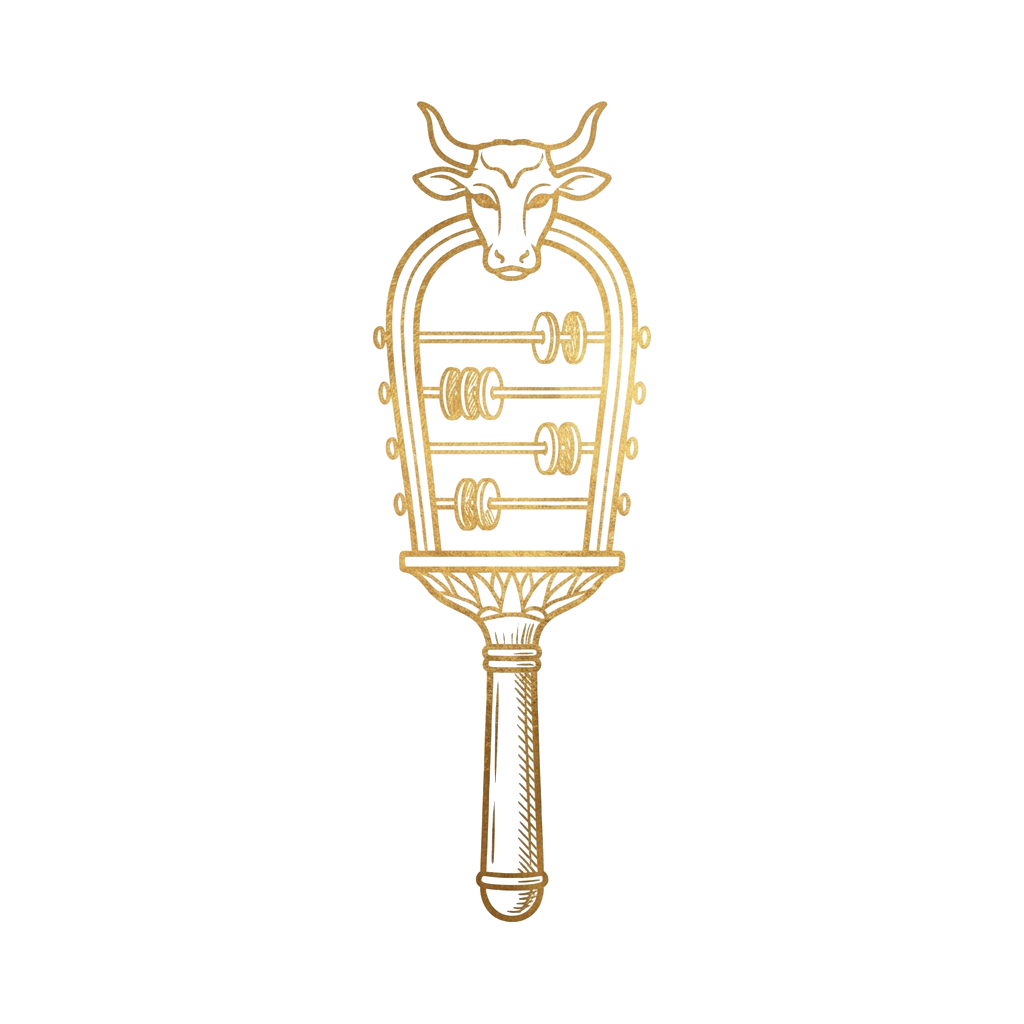
Handheld, the sistrum sits comfortably in a single fist. A wooden or metal handle rises into a frame (sometimes a small temple-shaped box, sometimes a U-shaped arch) pierced by two to four crossbars. Loose metal disks or jingles slide along those bars. Shake the instrument and the disks slap the bars and slap each other, and the whole frame buzzes for a second after you stop.
Its Egyptian name was sššt, transliterated sesheshet: an onomatopoeic word meant to imitate the sound itself, closer to 'shesh-shesh' than to any percussive crack. The Greeks borrowed the instrument and renamed it seistron, 'that which is shaken,' from which Latin sistrum and the modern English word descend. Both names are sound-words. The Egyptians named the instrument after the noise. The Greeks named it after the gesture. Either way, the instrument is identified by what it does, not what it looks like.
The sistrum is one of the longest-lived ritual instruments in human history. Its earliest secure attestation is the small alabaster sistrum inscribed with the name of King Teti of the Sixth Dynasty, c. 2323–2291 BCE, about 4,300 years old. Its latest use is happening this Sunday morning in Coptic Orthodox and Ethiopian Tewahedo churches, where a closely related rattle, the tsenatsil, marks rhythm during liturgical chant. Almost no other ritual object has held continuous, living use across that span.
Visual Description
Two distinct types coexisted, and they are not interchangeable. The naos sistrum (sometimes 'shrine sistrum') has a rectangular frame shaped like a small temple, with vertical sides, a flat lintel, and often a uraeus cobra or sun disk on top. The frame sits on a shaft that opens into a sculpted Hathor-head, and that head opens onto the handle. The Hathor face is the iconographic anchor: cow ears, heavy wig, often a tiny shrine-like box above her head. Naos sistra were the more elaborate, more elite type, frequent in royal and high-priestess contexts.
The arched sistrum has a U-shaped loop instead of a rectangular box. The loop is a single curve of metal or wood rising from the handle, sometimes from a smaller Hathor face, sometimes from a plain shaft. The arch was simpler to make, more practical to use, and it travelled. When the Isis cult spread across the Greco-Roman world, the arched type went with it. Most Roman-period sistra are arched.
Both types share the working mechanism: two to four horizontal crossbars run through the frame, threaded with loose metal jingles, usually flat disks or square plates of bronze. The bars themselves were sometimes bent into S-curves at the ends to hold the jingles in. Some bars also held small bells. Shaking the handle slides the jingles along the bars, producing the soft metallic shesh-shesh.
Materials track status. Royal and elite sistra were bronze, gilded wood, or gold; Tutankhamun's burial included a wooden, gesso, and gold-leaf example. Working temple instruments were usually bronze. Votive and funerary sistra, often non-functional, were made of faience (the blue-green glazed ceramic Egyptians called tjehenet, 'that which shines'). Faience sistra survive in large numbers from the Late Period onward and were often deposited in tombs as symbolic instruments. The sound they would have made mattered more than whether they could in fact make it.
Esoteric Meaning
Sound itself is the offering. This is the sistrum's distinctive theological move, and it sits behind every other meaning attached to the instrument.
In most ritual systems, an offering is a thing: bread, oil, incense, a sacrificed animal. The sistrum offers a vibration. When the priestess shakes the rattle in front of Hathor's image, what she gives the goddess is the sound. The sound is consumed, in the sense that it dissipates immediately, but it has been made. It existed. The air around the cult statue has been moved in a particular way for a particular goddess. That motion is the gift.
The second function is apotropaic. The same vibration that pleases Hathor disperses the forces opposing cosmic order, Set's storms and Apophis the chaos serpent. Sound, in Egyptian thinking, is not symbolic of order but a condition of it. The temple liturgy is a continuous low-grade re-creation of the world, and the sistrum is one of the tools that does that work. Shake it, and a small piece of the cosmos is re-stabilised.
Plutarch, writing his treatise On Isis and Osiris in the late first or early second century CE, gave the sistrum a fully developed cosmological reading. In chapter 63 he argues that the sistrum's curved upper portion stands for the sublunary sphere, the world of generation and decay, and the four bars threaded through it are the four elements: earth, water, air, fire. They must be shaken because all things in the realm of becoming need agitation; if they are not shaken, they grow torpid and die. Above the frame Plutarch reads the carved cat as the moon (variable, changeable, with the ability to give birth), and beneath it the faces of Isis and Nephthys as the poles of birth and death. The sistrum, in Plutarch's hands, is the cosmos in miniature: a four-element machine for keeping the world awake.
Whether or not the Egyptian priests themselves read the instrument that way (Plutarch was a Greek philosopher reading an Egyptian object through Platonic categories), the interpretation became part of the sistrum's working mythology and shaped how the Greco-Roman Isis cult understood the rattle they carried in procession.
The cross-tradition parallel is striking. The Indian damaru, the small two-headed drum carried by Shiva, is similarly understood as a sound-instrument that produces the cosmos: from its beat the Sanskrit alphabet emerges, and the rhythm of its play is the rhythm of creation and dissolution. The Tibetan chöd damaru, used in the cutting-through-ego practice of Machig Labdrön's lineage, is also a vibration-offering, in which the practitioner offers her own dissolution to the rhythmic drone of the small skull-drum. In all three traditions, sound is not a decoration on ritual but ritual's working medium.
Exoteric Meaning
On the ordinary surface, the sistrum is a temple rattle. A priestess shakes it during ceremonies for Hathor or Isis. Royal women shake it in cult scenes carved into temple walls. Festival musicians use it alongside drums, harps, and double-pipes during the great public celebrations: the New Year, the Festival of Drunkenness, processions of the divine image. It is the goddess's instrument, the way the harp is Apollo's instrument: an attribute, an iconographic marker, a sound that signals her presence.
Usage
The sistrum's primary home was the temple. At Dendera, Hathor's chief cult centre, sistra were shaken during the daily morning offering, when priestesses approached the goddess's image with food, drink, and the sound of their rattles. At Philae, the same role passed to Isis priestesses after the cult of Hathor merged with hers.
Festivals amplified the use. The Festival of Drunkenness, attested most fully in the Hall of Drunkenness that Hatshepsut built at the Mut temple precinct at Karnak (excavated and published by Betsy Bryan and her team starting in 2001), included worshippers drinking themselves into ritual sleep, then being woken by drums and sistra to commune with the goddess in her placated form. A text from Edfu records the gods playing the sistrum for Hathor 'to dispel her bad temper.' The ritual logic is concrete: the goddess in her angry, leonine aspect is dangerous, and the sistrum's sound soothes her into her cow-headed, beneficent form.
Royal and elite women carried sistra as part of their cultic duties. The title 'Great One of the Sistrum of Hathor' (wr.t-ḫnr.t) was held by senior priestesses; many other women carried the simpler 'sistrum-player' (ihy.t) designation. Queens and King's Wives are repeatedly shown shaking the sistrum in front of male divinities, not as decorative figures but as functional cult performers. The queen in this ritual position embodies Hathor and offers the sound that sustains the king's relationship with the gods.
With the spread of the Isis cult into the Greco-Roman world, the sistrum became the public marker of Isiac religion. Apuleius, in Book XI of The Golden Ass (later second century CE), describes the great spring procession of Isis at Cenchreae: a crowd of initiates moves through the streets, and 'each one shook a sistrum of bronze or silver or sometimes gold, giving out a shrill tinkling sound.' The chief priest carries a sistrum prepared specially for the goddess. Roman-period grave reliefs of Isiac priestesses across the empire show them holding the arched sistrum as the defining badge of office.
Funerary use was both literal and symbolic. The pair of sistra found in Tutankhamun's tomb (KV62), wooden, gilded, with copper-alloy disks, were probably functional and intended for the king's continued ritual life in the afterworld. Many other burials included faience sistra that were essentially symbolic: the form of the instrument, deposited as a guarantee that its sound would continue to be made on the deceased's behalf.
The contemporary survival is in Coptic Orthodox and Ethiopian Tewahedo Christian liturgy. The Ethiopian instrument, called the tsenatsil (ጸናጽል), is the closer relative: an arched metal frame with crossbars and jingles, played by deacons during liturgical chant alongside the prayer staff (mequamia) and drum (kebero). Its function in chant is rhythmic and structural, but the form is unmistakably continuous with the arched Egyptian sistrum, and the survival is one of the cleanest examples of a pre-Christian ritual implement absorbed wholesale into a Christian liturgy.
In Architecture
The sistrum is one of the few ritual instruments that became an architectural form in its own right. The Hathor-headed column, the canonical capital of Hathor's temples, is a sistrum made of stone. The shaft is the handle. The carved Hathor face on each side of the capital is the head that anchors a real sistrum. Above the face, a small box-like element, often pierced or carved with cobras and disks, stands in for the rattling frame. The temple is, in effect, a giant sistrum standing upright, with the goddess's face at the cult-eye level and the rattling frame at the roof.
The most fully developed sistrum-columns are the twenty-four in the great hypostyle hall of the Temple of Hathor at Dendera, the work begun under Ptolemy XII and continued under Cleopatra VII and the early Roman emperors, with the hypostyle hall itself ascribed to Tiberius. The columns rise about seventeen metres. Each face of Hathor on each capital looks out in a cardinal direction; the small naos-shaped element above her head reads as the temple-shaped sistrum frame. Walking through the hall, a worshipper moves through a forest of stone instruments, all silent, all aimed at the goddess in the inner sanctuary.
Hathor-headed sistrum capitals also appear at the Birth House (mammisi) at Dendera, at the temple of Isis at Philae, at Deir el-Bahri (Hatshepsut's mortuary temple), and as smaller architectural elements in chapels of Hathor across Nubia. Wherever the cow-eared goddess is worshipped, the sistrum-column tends to follow.
Temple wall reliefs across Egypt depict sistrum-shaking as a standard element of cult scenes, with kings, queens, and priestesses presenting the rattle to seated deities. The sistrum is one of the most common items in the iconographic kit of the New Kingdom and Late Period temple program.
Significance
Religious meaning. Sound as offering is the unique theological move. Most ritual gifts are objects that can be set on an altar; the sistrum's gift is a vibration that exists for half a second and then is gone. The Egyptian liturgy treated that vibration as substantial. The sistrum's noise was a thing the goddess received the way she received bread or beer, and this commitment to sound-as-substance is what aligns the Egyptian instrument with the Indian damaru and the Tibetan chöd drum across thousands of years and thousands of miles.
Plutarch's interpretation. The famous chapter 63 of On Isis and Osiris is the single most influential reading of the sistrum in Western thought. Plutarch made the rattle a cosmological diagram: four bars for four elements, the arched frame for the sublunary world, the cat for the moon, Isis and Nephthys for birth and death. Whether or not Egyptian priests would have recognised this reading, Plutarch's text shaped the Renaissance and early modern reception of the sistrum and is still the doorway most Western readers walk through to reach the instrument.
The Greco-Roman Isiac adoption. When Isis worship spread across the Roman Empire from the third century BCE onward, the sistrum spread with it. Apuleius's eleventh book of The Golden Ass describes the crowd of initiates each shaking a sistrum in the spring procession, and surviving Roman tombstones of Isiac priestesses across Italy and the provinces show the arched sistrum as the standard badge of office. The sistrum became, for several centuries, one of the most internationally recognised ritual instruments in the Mediterranean: Egyptian in origin, but worn by women in Pompeii, Athens, and Londinium.
The Coptic and Ethiopian survival. The sistrum is one of the very few pre-Christian ritual implements that the Christianised Egyptian church kept. In Coptic and especially Ethiopian Orthodox Tewahedo liturgy, the rattle (tsenatsil in Ge'ez) is still used by deacons during chant, played alongside the prayer staff and drum. The continuity is not metaphorical. The instrument's form, mechanism, and rhythmic role are all directly continuous with the late antique Egyptian sistrum. A worshipper at a Sunday liturgy in Addis Ababa is hearing, with very little modification, an instrument first carved in alabaster around 2300 BCE.
Modern reception. Eighteenth- and nineteenth-century Egyptomania pulled the sistrum into Masonic, Theosophical, and Romantic-period collections; surviving sistra became prized antiquities. Contemporary Kemetic and Goddess practitioners have revived ritual use, often with reproductions cast from museum originals. The instrument is also sold widely as a 'space-clearing' tool in contemporary New Age practice, a recent layer that, ironically, returns to something close to the original apotropaic function.
Connections
Deities. Hathor is the primary goddess of the sistrum; the instrument is her attribute, her sound, and (in the Hathor-headed capital) her image. Isis inherited the rattle when her cult absorbed Hathor's in the Late Period and carried it into the Greco-Roman world. Bastet, the cat-headed goddess, is connected through Plutarch's reading of the cat carved on top of the sistrum frame. Bes, the dwarf festival-deity, appears in many sistrum-shaking contexts, especially around childbirth. Mut, the great Theban goddess, is the deity of the Festival of Drunkenness at Karnak where sistra featured prominently. The chaos serpent Apep (Apophis) and Set are the forces the sistrum's sound drives away.
Texts. The Pyramid Texts mention Hathor in her sky-mother aspect, providing the early framework for her cult. The Coffin Texts develop her further (Spell 295 makes her keeper of one of the gates the deceased must pass) and form the backdrop against which the sistrum's funerary use makes sense. The Egyptian Book of the Dead continues these themes. Plutarch's On Isis and Osiris, chapter 63, is the single most important external commentary on the sistrum's symbolism. Apuleius, The Golden Ass Book XI, gives the fullest surviving narrative description of sistra in actual ritual use.
Other symbols. The ankh is constantly paired with the sistrum in priestess depictions: life held in one hand, sound offered with the other. The uraeus cobra often crowns the naos sistrum's frame. The Tyet (Knot of Isis) frequently accompanies sistrum-bearing Isiac priestesses in Greco-Roman contexts. The cartouche appears on royal sistra (the Teti example carries his cartouche on the handle).
Further Reading
- Manniche, Lise. Music and Musicians in Ancient Egypt. London: British Museum Press, 1991. The standard scholarly survey; chapter on the sistrum covers types, materials, and ritual use.
- Manniche, Lise. Musical Instruments from the Tomb of Tut'ankhamūn. Tutankhamun Tomb Series VI. Oxford: Griffith Institute, 1976. Detailed publication of the Tutankhamun sistra and other instruments.
- Reynders, Marleen. 'Names and Types of the Egyptian Sistrum.' In Egyptian Religion: The Last Thousand Years, ed. W. Clarysse et al. (Orientalia Lovaniensia Analecta 85), Leuven 1998. The technical study of naos vs arched typology and terminology.
- Plutarch. Moralia, Volume V: Isis and Osiris. Translated by Frank Cole Babbitt. Loeb Classical Library 306. Cambridge, MA: Harvard University Press, 1936. Chapter 63 contains the famous symbolic interpretation of the sistrum.
- Pinch, Geraldine. Egyptian Mythology: A Guide to the Gods, Goddesses, and Traditions of Ancient Egypt. Oxford University Press, 2002. Reliable reference for Hathor and the cult context of sistrum use.
- Wilkinson, Richard H. The Complete Gods and Goddesses of Ancient Egypt. Thames & Hudson, 2003. Visual and textual reference; Hathor entry covers sistrum iconography.
- Bryan, Betsy M. 'Hatshepsut and Cultic Revelries in the New Kingdom.' In Creativity and Innovation in the Reign of Hatshepsut, eds. J. Galán et al., SAOC 69, Chicago: Oriental Institute, 2014. Primary publication of the Mut-temple Hall of Drunkenness excavations.
- Apuleius. The Golden Ass. Translated by P.G. Walsh. Oxford World's Classics, 1994. Book XI, the Isis Book, contains the fullest narrative description of sistra in Greco-Roman ritual use.
- Teffera, Timkehet. 'The Ethiopian Sistrum Tsenatsil.' Academic monograph, 2016. Treatment of the surviving Ethiopian Tewahedo sistrum and its continuity with the Egyptian instrument.
Frequently Asked Questions
What is the sistrum and what was it used for?
The sistrum is an ancient Egyptian sacred rattle, a handheld instrument with two to four crossbars threaded with loose metal jingles set into a frame on a handle. Shaken, it makes a soft metallic chime; the Egyptians called it sššt (sesheshet), an onomatopoeic word imitating that sound. It was the primary cult instrument of the goddess Hathor and, later, of Isis. Priestesses shook it during daily temple offerings to please the goddess, during great festivals (notably the Festival of Drunkenness at the Mut temple at Karnak), and in processions. The sound was understood as both an offering, a vibration given to the goddess the way bread or oil might be, and as an apotropaic act, dispersing the chaotic forces of Set and the serpent Apophis. Royal women, including queens and King's Wives, are repeatedly shown shaking sistra in cult scenes; senior priestesses held the title 'Great One of the Sistrum of Hathor.'
What's the difference between a naos sistrum and an arched sistrum?
They're the two main forms of the instrument. The naos sistrum has a rectangular frame shaped like a small Egyptian temple-shrine (a 'naos') sitting above a sculpted Hathor face on the handle. The frame is often topped with uraeus cobras and a sun disk, and the whole instrument is more elaborate, more elite, and more closely tied to royal and high-priestess use. The arched sistrum has a simple U-shaped loop instead of the rectangular box. It is easier to make, more practical to shake at length, and travels better. When the cult of Isis spread across the Greco-Roman world, the arched type went with it; almost all Roman-period sistra are arched. Both types share the working mechanism: crossbars threaded with jingling metal disks. Materials varied with status: gold and gilded wood for elite examples (Tutankhamun's burial included gilded sistra), bronze for working temple instruments, and faience for symbolic and votive examples.
What did Plutarch say about the sistrum's symbolism?
In chapter 63 of his treatise On Isis and Osiris, Plutarch gave the sistrum a fully cosmological reading. He argued that the curved upper part of the sistrum stands for the sublunary world, the realm of generation and decay below the moon, and the four bars threaded through the frame are the four elements: earth, water, air, and fire. The bars must be shaken, Plutarch wrote, because everything in the realm of becoming needs to be agitated; without motion, all things grow torpid and die. Above the frame he reads the carved cat figure as the moon (changeable, fertile), and beneath the frame the carved faces of Isis and Nephthys as the poles of birth and death. The sistrum, in his account, is the cosmos in miniature — a four-element machine for keeping the world awake. Whether or not Egyptian priests themselves would have read the instrument that way, Plutarch's interpretation became canonical and shaped how the Greco-Roman Isis cult, and later Renaissance and modern Western readers, understood the rattle.
Is the sistrum still used today?
Yes, and the continuity is one of the cleanest cases in the history of ritual instruments. The Coptic Orthodox Church and the Ethiopian Tewahedo Orthodox Church, both descended from the early Christian community in Egypt, retained the sistrum when they Christianised. In Ethiopian liturgy the instrument is called the tsenatsil (ጸናጽል); deacons shake it during chant alongside the prayer staff (mequamia) and drum (kebero). The form is the arched sistrum, the mechanism is unchanged (crossbars with metal jingles), and the rhythmic role is structural and active, not decorative. A worshipper at a Sunday liturgy in Addis Ababa or in a Coptic church in Cairo is hearing, with very little modification, an instrument first carved in Egyptian alabaster around 2300 BCE. Outside the churches, contemporary Kemetic practitioners and Goddess-tradition practitioners have revived ritual use of the sistrum, often working from reproductions cast from museum originals, and the instrument is also widely sold as a 'space-clearing' tool, a recent layer that returns, perhaps unconsciously, to something close to the original apotropaic function.