Sema-Tawy
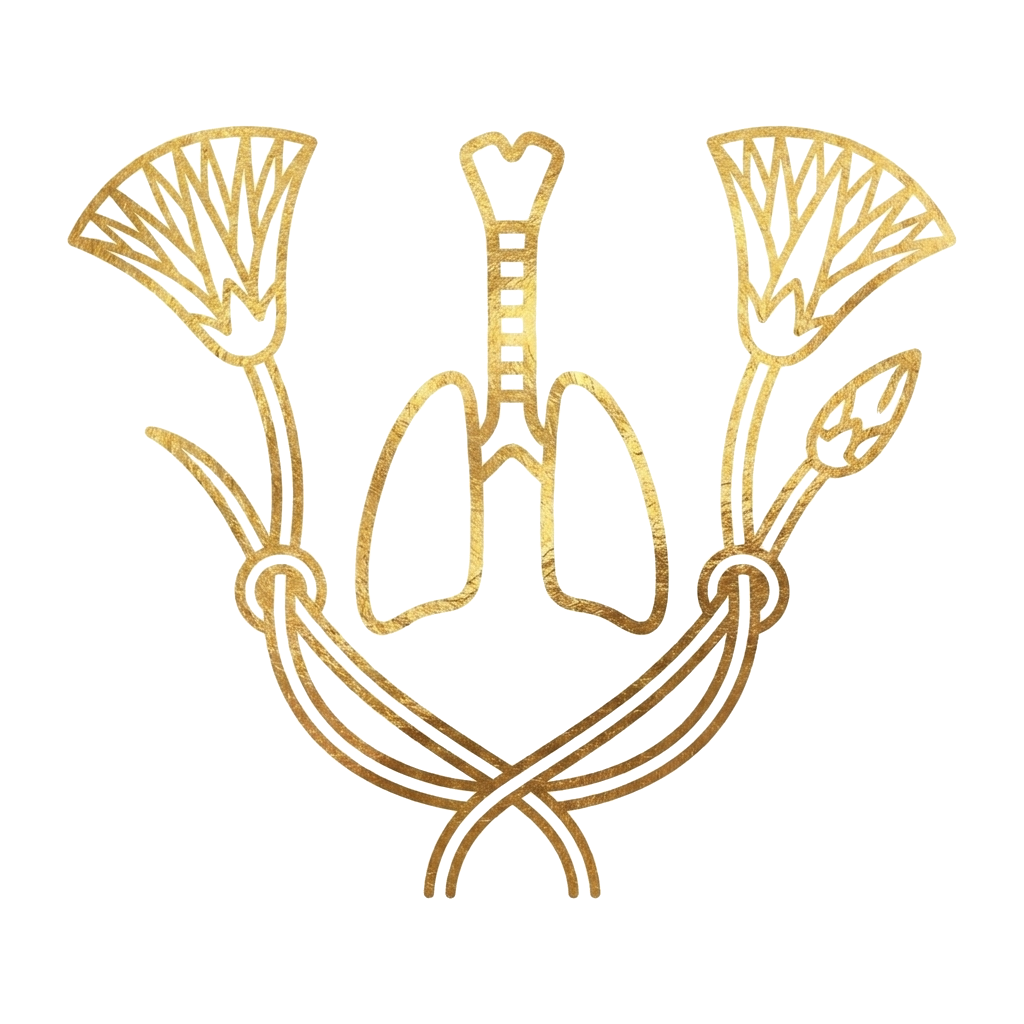
Sema-tawy is the Egyptian 'Uniter of the Two Lands' — a windpipe-and-lungs hieroglyph (Gardiner F36) with papyrus and lotus stems knotted around it, rendering the union of Lower and Upper Egypt as one breath through one throat.
About Sema-Tawy
Sema-tawy means 'the uniter of the Two Lands.' It is both a title the pharaoh bore and a symbol carved into his throne, his tomb, his coffin, and the pedestals of his colossal statues. The image is specific. A central windpipe-and-lungs hieroglyph — the sign Alan Gardiner catalogued as F36, read smꜣ, 'to unite' — stands at the centre. Around it a papyrus stem and a lotus (or lily) stem are knotted together, their long flexible stalks looping around the windpipe and tying in the middle. The papyrus is Lower Egypt, the marshy Nile Delta. The lotus is Upper Egypt, the narrow green valley south of Memphis. Knotting the two plants around the windpipe renders 'the two lands are joined in one breath' as a single readable picture.
The sema-tawy sign was one of the most persistently reproduced images in Egyptian royal iconography, from Sneferu in the Fourth Dynasty (c. 2613–2589 BCE) down to the Roman-period temple decoration at Dendera and Edfu. It was worked in gold, carved in granite, painted on linen, incised onto scarabs, and embroidered on ritual garments. It sits on the side of the throne on Khafre's diorite statue from Giza. It appears on Senusret I's White Chapel at Karnak. It is carved on the lower bodies of Colossi of Memnon and on the base of nearly every standing royal statue at Karnak and Luxor. Wherever the pharaoh's body was rendered in stone at full scale, the sema-tawy appeared at thigh level to state what that body stood for: one king, one breath, two lands.
This page covers the hieroglyphic structure of the sign, the political theology it encoded, the ritual at the coronation that enacted it, the divine figures who performed the binding (twin Hapis, Horus and Set, Thoth), and the comparative tradition of knot-unification symbolism.
Visual Description
The sema-tawy is a composite sign with three interlocking parts. At the centre is the smꜣ hieroglyph (Gardiner F36), which shows a windpipe rising vertically into a pair of lungs at the top — a stylised anatomical drawing of the lung-and-trachea assembly as seen from behind, with the lungs forming the two rounded lobes above a narrower vertical stem. The sign reads phonetically as smꜣ and semantically as 'to unite' or 'to join.'
To either side of the windpipe a plant rises. On the side of Lower Egypt (usually drawn on the heraldic north, viewer's left in most royal contexts) a papyrus (Cyperus papyrus) stem rises with its triangular umbel of fine radiating fronds. On the side of Upper Egypt (heraldic south, viewer's right) a lotus or lily rises with its bell-shaped flower. In some variants the Upper Egyptian plant is specifically the sedge (sut) rather than the lotus; the plant-species varies more than modern summaries admit, but the heraldic function is stable: one plant per land.
The two stems then perform a double-helix wrap around the central windpipe. They cross in front, curl back behind, and tie in a single symmetrical knot at the centre. The knot is drawn so it reads as a genuine tied knot, not a decorative bow, with the visible under-and-over crossings. In more elaborate versions two Hapi figures (twin river-gods, one wearing papyrus on his head, one wearing lotus) flank the central composition and physically hold the stems, pulling them tight. In other versions Horus and Set stand in the Hapi-position, sometimes cooperating, sometimes with Set subdued. The thrones of Senusret I, Amenhotep III, Ramesses II, and many others carry this fuller tableau on their side panels.
Esoteric Meaning
The central move of the sema-tawy is rendering political unity as a single physiological fact. The Egyptians did not say 'the two lands are administered together.' They said 'the two lands share one windpipe,' meaning the two kingdoms breathe through a single throat, and that throat is the pharaoh's. The image is a piece of body-politics in the most literal sense: the king's anatomy is the anatomy of the state.
This is why the knot is load-bearing. A knot is a fastening that can in principle be untied, so the sema-tawy never pretends the two lands are the same land. It shows them as two distinct plants brought into one breath by an act of binding. Maintaining the knot is the pharaoh's continuous ritual work; if the knot fails, the lands separate, the breath stops, and order (Maat) collapses back into chaos. The image contains its own anxiety: the possibility of untying.
Comparative knot-unification symbolism exists in other traditions but usually names a smaller thing. The Jewish kesher of the tefillin binds sacred text to the body of the individual worshipper. The Hindu mangalsutra binds two lives in marriage. The Buddhist endless knot binds the intertwined threads of cause and effect. The sema-tawy binds two political geographies, two plant species, one windpipe, and one cosmology. Its scale and specificity are distinctive.
The placement of the sign is also significant. On statues, the sema-tawy appears at thigh level, on the side of the throne or plinth, at the height of the seated king's knees. This is the place where the king's body becomes the state's body — not at the head, not at the heart, but at the supporting structure. The king's legs are the pillars on which the land stands, and the sema-tawy between them identifies what those legs carry.
Exoteric Meaning
At its plainest the sema-tawy is a statement that Egypt is one country. Before unification, around 3100 BCE, Upper and Lower Egypt were separate kingdoms with separate royal traditions, separate patron goddesses (Nekhbet the vulture for the south, Wadjet the cobra for the north), separate crowns (the white Hedjet and the red Deshret), and separate heraldic plants (lotus or sedge for the south, papyrus for the north). The traditional narrative credits Narmer or Menes with the military unification of both kingdoms around the First Dynasty; the sema-tawy is the visual shorthand for the political fact that followed.
Across three thousand years the sign kept appearing because the concern it addressed never went away. Egypt repeatedly fragmented — at the end of the Old Kingdom, during the Second Intermediate Period when the Hyksos held the north, during the Third Intermediate Period when it split again — and each restoration of pharaonic power reinstalled the sema-tawy as the visual declaration that the two lands were breathing through one throat once more. Under the Ptolemies and the Roman emperors, who were foreign rulers whose claim to Egypt depended heavily on pharaonic iconography, the sema-tawy appears even more frequently on the statues and temples commissioned in their names.
On a more everyday level, the sign was also a heraldic motif on furniture, coffins, and personal jewelry. Scarabs from the Middle Kingdom carry miniature sema-tawys. Coffin sides painted in the standard New Kingdom funerary style feature it at the base. The motif moved between monumental political statement and domestic decorative pattern without changing its basic meaning.
Usage
The sema-tawy saturated Egyptian royal material culture.
On royal statues, the sign appears carved into the sides of thrones and plinths at thigh level. Khafre's diorite enthroned statue from Giza (Fourth Dynasty, Cairo Museum) carries a sema-tawy on each side of the throne, with the simple two-plants-tied-around-the-windpipe version. Senusret I's White Chapel at Karnak (Twelfth Dynasty, reassembled in the Open Air Museum at Karnak) carries a detailed sema-tawy with twin Hapi figures. The Colossi of Memnon at Thebes (Amenhotep III, Eighteenth Dynasty) both have sema-tawy reliefs on the thrones. Ramesses II placed the sign throughout his building programme, most notably on the thrones of the seated colossi at Abu Simbel and on the lower body panels of his colossi at the Ramesseum. On Tutankhamun's perfume vase (Cairo Museum, JE 62114), the sema-tawy is rendered in its fullest late form with twin Hapi gods binding the plants.
In coronation ritual, the sema-tawy was enacted, not just shown. Egyptian coronation had several phases; the second phase was the Sema-tawy proper, in which priests acting as Horus (from the north) and Set (from the south), or as twin Hapis, tied the papyrus and lotus stems around a ceremonial windpipe-sign in the king's presence and proclaimed him the uniter of the two lands. The text of this rite appears in the Ramesside-period Dramatic Text of Memphite Theology and is alluded to in multiple coronation reliefs; the best-preserved visualisations are the reliefs at the temple of Seti I at Abydos and the interior scenes of the Ptolemaic temple at Edfu.
On scarabs and smaller objects, Middle Kingdom scarabs frequently carry a simplified sema-tawy as a protective and politically affirming emblem. A published example in the Metropolitan Museum of Art (accession 22.1.211, Middle Kingdom) shows the sign compressed onto a standard scarab base-plate. Personal coffins, cosmetic vessels, and linen funerary shrouds carry the motif throughout the New Kingdom.
In temple architecture, the sema-tawy is most commonly placed on the lower courses of pylon reliefs and on dado-height wall registers where human-scale reliefs meet the viewer. At Karnak, Luxor, Edfu, Dendera, and Philae, dado bands along the exterior and interior walls carry repeated sema-tawy reliefs as a continuous visual incantation of royal unity.
In Architecture
Egyptian architects used the sema-tawy as a placed statement rather than a structural element. It appears at specific heights and on specific surfaces that signal the king's body at full scale.
On throne plinths and statue bases, the sign is almost universal from the Fourth Dynasty onward. Khafre at Giza, Menkaure's triads, the many Senusrets and Amenemhats of the Middle Kingdom, the Thutmosids and Amenhoteps of the Eighteenth Dynasty, and the long Ramesside sequence all feature the sema-tawy on throne sides. Placing it at thigh level reads the king's seated body as the state body; the sign sits where the king's legs would rest if he were actually seated on his stone double.
On temple pylons, the sema-tawy appears at the base of large smiting-scenes, with the bound Nine Bows (Egypt's traditional enemies) carved below and the sema-tawy carved beside or above them. The message is heraldic: the king binds the enemies and binds the two lands in the same gesture.
On dado-registers inside temple courts, the sema-tawy can be repeated as a continuous horizontal band at knee-height around the room, sometimes alternating with the ankh or the djed. The temples of Dendera, Edfu, and Philae — all Ptolemaic or Ptolemaic-to-Roman — have the most densely repeated dado versions. A worshipper entering the room walks past a continuous visual recitation of 'unite, unite, unite' at their own knee level.
On royal barques and ceremonial furniture, the sema-tawy appears on painted wood panels of royal chariots, on the inlaid backrests of thrones (Tutankhamun's golden throne carries a small sema-tawy on the side), and on the sides of funerary sledges. The sign was portable because the theology was portable: wherever the king's body was, there the two lands were joined.
Significance
Political theology. The sema-tawy is the single most compact Egyptian statement of royal ideology. One king, one windpipe, two plants knotted in the middle, two lands breathing together. The sign does the same work as long coronation liturgies, done in a picture. The Egyptologist Jan Assmann in The Mind of Egypt (Metropolitan Books, 2002) argues that Egyptian political theology is best read through its symbolic compressions rather than through its narrative myths, and the sema-tawy is his lead example.
The knot as institution. Choosing a knot as the sign of unity is a theological commitment. A knot is a human act, performed on available materials, capable of being tied and untied. The sema-tawy therefore acknowledges that Egyptian unity is constructed, not natural. The lotus does not grow next to the papyrus. They are brought together by the pharaoh's continuous ritual maintenance of the knot. If the king fails, the knot slips. The Egyptologist Vincent Davis in Pharaonic Regalia: Royal Iconography of the New Kingdom reads the sign as 'the most honest piece of state iconography any ancient civilisation produced' precisely because it admits its own contingency.
The Hapi performers. When twin Hapi figures perform the binding, the sema-tawy takes on hydraulic-political overtones. Hapi is the Nile flood; his twin form represents the Nile at Elephantine (Upper Egyptian source) and the Nile in the Delta (Lower Egyptian dispersal). The river binds the two lands into one breath — the political knot is also the geographical knot. When Horus and Set perform the binding, the sign registers a mythological reconciliation: Horus (Lower Egypt) and Set (Upper Egypt) as former adversaries now cooperating to hold the state together. Different royal programmes chose different binders for different ideological purposes.
Comparative political symbolism. Other ancient states produced images of unity, but few are as anatomically specific. The Roman fasces bundles sticks around an axe to signal authority-by-consolidation. The American Great Seal shows a bald eagle holding arrows and an olive branch. The Habsburg double-headed eagle places two heads on one body. None of these chose an internal organ as the sign of union. Egypt placed the windpipe at the centre because the windpipe is where breath happens, and one country breathes through one throat. The specificity is part of the point.
Modern reception. The sema-tawy appears in modern Egyptian national symbolism and in neo-Kemetic religious practice. It has also been adopted by reconstructionist polytheist groups as a ritual emblem of integration, though the political content of the original is usually dropped in those uses.
Connections
Deities. Hapi, the Nile flood god, is the most common binder of the sema-tawy; when shown in twin form (Upper and Lower Egyptian Hapis), he physically ties the papyrus and lotus around the windpipe. Horus and Set sometimes take the Hapi role, with Horus representing Lower Egypt and Set Upper Egypt, cooperating despite their mythological enmity. Thoth, the scribe of the gods, occasionally performs the binding as the divine administrator of the cosmic order. Osiris as the dead king whose son Horus inherits the living throne sits behind the whole scheme.
Texts. The Ramesside-period Dramatic Text of Memphite Theology describes the sema-tawy coronation rite. The Pyramid Texts include utterances that address the king as uniter of the two lands. Coronation scenes in the temple of Seti I at Abydos and in the Edfu Temple preserve fully illustrated versions of the ritual. Herodotus in Histories Book 2 describes aspects of Egyptian kingship that reflect the sema-tawy theology without naming the sign.
Other symbols. The Pschent (double crown) is the sema-tawy's counterpart on the head: where the sema-tawy binds the two lands at thigh level with knotted plants, the pschent binds them at the head level with fitted crowns. The uraeus and vulture of the Two Ladies (Nebty) title function in parallel as the brow-level binders. The ankh often accompanies the sema-tawy in reliefs to add the dimension of 'life' to 'unity.' The djed pillar appears paired with the sema-tawy in royal funerary contexts, contributing the vertical stability to the horizontal binding.
Further Reading
- Richard H. Wilkinson, Reading Egyptian Art: A Hieroglyphic Guide to Ancient Egyptian Painting and Sculpture (Thames & Hudson, 1992). Detailed entry on the sema-tawy sign and its iconographic variants.
- Jan Assmann, The Mind of Egypt: History and Meaning in the Time of the Pharaohs (Metropolitan Books, 2002). Reads Egyptian political theology through its symbolic compressions; the sema-tawy is a lead example.
- Alan Gardiner, Egyptian Grammar (3rd ed., Oxford, 1957). Catalogues F36 (smꜣ) and its compound uses, including sema-tawy.
- Toby Wilkinson, Early Dynastic Egypt (Routledge, 1999). Treatment of the First-Dynasty consolidation narrative that the sema-tawy later encoded.
- Aidan Dodson & Dyan Hilton, The Complete Royal Families of Ancient Egypt (Thames & Hudson, 2004). Coronation ritual and the pharaoh's titulary, including the sema-tawy's role.
- Barry Kemp, Ancient Egypt: Anatomy of a Civilization (2nd ed., Routledge, 2006). Political theology and the visual programme of royal consolidation; sema-tawy discussed throughout.
- Emily Teeter, The Presentation of Maat: Ritual and Legitimacy in Ancient Egypt (University of Chicago Press, 1997). Coronation ritual context and the sema-tawy's place in it.
Frequently Asked Questions
What does the Sema-tawy symbol mean?
Sema-tawy means 'the uniter of the Two Lands' in ancient Egyptian. It is a composite hieroglyphic image showing a windpipe-and-lungs sign (read 'sema,' meaning 'to unite') with a papyrus stem and a lotus or sedge stem knotted around it. The papyrus represents Lower Egypt, the marshy Nile Delta in the north; the lotus or sedge represents Upper Egypt, the narrow green valley in the south. Tying the two plants around the windpipe produces a single readable picture that says 'the two kingdoms breathe through one throat' — that throat being the pharaoh's. The sign appears throughout Egyptian royal art from the Fourth Dynasty (c. 2600 BCE) down to the Roman period, most often on the sides of throne plinths at thigh-level on royal statues, on temple dado registers, and on coronation reliefs.
What plants are shown in the Sema-tawy?
The papyrus (Cyperus papyrus) and the lotus or lily (Nymphaea caerulea or Nymphaea lotus), with some variants substituting the sedge (sut) for the lotus on the Upper Egyptian side. The plant choice is heraldic: one plant per land. Papyrus grew in the marshy Nile Delta of Lower Egypt, and its triangular umbel of fine radiating fronds was the heraldic plant of the north. The lotus (or sedge) stood for the valley of Upper Egypt in the south. The two plants are shown with long flexible stems that cross, loop, and tie in a symmetrical knot around the central windpipe hieroglyph. In the fullest New Kingdom and later versions, two Hapi figures — twin river-gods wearing papyrus and lotus respectively on their heads — flank the composition and physically pull the stems tight. In other versions Horus and Set perform the binding in their place.
Why is the Sema-tawy drawn with a windpipe?
Because the windpipe-and-lungs hieroglyph is the sign smꜣ, which means 'to unite' or 'to join.' Alan Gardiner catalogued it as F36. The sign shows a vertical trachea rising into two rounded lungs at the top, read as an anatomical image of the breathing apparatus seen from behind. The Egyptians chose this sign as their writing for 'to unite' because the lungs-and-trachea assembly is itself a unification: two lungs joined by one throat. Placing the windpipe at the centre of the sema-tawy and knotting the two plants around it renders political unity as a single physiological fact: the two lands share one breath through one throat, and that throat is the pharaoh's. The anatomical specificity is part of the theology — Egyptian royal ideology treated the king's body as the state's body, and the sema-tawy made the identification visible.
Where can I see the Sema-tawy in surviving Egyptian art?
Almost everywhere major royal monuments survive. Khafre's diorite enthroned statue from Giza (Fourth Dynasty, Cairo Museum) carries a classic sema-tawy on the throne sides. Senusret I's White Chapel at Karnak, reassembled in the Open Air Museum, has a detailed sema-tawy with twin Hapi figures. The Colossi of Memnon at Thebes and the seated colossi of Ramesses II at Abu Simbel and the Ramesseum all feature the sign on their throne panels. Tutankhamun's gold throne and his perfume vase (Cairo Museum, JE 62114) carry sema-tawys in their fullest late form. Middle Kingdom scarabs with compressed sema-tawy designs are common in museum collections, including in the Metropolitan Museum of Art and the British Museum. Temple dado registers at Karnak, Luxor, Edfu, Dendera, and Philae show the sign repeated as a continuous horizontal band. The sign is so widespread that absence of it from a major royal monument would be more surprising than its presence.