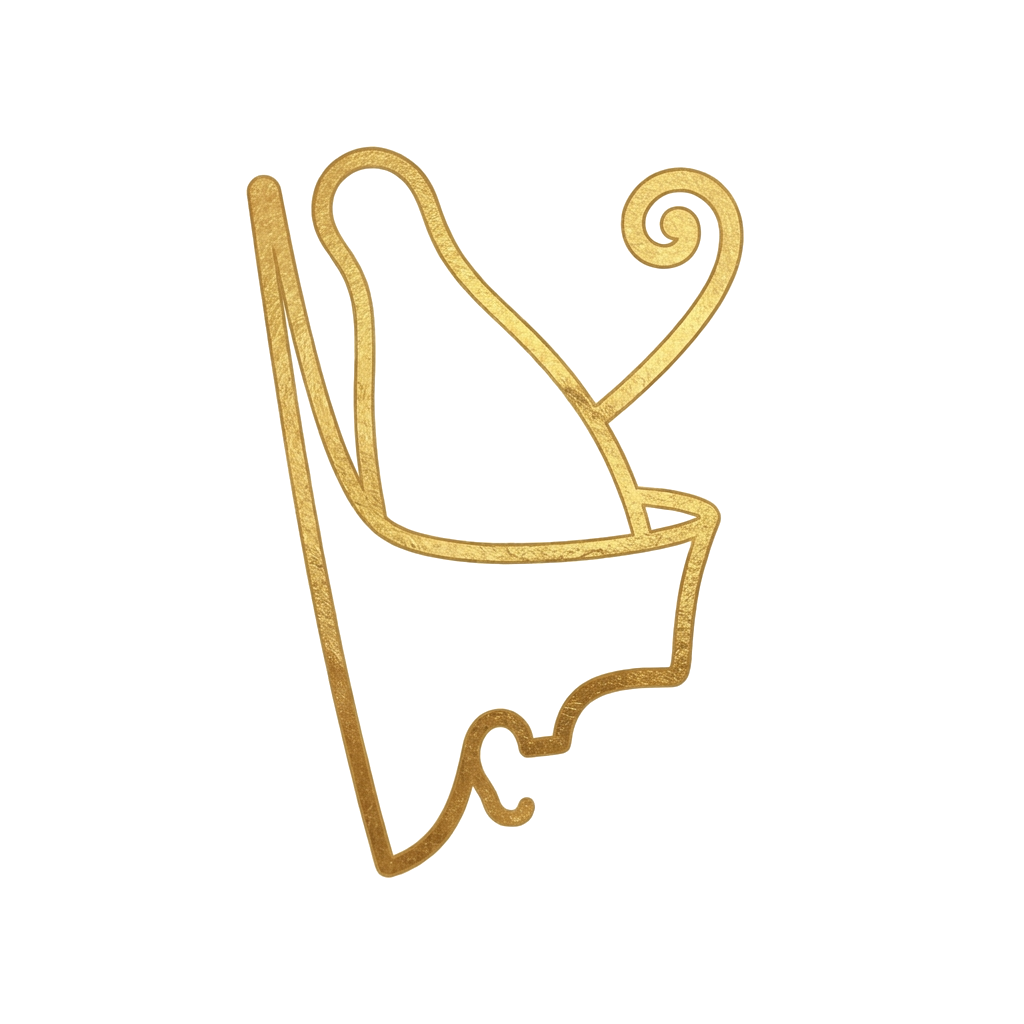
Pschent
The double crown of unified Egypt: white Hedjet of the south fitted into red Deshret of the north, declaring two lands one head, worn from the First Dynasty to the Ptolemies and never once recovered as an object.
About Pschent
The Pschent is the Egyptian double crown: a tall white cone fitted inside a red mortar, worn by pharaohs to declare that two countries had become one head. The Egyptians themselves called it pꜣ-sḫm.ty, the Two Powerful Ones, a dual noun built from sḫm, meaning 'powerful.' Greek writers rendered it as pschent, the spelling that has stuck in modern usage.
It is the visible answer to a political question. Egypt was always two places. Upper Egypt was the long, narrow river valley running south. Lower Egypt was the fan of marshland where the Nile broke into branches and met the sea. Each had its own crown, its own patron goddess, its own emblem-plant, its own founding city. The Pschent is the moment those two crowns are forced to share a skull.
No physical Pschent has ever been found. Not one. Every claim about how it looked, what it was made of, and how it sat on the head comes from sculpture, relief, painted scenes, and inscription. That gap between rich depiction and total material absence is one of the more arresting facts in Egyptian regalia studies, and it is part of what this page is about.
This page covers the assembly logic, the dynastic origin and the long Narmer Palette debate, the wearer-list and surviving depictions, the Two Ladies attached to the crown, the sed-festival ritual, the comparative question of how other cultures handled unifying-headdress problems, and the modern reception of the most recognizable piece of pharaonic regalia.
Visual Description
The Pschent is a composite crown. The Hedjet, the white crown of Upper Egypt, is a tall conical bulb that tapers to a rounded knob. The Deshret, the red crown of Lower Egypt, is a flat-bottomed basket that rises sharply at the back into a square wall, with a thin wire-like stem that curls up and forward at the front. In the Pschent, the white Hedjet is fitted inside the red Deshret so the cone rises out of the basket and the curling stem of the Deshret continues to project from the brow.
That curling stem is the most distinctive single element. Some scholars read it as a stylised plant, papyrus or reed, fitting the Delta marshes of Lower Egypt. Older popular literature reads it as the proboscis of the honey bee, the insect that titles the Lower Egyptian king as nsw-bity. The curl carries either reading; the depictions do not settle the question.
When the Two Ladies are shown attached to the crown, they sit at the brow: Wadjet as a rearing cobra (the uraeus) and Nekhbet as a vulture, side by side. Not every depiction includes both. The cobra alone is more common; the vulture is sometimes carried separately on the king's headcloth or held in the talons of an overhead emblem.
Color in surviving depictions follows convention rigidly. White is white plaster or limestone. Red is the iron-red ochre used for Lower Egyptian regalia. In painted reliefs the join between the two halves is left visible. The artist does not pretend the crown is one piece.
Materials are inferred, not known. Where any Egyptian source touches on the construction of crowns, the description is of weaving and basket-work — plant fiber, felt, leather, perhaps a stiffened linen frame. Nothing has survived. The most famous royal burials, including the intact tomb of Tutankhamun, contained no Pschent. What Carter found among Tutankhamun's regalia were headcloths (including the Nemes preserved on the famous gold mask), a beaded skullcap, gold diadems, and a sheshed-circlet — but no Pschent and no other physical crown object. The Khepresh and other crown types appear on Tut only in painted and sculpted depictions; no original example of any Egyptian royal crown has ever been recovered.
Esoteric Meaning
The Pschent is the political theology of unified opposites worn at the head. The king does not stand between the two lands; he is the place where they meet. The crown is not a symbol pointing to unification. The crown is the unification, performed every time the king puts it on.
This matters for how Egyptian kingship understood itself. Maat, the order the king is sworn to maintain, is not the suppression of one half by the other. It is the holding of complementary polarities in a single integrated form. Red and white, marsh and valley, Set's old territory and Horus's old territory, the cobra and the vulture: none of these are erased by the Pschent. They are stacked.
The king as Horus is the working principle. In the Osiris cycle, the country was fragmented and contested between Horus and Set; the resolution was a judgment that gave Horus the whole. The pharaoh wearing the Pschent is the living continuation of that resolution. He carries on his head the daily proof that the fragmentation is being held.
Other cultures faced the same problem and produced their own integrated-headdress solutions. The Achaemenid Persian king wore the kidaris, an upright cylindrical tiara, often combined with a diadem ribbon; only the king could wear them paired, and the pairing functioned as a portable declaration of sovereignty over a multi-ethnic empire (see the upright tiara studies catalogued in the Encyclopaedia Iranica). In Rome, no single emperor's crown collected the corona civica and corona muralis into one object, but emperor-portraits could combine the radiate crown of Apollo with the laurel of the triumphator and the oak of the civic-savior, a portrait-grammar that worked the same political shorthand. The Pschent is the earliest and most literal of these: two distinct crowns physically nested.
Exoteric Meaning
Royal regalia. Coronation insignia. Public token of pharaonic authority over the whole country. When the Pschent appears on a relief, it is shorthand for 'this scene is the king at full claim, ruling all of it.'
Usage
The Pschent's working life is ceremonial and representational. It appears in coronation, in formal court scenes, in monumental statuary, in reliefs of the king before deities, and in the sed-festival jubilee where the king's continued rule was renewed.
The earliest secure depiction is on a rock inscription showing the Horus-name of Djet, a First Dynasty king (c. 2980 BCE), wearing the double crown. This is the first time the two crowns appear as a fused composite rather than as a pair worn separately.
The Narmer Palette (c. 3100 BCE, Egyptian Museum, Cairo) is older and more famous, but it does not show the Pschent. It shows Narmer wearing the Hedjet on one face and the Deshret on the other. Many introductory sources flatten this into 'Narmer wore the double crown.' He didn't. The palette is the moment one king is shown in both crowns, the conceptual ground out of which the Pschent later grew, but the Pschent itself is not yet there.
King Den, fourth king of the First Dynasty, is the figure tied to the political naming. Den was the first to use the title 'King of Upper and Lower Egypt' (nsw-bity), and his ivory 'Year Label' or 'Sandal Label', also called the MacGregor Plaque, from his tomb at Abydos, shows him in a smiting pose with regalia widely read as the earliest depiction of a paired or proto-Pschent double crown. The label commemorates 'the first occasion of smiting the East.'
A Fourth Dynasty relief of Sneferu at Wadi Maghara in Sinai (now Egyptian Museum, Cairo) shows the god Horus wearing the Pschent in fully developed form, standing opposite the king on a serekh that holds Sneferu's Horus name (Nebmaat). The crown is fully formed by the Old Kingdom, even when worn here by the god rather than the king. By the Old Kingdom the crown is standard royal iconography. It appears across the New Kingdom on monumental statuary, most famously on the four colossal seated Ramesses II figures at the entrance of the Great Temple of Abu Simbel, each twenty meters tall, each wearing the double crown.
The golden throne of Tutankhamun (Egyptian Museum, Cairo) does not show the king in the Pschent. Tutankhamun on the throne-back wears a composite headdress with sun disk and feathers. But the arms of the throne are formed as winged uraei, each rearing cobra crowned with the Pschent, guarding the cartouche. The double crown is the protective royal symbol the cobras are wearing on the king's behalf.
In the sed festival, the jubilee that renewed the king's rule after thirty years, the crowning was sequential and theatrical. The king was crowned first with the Hedjet of Upper Egypt, then with the Deshret of Lower Egypt, then ran a ritual circuit and was carried in procession to the chapels of the gods of both lands. The festival is read as a re-enactment of the original unification, the ritual of becoming the Pschent rather than just wearing it.
In Architecture
The Pschent appears across Egyptian temple and tomb architecture in three main contexts: monumental statuary at temple entrances, wall reliefs of the king before deities, and royal portraits in the inner sanctuaries.
The four colossal seated statues of Ramesses II at the facade of the Great Temple of Abu Simbel are the most-photographed examples. They are twenty meters tall, each in the double crown, dating to roughly the 24th year of his reign (c. 1265 BCE). At Karnak and Luxor, Pschent-wearing king figures appear in formal court and offering scenes across the New Kingdom. At Abydos, the temple of Seti I includes Pschent depictions in the king-list chamber and offering halls. The Ptolemaic temples at Edfu and Dendera continue the Pschent on their carved kings into the last centuries BCE, even as the rulers themselves were Macedonian Greek by descent.
In smaller-scale architecture, the crown appears in offering scenes on shrine walls, on the sides of royal sarcophagi, and on the doorjambs and lintels of private tombs whose owners served the king. The composite is also a hieroglyph in its own right, used as a determinative for words connected to kingship and the unified country.
Significance
Political ideology of unification. The Pschent is the most concentrated expression of the founding political claim of the Egyptian state: that the two lands are one. The country is structurally dual. The king's titulary names him 'King of Upper and Lower Egypt' (nsw-bity); his Two Ladies name (nebty) lists his Upper and Lower patron goddesses; his crown stacks the Upper and Lower crowns physically. None of these are decorative redundancy. They are the same claim made in three different registers (name, patronage, regalia), so the unification is repeated every time the king is referred to or depicted.
Religious meaning: the king as Horus. The mythological backbone is the Osiris cycle. Set fragmented Egypt; the gods awarded the whole back to Horus, son of Osiris. The living king is Horus on the throne. The Pschent on his head is the visible token of that judgment carried in a body. To remove the crown, in this logic, is to refragment the country. To wear it daily is to keep the verdict standing.
The Two Ladies titulature. One of the five great names of every pharaoh from at least Semerkhet (First Dynasty, c. 2920 BCE) onward was the Nebty name, meaning 'He of the Two Ladies.' It formally placed the king under the joint protection of Wadjet, the cobra goddess of the Delta city of Per-Wadjet (Greek Buto), and Nekhbet, the vulture goddess of the Upper Egyptian city of Nekheb (Greek El-Kab). The Pschent is the visible ground of this titulature. When the Two Ladies appear at the brow of the crown, cobra and vulture together, the king's name and the king's headgear say the same sentence at once.
Comparative integrated-headdress traditions. The political problem of ruling two or more peoples through one head is not unique to Egypt, and the responses are worth comparing. The Achaemenid Persian king wore the kidaris, an upright tiara, paired with a diadem ribbon. Only the king could legally wear them paired, and the pairing functioned as a portable declaration of multi-ethnic sovereignty. Roman emperor-portraits stacked oak (corona civica), laurel (triumphal), and sun-rays (corona radiata) into single image-grammars without ever forging them into one literal crown. Medieval European kings collected separate crowns for separate kingdoms; the Habsburgs accumulated the Holy Roman, Hungarian, and Bohemian crowns as a set, not a stack. The Pschent is the strictest of these solutions: not a portrait-grammar, not a collection, but two crowns physically nested into one.
Modern reception. The Pschent survives in the modern imagination through Egyptomania, the wave of European fascination that followed Napoleon's 1798 to 1801 campaign and the publication of the Description de l'Égypte (1809 to 1826), and the second wave that followed Howard Carter's opening of Tutankhamun's tomb in 1922. It became one of the standard visual quotations for 'pharaoh' in nineteenth- and twentieth-century painting, opera (Aida), film (every Hollywood Egypt from the 1950s onward), advertising, and museum display. The crown is rarely identified by its Egyptian name in popular use; people recognize the silhouette long before they know what it is called.
Modern Egyptian state symbols, by contrast, do not use the Pschent. The Republic's coat of arms centers on the Eagle of Saladin, drawing from Arab-Islamic rather than pharaonic heritage, a deliberate political choice that has been periodically debated. The Pschent stayed in the museum, where it functions as the most legible single image of the long political idea that made Egypt Egypt: two lands, one head.
Connections
Deities. Horus is the primary connection: the living king is Horus, and the Pschent is the visible proof of Horus's judgment-won kingship over the unified country. Wadjet (cobra of Lower Egypt) and Nekhbet (vulture of Upper Egypt) are the Two Ladies attached to the brow of the crown and named in the king's nebty titulary. Set sits in the background as the original fragmenter and, in earlier periods, the patron of the Lower-Egyptian Deshret context; the asymmetry of his role across dynasties is a separate study. Osiris is the throne the king inherits; the Pschent is what the heir wears once the inheritance is sealed.
Texts. The Pyramid Texts contain crown-utterances in which the Red Crown and the White Crown are addressed and identified with the Eye(s) of Horus (Utterance 56 and others). This is the textual ground that Katja Goebs's monograph reconstructs in detail. The Coffin Texts extend crown-imagery to non-royal deceased, who in turn assume crowns to be transfigured. The Egyptian Book of the Dead continues the line.
Other symbols. The uraeus is the rearing cobra at the brow, Wadjet in person, almost always present on the Pschent. The Atef is the parallel composite crown worn by Osiris (Hedjet plus ostrich plumes), the funerary mirror of the Pschent's political composite. The ankh appears in the king's hand in the same reliefs that show the Pschent on his head: life held by the ruler of two lands. The djed pillar behind the throne is the stability that the crowned king is sworn to maintain. The cartouche encircles the king's name; the Pschent crowns the king who wears that name.
Further Reading
- Goebs, Katja. Crowns in Egyptian Funerary Literature: Royalty, Rebirth, and Destruction. Griffith Institute Monographs. Oxford: Griffith Institute, 2008. The standard scholarly treatment of crown-ideology in the Pyramid and Coffin Texts.
- Wilkinson, Toby A. H. Early Dynastic Egypt. London: Routledge, 1999. The standard reference on Djet, Den, and the First Dynasty regalia material.
- Wilkinson, Richard H. Reading Egyptian Art: A Hieroglyphic Guide to Ancient Egyptian Painting and Sculpture. London: Thames & Hudson, 1992. Includes the Pschent and its component crowns as iconographic signs.
- Wilkinson, Richard H. Symbol and Magic in Egyptian Art. London: Thames & Hudson, 1994. Companion volume on symbolic structure.
- Hornung, Erik. Conceptions of God in Ancient Egypt: The One and the Many. Translated by John Baines. Ithaca: Cornell University Press, 1982. Background on the king-as-Horus theology that the Pschent makes visible.
- Bonnet, Hans. Reallexikon der ägyptischen Religionsgeschichte. Berlin: De Gruyter, 1952. Standard German-language lexicon; entries on Doppelkrone, Hedjet, Deshret.
- Dodson, Aidan, and Dyan Hilton. The Complete Royal Families of Ancient Egypt. London: Thames & Hudson, 2004. Reference for wearer-attestation across dynasties.
- Schulz, Regine. 'Sculpture.' In A Companion to Ancient Egyptian Art, edited by Melinda K. Hartwig, 192 to 218. Boston and Oxford: Wiley-Blackwell, 2015. On royal statuary and the conventions for depicting the regalia.
Frequently Asked Questions
What does the double crown of Egypt symbolize?
The Pschent symbolizes the unification of Upper and Lower Egypt under one ruler, and more strictly, it performs that unification rather than just pointing to it. Egypt was structurally two countries: the long river valley to the south (Upper Egypt, whose crown was the white Hedjet) and the marsh delta to the north (Lower Egypt, whose crown was the red Deshret). The Pschent fits the white cone inside the red basket so both crowns are worn at once on a single head. The Egyptian name pꜣ-sḫm.ty means 'the Two Powerful Ones,' a dual noun that names the crown by its doubleness. Wearing it was the visible answer to the founding political claim that the two lands are one. Every depiction of a king in the Pschent is a re-statement of that claim.
Why has no original Pschent ever been found?
No physical Pschent has survived, despite tens of thousands of depictions across three thousand years of Egyptian art. There are two main scholarly explanations. The first is materials. The crown was almost certainly built from perishable plant fiber, felt, leather, or stiffened linen, woven like a basket and reinforced. None of those materials survive Egyptian burial conditions reliably. The second is custodial. Regalia of this rank may have been considered too sacred to bury with a single king. It would have passed from ruler to ruler, or been ritually destroyed at the end of a reign rather than committed to a tomb. Tutankhamun's intact burial included diadems and headcloths but no Pschent. Either way (perished or never buried), what we have are sculptures, reliefs, painted scenes, and inscriptions. The crown exists only as image.
Did Narmer wear the Pschent on his palette?
No. This is one of the most common misreadings in introductory Egyptology. On the Narmer Palette (c. 3100 BCE, Egyptian Museum, Cairo) Narmer wears the white Hedjet of Upper Egypt on one face and the red Deshret of Lower Egypt on the other. He wears them separately, on opposite sides of the same object. He does not wear them stacked. The palette is the conceptual ground from which the Pschent later grew, the moment one king is shown in both crowns, but the composite double crown itself is not yet there. The earliest secure depiction of the fused Pschent is on a rock inscription showing the Horus-name of King Djet, several reigns later in the First Dynasty, around 2980 BCE.
What's the difference between the Pschent, the Atef, and the Khepresh?
All three are royal headgear with different functions. The Pschent is the political crown (Hedjet of Upper Egypt fitted into Deshret of Lower Egypt), declaring rule over the unified country. The Atef is Osiris's crown, the funerary and ritual composite: a Hedjet flanked by two ostrich plumes, sometimes with ram horns and sun disk added. Pharaohs wore the Atef in religious and underworld contexts where the king was acting on the Osiris pattern. The Khepresh is the blue crown, also called the war crown or court crown: a tall blue cap covered with small golden discs or sequins, dominant in the New Kingdom for military, formal court, and chariot scenes. The Nemes is not a crown at all but the striped cloth headdress most familiar from Tutankhamun's gold mask. Pschent for unified rule, Atef for Osirian ritual, Khepresh for power-in-action, Nemes for cultic and funerary contexts.