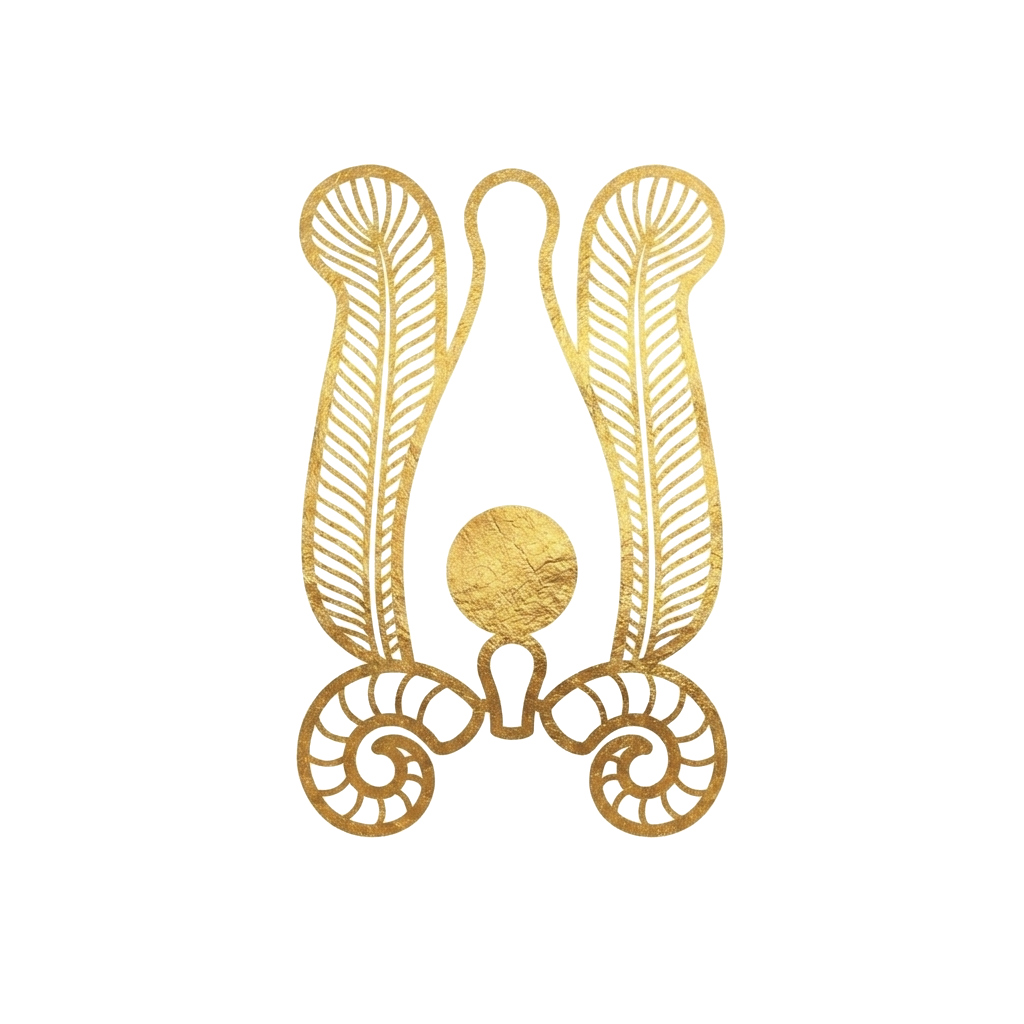
Atef Crown
The Atef is Osiris's crown — the white Hedjet of Upper Egypt flanked by two ostrich plumes, ringed by ram's horns, and topped in elaborated forms by a sun disk.
About Atef Crown
The Atef is the crown of Osiris. A tall white Hedjet rises from the brow, two long ostrich plumes flank it on either side, twin ram's horns curl outward at the base, and in elaborated forms a sun disk sits at the apex between the feathers.
No single Egyptian crown packs more theology into one object. The Hedjet is sovereignty. The plumes are Maat. The horns are the ram-soul of the dying-and-rising god. The disk is solar union. The Atef welds these into one composite ideogram and seats it on the head of the lord of the dead.
The earliest known image of the crown comes from the pyramid complex of Sahure in the Fifth Dynasty (c. 2480 BCE), where the Atef already attaches to royal funerary symbolism. By the New Kingdom, Osiris is almost never shown without it, and certain kings — Hatshepsut, Seti I, Ramesses II — wear the Atef in ritual scenes that knit the living pharaoh to Osiris's power of return. Sokar wears it. Heryshef of Heracleopolis wears it. The composite Ptah-Sokar-Osiris funerary statuettes that proliferate in the Late and Ptolemaic periods carry it on their heads as standard equipment.
The crown is also famously heavy. A tradition preserved in the Book of the Dead reports that when Osiris first put on the Atef given to him by Ra, his head swelled and burned from the weight and heat of it. The lord of the underworld sweats under his own regalia. That detail is part of the meaning, not a footnote to it.
Visual Description
A conical white crown — the Hedjet of Upper Egypt — rises from the brow as the central element. Two tall ostrich plumes flank it, one on each side, slightly curved. At the base, a pair of ram's horns curls outward laterally, often with a wavy or spiral profile rather than the tight in-curling horns of Khnum. From the New Kingdom forward, a small solar disk frequently sits at the apex between the plumes; in late forms a uraeus or pair of uraei rises from the base.
In surviving relief and statuary, the Atef is set tall — on the painted Osiris in the Seti I temple at Abydos the crown stands tall above the head, often nearly the height of the face beneath it. On three-dimensional pieces it is built up from carved stone or wood, with the plumes as separate flat elements rising on either side; bronze and faience amulets compress the same shape into a few centimeters.
When worn by Osiris, the crown sits on a head with green or black skin — the color of fresh growth and of the silt of the Nile after the flood. The body below is usually mummiform, holding the crook and flail. When worn by a king in a ritual scene, the Atef appears over a normal royal head with the false beard and the broad collar, marking that this is a moment of identification with Osiris rather than ordinary regnal display.
Esoteric Meaning
The crown as composite ideogram. Most Egyptian crowns are a single symbol — the Hedjet alone is Upper Egypt, the Deshret alone is Lower Egypt, the Nemes is the royal head-cloth. The Atef does something different. It welds four discrete sealed concepts into one piece of regalia.
Hedjet — primordial sovereignty. The white crown of Upper Egypt is the older crown. It carries the memory of the southern kingdom that conquered the north and the white-land radiance of Nekhbet. Underneath the Atef sits this claim: whoever wears it rules from the origin.
Plumes — Maat. The ostrich feather is the hieroglyph and emblem of Maat — truth, balance, cosmic order. The same feather sits opposite the heart on the scales in the judgment hall of Osiris. Doubled and lifted on either side of the head, the plumes mark the wearer as the one who weighs, not the one who is weighed.
Ram's horns — Banebdjedet, soul of Osiris. The ram horns at the base reference Banebdjedet, the ram of Mendes, whose name parses as "Ram (Ba) Lord of Djedet" — Egyptian ba meaning both "soul/manifestation" and "ram" by homophony. The Book of the Heavenly Cow names this ram as the Ba of Osiris. The Egyptian words for "ram" and "soul" sounded alike, so a ram's horn on a crown is a soul on the head — virility, generative force, the power to come back.
Sun disk — Ra-Osiris union. When the disk is added, the crown registers the nightly mystery of New Kingdom theology in which Ra and Osiris meet in the underworld at midnight and merge: Ra gives Osiris his light, Osiris gives Ra his power of regeneration, and from that union both rise. The Atef with disk shows this union worn.
The whole crown. Read together, the Atef is the integrated mystery of the dying-and-rising god — sovereignty plus truth plus soul plus solar return, fused on one head. There is also an agricultural reading. Osiris is the grain that dies and sprouts; the plumes have been read as growing wheat, the crown as the reborn-Osiris-as-sheaf. The chthonic green skin under the crown supports this: what is buried sprouts.
The burdensome crown. The Atef is heavy. The Book of the Dead preserves a tradition in which Ra gives Osiris the Atef, and on the first day Osiris's head swells and burns from its weight. This is not a flaw in the iconography. It is the iconography. The crown of cosmic office is also the crown of cosmic load. The lord of the dead carries something that hurts him.
Exoteric Meaning
Royal funerary regalia. The visual identifier of Osiris in temple and tomb programs across three thousand years. A crown the king borrows in jubilee and funerary contexts to align himself with Osirian return. In the elaborated triple form (Hemhem) it shifts toward coronation and festival display. On amulets and Ptah-Sokar-Osiris statuettes it functions as a portable claim on Osirian afterlife.
Usage
Temple reliefs. The Osiris reliefs in the Temple of Seti I at Abydos show the god enthroned in the Atef, with Isis behind him in Hathor horns and disk — one of the most reproduced Atef images in the corpus. The Khonsu temple at Karnak preserves chapel scenes of dead Osiris with Isis and Nephthys mourning, the Atef on his head. The Osirian chapels of Dendera and the Osireion at Abydos carry similar programs.
Royal jubilee scenes. Pharaohs wear the Atef in Sed festival contexts where the king's renewal is staged through Osirian identification. The crown fragment from a colossal granite statue of Ramesses II — found by Flinders Petrie at the Ptolemaic temple of Isis at Coptos and now in the Manchester Museum (Acc. No. 1783) — preserves the Atef surmounted by a solar disk containing a scarab; the back-pillar inscription names the heb-sed jubilee — combining Osiris (death and rebirth), Horus (kingship), and Khepri (the new-born sun) in one head. Hatshepsut and Seti I appear in Atef in ritual contexts of similar logic.
Funerary objects. Coffins of the Middle and New Kingdom show the deceased identified with Osiris and crowned with the Atef. Book of the Dead papyri repeatedly figure Osiris enthroned in the Atef in the judgment vignette of Spell 125. Ptah-Sokar-Osiris statuettes — small wooden composite figures placed in tombs of the Late and Ptolemaic periods — almost universally wear the Atef.
Amulets. Small faience and bronze Atef crowns survive as standalone amulets and as crowns on figurines of Osiris, Sokar, and Heryshef across the first millennium BCE.
In Architecture
Wall scenes featuring Osiris enthroned in the Atef appear in the Osirian chapels of the Temple of Seti I at Abydos, the Osireion behind it, the Khonsu temple at Karnak, and the Osirian chapels on the roof of the Dendera temple. Heryshef in the Atef appears at the Heracleopolis Magna sanctuary. The Atef itself is regalia, not architecture — but the wall programs that frame Osiris in the crown are some of the most coherent surviving theological cycles in Egyptian temple decoration. Funerary papyri vignettes are ritual record rather than built form, but they preserve the same compositions in portable scale.
Significance
Osirian theology. The Atef is the visual signature of the god whose myth structured Egyptian thinking about death for three thousand years. Osiris dies, is dismembered by Set, is reassembled by Isis, and rules the underworld as the king who came back. The crown encodes this. The Hedjet asserts continued kingship after death. The plumes assert that the dead king is the one who weighs souls, not the one whose soul is weighed. The horns and disk assert that life-force and solar light continue inside the tomb.
Royal funerary ideology. When a pharaoh wears the Atef, he is staking the claim that he too will pass through the gate Osiris opened. Sed festival depictions of the king in Atef are not portraits of an ordinary moment of rule. They are the king borrowing Osiris's regalia to rehearse his own resurrection.
The burdensome-crown tradition. The Book of the Dead detail of Osiris suffering under the heat and weight of the Atef given to him by Ra is rare in ancient regalia mythology. Most crowns confer power without cost. This one hurts. The image quietly admits that holding cosmic office — judging the dead, gating the afterlife, being the still point of the dying-and-rising cycle — is a load. Egyptian theology does not pretend the lord of the dead is comfortable.
Comparative composite-crown symbolism. Most crown systems append one or two emblems to a base. The double crown (Pschent) joins the Hedjet and Deshret to claim both kingdoms. The Atef goes further. It is a crown of crowns, an assembled theology rather than a heraldic merger. The closest analogue is the later Hemhem (the so-called "triple Atef"), which compounds the Atef's logic by tripling it.
The Hemhem distinction. The Hemhem — sometimes called the triple Atef — appears under Akhenaten in the 14th century BCE and develops through the 18th to 21st dynasties. It stacks three Atef crowns side by side, with two uraei and three to six solar disks. Tutankhamun is shown wearing it on the inlay of a throne from his tomb. The word hemhem means "to shout" or "cry out," and the crown is associated with festive and coronation contexts where the king's power is being proclaimed loudly. The Atef is contemplative regalia of the god of the dead. The Hemhem is a horn-blast on the head of the living king. They share a vocabulary; they do different work.
Modern reception. The Atef passed into the visual repertoire of European Egyptophilia in the 18th and 19th centuries and from there into ceremonial-magic orders. The Hermetic Order of the Golden Dawn organized its lodges under Egyptian deity names — Isis-Urania, Osiris, Horus, Amen-Ra, Ahathoor — and adopted Osirian iconography in ritual robing and stage-set design. Aleister Crowley, trained in the Golden Dawn before founding his own systems, kept the Egyptian frame. Osirian figures crowned with the Atef appear in tarot decks of this lineage, including Crowley's Thoth deck. Contemporary Kemetic-revival practitioners working from the surviving texts use Osiris-in-Atef as a primary devotional image. None of this modern use is ancient. It is one of the longer afterlives of an Egyptian crown.
Connections
Deities. Osiris is the primary wearer — the Atef is essentially his identifier in temple art. Sokar wears it in his falcon-headed and mummified forms, and the syncretized Ptah-Sokar-Osiris composite carries it as standard regalia. Heryshef of Heracleopolis wears the Atef when his ram-headed body is read in its Osirian aspect. Banebdjedet, the ram of Mendes, supplies the horns at the crown's base — his name parses as "Ram (Ba) Lord of Djedet" — and Egyptian ba ("soul") and ba ("ram") are homophones, and the Book of the Heavenly Cow names him as the Ba of Osiris. Khnum, the other great ram-headed creator, sometimes wears the Atef when his role overlaps with Osirian regeneration. Ra supplies the solar disk in elaborated forms and, in New Kingdom theology, gave Osiris the original Atef. Isis and Nephthys appear flanking Osiris-in-Atef in mourning and enthronement scenes.
Texts. The Pyramid Texts are the earliest written corpus where Osiris enters the royal funerary record; the Atef's earliest depictions are contemporaneous Old Kingdom reliefs (Sahure) rather than specific PT spells. The Coffin Texts extend the Osirian afterlife to non-royal deceased and develop the imagery of crowning the dead. The Egyptian Book of the Dead preserves the tradition of Osiris suffering under the Atef given by Ra, and Spell 125 (the judgment vignette) shows Osiris enthroned in the crown.
Other symbols. The djed pillar is the other primary Osirian symbol — the backbone of the god, raised in ritual to ensure stability and renewal. Together the djed and Atef anchor the two halves of Osirian iconography (body and head, stability and sovereignty). The ankh appears in Osiris's hand in many crowned scenes. The scarab sometimes sits inside the solar disk on elaborated Atef crowns, registering Khepri-Ra-Osiris fusion. The winged sun disk shares the solar-disk vocabulary the Atef draws on.
Further Reading
- Goebs, Katja. Crowns in Early Egyptian Funerary Literature: Royalty, Rebirth, and Destruction. Griffith Institute Monographs, Oxford, 2008. The standard scholarly treatment of Egyptian crown symbolism in the Pyramid and Coffin Texts.
- Wilkinson, Richard H. The Complete Gods and Goddesses of Ancient Egypt. Thames & Hudson, 2003. Standard reference for divine iconography including Osiris's regalia.
- Assmann, Jan. Death and Salvation in Ancient Egypt. Cornell University Press, 2005. The Osirian afterlife and the theology of the crowned dead.
- Hornung, Erik. Conceptions of God in Ancient Egypt: The One and the Many. Cornell University Press, 1982. The theological frame in which composite-crown deities operate.
- Griffiths, J. Gwyn. The Origins of Osiris and His Cult. Brill, 1980. Foundational study of the Osirian cult from which the Atef emerged.
- Pinch, Geraldine. Egyptian Mythology: A Guide to the Gods, Goddesses, and Traditions of Ancient Egypt. Oxford University Press, 2002. Accessible reference for Osiris, Sokar, Heryshef, and Banebdjedet.
- Faulkner, R. O. (trans.). The Ancient Egyptian Book of the Dead. British Museum Press, revised editions. For Spell 125 and the judgment vignettes featuring Osiris in the Atef.
- Borrego Gallardo, Francisco L. "La corona atef durante el Reino Antiguo" ("The Atef Crown during the Old Kingdom"). Specialist study of the Old Kingdom attestations including the Sahure reliefs, arguing the crown's earliest Old Kingdom connections lie with Ra rather than Osiris.
Frequently Asked Questions
What does the Atef crown of Osiris symbolize?
The Atef is a composite ideogram. The white Hedjet at its core asserts sovereignty in the line of Upper Egypt. The two ostrich plumes flanking it are the feather of Maat — truth and cosmic order, the same feather weighed against the heart in Osiris's judgment hall. The ram's horns curling at the base reference Banebdjedet of Mendes, whose name parses as 'Ram (Ba) Lord of Djedet' — ba meaning both 'soul' and 'ram' in Egyptian by homophony, and who is named in the Book of the Heavenly Cow as the Ba of Osiris. In elaborated New Kingdom forms a solar disk sits at the apex, registering the nightly union of Ra and Osiris in the underworld. Read together, the crown is the integrated mystery of the dying-and-rising god: sovereignty plus truth plus soul plus solar return, welded into one piece of headgear and worn by the lord of the dead.
What's the difference between the Atef and the Hemhem crown?
The Hemhem — sometimes called the triple Atef — is an elaborated variant that stacks three Atef crowns side by side, adds two uraei, and crowns the assembly with three to six solar disks. It first appears under Akhenaten in the 14th century BCE and develops through the 18th to 21st dynasties. Tutankhamun is shown wearing it on the inlay of a throne from his tomb. The word hemhem means 'to shout' or 'cry out,' and the crown belongs to coronation and festive contexts where royal power is being proclaimed. The Atef is contemplative regalia worn primarily by Osiris and by kings in Osirian funerary or jubilee contexts. The Hemhem is a horn-blast on the head of the living king. Same vocabulary, different work.
Why does Osiris wear feathers on his crown?
The two ostrich plumes are the feather of Maat — truth, justice, and cosmic balance. The same feather is what the heart of the deceased is weighed against in the judgment hall over which Osiris presides. By wearing two of them on his head, Osiris marks himself as the one who weighs, not the one whose soul is weighed. There is also an agricultural reading: Osiris is the grain that dies and sprouts, and the plumes have been read as growing shoots, the crown as the reborn-Osiris-as-sheaf. The green or black skin shown under the crown — the color of fresh growth and of the Nile's fertile silt — supports this vegetative layer of meaning. Both readings hold: the plumes are truth, and they are also new growth.
Did pharaohs ever wear the Atef crown?
Yes, in specific ritual contexts. The Atef is primarily Osiris's regalia, but living kings wore it in Sed jubilee scenes and in funerary or temple rites where the king identified himself with Osirian return. Seti I and Ramesses II both appear in Atef in jubilee or temple contexts; Hatshepsut adopted the Atef in ritual scenes at Deir el-Bahari, where it appears in the temple's mortuary program. The crown fragment of a colossal granite statue of Ramesses II from a heb-sed context — found by Petrie at Coptos, now in the Manchester Museum (Acc. No. 1783) — surmounts the Atef with a solar disk containing a scarab — combining Osiris, Horus, and Khepri in one head. Pharaohs did not wear the Atef as everyday regalia the way they wore the Nemes or the double crown. They put it on when they wanted to stake the claim that they too would pass through the gate Osiris opened.