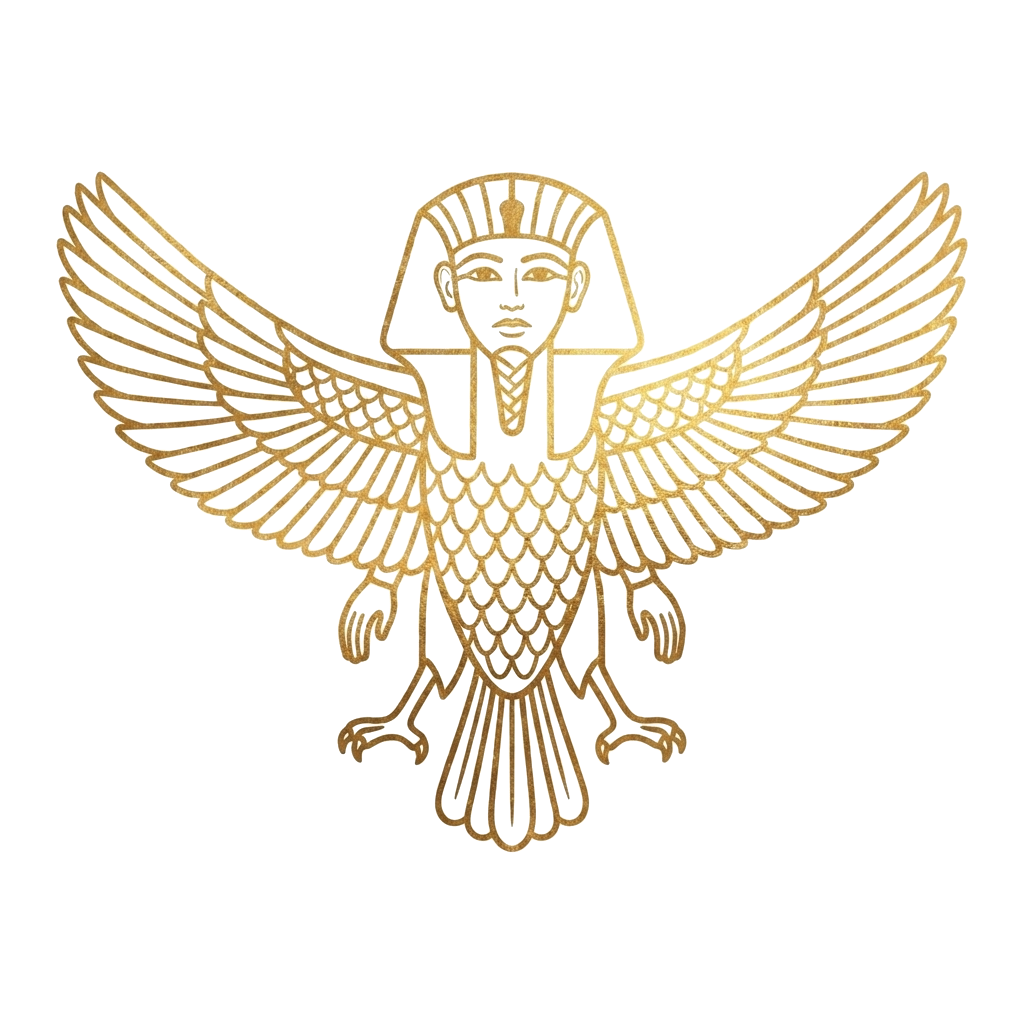
Ba Bird
The human-headed bird that flies free of the corpse at death, returns to the tomb at dusk, and gives ancient Egypt one of the world's first technical languages for personality after death.
About Ba Bird
A small falcon body with a tiny human head wearing the wig and features of the deceased. That is the ba bird, and it is one of the strangest images Egyptian artists ever painted, because it is a portrait of a part of you that survives the body but is not the whole of you.
The ba is one piece of a person in Egyptian theology. There are others. A living human is held together out of seven or more components (body, ka, ba, akh, name, shadow, heart, and the perfected spiritual body), and death dissolves the bundle. Each part has its own afterlife and its own job. The ba is the one with personality, the one that can leave, the one that flies up out of the tomb shaft to see the sun, then returns at dusk to perch on the chest of the mummy and rejoin it for the night.
So the ba bird is a picture of mobility. It is also a picture of what death does to a person. The image exists because, in Egyptian theology, the parts of the person come apart at death and have to find each other again on a daily cycle to keep the deceased coherent.
The Egyptians wrote spells for this reunion. They placed pottery ba-pots in tombs as perches. They composed, in the late Middle Kingdom (c. 1850 BCE), a long dialogue between a depressed man and his ba in which the man wants to die and the ba argues against it. That text survives on Papyrus Berlin 3024 and is one of the earliest preserved psychological dialogues in any language.
The symbol looks like a tiny novelty. The theology behind it is one of the most precise pre-modern attempts anywhere to map what a person is made of.
Visual Description
The ba bird is almost always a bird-body with a human head. The body is a stylized small raptor, usually identified as a small falcon or a sparrowhawk (Accipiter nisus), with folded or outstretched wings, raptor talons, and a forked or fanned tail. The head is human, modeled on the face of the deceased and often wearing the long striated wig of the New Kingdom or the close-cropped style of earlier periods.
From the New Kingdom onward (c. 1550 BCE), the ba is sometimes given small human arms emerging from the body or wings, frequently shown holding a shen ring or a sail-shaped hieroglyph for breath. In the most elaborate vignettes, the ba grasps in its talons a small figure of the sun or a lit lamp, marking its access to daylight that the corpse no longer has.
Scale is small. In tomb paintings the ba bird hovers a few inches above the mummy or perches on the chest, never large enough to dominate the scene. In the round, ba-bird statuettes from the Late and Ptolemaic Periods stand a few centimeters tall in painted wood, often with attachment dowels for fixing to a coffin lid or a stela.
The ba is iconographically distinct from its cousins. The ka is shown either as a human figure identical to the deceased or as a pair of upraised arms, never as a bird. The akh is a northern bald ibis (Geronticus eremita), recognizable by its full bird head, long curved beak, and absence of a human face. Confusion with these two is the main reason the ba's human head is so emphatically rendered: it is the marker that says this bird is a person.
Esoteric Meaning
The ba is one part of a multipart self. The standard Egyptian breakdown, drawn together from the Pyramid Texts, the Coffin Texts, the Book of the Dead, and later mortuary literature, runs roughly as follows.
Khat is the physical body, what gets mummified. The container.
Ka is the life-force or vital double, transmitted from the gods at birth. The ka stays with the body and the tomb. It eats the offerings. When an Egyptian "goes to his ka," he dies.
Ba is personality, individuality, the distinct presence a person has on the world. The ba is the part that survives intact and mobile. It can leave the tomb, fly above the marshes, board the solar boat, and return.
Akh is the transfigured spirit, the shining one. The akh is what you become if your ba and ka successfully reunite after death and you are vindicated in judgment. It is the post-mortem perfected state, identified with the imperishable stars.
Ren is the name. To preserve the name is to preserve the person. To erase a name from a monument is a second death.
Sheut is the shadow. Inseparable in life, it carries some of the person's substance and is itself a target of magical attack and protection.
Ib is the heart. The seat of mind, will, and moral character. It is weighed against the feather of Maat in the judgment hall, and its testimony is what condemns or saves.
Sahu is the perfected/glorified body — the form the deceased takes once successfully transfigured, sometimes encountered by the living in dreams or apparitions.
This is not a sloppy folk inventory. The components are functionally distinct, attested across two millennia of texts, and theologically precise about which one does what. The Egyptologist Louis V. Žabkar argued in his 1968 study A Study of the Ba Concept in Ancient Egyptian Texts that translating ba simply as "soul" loses almost everything specific about it; he preferred renderings closer to animation, manifestation, or distinct mode of being.
Other ancient cultures broke the person into multiple components in similar ways. The Greeks distinguished psyche (the breath-soul that left at death), thymos (the seat of passion in the chest), and pneuma (breath-spirit). The Hebrew Bible names nefesh (life-breath, animal soul), ruach (wind, spirit), and neshamah (higher breath given by God). The Nahua of central Mexico described tonalli (day-soul lodged in the head), teyolia (heart-soul), and ihíyotl (breath-soul in the liver), as documented by Alfredo López Austin in The Human Body and Ideology (1988). Tibetan Buddhism distinguishes namshe (consciousness) from the gross and subtle bodies. In every case the move is the same: the unity of the living person comes apart at death, and the parts scatter.
The ba is the Egyptian name for the part that flies.
Exoteric Meaning
What the ba bird shows ordinary Egyptians, on the tomb wall or amulet they could see: the part of the dead person that is no longer trapped. The ba flies out of the burial shaft at dawn, goes wherever it likes (the marshes, the orchard, the river, the sun's boat) and comes home at dusk to settle on the body for the night. The dead person, through the ba, is still in the world.
This is consoling. It is also why so much funerary equipment is designed for the ba: doors painted on tomb walls so it can pass in and out, perches and pots so it has somewhere to land, spells so it can find the corpse again, and food offerings whose smell or essence it can take.
Usage
The ba bird appears in three main contexts in Egyptian funerary practice.
Book of the Dead vignettes. Spell 89 of the Book of the Dead is titled, in Raymond Faulkner's translation, For Letting a Soul Rejoin Its Corpse in the Realm of the Dead. The accompanying vignette nearly always shows a ba bird descending the tomb shaft and hovering over the mummified body laid out on its bier. The text reads in part: "Come for my soul, O you wardens of the sky! If you delay letting my soul see my corpse, you will find the eye of Horus standing thus against you..." Spell 85 ("Spell for being transformed into a living ba") and spell 86 ("Spell for being transformed into a swallow") are related transformations the deceased can undergo. Spells 91 and 92 concern keeping the ba from being shut away from its body.
Tomb wall scenes. Ramesside tombs at Deir el-Medina (including TT1, the tomb of Sennedjem, and TT3, the tomb of Pashedu) show the ba either drinking from a pool, perching on the door of the tomb, or hovering over the sarcophagus. The vignette of the ba descending the burial shaft becomes a near-standard image in 19th and 20th Dynasty tombs.
Funerary equipment. Ba-bird statuettes, generally carved in wood and painted with a black wig and gilded details, were placed in burials primarily in the Late Period (c. 664–332 BCE) and Ptolemaic Period (332–30 BCE). Many surviving examples have dowel holes in their bases, suggesting they were originally attached to coffin lids, the tops of stelae, or shrine fittings. The Metropolitan Museum, the Brooklyn Museum, the McClung Museum, and the British Museum all hold examples. So-called ba-pots, small ceramic vessels with the rim shaped to suggest a perch, are sometimes interpreted as resting places for the returning ba, though some scholars read them instead as libation vessels for funerary offerings.
In Architecture
The ba did not generate its own building type, but it shaped the architecture of the tomb in three concrete ways.
The false door. Old Kingdom mastabas and rock-cut tombs include a carved or painted false door, usually on the west wall of the offering chamber, through which the ka and the ba could pass between the burial chamber and the chapel where the living brought offerings. The false door is a threshold designed for incorporeal traffic.
The tomb shaft. The vertical or sloping shaft that connects the surface chapel to the underground burial chamber is, in funerary art, the route the ba flies down each evening. Vignettes from Spell 92 of the Book of the Dead and from Ramesside tomb walls (such as those in the tomb of Pashedu, TT3, at Deir el-Medina) show the ba descending the shaft to reach the mummy.
Coffins and amulets. Anthropoid coffins from the Middle Kingdom onward sometimes carry a painted ba bird on the chest or at the head end, marking the spot where the ba returns to rest. Small ba-bird amulets in faience, gold, or stone were placed on the body inside the wrappings, often near the heart, and are listed in the Book of the Dead's amulet inventory. Surviving examples can be seen in the Egyptian Museum in Cairo and the Petrie Museum in London.
The temple of Banebdjedet at Mendes (modern Tell el-Rub'a) in the Delta is the one place where ba-theology generated monumental architecture. Banebdjedet, whose name means "the Ba (Lord) of Djedet," was the local ram god understood as the living ba of Osiris, and according to the Book of the Heavenly Cow as the four bas of the sun god Ra in one form. Monumental granite naoi from the temple, primarily dated to the 26th Dynasty under Amasis (Ahmose II) and continued under the 30th-Dynasty Nectanebos, still stand on the site.
Significance
A precise psychology of death. The ba is not the whole soul. That is the single most important thing to understand about it. The Egyptians did not have a soul-body dualism in the Platonic or Christian sense, where one immaterial thing leaves one material thing behind. They had a multipart account in which the living person is a fragile composition of seven or more components, and death is the dissolution of that composition. The ba is the part that handles personality and mobility. The ka handles vitality. The akh handles luminous post-mortem identity. The ren handles social memory. Each part has its own care and feeding, and the survival of the deceased depends on keeping the parts in working relation. Jan Assmann, in Death and Salvation in Ancient Egypt (2005), argues that the Egyptian self is built out of two clusters: a bodily self (ba and shadow) and a social self (ka and name), and that the entire funerary apparatus is engineered to keep both clusters intact across the transition.
The Dialogue of a Man with His Ba. In the late Middle Kingdom, around the reign of Amenemhat III (c. 1859–1814 BCE), the surviving manuscript of a long literary dialogue between a despairing man and his ba was written down. The text survives, incompletely, on Papyrus Berlin 3024, with new fragments identified in 2017 (Papyri Mallorca I and II) by Marina Escolano-Poveda. The man is exhausted with life, considers suicide, and pleads with his ba to follow him into death. The ba answers back, sometimes mocking, sometimes consoling, sometimes threatening to abandon him if he goes through with it. The text contains some of the most quoted lines of Egyptian poetry, including: "To whom shall I speak today? Brothers are evil, and the friends of today do not love. To whom shall I speak today? Hearts are rapacious; every man takes his neighbor's goods." What makes the dialogue extraordinary is the form. It is a recorded conversation between a person and a part of himself, treated as two voices with distinct positions of their own. Nothing comparable survives from the ancient world for roughly a thousand years afterward. Miriam Lichtheim included the full text in volume one of Ancient Egyptian Literature (1973), and it has been translated into English many times — Wilfried Barta's 1969 survey alone counted 37 versions across modern languages.
The ba in comparative religion. The fact that an ancient culture broke the soul into multiple parts is not unique to Egypt. The Greek distinction between psyche, thymos, and pneuma; the Hebrew nefesh-ruach-neshamah; the Nahua tonalli-teyolia-ihíyotl; the Tibetan distinction of namshe (consciousness) from the various subtle bodies. All of them point to the same thing the Egyptian system points to. The unity of the person is a working assembly of distinct functions, not a single indivisible substance. Erik Hornung's Conceptions of God in Ancient Egypt (1971; English 1982) shows how the Egyptians applied the same multiplicity logic to their gods, who could each have multiple bas through which they manifested in the world. A god could be one and many at once. So could a person.
Modern reception. The ba bird entered Western imagination through the Napoleonic Description de l'Égypte (1809–1828) and became a fixed motif in 19th-century Egyptomania, appearing in funerary art across Europe and America. Carl Jung drew on Egyptian soul-components, including the ba and the ka, in his comparative writing on death and the structure of the psyche. The image of a personality-bird that flies free of the corpse and returns at night still circulates in modern fantasy and gothic fiction that draws on Egyptian sources. None of these popular uses preserve the technical Egyptian distinctions, but they trace back to the same picture: the small bird with the human face, perched on the chest of a sleeper.
Connections
Deities. Osiris presides over the judgment of the heart that determines whether the ba can rejoin the body or is annihilated. Anubis guides the ba and presides over the embalming of the corpse it must return to. Thoth records the verdict of the heart-weighing in writing. Ra sails the solar boat that the ba can join during its daytime flights, and the ba's nightly return to the body parallels Ra's nightly journey through the Duat. Banebdjedet ("the Ba [Lord] of Djedet") at Mendes is the divine ba of Osiris, manifested as a ram and identified in some texts as the four bas of Ra in one body.
Texts. The Pyramid Texts contain the earliest secure references to the ba (late Old Kingdom, c. 2350 BCE). The Coffin Texts develop the ba's transformations in the Middle Kingdom. The Book of the Dead contains spells 85, 86, 89, 91, and 92 directly concerning the ba, with the standard ba-bird vignette accompanying spell 89. The Dialogue of a Man with His Ba is preserved on Papyrus Berlin 3024.
Other symbols. The ankh is the sign of life that the ba carries between worlds. The djed pillar, the backbone of Osiris, marks the stable axis the ba returns to. The scarab set on the chest at burial protected the ib (heart) during the same judgment that determined the ba's fate.
Further Reading
- Žabkar, Louis V. A Study of the Ba Concept in Ancient Egyptian Texts (Studies in Ancient Oriental Civilization 34). Chicago: University of Chicago Press, 1968.
- Allen, James P. The Ancient Egyptian Pyramid Texts (Writings from the Ancient World 23). Atlanta: Society of Biblical Literature, 2005; revised edition 2015.
- Assmann, Jan. Death and Salvation in Ancient Egypt, trans. David Lorton. Ithaca: Cornell University Press, 2005, esp. ch. 4 ("Death as Dissociation").
- Hornung, Erik. Conceptions of God in Ancient Egypt: The One and the Many, trans. John Baines. Ithaca: Cornell University Press, 1982.
- Lichtheim, Miriam. Ancient Egyptian Literature, Volume I: The Old and Middle Kingdoms. Berkeley: University of California Press, 1973 (full text of the Dialogue of a Man with His Ba).
- Pinch, Geraldine. Egyptian Mythology: A Guide to the Gods, Goddesses, and Traditions of Ancient Egypt. Oxford: Oxford University Press, 2002.
- Goedicke, Hans. The Report about the Dispute of a Man with His Ba: Papyrus Berlin 3024. Baltimore: Johns Hopkins University Press, 1970.
- Escolano-Poveda, Marina. "New Fragments of Papyrus Berlin 3024: The Missing Beginning of the Debate Between a Man and his Ba and the Continuation of the Tale of the Herdsman." Zeitschrift für Ägyptische Sprache und Altertumskunde 144 (2017).
Frequently Asked Questions
Is the ba the same as a soul?
Not in the way English speakers usually mean the word. The Egyptian person is built out of multiple components: body, ka (life-force), ba (personality), akh (transfigured spirit), ren (name), sheut (shadow), ib (heart), and others. Each one has a distinct function and a distinct fate after death. Translating ba as 'soul' collapses all of that into a single word that the Egyptians would not have recognized. The ba is closer to what we might call individuality, distinct presence, or the part of you that registers on other people. Louis V. Žabkar's 1968 study showed that the ba is best understood as the deceased's animated manifestation — the capacity to show up as oneself, to move, to be seen and remembered. The ka is what keeps you alive; the ba is what makes you you; the akh is what you become when both have safely transitioned. None of those map cleanly onto the Greek psyche, the Hebrew nefesh, or the Christian soul.
Why is the ba shown with a human head on a bird's body?
Because it has to do two things at once. It has to be unmistakably the deceased (recognizable, identifiable, the same person) and it has to be able to fly. The body of the bird gives it mobility. The head, modeled on the face of the dead person, gives it identity. Egyptian art is unusually literal about iconographic logic: a hybrid creature is doing two jobs, and the parts of its body tell you what those jobs are. The choice of a small falcon or sparrowhawk for the body draws on existing Egyptian associations between raptors and the sky-bound divine, the same association that powers Horus iconography. The human head distinguishes the ba sharply from the akh, which is shown as a pure crested ibis with no human features. Without the head, you would not know which spiritual component the bird represented. The pairing is a piece of theological signage.
What is the Dialogue of a Man with His Ba?
It is a Middle Kingdom literary text, dated to the late Middle Kingdom, often the reign of Amenemhat III (c. 1859–1814 BCE), preserved on Papyrus Berlin 3024 with additional fragments identified in 2017 as Papyri Mallorca I and II. The dialogue is a long argument between a man who wants to die and his ba, who initially refuses to follow him into the next world. The man complains that life has become unbearable, that his reputation is destroyed, that no one can be trusted. The ba answers with a mix of pragmatism, mockery, and consolation, threatening at one point to abandon him if he kills himself, then later seeming to accept his choice. What makes the text remarkable is not the suicidal subject matter but the literary form. It is a recorded interior conversation between a person and a part of himself, with both voices given distinct positions and tones. Nothing comparable survives from the ancient world for roughly a thousand years afterward. The text has been translated and re-translated many times — Wilfried Barta's 1969 survey alone counted 37 versions across modern languages — with Miriam Lichtheim's 1973 version in Ancient Egyptian Literature among the most widely read in English.
What does Spell 89 of the Book of the Dead do?
Spell 89 is the formula for reuniting the ba with the corpse in the realm of the dead. The spell is needed because the ba and the body separate at death and live partly distinct existences afterward. The ba flies out by day to see the sun and travel through the world; the corpse remains in the tomb. If the ba cannot find its way back at dusk, the deceased begins to disintegrate as a person. The spell addresses the 'wardens of the sky' and warns them that any delay in letting the ba see its corpse will provoke the eye of Horus against them. The vignette accompanying the spell shows the human-headed ba bird descending into the burial chamber and hovering over the mummy on its bier. Related spells (85, 86, 91, 92) handle adjacent transformations and protections. Together they form a small technical liturgy whose only purpose is to keep the parts of the deceased reachable to each other across the daily separation that death has imposed on them.