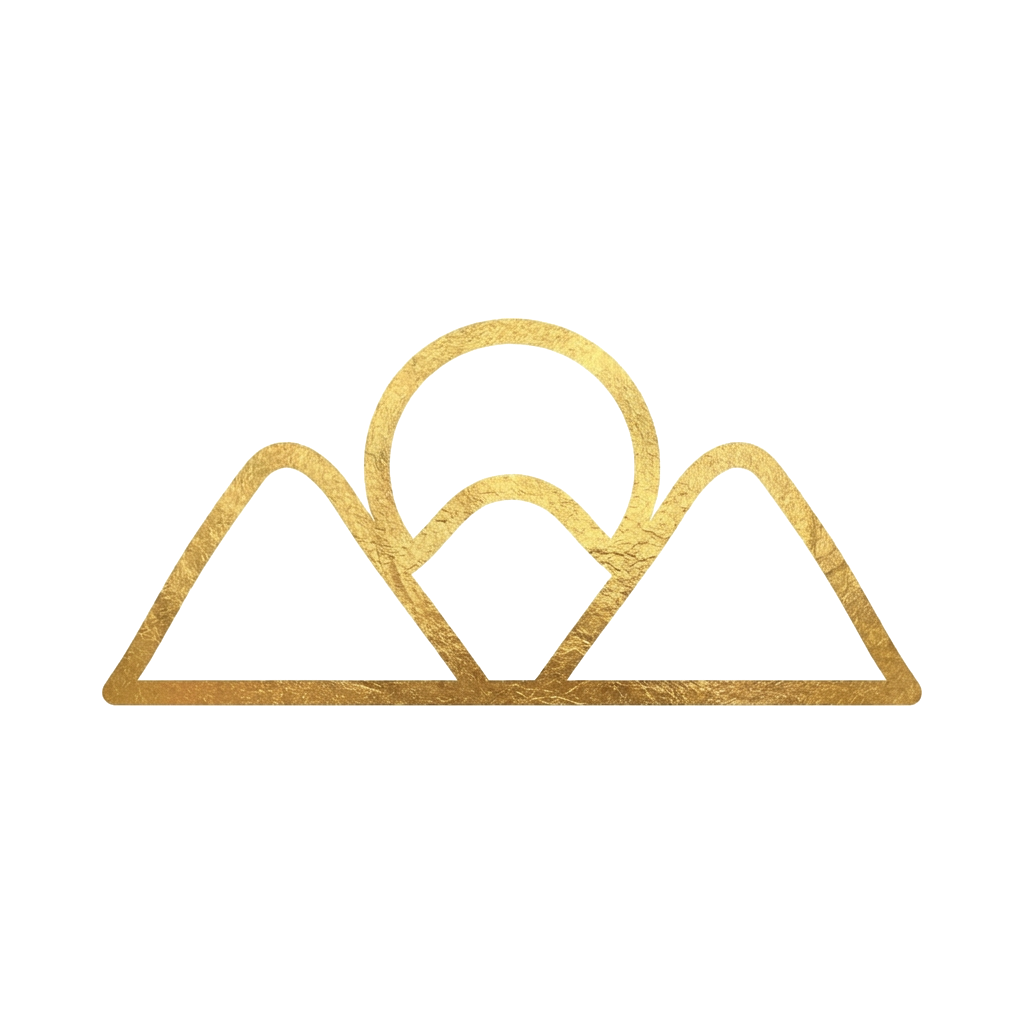
Akhet (Horizon)
The Akhet is the Egyptian horizon as a named sacred threshold — a solar disk between two mountains, Bakhu and Manu, where the sun is reborn each dawn and the dead king becomes an akh.
About Akhet (Horizon)
The Akhet is the Egyptian horizon as a named place. It is also a hieroglyph: a solar disk held between two mountain peaks, the sign Alan Gardiner catalogued as N27. Unlike the English word 'horizon,' which describes an optical boundary, the Egyptian Ꜣḫt is a destination. It is where the sun goes to become invisible at dusk and where it comes back at dawn, and the Egyptians gave its two halves proper names. The eastern peak was Bakhu. The western peak was Manu. The gap between them, held open by the lion-god Aker, was the threshold the sun crossed twice a day.
The sign is also a theological claim. The root Ꜣḫ shows up across Egyptian religious vocabulary: in akh, the transfigured spirit the dead became after successful judgment; in akhu, the luminous blessed ones; and in akhet, the horizon as the place at which a thing becomes effective. All three words share a sense of shining-into-effectiveness. The horizon is not just where the sun sets. It is where the sun becomes the sun, and by extension where the dead king becomes an akh. When the Pyramid Texts describe the king ascending through the akhet, they are describing an act of becoming, not a physical journey.
This page covers the hieroglyph and the etymology, the paired mountains Bakhu and Manu, the temples and cities the Egyptians built to frame and name the akhet (Akhet-Khufu, Akhet-Aten, Abu Simbel), the daily solar liturgy that moved through it, and the difference between the Egyptian horizon-as-threshold and the modern horizon-as-line.
Visual Description
The akhet hieroglyph is two rounded mountain peaks with a solar disk sitting in the valley between them. In Alan Gardiner's catalogue of Egyptian signs it is N27. The two peaks derive from the sign for 'mountain' (djew, N26), which shows the same twin-peak form without the sun. Drop a solar disk into the gap and the mountain-sign becomes the horizon-sign. The Egyptians drew the peaks rounded rather than triangular, and the disk was a full circle, never a half-risen semicircle.
In monumental art the akhet appears more elaborated. Temple reliefs and coffin vignettes often show the two peaks as proper landscape features, sometimes with vegetation, sometimes with wild animals. The sun-disk in the centre may be plain or winged or flanked by uraei. On some reliefs the lion-god Aker — two lions back-to-back or face-to-face — replaces the mountains entirely, with the sun rising between their shoulders. Aker's two heads point east and west respectively, one named Sef ('yesterday') and one Duau ('tomorrow'), so the king passes through the body of time itself as he crosses the akhet.
The sign should not be confused with the Aten-disk (a plain solar disk with rays ending in hands, specific to the Amarna period) or with the scarab-and-disk image of Khepri (a scarab pushing the sun), both of which share the solar element but drop the twin peaks and name different aspects of the solar event.
Esoteric Meaning
The akhet is where becoming-effective happens. The Egyptian root Ꜣḫ carries a cluster of related meanings — 'to shine,' 'to be effective,' 'to be useful,' 'to be glorified' — and the horizon is the place where each of those events takes place at cosmic scale. The sun shines at the akhet. The sun becomes effective (visible, active, life-giving) at the akhet. The dead king becomes akh at the akhet. Ordinary horizons do not do this work. Only the cosmic horizon does, and it does it at dawn and at sunset, twice a day, every day, for all of Egyptian time.
This makes the akhet the horizontal axis of the Egyptian cosmos. The djed pillar holds the vertical axis: earth rising into sky through the king's backbone. The akhet holds the horizontal: day passing into night, life passing into rebirth, the visible world meeting the hidden Duat. Every Egyptian funerary text that traces the king's journey through the afterlife moves him through both axes — vertical to rise, horizontal to cross. Reading the djed and the akhet together gives the whole Egyptian spatial theology in one pair of symbols.
Comparative horizon-traditions exist but Egypt's is unusually specific. In Zoroastrian eschatology the Chinvat Bridge is the threshold the soul crosses from earth to either paradise or punishment; Mary Boyce traces the motif back to the pre-Zoroastrian Indo-Iranian inheritance. In Homeric Greek thought the 'gates of the sun' appear in the Odyssey Book 24 as the border of the land of the dead. Mircea Eliade catalogued these as variants of the cosmic-threshold archetype. The Egyptian version is the most precisely named: Bakhu and Manu as specific mountains, Aker as the guarding being, and a hieroglyphic sign dedicated to it. Egypt did not treat the threshold as a vague edge. It gave it a proper name, a location, and a body.
Exoteric Meaning
At the most immediate level the akhet is the horizon as people saw it: sunrise in the east, sunset in the west. The Egyptians lived in a narrow green valley with hard desert on both sides rising into actual cliffs and hills, so the horizon was never just a flat line. It was always a real skyline, and the sun visibly entered and left between real features of the landscape. The akhet sign is a stylised portrait of what they saw every morning.
That direct observation expanded into royal ideology and city-planning. Any place where the sun appeared to enter or leave a dramatic cleft in the land could be designated a proper akhet, and the Egyptians named such places deliberately. The Great Pyramid of Khufu was called Akhet-Khufu, the 'Horizon of Khufu,' turning the monument itself into a named horizon for the king's soul. Akhenaten's new capital at Amarna was called Akhetaten, 'the Horizon of the Aten,' sited at a wide east-bank bay where the surrounding cliffs form a natural akhet-shape that the king read as a direct message from his god. On a smaller scale, tomb stelae and funerary papyri showed the deceased raising hands in adoration to the akhet at the moment of the sunrise prayer. The sign moved freely between literal description, naming convention, and ritual gesture.
Usage
The akhet appears across every register of Egyptian religious life — in royal titulature, in temple orientation, in funerary papyri, in personal names, and in ritual recitation.
In royal titulature, pharaohs took the name Horus-of-the-Two-Horizons (Horakhty) as part of their Ra-identification. The king at dawn stood in the eastern akhet; the king at dusk stood in the western akhet; in between, he crossed the sky as the visible sun.
In temple orientation, Egyptian builders aligned major solar monuments to catch the sun at the exact akhet position on key calendrical dates. The temples at Abu Simbel in Nubia, built by Ramesses II in the 13th century BCE, admit a shaft of sunlight into the innermost sanctuary twice a year — under the original siting before the UNESCO relocation, on 21 February and 21 October, dates traditionally associated with the king's ascension and birth. The relocation in the 1960s shifted the alignment by one calendar day, so the modern sunrise now falls on 22 February and 22 October. The Great Temple of Amun at Karnak is aligned to catch the midwinter sunrise along its main axis; the temple of Horus at Edfu and the temple of Hathor at Dendera both integrate akhet imagery into their ceiling programs and axial alignments.
In funerary literature, the akhet is the gate the deceased must pass. Pyramid Texts utterances repeatedly describe the king 'going up to the akhet' as the decisive event of his afterlife transformation. The Coffin Texts and the Book of the Dead develop this further: Spell 15 of the Book of the Dead is a hymn to Ra at dawn, addressing him explicitly as the one rising from the eastern akhet; Spell 16 is the vignette of the sunrise, showing the horizon-mountains, the disk, and the adoring deceased.
In place-names and personal names, the element 'akhet' appears widely. Akhet-Khufu ('Horizon of Khufu') was the Great Pyramid's name in antiquity, though there is scholarly discussion over whether the 'akhet' in that specific compound was written with the horizon sign or the akh-spirit (crested ibis) sign — Khufu-era administrative papyri from Wadi al-Jarf use the crested-ibis spelling. Akhetaten at Amarna names the sun-disk's own horizon. Personal names such as Akhethotep ('the horizon is satisfied') appear from the Old Kingdom through the New.
In Architecture
The akhet shaped Egyptian architecture at three scales.
At monumental scale, the pyramid form is the largest architectural akhet. A pyramid seen from the east at sunrise or from the west at sunset frames the sun between its sloping sides, producing a literal akhet-silhouette: mountain-sun-mountain, rendered in stone. Khufu's pyramid at Giza called itself Akhet-Khufu; the two main Giza pyramids seen together at sunset from the Nile Valley produce a shared akhet image, with the sun dropping between them. Recent archaeo-astronomical work by Giulio Magli and others has argued this was intentional: two pyramid-mountains positioned to stage the setting sun between them as a single composite horizon.
At city scale, Akhenaten's Akhetaten at Amarna reads as a site chosen for its natural akhet shape. The eastern cliffs above the city break open at a wadi called the Royal Wadi, which, seen from the valley floor at dawn, frames the rising sun between two high limestone shoulders. Akhenaten's boundary stelae explicitly state that the site was chosen because the place belonged to no other god and because its natural form matched the akhet sign. The city plan, the royal tomb's orientation, and the daily temple worship were all arranged around that natural frame.
At temple scale, Abu Simbel is the most famous solar-alignment temple. Ramesses II's engineers cut the sanctuary 60 metres into the sandstone cliff so that only one small shaft penetrated from the façade to the innermost chamber. Twice a year (originally 21 February and 21 October), the rising sun enters that shaft, travels 60 metres, and illuminates three of the four cult statues: Ramesses himself, Amun-Ra, and Ra-Horakhty. Ptah, god of darkness, is left in shadow. The architecture is a three-dimensional diagram of the akhet as a crossing place between worlds. Karnak's main axis is set for the winter solstice sunrise; Dendera's Hathor-temple ceiling includes a large winged sun-disk at the apparent position of the akhet in the ceiling's zodiac layout. Egyptian pylon gateways, the great trapezoidal towers flanking temple entrances, can themselves be read as architectural akhet-frames: two mountain-shaped towers with the gate (and therefore the approaching worshipper, and at certain moments the sun) passing between them.
Significance
Religious meaning. The akhet carries the full Egyptian theology of becoming-effective. The word root Ꜣḫ covers the sun's shining, the dead king's transfiguration, and the luminous condition of the blessed. When the Egyptians placed the sun between two mountains and named that image 'akhet,' they were compressing a whole metaphysics into a sign. Every sunrise was a rehearsal of the primordial moment at which light first emerged into the world. Every sunset prepared the next one. The king's funerary ascent was a joining of that daily cycle. Read through the akhet, Egyptian religion looks less like a myth-collection and more like a sustained meditation on the moment of emergence.
Architectural theology. Egypt built the akhet. Pyramid, pylon gate, obelisk pair, and temple axis all return to the same image: the sun held between two vertical supports. James P. Allen, in Genesis in Egypt (Yale, 1988), reads this as the architectural signature of Heliopolitan creation theology. Juan Antonio Belmonte's archaeo-astronomical survey of Egyptian temple orientations (published across multiple papers in the Journal for the History of Astronomy and elsewhere) has mapped the degree to which major sanctuaries are tuned to solstitial, equinoctial, or stellar risings — the Egyptian akhet as practical astronomy rather than metaphor.
Comparative horizon-symbolism. The horizon-as-threshold appears across other ancient traditions but rarely with Egypt's level of specificity. In Zoroastrianism the Chinvat Bridge is the judgement-crossing; Mary Boyce (A History of Zoroastrianism) argues the motif is Indo-Iranian in origin and shares structural elements with Egyptian afterlife-threshold imagery, though direct transmission is unproven. In archaic Greek thought Homer's 'gates of the sun' (Odyssey 24.11–12) function similarly as the border of the land of the dead. In Norse cosmology the Bifröst bridge spans between Midgard and Asgard, a horizon-as-bridge rather than horizon-as-gate. Mircea Eliade treated these collectively as the axis mundi motif's horizontal mode, complementary to the world-pillar's vertical mode.
Modern reception. The akhet sign still circulates in popular Egyptiana and tattoo iconography, usually without its original etymological link to the akh-spirit. Mainstream archaeoastronomy — now a legitimate subfield — reads Egyptian temple alignments with more care than the 19th-century amateur tradition; the two-pyramid akhet argument for Giza, the Akhetaten site-selection argument at Amarna, and the Abu Simbel shaft calculations are now standard examples in undergraduate survey courses on ancient astronomy.
Connections
Deities. Ra is the primary akhet-god: every sunrise is his emergence from the eastern horizon, every sunset his entry into the western one. Horus absorbed the akhet through the title Horakhty (Horus-of-the-Two-Horizons), which merged with Ra as Ra-Horakhty, one of the most common solar-falcon compound names. Atum is the sunset-form; Khepri the sunrise-form; together with Ra at midday they form the three ages of the daily solar cycle, each linked to one position along the akhet axis. Aker, the double-lion god, guards the horizon itself as its embodied gate.
Texts. The Pyramid Texts contain repeated references to the king's ascension through the akhet (utterances on the eastern horizon as the site of royal transfiguration). The Coffin Texts extend this imagery to non-royal dead. The Book of the Dead preserves the classic dawn hymn (Spell 15) and the vignette of the sunrise over the horizon-mountains (Spell 16). Later solar litanies continue the pattern.
Other symbols. The winged sun disk is the akhet rendered with solar wings, often placed above temple doorways to re-enact the sunrise in architecture. The scarab is Khepri pushing the sun up through the akhet at dawn. The djed pillar is the akhet's vertical-axis counterpart. The uraeus frequently flanks the akhet-disk, protecting the threshold. The ankh is the life that flows into the world at each crossing.
Further Reading
- James P. Allen, Genesis in Egypt: The Philosophy of Ancient Egyptian Creation Accounts (Yale Egyptological Studies 2, 1988). The standard treatment of Heliopolitan solar theology, with extensive discussion of the akhet as cosmogonic place.
- Richard H. Wilkinson, Reading Egyptian Art (Thames & Hudson, 1992). Iconographic reference that situates the akhet sign within the visual grammar of Egyptian relief.
- Alan Gardiner, Egyptian Grammar: Being an Introduction to the Study of Hieroglyphs (3rd ed., Oxford, 1957). The foundational grammar; N27 is catalogued and defined here.
- Juan Antonio Belmonte & Mosalam Shaltout, eds., In Search of Cosmic Order: Selected Essays on Egyptian Archaeoastronomy (American University in Cairo Press, 2009). Modern archaeoastronomy of Egyptian temple alignments, including Abu Simbel, Karnak, and Dendera.
- Erik Hornung, The Valley of the Kings: Horizon of Eternity (Timken, 1990). The royal necropolis as an architectural akhet.
- Stephen Quirke, The Cult of Ra: Sun-Worship in Ancient Egypt (Thames & Hudson, 2001). The Heliopolitan solar cult that gave the akhet its theological weight.
- Giulio Magli, Architecture, Astronomy and Sacred Landscape in Ancient Egypt (Cambridge University Press, 2013). Includes the two-pyramid akhet argument for Giza.
- Mircea Eliade, The Sacred and the Profane: The Nature of Religion (Harcourt, 1959). The axis-mundi and threshold framework within which comparative horizon-symbolism is usually discussed.
Frequently Asked Questions
What does the Akhet symbol mean in ancient Egypt?
The Akhet is the Egyptian horizon, represented as a hieroglyph (Gardiner sign N27) showing a solar disk held between two rounded mountain peaks. Beyond the literal meaning it names a sacred threshold: the place where the sun becomes visible at dawn and disappears at dusk, and by extension the place where the deceased king becomes 'akh' — a transfigured, effective spirit. The Egyptian word root Ꜣḫ covers shining, being-effective, and being-glorified, all of which happen at the horizon. The akhet is therefore not just a line at the edge of sight; it is a named sacred location, flanked by two named peaks (Bakhu in the east, Manu in the west) and guarded by the double-lion god Aker. Every sunrise and sunset was a ritual event at the akhet, and Egyptian temples, pyramids, and royal cities were sometimes aligned or named to make that event visible.
What's the difference between the Akhet, the Aten disk, and the winged sun disk?
All three use a sun disk but the setting and meaning differ. The Akhet is the disk between two mountains; it names the horizon as a threshold. The Aten is a plain solar disk with rays ending in small hands, specific to the religious reform under Akhenaten (c. 1353–1336 BCE) and largely abandoned after his reign; it represents the sun itself as the sole deity, not the horizon. The winged sun disk is the solar disk flanked by falcon wings and often two uraei cobras, used above temple doorways across Egyptian history; it can be read as the akhet in flight, or more directly as Horus of Behdet in his sky-crossing form. Functionally, the akhet names a place, the Aten names a god, and the winged disk names a protective architectural gesture. The three often appear on the same temple but do distinct theological work.
Why is the Great Pyramid called Akhet-Khufu?
The Great Pyramid of Khufu (c. 2589–2566 BCE) was called Akhet-Khufu in ancient Egyptian, usually translated 'the Horizon of Khufu.' The name identifies the monument as a sacred threshold through which the king's transformed spirit could pass. There is a small complication: in the Old Kingdom administrative papyri from Wadi al-Jarf, contemporary with Khufu's reign, the word 'akhet' in this compound is written with the crested ibis hieroglyph (akh, meaning 'transfigured spirit') rather than the horizon hieroglyph. Some scholars therefore read the compound as 'Spirit of Khufu' rather than 'Horizon of Khufu.' The two readings are not mutually exclusive, since the Egyptian root Ꜣḫ carries both senses. The pyramid was the horizon at which Khufu became akh. Either translation names that event, with different emphases on place versus transformation.
Was Akhetaten chosen for its natural akhet-shaped landscape?
Yes, and Akhenaten said so explicitly. Akhetaten (modern Amarna) was the capital city Akhenaten founded around 1346 BCE for his Aten-only cult. The site he chose on the east bank of the Nile in Middle Egypt is marked by a break in the eastern cliffs — a wide wadi, later called the Royal Wadi — which, seen from the valley floor at dawn, frames the rising sun between two high limestone shoulders, producing a literal akhet-shape in the natural landscape. Akhenaten's boundary stelae, inscribed around the perimeter of the new city, state that the site was chosen because it belonged to no other god and because its form matched the akhet sign. The name Akhetaten means 'Horizon of the Aten,' and the city plan, the royal tomb's orientation (cut into the wadi itself), and the daily temple worship of the Aten were all arranged around that natural frame. It is one of the clearest ancient cases of a city-site selection made on iconographic grounds.