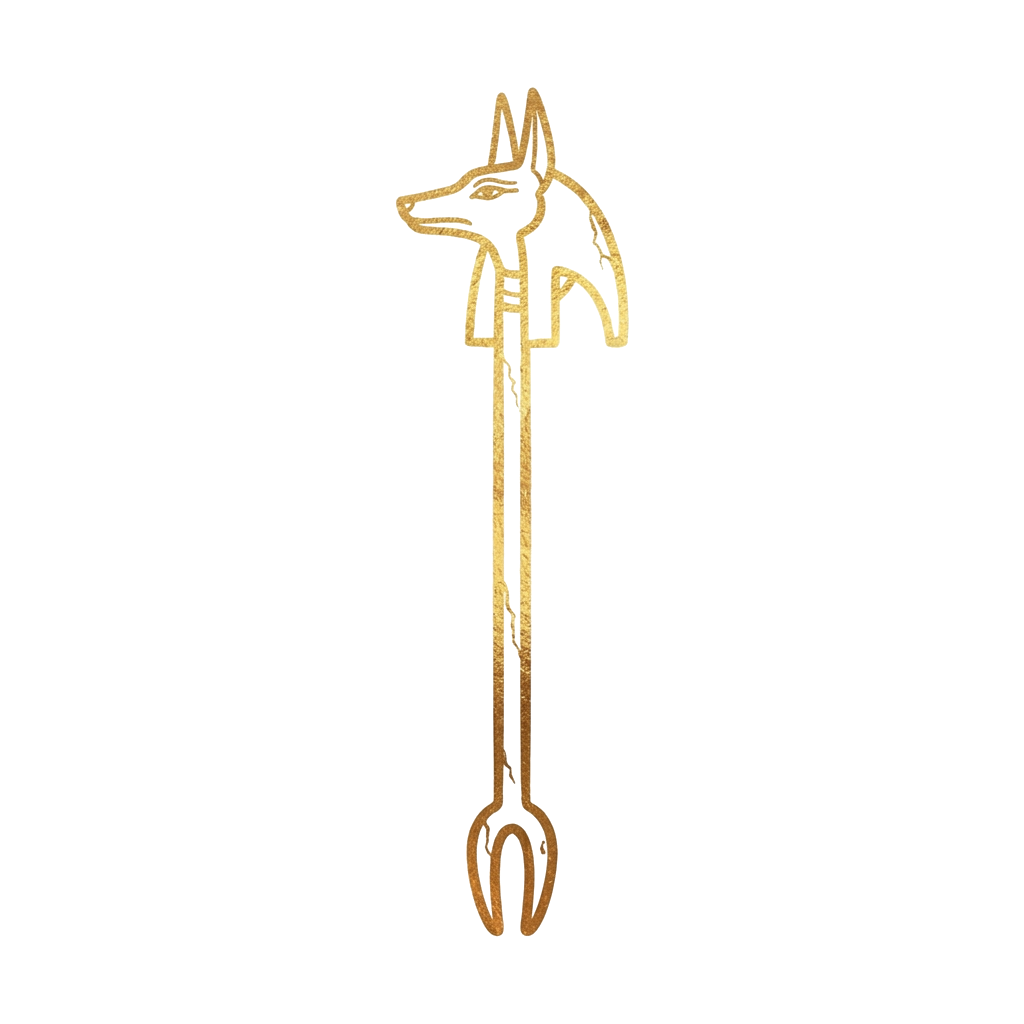
Was Scepter
The Was scepter is the long forked-base, jackal-headed staff carried by Egyptian gods and pharaohs as the visual sign of power and dominion — a portable axis mundi connecting earth to sky in the bearer's hand.
About Was Scepter
The Was scepter is an Egyptian staff with a canine or jackal head at the top and a forked base at the bottom. The Egyptian word wꜣs means 'power' or 'dominion,' and the staff is the visual sign of that word: a tall, slender shaft, instantly recognisable in profile, carried by gods and pharaohs as the badge of their authority. The earliest examples date to the First Dynasty (c. 3000 BCE), and the form remains stable across the next three thousand years of Egyptian art. By the time of the Old Kingdom it is the standard scepter held by male deities — Ptah, Anubis, Set, Osiris, and many others — in temple reliefs, statuary, and funerary scenes.
The scepter's identity is concentrated in two features. The animal head at the top is most often described as the head of the Set-animal, the mysterious composite creature with a long curved snout, square upright ears, and a tail with a forked tip — the same animal that gives the god Set his iconography. Some scholars read it as a stylised jackal, others as a fennec fox, others as a dog, others still as an unidentifiable cult-animal that may not correspond to any real species. The forked base appears as two prongs at the bottom of the staff, often with a horizontal bar between them, and may originally have served as a ground-stake when the staff was planted. Together the head and the fork frame the shaft as a tool that connects sky to ground — a small portable axis mundi held in the hand of the bearer.
This page covers the was scepter as the standard divine and royal regalia, the Set-animal head and its iconographic mystery, the four-Was sky-supports cosmology, the was scepter's pairing with the ankh and djed, the use of the was as a hieroglyph (Gardiner sign S40), the funerary use of full-size and miniature was-scepters, and the modern reception of the staff in contemporary Egyptian-themed iconography.
Visual Description
The Was scepter has three iconographic parts. The shaft is a long, slender vertical staff, generally drawn longer than the figure carrying it — held in the hand at chest or waist height, with the bottom resting near or on the ground and the top rising above the bearer's head. In monumental reliefs the shaft is usually plain; in funerary art it can be painted in alternating bands of colour, sometimes wrapped with fillets or bound with cord at intervals.
The animal head sits at the top of the shaft. Its silhouette is the visual signature of the Was: a long curved snout slightly downturned, two square upright ears flat-topped not pointed, a long forward-tilting profile that reads as canine or canid-adjacent. The head is rendered with the same conventions as the Set-animal's head — Set being the desert god whose own zoological identity the Egyptians left unsettled. Egyptologists have proposed identifications including a jackal, a fennec fox, a domestic dog, a pig, an aardvark, an okapi, and an extinct or imagined cult-animal. The current consensus is that no single living species matches the iconography, and that the Was-head was a deliberate composite intended to evoke the desert and its god rather than a specific creature.
The forked base sits at the bottom of the shaft. Two prongs descend from the staff, sometimes with a horizontal cross-bar bridging them. The fork may originally have functioned as a ground-stake (some scholars compare it to the bifurcated bottoms of practical staves used in herding), but in iconography it is stylised and usually does not touch the ground at the right angle a stake would require. In some versions the prongs are stylised as two narrow legs.
When carried, the Was is held in the right or left hand, sometimes paired with an ankh (life) in the other hand and sometimes with a djed (stability) standing nearby. Many divine images show the god gripping all three together, or the Was alone with the ankh dangling from a finger. As a hieroglyph the Was is Gardiner sign S40, used as the determinative or phonetic in writing wꜣs (power) and related words.
Esoteric Meaning
The Was is a small portable cosmology. The staff connects earth to sky in the same shape Egyptian builders gave to the great architectural axes mundi — the obelisk, the column, the pyramid's vertical line. Holding a Was is holding a vertical axis between the bearer's hand and both the ground and the heavens. The word wꜣs translates as 'power' or 'dominion,' but the iconographic move is more specific than abstract authority. Power in this Egyptian sense is the capacity to maintain a vertical line through the cosmos — to keep the sky above and the earth below from collapsing into each other. The bearer of the Was is the person whose grip holds that line steady.
This reading is supported by Egyptian sky-cosmology. The Egyptians described the sky as held up over the earth by four pillars at the four cardinal points, and these four pillars were sometimes depicted explicitly as four Was scepters. In tomb-ceiling and coffin-interior compositions, the sky-goddess Nut arches over the earth-god Geb, and the supports between them at the four corners are drawn as Was-staffs. Holding a Was therefore identifies the bearer as a participant in the cosmic structure that keeps creation arranged correctly. Pharaonic ideology took this directly into political theology: the king carries the Was because the king's authority maintains the cosmic order; the gods carry the Was because the gods hold the cosmos together at scales the king cannot reach.
The Set-animal head is more puzzling. Set is the god of disorder, foreign lands, storms, and the desert — not an obvious candidate for the head of an order-maintaining staff. One reading (Geraldine Pinch, Egyptian Mythology, 2002) is that the Was domesticates Set's chaotic energy: by topping the order-staff with the disorder-god's animal, the Egyptians recognise that effective dominion requires the integration of chaotic force, not its denial. Power that pretends chaos doesn't exist is brittle; power that holds chaos at the top of its staff is real power. This is why Set himself, Anubis (also a desert canid), Ptah, Osiris, and other gods of widely different domains all carry the same staff: it is the universal token of integrated authority.
The Was scepter pairs with two other regalia in the standard divine triad. The Was carries power. The ankh carries life. The djed pillar carries stability. Held together — Was in one hand, ankh in the other, djed standing alongside — the bearer commands the three conditions a kingship needs: the power to act, the life to sustain, and the stability to endure. This triad appears constantly in Egyptian art, especially on coffins, on stelae, and in the headdresses of gods who are shown holding all three.
Exoteric Meaning
At immediate level the Was is a badge of office. Pharaohs are shown holding it. Gods are shown holding it. High priests in some periods carried small ceremonial Was-scepters. To see a figure with a Was in Egyptian art is to be told without words that this figure has authority — divine or royal — over the territory of the scene. The shape was so widely recognised that even small objects (amulets, scarabs, votive offerings) that bore the Was-shape carried the implication of authorised power.
For ordinary Egyptians, the Was appeared most often in funerary contexts. Was-amulets in faience, gold, electrum, and lapis lazuli are common finds in burials from the Middle Kingdom onward. They were placed on or near the mummy to give the deceased the divine attribute of dominion in the afterlife. A dead person equipped with a small Was could expect to wield authority before the gods, in the Hall of Two Truths and beyond. Andrews's Amulets of Ancient Egypt (1994) catalogues the Was-amulet typology in detail.
In temple ritual, full-size Was-scepters appear in the regalia inventories of major temples. Some New Kingdom temples list ceremonial Was-staffs of cedar, ebony, or ivory among their regular cult equipment. These were carried in processions, presented to the gods during the daily offering rite, and used as ritual objects in the hands of priests acting in the gods' roles. The Was-shape also appeared on the lintels and column capitals of certain temples, both as decoration and as architectural restatement of the cosmic-axis logic the staff named.
Usage
The Was scepter saturates Egyptian religious and royal material across all periods.
In divine iconography, the Was is the standard staff of male gods. Osiris, Anubis, Set, Ptah, Khnum, Sobek, and many others are routinely shown holding a Was. Female deities sometimes hold a variant called the wadj-scepter (a papyrus stem rather than the canine-headed Was), but Hathor, Mut, and Sekhmet in some contexts also carry the Was. The Was is never absent from a major god's iconography for long; it is the visual constant of Egyptian divine portraiture.
In royal regalia, the pharaoh carries the Was in formal court and ritual scenes. Coronation reliefs, smiting scenes, and offering scenes routinely show the king holding a Was in one hand and an ankh in the other, with a djed standing or floating nearby. The king is sometimes shown holding a smaller heqa (crook) and nekhakha (flail) for the more shepherd-king and crook-and-flail iconography, but in solemn divine-presentation scenes the Was is the standard.
In funerary use, full-size or miniature Was-scepters are placed in tombs as grave goods. Tutankhamun's tomb included several Was-scepters among the regalia in the burial chamber and antechamber. Was-amulets — small versions in faience or precious materials — are placed on the mummy or wrapped in the bandages, often paired with djed and ankh amulets to deliver the full triad of power, stability, and life to the deceased. Book of the Dead vignettes show the deceased presented to Osiris while holding (or being given) a Was, marking the deceased's transformation into a being of divine authority.
As a hieroglyph, the Was is Gardiner sign S40, used in writing the word wꜣs ('power,' 'dominion') and in compound spellings of titles, royal epithets, and city names. The city-name Wast — a name for Thebes — uses the Was sign as part of its writing.
In the four-Was sky cosmology, the Egyptians describe the sky as supported at its four corners by four Was-staves. This appears in tomb-ceiling decoration (the Senenmut tomb-ceiling at Deir el-Bahri, the Ramesside royal tombs at the Valley of the Kings), in coffin-interior compositions where Nut arches over Geb with four Was-supports between them, and in the cosmographic plates of the Book of the Dead. The cosmological deployment of the Was as architectural support for the universe is one of the most theologically dense uses of the symbol.
In Architecture
The Was scepter shaped Egyptian architecture in two distinct ways.
In cosmographic decoration, the Was appears at the four corners of tomb ceilings and coffin interiors as the architectural representation of the sky-supports. The most famous example is the astronomical ceiling of Senenmut's unfinished tomb (TT353) at Deir el-Bahri, where the corners of the painted sky are marked with Was-staffs holding up Nut. The royal tombs in the Valley of the Kings — Seti I's tomb (KV17), Ramesses VI's tomb (KV9) — carry similar treatments, with Was-staves drawn explicitly as architectural supports for the painted heavens. The cosmographic plates of the Book of the Dead reproduce the same scheme: Nut arching over Geb, four Was at the cardinal points holding her body up.
As a decorative architectural motif, the Was appears on temple lintels, column capitals, and palace wall friezes as a repeated emblem of authority. Karnak, Luxor, Edfu, and Dendera all carry decorative Was-bands in various locations. Some temples have column capitals with stylised Was-shapes at the top, especially in subsidiary chapels and barque-shrines. The motif moves between the cosmological function (sky-support at the corner of a ceiling) and the heraldic function (badge of authority on a wall) without changing its basic shape.
In temple-and-tomb regalia inventories, full-size Was-scepters are listed among the cult equipment. The Karnak temple inventories from the New Kingdom list cedar Was-staves with gold-leafed heads and ivory inlay; the temple of Amun-Min at Luxor had similar regalia. These were not architectural elements in the strict sense but were stored within the architecture, brought out during festival processions, and returned to dedicated rooms between rituals.
Significance
Religious meaning. The Was is the staff of dominion, and dominion in the Egyptian sense is the capacity to maintain cosmic structure. The bearer of a Was — god or king — holds an axis between sky and earth that helps keep the cosmos arranged correctly. This reading aligns with the four-Was sky-supports cosmology, in which the universe itself is held up by Was-staffs at its corners. Erik Hornung in Conceptions of God in Ancient Egypt (Cornell, 1982) argues that the Was is the most theologically dense piece of Egyptian regalia precisely because it carries both political-authority meaning and cosmic-architecture meaning in one image.
The Set-animal head. The choice of Set's animal as the staff's head is a deliberate theological move, not an iconographic accident. Set is the god of chaos, foreign lands, storms, and the desert — the principle that opposes Maat (cosmic order). Topping the order-maintaining staff with the disorder-god's animal acknowledges that effective dominion requires the integration of chaotic force. Power that suppresses chaos cleanly is brittle; power that incorporates chaos at the top of its staff is durable. This is why even Osiris, the god of cosmic order par excellence, carries a Was with a Set-headed top: order without integrated disorder is not the full picture. Geraldine Pinch's Egyptian Mythology (Oxford, 2002) develops this reading in detail.
The triad of regalia. The Was, the ankh, and the djed pillar form the standard triad of Egyptian divine regalia: power, life, stability. They appear together so frequently — in priestly hands, on coffin sides, in temple wall scenes — that they function almost as a single composite symbol. The triad encodes the Egyptian theory of well-functioning authority: a king or god requires all three at once. Power without life is tyranny. Life without stability is chaos. Stability without power is impotence. Holding the triad in coordinated form was the Egyptian image of complete divine kingship.
Comparative regalia. Other ancient cultures developed staff-of-authority symbols: the Mesopotamian shepherd's-crook, the Greek kerykeion (caduceus), the Roman fasces, the medieval European royal sceptre. None of these carry the cosmic-architectural reading the Was carries. The Egyptian staff is unusually metaphysically loaded. It is not just a symbol of office; it is a small model of the universe held in the bearer's hand. This is part of what makes the Was the persistent, unchanging image it is across three thousand years of Egyptian art: the symbol does work no other symbol does.
Modern reception. The Was scepter circulates in contemporary Kemetic religion and in Egyptian-themed jewelry and tattoo iconography, sometimes in faithful reconstructions and sometimes in adaptations that drop the Set-animal head in favour of a generic canine or jackal. Mainstream Egyptological reference works treat the Was as one of the central iconographic objects of the Egyptian visual programme; the British Museum, the Metropolitan Museum, and the Cairo Museum hold extensive collections of Was-amulets and full-scale Was-staves.
Connections
Deities. Set is the god whose animal-head crowns the staff; the Was is, in one reading, Set's contribution to the standard regalia of all male gods. Anubis as a desert canid is iconographically related to the Set-animal and frequently carries the Was. Osiris is the most consistently Was-bearing god in funerary art, holding the staff in his standard mummy-form alongside the crook and flail. Ptah, the creator-god of Memphis, carries a unique composite scepter that combines the Was, the ankh, and the djed in a single staff — the most explicit visual statement of the regalia-triad as one object. Horus, Ra, Thoth, and Hathor in some contexts also carry the Was.
Texts. The Pyramid Texts reference the Was in royal funerary contexts as the staff the king takes up in his transformation into an Osirian being. The Coffin Texts develop this further, with spells that arm the deceased with the Was for the journey through the Duat. The Book of the Dead includes vignettes of the deceased holding the Was in scenes of presentation to Osiris.
Other symbols. The ankh and the djed pillar form the standard divine-regalia triad with the Was — power, life, stability held together. The uraeus at the bearer's brow combined with the Was in the bearer's hand is a frequent paired image of total divine authority. The Atef crown on the head and the Was in the hand together compose the standard Osirian portrait.
Further Reading
- Erik Hornung, Conceptions of God in Ancient Egypt: The One and the Many, trans. John Baines (Cornell University Press, 1982). Treats the Was as the most theologically dense piece of Egyptian regalia.
- Geraldine Pinch, Egyptian Mythology: A Guide to the Gods, Goddesses, and Traditions of Ancient Egypt (Oxford University Press, 2002). Develops the reading of the Set-animal head as the integration of chaotic force into the staff of order.
- Carol Andrews, Amulets of Ancient Egypt (British Museum Press, 1994). Catalogues the Was-amulet typology in detail.
- Richard H. Wilkinson, The Complete Gods and Goddesses of Ancient Egypt (Thames & Hudson, 2003). Standard reference for the Was as the staff of male divine iconography.
- Richard H. Wilkinson, Reading Egyptian Art: A Hieroglyphic Guide to Ancient Egyptian Painting and Sculpture (Thames & Hudson, 1992). Iconographic reference for the Was sign and its symbolic deployments.
- Alan Gardiner, Egyptian Grammar (3rd ed., Oxford, 1957). Catalogues S40 (Was-scepter) and its phonetic and semantic uses.
- Henry George Fischer, 'The Ancient Egyptian Attitude towards the Monstrous,' in Monsters and Demons in the Ancient and Medieval Worlds, ed. A. E. Farkas et al. (Mainz, 1987). Discussion of the Set-animal as deliberate composite.
- Jan Assmann, The Mind of Egypt: History and Meaning in the Time of the Pharaohs (Metropolitan Books, 2002). Royal ideology and the regalia-triad as the visual programme of pharaonic theology.
Frequently Asked Questions
What does the Was scepter symbolize?
The Was scepter is the Egyptian symbol of power and dominion — wꜣs in Egyptian means 'power' — but the iconographic move is more specific than abstract authority. The Was is a tall slender staff with a canine or jackal head at the top and a forked base at the bottom, and it represents the bearer's capacity to maintain a vertical axis between earth and sky. The Egyptian sky was held up by four pillars at the cardinal points, and those pillars were sometimes depicted as four Was-scepters. Holding a Was therefore identifies the bearer as someone who participates in keeping cosmic order steady. Pharaohs and male gods carry it as their standard regalia, often paired with the ankh (life) in the other hand and with a djed pillar (stability) standing nearby. The triad of Was-ankh-djed encodes the Egyptian theory of complete authority: power, life, stability all held together.
What animal head is on top of the Was scepter?
The animal at the top of the Was is the so-called Set-animal — the same composite creature that gives the god Set his iconography. Its long curved snout, square upright ears, and forward-tilting profile are stable across three thousand years of Egyptian art, but Egyptologists have never reached consensus on what real animal it represents. Proposals include a jackal, a fennec fox, a domestic dog, a pig, an aardvark, an okapi, an extinct species, and a deliberate composite intended to evoke the desert and its god rather than any specific creature. The current view is that the Set-animal was a calculated visual fiction, not a portrait of a living animal. Topping the order-maintaining staff with the disorder-god's animal is theologically pointed: effective dominion in the Egyptian view requires the integration of chaotic force, not its suppression. Even gods of cosmic order, like Osiris, carry the Set-headed Was — the staff of order needs the head of disorder.
Why are the Was, the Ankh, and the Djed shown together?
They form the standard divine-regalia triad of Egyptian art: power, life, and stability held together. The Was is power and dominion. The ankh is life. The djed is stability and endurance. Egyptian divine portraits, royal images, and funerary scenes routinely show the bearer holding all three — Was in one hand, ankh in the other, djed standing alongside or visible in the composition. The triad encodes the Egyptian theory of well-functioning authority. Power alone, without life, is tyranny. Life alone, without stability, is chaos. Stability alone, without power, is impotence. A god or king needs all three at once for the cosmos to function correctly. The most explicit visual statement of the triad is the staff of Ptah, the creator-god of Memphis, whose composite scepter combines the Was, the ankh, and the djed into a single staff — three regalia compressed into one object, suggesting that creation itself requires power, life, and stability inseparably joined.
Did the four Was scepters really hold up the Egyptian sky?
In Egyptian cosmology, yes. The Egyptians described the sky as a flat or arched plane held up over the earth by four pillars at the cardinal points. Those four pillars are sometimes depicted explicitly as four Was-scepters. The cosmographic ceiling of the unfinished tomb of Senenmut at Deir el-Bahri (TT353, c. 1473 BCE) shows this clearly: the painted sky is supported at the corners by Was-staves. The cosmographic plates of the Book of the Dead show Nut, the sky-goddess, arching over Geb the earth-god, with four Was-staves between them at the cardinal points holding her body up. The royal tombs of the Valley of the Kings — Seti I's tomb (KV17), Ramesses VI's tomb (KV9) — carry similar compositions. The Egyptians did not draw a sharp line between literal architecture and cosmic architecture. The Was-shape was both a staff a king carried and the structural support that kept the sky from falling. This is what makes the Was scepter unusually theologically loaded: it is not just a symbol of office, it is a small portable model of the universe.