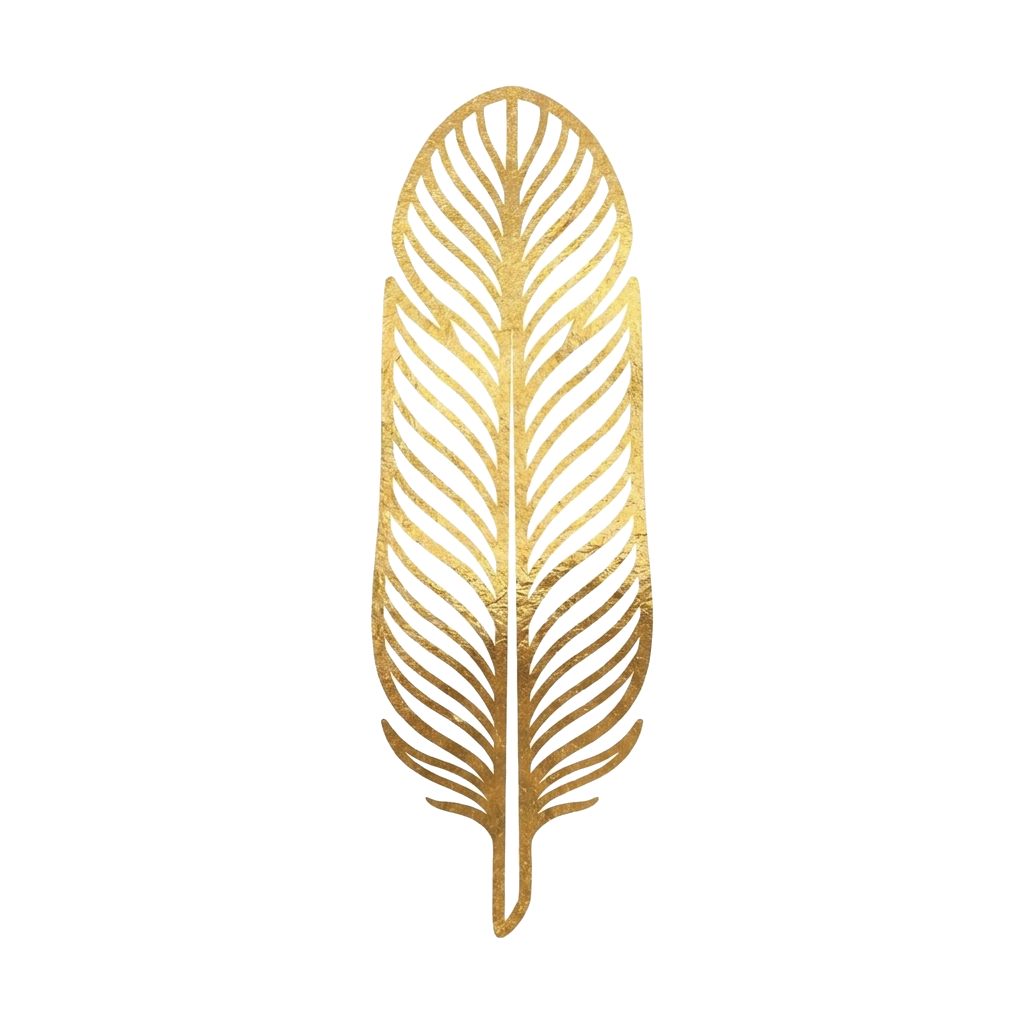
Feather of Ma'at
The Feather of Ma'at is the ostrich plume worn by the goddess Ma'at and weighed against the heart of the deceased in the Egyptian judgement of the dead — a small symmetrical object representing cosmic truth and the balance of creation.
About Feather of Ma'at
The Feather of Ma'at is a single ostrich plume. It is worn upright in the headband of the goddess Ma'at, the personification of cosmic truth, balance, and the order of creation. The feather appears on its own as a hieroglyph (Gardiner sign H6, read mꜣꜥt) and as a free-standing iconographic object across Egyptian funerary art. Its most famous appearance is in the Weighing of the Heart, the judgement scene from Book of the Dead Spell 125: in the Hall of Two Truths, Anubis sets the heart of the deceased on one pan of a balance and the Feather of Ma'at on the other. If the heart is lighter than or equal to the feather, the deceased is justified and admitted to the afterlife. If heavier, the heart is devoured by Ammit, a composite monster part-crocodile, part-lion, part-hippopotamus, and the deceased ceases to exist.
The choice of an ostrich feather is precise. Ostrich plumes are physically light, almost weightless when held, and visually they have an even symmetry along the central rachis that no other feather quite matches. The Egyptians read this evenness as the visual analogue of balance — the feather is itself a small set of scales. Placing it opposite the human heart in the judgement scene therefore has both a physical logic (a heart heavy with wrongdoing will outweigh a feather; a heart purified will balance one) and a structural logic (truth has the form of symmetry; if your inner life cannot match a symmetrical thing, it has lost its truth).
This page covers the feather as a hieroglyph and an iconographic object, the goddess Ma'at whose head it crowns, the 42 negative confessions of Spell 125, the architecture of the judgement scene, the cosmic concept of maat (the principle of order), and the survival of the feather-as-justice motif in later Mediterranean and Western iconography.
Visual Description
The Feather of Ma'at is rendered in Egyptian art as a single ostrich plume, drawn upright with its central rachis (shaft) clearly visible and the soft barbs spreading symmetrically to either side. The whole feather tapers from a slightly broader middle to a rounded tip and a narrow base where it meets the headband.
Worn by the goddess Ma'at, the feather rises from her brow at the centre of a low headband, giving her silhouette its instantly recognisable profile: a slim seated or standing figure with one tall, slim feather rising from her head. She is usually shown in a sheath dress, with arms crossed or one outstretched holding the ankh, sometimes with wings spread to indicate her cosmic reach.
As a free-standing iconographic object, the feather appears on its own in the pan of the balance in weighing-of-the-heart vignettes. The Papyrus of Ani (British Museum EA 10470, c. 1250 BCE) shows the canonical version: a tall freestanding balance with two pans suspended from a horizontal beam, the heart in one pan as a small jar (Egyptian heart-shaped, broader at top), the feather standing upright in the other pan, and Anubis adjusting the plummet at the centre. Thoth records the result as the ibis-headed scribe to one side; Ammit waits in the lower register, ready to consume rejected hearts.
As a hieroglyph, the feather is Gardiner sign H6, used for the words mꜣꜥt (truth/order/justice) and as a determinative for related concepts. The hieroglyph is drawn the same way as the iconographic feather — single tall plume, symmetrical barbs — but stripped of any wearing context, and it can be repeated in inscriptions wherever maat is named.
Esoteric Meaning
The feather encodes the Egyptian principle of maat. Maat is not just truth in the modern English sense of 'accurate statement.' It is the structural condition that lets reality cohere: cosmic order, social justice, ritual correctness, and personal honesty all read as facets of one underlying principle. When the Egyptians said the king ruled by maat, they meant the king's exercise of power continued the structural condition of the cosmos. When they said the priest performed maat, they meant the priest renewed the world's order through the rite. When they said an ordinary person lived in maat, they meant their inner life and outer actions were aligned with that same structural condition.
The feather as the visible token of maat works because of its symmetry. An ostrich plume drawn through its central rachis has near-perfect bilateral symmetry; the barbs to one side mirror the barbs to the other. Symmetry is a low-level signature of order. The Egyptians could have chosen many objects to represent maat — a square, a circle, a column — but they chose a feather because its lightness is also part of the meaning. Maat does not weigh much. It does not press down. It is the natural condition of a properly ordered thing, and the feather embodies this lightness in a form anyone can hold.
The Weighing of the Heart turns this into anthropology. The Egyptians took the heart, not the brain or the breath, as the seat of the person — the locus of memory, conscience, intention, and continuity through death. (The brain was discarded during mummification; the heart was preserved and returned to the body. This was not anatomical ignorance, it was theological commitment.) Putting that heart on a balance against an ostrich plume is the visual claim that personal worth is structural alignment. The well-lived life is not heavier or grander than maat — it is exactly the same weight, because it has been lived in the shape of maat. Anything beyond that weight is excess, distortion, accumulation, the residue of acts that pulled the inner life out of true.
Cross-tradition parallels are real but few. The Tibetan Buddhist bardo judgement weighs the soul's white and black pebbles in a scale; this draws partly on Egyptian imagery transmitted through Hellenistic and later channels. The Christian psychostasis (the 'weighing of souls') in medieval art shows Saint Michael holding a balance with souls or virtues on the pans; the iconography is directly inherited from the Egyptian model through Coptic and Greco-Roman intermediaries. The figure of Lady Justice in modern Western iconography — blindfolded woman holding a sword and a balance — is a remote descendant of Ma'at via Greek Themis and Roman Justitia, with the balance tracing back to the Hall of Two Truths.
Exoteric Meaning
At everyday level the feather was the recognisable identifier of the goddess Ma'at and a shorthand for truth, justice, and rightness. Egyptians swore oaths by maat. Judges in lawcourts wore small gold or wooden Ma'at images on their chests as the visual mark of judicial office; Diodorus Siculus (1st century BCE) describes this practice in his account of Egyptian legal customs. The vizier — the chief administrator and judicial officer of the kingdom — held the title 'Priest of Ma'at,' indicating that the highest civil authority in Egypt was conceived as the goddess's earthly servant.
In personal religious life, the feather appeared on amulets carried by the living and placed on the dead. Faience or gold feather-amulets are common finds in burials from the Middle Kingdom onward. They carried two layers of meaning: the wearer aligned themselves with maat in life, and the deceased equipped themselves for the weighing-of-the-heart in death. The amulet was both a moral statement and an afterlife credential.
In temple and palace contexts, the feather was used as a recurring decorative element on royal regalia, on ceremonial fans (the king was attended by feather-bearers carrying actual ostrich plumes), and on the architectural backdrop of the throne. The pharaoh as ruler was understood as the principal upholder of maat, and the feather around his image continually restated this commitment.
Usage
The Feather of Ma'at appears across the full range of Egyptian religious and civic material.
In funerary literature, the central use is Book of the Dead Spell 125, the 'Negative Confession.' Book of the Dead Spell 125 sets the deceased before 42 assessor-gods, each one identified with a specific wrongdoing the deceased must deny. The deceased addresses each assessor by name and declares 'I have not killed,' 'I have not stolen,' 'I have not committed adultery,' through the full list of 42. The negative-confession framework is preceded by a hymn to Osiris and followed by the weighing-of-the-heart scene proper. The feather appears in Spell 125 both as the goddess's ornament and as the standard against which the heart will be weighed. The Papyrus of Ani (British Museum EA 10470, c. 1250 BCE) is the most famous illustrated copy, with the full vignette of the Hall of Two Truths spread across one continuous panel.
In tomb decoration, the weighing-of-the-heart scene is one of the standard scenes of New Kingdom tomb art. The tombs of Sennedjem (TT1) and Pashedu (TT3) at Deir el-Medina, the tomb of Nefertari (QV66) in the Valley of the Queens, and the royal tombs of the Valley of the Kings all carry versions of the scene. The feather always sits in one pan of the balance opposite the heart in the other.
As a hieroglyph, Gardiner H6 (the single feather) appears in the spelling of mꜣꜥt itself and in compound words and titles. The vizier's title 'Priest of Ma'at' uses the feather sign. Royal epithets such as 'Beloved of Ma'at' or 'Living through Ma'at' deploy the sign. Personal names with the maat element — Maat-Hor-Neferure (Ramesses II's Hittite queen), Maat-ka-Ra (Hatshepsut's prenomen), Neb-Ma'at-Re (Amenhotep III's prenomen) — write the feather hieroglyph.
On amulets, small feather-amulets in faience, gold, electrum, and lapis lazuli appear from the Middle Kingdom onward. Andrews's Amulets of Ancient Egypt (British Museum Press, 1994) catalogues the typology. The British Museum, the Metropolitan Museum, and the Cairo Museum hold extensive collections.
On royal regalia, the feather appears in two distinct ways. As a single Ma'at-feather it adorns the headbands of royal images and the pendants of necklaces. As paired feathers — sometimes the Shuty crown's twin plumes — it crowns Osiris's Atef, Amun's headdress, and various royal headdresses, though the paired-feather imagery has its own theological reading distinct from the single Ma'at-feather. The Atef crown of Osiris combines the white Hedjet with twin plumes that are sometimes interpreted as Ma'at-feathers and sometimes as separate symbols of truth and justice.
In Architecture
The Feather of Ma'at influences Egyptian architecture indirectly, primarily through the structural concept of maat itself rather than as a purely decorative element.
In tomb architecture, the painted weighing-of-the-heart scene is positioned on the tomb's main wall in the burial chamber or the antechamber. In the Valley of the Kings, royal tombs incorporate the Spell 125 vignette as a major painted element; in private tombs, the scene typically occupies one wall of the burial chamber. The architectural placement is deliberate. The deceased's body lies in the chamber where the painted balance hangs, so that the actual moment of judgement is staged for the deceased's ka in the room of their burial.
In temple architecture, Ma'at's image appears at strategic points in the wall programmes of Karnak, Luxor, Edfu, and Dendera. The king is shown 'offering Ma'at to the god,' a ritual gesture in which a small image of the goddess (with her feather) is held forward in the king's outstretched hand. This is one of the standard ritual scenes of New Kingdom and later temple decoration. The architectural function is to repeatedly inscribe, on every temple wall, that the king's role is to hand the principle of order back to the gods who entrusted him with it.
In court and palace architecture, the vizier's audience hall — the place where civil justice was administered — was symbolically aligned with the Hall of Two Truths. The vizier wore a Ma'at-image on his chest as the visual sign of his judicial office. Surviving Old Kingdom and New Kingdom administrative documents reference the spatial conventions of the audience hall, in which the petitioner approached the seated vizier as the deceased approached the judgement seat of Osiris.
Significance
Religious meaning. The feather is the visible form of the most foundational concept in Egyptian religion. Maat is not one virtue among many; it is the structural condition that allows reality to be reality. Erik Hornung in Conceptions of God in Ancient Egypt (Cornell, 1982) argues that maat is the irreducible base of Egyptian theology, more basic than any individual god, since the gods themselves act in service of maat. Jan Assmann's Ma'at: Gerechtigkeit und Unsterblichkeit im alten Ägypten (Beck, 1990) is the standard study of maat as both cosmic principle and social ethic, tracing how the same word covers natural order, ritual correctness, royal legitimacy, and personal honesty.
The judgement of the heart. Spell 125's weighing-of-the-heart is one of the most influential afterlife images ever produced. Three claims are bundled into the vignette: first, that the moral worth of a life is a measurable quantity, not a sentiment; second, that the standard of measurement is structural alignment with cosmic order, not external rule-following; third, that the result is binary — the heart is light enough or it is not, with no gradations of partial salvation. Christian, Islamic, and later Mediterranean afterlife systems inherit much of this imagery through Hellenistic, Coptic, and Hermetic transmission. The Christian psychostasis tradition (Saint Michael with the balance) is the most direct iconographic descendant.
The 42 assessors. Spell 125 lists 42 specific assessor-gods, each associated with a specific wrongdoing. The number 42 is the number of nomes (administrative districts) of unified Egypt, so the assembly of judges is also a roll-call of the country's political geography. The assessors' presence reads as a claim that civil justice and cosmic justice share the same structure — the dead person's judgement before Osiris is the same in form as the living person's judgement before the vizier. Some scholars (notably Henri Frankfort in Ancient Egyptian Religion) have argued the negative-confession formula is the earliest known articulation of a universal moral code.
Comparative iconography. The blindfolded woman holding sword and balance — Lady Justice in modern Western legal iconography — descends from the Egyptian Ma'at through Greek Themis and Roman Justitia. Themis carries the balance without the blindfold (added in the Renaissance to indicate impartiality); Justitia carries balance and sword. The continuity is well-documented in art-historical literature; Robert Jacob's Images de la Justice (Le Léopard d'Or, 1994) traces it explicitly. The ostrich-feather is dropped in the Greek and Roman versions, but the balance-as-emblem-of-truth survives into modern courthouse iconography as a direct inheritance from the Hall of Two Truths.
Modern reception. The Ma'at feather circulates in contemporary Kemetic religion, esoteric and tarot iconography, and popular illustrations of Egyptian mythology. The Justice card in many tarot decks (Rider-Waite-Smith, Crowley's Thoth) carries echoes of the Ma'at scene, with the figure holding the balance and sword.
Connections
Deities. Ma'at is the personification of the principle the feather names; she is the daughter of Ra and the consort of Thoth in some genealogies. Ra rules by maat: the king's authority derives from his role as Ra's representative in the maintenance of the principle. Osiris presides over the Weighing of the Heart as the judge in the Hall of Two Truths. Anubis guides the deceased to the hall and operates the balance. Thoth records the result as scribe of the gods. Horus escorts the justified deceased into the presence of Osiris after a successful weighing. Ammit, the heart-devouring composite monster (crocodile head, lion forequarters, hippopotamus hindquarters), waits beneath the balance to consume hearts that fail.
Texts. The Pyramid Texts contain the earliest references to maat as a cosmic principle. The Coffin Texts develop the judgement-of-the-dead imagery. The Book of the Dead Spell 125 is the canonical articulation of the feather's role: the 42 negative confessions, the Hall of Two Truths, the Weighing of the Heart. Wisdom literature — the Instruction of Ptahhotep, the Instruction of Amenemope, the Maxims of Any — is built around maat as the principle of well-lived life.
Other symbols. The ankh is often paired with the Ma'at-feather in priestly iconography (life and truth held together). The Atef crown of Osiris incorporates twin plumes which are sometimes read as Ma'at-feathers. The scarab heart-amulet (the so-called heart-scarab) was placed on the mummy's chest with Spell 30B inscribed on its underside, a spell that addresses the heart directly to prevent it from testifying against the deceased at the weighing. The djed pillar shares with the feather a commitment to structural condition — both name the underlying order of cosmos rather than a particular event.
Further Reading
- Jan Assmann, Ma'at: Gerechtigkeit und Unsterblichkeit im alten Ägypten (C. H. Beck, 1990; English material in The Search for God in Ancient Egypt, Cornell, 2001). The standard study of maat as cosmic principle and social ethic.
- Erik Hornung, Conceptions of God in Ancient Egypt: The One and the Many, trans. John Baines (Cornell University Press, 1982). Treats maat as the irreducible base of Egyptian theology, with extensive discussion of the feather and the judgement scene.
- Raymond Faulkner, The Ancient Egyptian Book of the Dead, ed. Carol Andrews (British Museum Press, 1985). Standard English translation; see Spell 125 for the Hall of Two Truths.
- Carol Andrews, Amulets of Ancient Egypt (British Museum Press, 1994). Catalogues the feather-amulet typology.
- Geraldine Pinch, Egyptian Mythology: A Guide to the Gods, Goddesses, and Traditions of Ancient Egypt (Oxford University Press, 2002). Reliable reference for Ma'at and the judgement-of-the-dead complex.
- Henri Frankfort, Ancient Egyptian Religion (Columbia University Press, 1948). Classic argument that the negative-confession formula is the earliest articulation of a universal moral code.
- Maulana Karenga, Maat, the Moral Ideal in Ancient Egypt (Routledge, 2004). Extended study of maat as ethical philosophy, with particular attention to the negative confessions.
- Robert Jacob, Images de la Justice: Essai sur l'iconographie judiciaire du Moyen Âge à l'âge classique (Le Léopard d'Or, 1994). Traces the iconographic descent from Ma'at through Greek Themis and Roman Justitia to medieval and modern Lady Justice.
Frequently Asked Questions
What does the Feather of Ma'at represent?
The Feather of Ma'at is the visible token of maat — the Egyptian principle of cosmic truth, balance, justice, and the structural order of creation. The feather is an ostrich plume, drawn upright with symmetrical barbs to either side of the central rachis. It is worn by the goddess Ma'at on her headband and serves as her instantly recognisable identifier. In the Weighing of the Heart in Book of the Dead Spell 125, the feather sits in one pan of the balance against the heart of the deceased in the other; if the heart is light enough to balance the feather, the deceased is justified and admitted to the afterlife. The choice of feather matters. Ostrich plumes are physically light and structurally symmetrical, and the Egyptians read both qualities as visual analogues of the principle they were naming. Maat does not weigh much, and it has the form of a thing in equilibrium.
What is the Weighing of the Heart?
The Weighing of the Heart is the Egyptian judgement of the dead, depicted in Book of the Dead Spell 125 and staged in the Hall of Two Truths in the Duat (the underworld). After death and a perilous journey through the underworld, the deceased is led by Anubis before a tribunal of 42 assessor-gods and the high god Osiris. The deceased recites the 42 negative confessions — denying each of 42 specific wrongdoings ('I have not killed,' 'I have not stolen,' 'I have not lied,' and so on). Anubis then places the deceased's heart on one pan of a great balance and the Feather of Ma'at on the other. Thoth records the result as the ibis-headed scribe. If the heart is lighter than or equal to the feather, the deceased is justified and admitted to Aaru, the field of reeds. If the heart is heavier, it is devoured by Ammit — a composite monster part-crocodile, part-lion, part-hippopotamus — and the deceased ceases to exist. The scene appears in countless tomb paintings and funerary papyri; the Papyrus of Ani (British Museum, c. 1250 BCE) is the most famous illustrated version.
Why is the heart weighed against a feather, not something heavier?
Because maat is light. The Egyptians did not conceive of the principle of cosmic order as something massive or imposing. They conceived of it as the natural condition of a properly ordered thing, which has no excess, no distortion, no accumulated weight. An ostrich feather is the heaviest object that can still feel weightless, and the Egyptians chose it precisely for that physical quality. A well-lived life, in maat, weighs no more than the feather, because nothing has been added beyond what the structure of cosmic order requires. Hearts grow heavy through wrongdoing — through the accumulation of the 42 wrongdoings the negative confessions deny — and a heavy heart is a heart that has pulled itself out of structural alignment with the cosmos. The image is anthropologically precise. Egyptian theology took the heart as the seat of memory, conscience, intention, and continuity through death, not the brain (the brain was discarded in mummification, the heart preserved). Putting that heart on a balance against a symmetrical, weightless feather makes the metaphysical claim that personal worth is structural alignment.
Did the Feather of Ma'at influence later traditions of justice?
Yes, more than is usually recognised. The figure of Lady Justice in modern Western iconography — the woman holding a balance and a sword, sometimes blindfolded — is a direct iconographic descendant of the Egyptian Ma'at, transmitted through Greek Themis and Roman Justitia. The balance is the Hall of Two Truths' weighing scale. The Christian psychostasis tradition, which shows Saint Michael holding a balance to weigh souls or virtues, is also inherited from the Egyptian model through Coptic and Hellenistic intermediaries. The Tibetan Buddhist bardo judgement, in which the soul's white and black pebbles are weighed, draws partly on Egyptian imagery transmitted through Hellenistic channels. The negative-confession formula of Spell 125 — the deceased denying 42 specific wrongdoings before a tribunal — has structural similarities to later confessional traditions in Christianity and Islam, though the lines of transmission for the verbal form are less clear than for the visual one. The ostrich feather itself dropped out of the Greek and Roman descendants, but the balance, the binary outcome, and the principle of moral weighing all survived. Walking into a modern courthouse decorated with statues of Lady Justice is, at one remove, walking into the Hall of Two Truths.