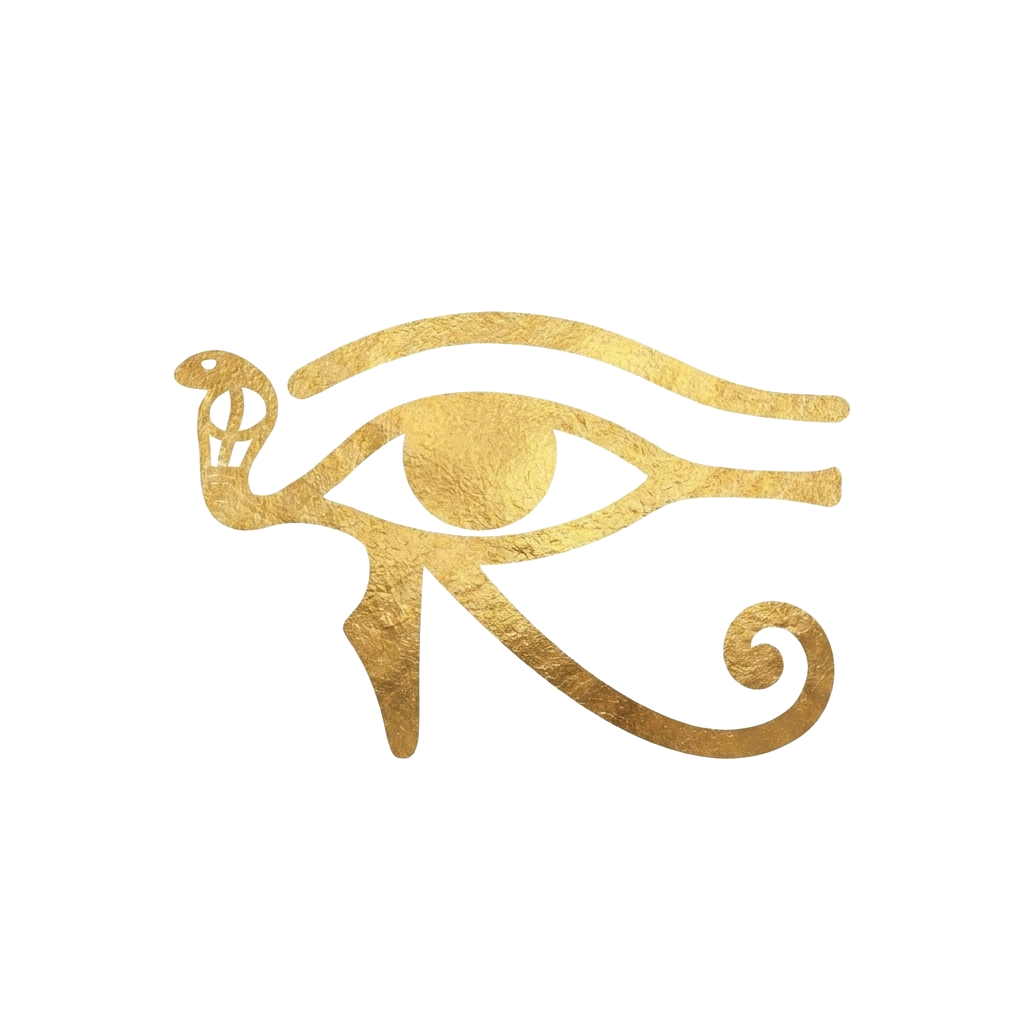
Eye of Ra
The wrathful daughter of the sun god: a feminine solar power who goes out as Sekhmet, Hathor, Tefnut, Bastet or the cobra Wadjet, leaves Egypt in anger, and must be coaxed home through beer, music, and dance to release the flood.
About Eye of Ra
The Eye of Ra is the ancient Egyptian sun god's daughter, weapon, and double. She is a feminine power that goes out from him, acts in the world on his behalf, and sometimes refuses to come back. Where the Eye of Horus is a healed wound and a promise of restoration, the Eye of Ra is the active, often dangerous, solar feminine. She burns enemies, hunts the serpent, crowns the pharaoh, and turns the desert into a hunting ground when she is angry.
She is not one goddess. She is a position. The role of Eye of Ra was held by several different goddesses at different times and places. Sekhmet the lioness wears it as wrath. Hathor wears it as joy and love returned. Tefnut wears it as moisture and breath. Bastet wears it as the protective cat. Wadjet, the cobra, wears it as the uraeus rearing on the king's brow. Mut, Raet-Tawy, and Menhit are also named, in different periods and temples, as the Eye.
The unifying story is the myth of the Distant Goddess. The Eye leaves Egypt in anger, travels to Nubia, lives as a wild lioness, and must be coaxed home by Thoth or Shu through music, dance, and beer. When she returns, the Nile floods, the year begins again, and the country is reborn. The Egyptologist Geraldine Pinch describes this as one of the most durable myth-cycles in Egyptian religion, attested through allusions and festival references from the Middle Kingdom (c. 2055 BCE) and elaborated fully in Late and Ptolemaic temple ritual more than two thousand years later.
This page is about the Eye of Ra specifically: the wrathful daughter, the Distant Goddess, the solar uraeus, and how that bundle of meanings is distinct from the protective wedjat eye associated with Horus.
Visual Description
The Eye of Ra is most often shown as a right eye, paired with the disk of the sun, a uraeus cobra, or both. In its simplest form it is a stylized human eye with a long extension at the outer corner and a curving cosmetic line beneath, drawn the same way Egyptian artists drew Horus's wedjat eye. The element that marks it as Ra's eye rather than Horus's is context: the disk, the cobra, the lioness, or the inscription naming Ra, Hathor, Sekhmet, or Tefnut.
Color conventions matter. When the Eye stands for solar fire it is painted red or yellow-gold. When it sits in the headdress of a goddess as a sun disk wrapped by a cobra, the disk is red and the cobra's hood is flared. On the brow of a pharaoh the uraeus alone, often gilded, is enough to invoke the Eye without drawing the eye shape at all. The cobra is the Eye in another form.
Many late-period and Ptolemaic representations show the Eye as a goddess seated or standing inside the sun disk, holding ankh and was-scepter, with Ra-as-falcon overhead. Lioness-headed Sekhmet with the solar disk above her mane is one of the most common cult-statue forms. Karnak alone preserves several hundred such statues from the reign of Amenhotep III (c. 1390-1352 BCE), originally commissioned for his mortuary temple at Kom el-Hettan and dispersed by Ramesses II to the Mut precinct and other sanctuaries.
Distinguishing it from the Eye of Horus takes one rule. The Horus eye is conventionally (from the New Kingdom on) the left eye and is read as the moon, healed and restored after Set's attack. The Ra eye is conventionally the right eye and is read as the sun, never wounded, but liable to leave. The two eyes were sometimes drawn as a matched pair, left moon and right sun, to mean the totality of celestial light. The mythic content is different. Horus's eye is about repair. Ra's eye is about return.
Esoteric Meaning
At the level of mystery teaching, the Eye of Ra is the active, executive aspect of a creator who is otherwise hidden. Ra, in the Old Kingdom theology of Heliopolis, sits at the center as light and source. He doesn't move through the world directly. He sends. What he sends is his Eye, a feminine emanation that does the work he wills but that has her own character, her own appetite, and the capacity to disobey.
This is closer to the Hindu concept of shakti than most Egyptological summaries acknowledge. Shakti is the active power of a deity, conceived as feminine and sometimes personified as the deity's wife or daughter. The god is the still source. The goddess is the doing. In the Pyramid Texts (c. 2350-2150 BCE) and more clearly in the Coffin Texts of the Middle Kingdom, the Egyptian word for eye (irt) sounds like a word for doing or acting. This pun is widely noted in Egyptological literature, including by Pinch. The Eye is what Ra does in the world. She is his agency made into a being.
The Distant Goddess myth, in this reading, is the mystery of the soul's flight and return. Something animating goes out, gets caught up in the wildness of its own power, forgets its source, and lives for a while as a beast in the wilderness. The work of bringing her home, done in the texts by Thoth with stories and Shu with cooling water, is the work of recollection. The Demotic Myth of the Sun's Eye, preserved in Leiden Papyrus I 384 (second century CE) and edited by Wilhelm Spiegelberg in 1917, is essentially a long sequence of Thoth telling Tefnut animal fables until she remembers herself and agrees to come back. The wisdom god teaches the wild goddess back into the temple by reflection.
There is a further esoteric layer in the doubled-eye motif. When the Eye returns and finds Ra has grown a new eye, she rages. Ra placates her by setting her on his forehead as the uraeus, in the third-eye position at the brow center, the seat of will and command. Later esoteric traditions associate this exact brow position with the ajna chakra or pineal seat. Whether or not the Egyptians thought in those terms, the iconography is precise: the active solar power rests at the brow of the king and god, ready to spit fire at any threat to cosmic order.
Cross-traditionally, the Eye of Ra sits in a family with the Greek Gorgoneion (a fierce female face on the aegis that turns enemies to stone), the apotropaic evil eye reversal symbols across the Mediterranean and Near East, and the Hindu image of Durga riding a lion to slaughter demons. In each case, the protective fierce feminine is set facing outward as a weaponized gaze. The Egyptian version may be the oldest continuously documented instance.
Exoteric Meaning
In daily Egyptian life the Eye of Ra was protection. A faience or gold Eye of Ra amulet worn at the throat or wrist was understood to spit fire at illness, at hostile spirits, at the bite of snakes and scorpions, at the chaos that pressed in from the desert edges. The mechanism was direct. The Eye sees you, the Eye protects you, the Eye burns what threatens you.
For the king, the Eye was legitimacy. The uraeus rearing from the brow of the pharaonic crown was not a decorative element. It was the goddess herself, present on the king's body, ready to defend him and strike his enemies. To wear the uraeus was to claim that the Eye of Ra had chosen you and rested on you. Without that claim, no one could legitimately rule Egypt. Both the Red Crown of Lower Egypt and the White Crown of Upper Egypt carry the cobra. The combined Double Crown carries both the cobra Wadjet and the vulture Nekhbet, doubling the protective gaze.
In temple decoration the Eye signaled that the building and the ritual within it were sanctioned by the sun god. Lintels, doorways, ceilings, and the upper registers of relief walls carried winged sun disks flanked by uraei. The Eye was made architectural. Worshippers walking into the temple were walking into the gaze.
At the funerary level, the Eye protected the dead. Coffin lids, sarcophagi, and mummy wrappings carried Eye amulets and painted eyes so that the deceased had the goddess with them through the night journey of the underworld and the threats of Apophis the chaos-serpent. Spell 17 of the Book of the Dead and many funerary texts invoke the Eye in this protective register.
The everyday meaning, then: protection, royal sanction, divine attention turned toward you specifically. Less abstract than the mystery-school reading. Closer to "the goddess has her eye on you, and that is good news as long as you stay on her right side."
Usage
The Eye of Ra appears across nearly every category of Egyptian religious activity attested from the Old Kingdom forward.
Royal regalia. The uraeus on every pharaonic crown is the most consistent and politically loaded use. From the early dynastic period through the Roman emperors who continued to be depicted as pharaohs, no king is shown without the cobra on his brow. When Tutankhamun's burial mask (c. 1323 BCE) places the gold cobra and the gold vulture side by side on the king's forehead, that is Wadjet (Eye of Ra in cobra form, protector of Lower Egypt) and Nekhbet (vulture protector of Upper Egypt) declaring the unified country protected by the goddess.
Funerary texts and amulets. The Pyramid Texts of the late Old Kingdom, the Coffin Texts of the Middle Kingdom, and the Book of the Dead all reference the Eye repeatedly. The Coffin Texts (Spell 75, in the Shu cycle edited by Adriaan de Buck) preserve the cooling-of-the-eye motif. Shu says he has "extinguished the fire" and "calmed the soul of her who burns," referring to Tefnut as the Eye, pacified after her rage. Faience and gold Eye amulets are recovered from burials throughout the New Kingdom and especially in dense numbers from Late Period and Ptolemaic mummies.
Temple ritual at the New Year. The return of the Distant Goddess was celebrated annually at temples of Hathor (Dendera), Mut (Karnak), Bastet (Bubastis), Sekhmet (Memphis), and Tefnut (Leontopolis). The festival coincided with the arrival of the inundation, the rust-red flood waters reaching Egypt from the south. Music, dance, and intentional drunkenness were part of the rite. A papyrus from Lahun in the Middle Kingdom already references "the inebriety for Hathor," and the Mut priesthood at Karnak celebrated a Festival of Drunkenness from at least the early New Kingdom, archaeologically documented through the temple's Hall of Drunkenness, excavated by Betsy Bryan's Johns Hopkins team and dated to the reign of Hatshepsut (c. 1475-1460 BCE).
The Destruction of Mankind narrative. The fullest mythological treatment is the Book of the Heavenly Cow, an etiological text first attested in truncated form on a shrine of Tutankhamun (c. 1336-1327 BCE) and preserved more fully in the tombs of Seti I, Ramesses II, Ramesses III, and Ramesses VI. Erik Hornung published the standard German edition in 1982, and Édouard Naville had translated the Seti I version in 1876. The narrative is the canonical source for the Eye-as-Sekhmet on a rampage, the seven thousand jars of beer dyed red with ochre, the flooding of the Dendera plain, and Sekhmet drinking herself into Hathor.
Magical and apotropaic use. Healing spells, snakebite spells, and execration rituals invoke the Eye as the burning gaze that destroys what threatens. The Eye is depicted on house-shrines, on the prows of ritual barques, on furniture, and on cosmetics containers. Robert Ritner's work on Egyptian magic documents the Eye's role across these domains.
Hellenistic and Roman continuity. The Demotic Myth of the Sun's Eye (Leiden Papyrus I 384, second century CE), edited by Wilhelm Spiegelberg, shows the cycle still actively narrated and theologically elaborated more than two thousand years after its earliest hints. A Greek translation circulated, suggesting the myth had a readership outside Egyptian temple culture in the Roman world.
In Architecture
The Eye is built into Egyptian sacred architecture from the Old Kingdom forward, but the densest deposits are in temples dedicated to goddesses identified as the Eye.
Karnak. The precinct of Mut at southern Karnak preserves several hundred granite Sekhmet statues commissioned by Amenhotep III (c. 1390-1352 BCE) and reused or redistributed by his successors. Scholarly estimates of the original count range from Mariette's 572 to Yoyotte's 730 (one seated and one standing for each day of the year), with several hundred still on site or in museums worldwide. Each statue is a seated or standing lioness-headed woman with a sun disk and uraeus on her head, the Eye of Ra in physical form, multiplied for daily ritual. The horseshoe-shaped sacred lake (isheru) at Mut's precinct is itself an architectural enactment of the cooling-the-Eye theme. Te Velde and others have shown that sacred lakes at temples of Eye-goddesses (Mut at Karnak, Sekhmet at Memphis, Bastet at Bubastis, Wadjet near Buto) were understood as the cool water in which the burning goddess could be calmed.
Dendera. The Ptolemaic temple of Hathor at Dendera (construction begun c. 54 BCE under Ptolemy XII, completed under the Roman emperors) is the most complete surviving architectural treatment of the Eye-as-Hathor cycle. The astronomical ceiling, the crypts, and the wabet (purification chapel) all carry Eye-of-Ra iconography. The roof shrines were used in the New Year ritual when the cult statue of Hathor was carried up to be re-united with the rays of Ra at the dawn of the year — the return of the Eye made literal in stone and procession.
Edfu. The Ptolemaic temple of Horus at Edfu (begun 237 BCE, completed 57 BCE) preserves extensive ritual texts on the Eye, including scenes in which the king "dispels the anger of the Eye-of-Ra (Hathor)" through offerings of the menat necklace and the sistrum, instruments specifically associated with calming the goddess.
Philae. The temple complex at Philae (mostly Ptolemaic, with Roman additions) preserves wall scenes of Tefnut as the returning Eye, brought back from Nubia by Thoth and Shu. Philae sits at the southern frontier, the geographic edge across which the Distant Goddess was imagined to leave and return.
Medamud, Bubastis, Leontopolis, Memphis. The Montu temple at Medamud preserves a festival of the returning goddess that may go back to the late Middle Kingdom. Bubastis was the center of Bastet's cult and her version of the Eye-return celebration. Leontopolis (Tell el-Muqdam) was the cult center of Tefnut as Eye. Memphis preserves Sekhmet temples and statues from multiple dynasties.
Royal tombs. The Book of the Heavenly Cow, the canonical Eye-of-Ra-as-Sekhmet text, appears on the walls of tomb chambers in KV17 (Seti I), KV7 (Ramesses II), KV11 (Ramesses III), and KV9 (Ramesses VI), and in truncated form on the gilded shrines of Tutankhamun (KV62). The text was meant to accompany the king through the night of the underworld with the Eye's protective rage on his side.
Significance
Religious significance. The Eye of Ra is the Egyptian solution to a problem every theistic system faces. How does a transcendent creator act in the world without losing transcendence? The answer in Heliopolitan theology is that the creator sends his Eye. She is him acting, but she is also her own person, capable of disobedience, capable of wandering, capable of needing to be appeased. This makes the Eye a working theology of immanent divine activity, not just a symbol. Jan Assmann's analysis of Egyptian solar religion notes that the daily course of the sun, the protection of the king, and the destruction of chaos are all narrated as Eye-actions. The Eye is how Ra is in the world.
Political significance. The Eye legitimized rule. No king could be pharaoh without the uraeus, and the uraeus was the Eye. This put the active power of the sun god on the body of the human ruler. It worked as a constant reminder, both to subject and to king, that royal authority was on loan from a goddess who could withdraw it. The Distant Goddess myth carries a buried political warning. The source of the king's power can leave. The state's job is to keep her here, fed, propitiated, and pleased.
The wrathful feminine in comparative religion. The Eye of Ra is one of the earliest continuously documented examples of the protective fierce goddess: Sekhmet with her arrows, Bastet with her claws, Wadjet with her venom, Hathor in her lioness rage. Comparable figures appear later as Durga and Kali in Hindu Tantra, the Greek Gorgon and Athena's aegis, the Sumerian Inanna in her warrior aspect, the Tibetan dakinis in their wrathful forms. Geraldine Pinch and Barbara Lesko have both argued for the Eye-of-Ra cycle as a foundational template for thinking about divine femininity that holds power, danger, and protection together rather than splitting them across separate goddesses.
Modern relevance. The Eye of Ra entered Western occultism through Hellenistic Hermetic transmission, was picked up in Renaissance Egyptomania, and reached its current visibility through 19th and 20th century esoteric movements. Most contemporary uses confuse it with the Eye of Horus or the all-seeing eye of Enlightenment iconography. The serious recovery of the Eye of Ra as a distinct symbol — wrathful daughter, Distant Goddess, solar feminine — has come mostly through the work of Egyptologists rather than esotericists, with Pinch's Egyptian Mythology (2002) and Wilkinson's The Complete Gods and Goddesses of Ancient Egypt (2003) as the most accessible entry points.
For a contemporary practitioner, the Eye of Ra is a symbol with teeth. It is not gentle, not soothing, not generic protection. It is the divine feminine in active executive mode, the part of the sacred that goes out, does the work, sometimes overdoes it, and has to be coaxed home. That specificity is what makes it useful and what makes it different from every adjacent symbol on this site.
Connections
Deities who occupy the role of Eye of Ra. Sekhmet the lioness is the wrathful Eye in her purest form, the killing edge. Hathor is the same Eye in her placated form: joy, music, love, the cow goddess of Dendera. Tefnut, the moisture goddess and one of the first creations of Atum, is the Eye in the Heliopolitan creation cycle and the central character of the Demotic Myth of the Sun's Eye. Bastet, the cat goddess of Bubastis, is the Eye in protective domestic form. Mut, consort of Amun at Thebes, was first called Eye of Ra in the late New Kingdom and held the role at Karnak. Wadjet, the cobra of Lower Egypt, is the Eye in uraeus form on the king's brow. Raet-Tawy and Menhit are less common but attested Eye-identifications.
Ra and Atum. The Eye is the Eye of Ra in most attestations, but in the Heliopolitan creation account it is the Eye of Atum (the older creator-form of Ra) sent out to find the lost children Shu and Tefnut.
Shu and Thoth as pacifiers. The two figures consistently named as bringing the Distant Goddess home are Shu (the air god, who cools her with breath and water) and Thoth (the wisdom god, who tames her with stories). The Demotic Myth of the Sun's Eye is essentially Thoth's extended fable-telling to Tefnut. Coffin Texts Spell 75 (in the Shu cycle edited by Adriaan de Buck) preserves the older Shu version of the cooling-the-Eye motif.
Texts. The Pyramid Texts contain the earliest references to the Eye. The Coffin Texts elaborate the Shu-cooling motif. The Book of the Dead invokes the Eye in protective contexts including Spell 17. The Book of the Heavenly Cow is the canonical Destruction-of-Mankind text. The Bremner-Rhind Papyrus (BM EA 10188, late 4th century BCE — colophon dated to year 12 of Alexander IV, c. 312-311 BCE) preserves a fuller version of the Eye-and-Shu-and-Tefnut creation episode. Leiden Papyrus I 384 (second century CE) preserves the Demotic Myth of the Sun's Eye.
Other symbols, contrasted and compared. The Eye of Horus is the close cousin most often confused with the Eye of Ra; the two share visual form but carry different myths. The winged sun disk incorporates the uraei flanking the disk and is functionally an extended Eye-of-Ra image. The all-seeing eye of post-Enlightenment esotericism draws iconographically on both Egyptian eyes but carries different theology. The evil eye apotropaic tradition across the Mediterranean and Near East shares the structural logic of the protective gaze that turns malice back on its source.
Cross-traditional parallels. The Hindu shakti-as-active-feminine-power of a transcendent god maps closely onto the Eye-of-Ra concept; Durga and Kali as wrathful protective daughter-aspects of Shiva or the Devi are the closest parallels. The Greek Gorgoneion on Athena's aegis is the closest Mediterranean parallel for the protective fierce female face. Sumerian Inanna in her warrior aspect and Akkadian Ishtar share the pattern of a goddess who is desire and battle in one body.
Further Reading
- Pinch, Geraldine. Egyptian Mythology: A Guide to the Gods, Goddesses, and Traditions of Ancient Egypt (Oxford University Press, 2002) — the most accessible scholarly survey, with strong treatment of the Distant Goddess cycle and the Eye-goddesses.
- Wilkinson, Richard H. The Complete Gods and Goddesses of Ancient Egypt (Thames and Hudson, 2003) — entries on each goddess identified as the Eye, with iconographic detail.
- Hornung, Erik. Der ägyptische Mythos von der Himmelskuh: Eine Ätiologie des Unvollkommenen (Universitätsverlag Freiburg, 1982; second edition 1991) — the standard critical edition and German translation of the Book of the Heavenly Cow.
- Spiegelberg, Wilhelm. Der ägyptische Mythus vom Sonnenauge: Nach dem Leidener demotischen Papyrus I 384 (Strassburg, 1917) — first edition of the Demotic Myth of the Sun's Eye, still the foundation for all later work on this text.
- Assmann, Jan. Egyptian Solar Religion in the New Kingdom: Re, Amun and the Crisis of Polytheism, trans. Anthony Alcock (Kegan Paul, 1995) — sustained treatment of how the Eye fits into the daily solar liturgy and the broader theology of the sun god.
- te Velde, Herman. "Mut, the Eye of Re," in Akten des Vierten Internationalen Ägyptologen Kongresses (Helmut Buske Verlag, 1988) — definitive short study of Mut's identification with the Eye and the isheru sacred-lake theology.
- Goebs, Katja. Crowns in Egyptian Funerary Literature: Royalty, Rebirth, and Destruction (Griffith Institute, 2008) — applies a structural-mytheme analysis to the Eye cycles and argues for the Eye of Ra and Eye of Horus as variants of a single underlying myth-pattern.
- Naville, Édouard. "La destruction des hommes par les dieux," Transactions of the Society of Biblical Archaeology 4 (1876) — first European translation of the Book of the Heavenly Cow from Seti I's tomb; historically important.
Frequently Asked Questions
What is the difference between the Eye of Ra and the Eye of Horus?
They look almost identical but tell different stories. The Eye of Horus is the lunar left eye, wounded by Set in the conflict over Osiris's throne and healed by Thoth. Its mythology is about damage and restoration; its main use is healing and protection through wholeness restored. The Eye of Ra is the solar right eye, the wrathful daughter of the sun god, who goes out as Sekhmet, Hathor, Tefnut, Bastet or the cobra Wadjet. Her mythology is about leaving and returning — she travels to Nubia in anger, lives as a wild lioness, and is brought home by Thoth or Shu to release the flood. The Egyptologist Katja Goebs has argued the two eyes share a common mytheme of an Object separated from its owner, but the dramatic content is distinct: Horus's eye is healed, Ra's eye is recalled.
Why is the Eye of Ra associated with so many different goddesses?
Because Eye of Ra is a role, not a single goddess. Different temples, periods, and theological schools assigned the role to whichever local goddess fit. Sekhmet held it at Memphis and in any context calling for wrath. Hathor held it at Dendera and in any context calling for the placated, joyful return. Tefnut held it in the Heliopolitan creation cycle. Bastet held it at Bubastis as the protective cat. Mut held it at Karnak from the late New Kingdom on. Wadjet, the cobra goddess of Lower Egypt, held it whenever the Eye appeared as the uraeus on a king's brow. The unifying feature is the function — active feminine power sent out by the sun god — not the personal identity of the goddess fulfilling it.
What is the Distant Goddess myth?
The Distant Goddess myth is the core narrative of the Eye of Ra. The Eye, in the form of a goddess (most often Tefnut or Hathor in early versions, Sekhmet in the wrathful version), leaves Egypt in anger and travels south to Nubia. There she lives as a wild lioness in the desert, dangerous and uncontactable. Ra cannot rule properly without her, so he sends Thoth and Shu to bring her back. They use stories, music, water, and beer to coax her out of her wildness and into willingness to come home. Her return brings the inundation, the rust-red flood that renews Egypt each year, and the start of the new year is celebrated as her return. The myth is attested from the Middle Kingdom through the Roman period and was the basis for annual return-of-the-Eye festivals at Dendera, Karnak, Bubastis, Memphis, and Philae.
How was the Eye of Ra used as protection?
Three main ways. As an amulet, made in faience, gold, carnelian, or lapis lazuli, worn at the throat, wrist, or in mummy wrappings, where the goddess's gaze was understood to spit fire at illness, snakebites, hostile spirits, and the chaos-serpent Apophis. As the uraeus on the pharaoh's crown, where the cobra goddess Wadjet, identified as the Eye, defended the king from his enemies and legitimized his rule — no king could be pharaoh without the cobra. And as architectural decoration on temple lintels, doorways, and shrine ceilings, often in the form of the winged sun disk flanked by uraei, marking the building as under solar protection. Funerary protection was especially important; the Book of the Heavenly Cow on the walls of New Kingdom royal tombs put the Eye-as-Sekhmet's wrath at the king's disposal during his nighttime journey through the underworld.