Sweet Potato Casserole
American Recipe
Overview
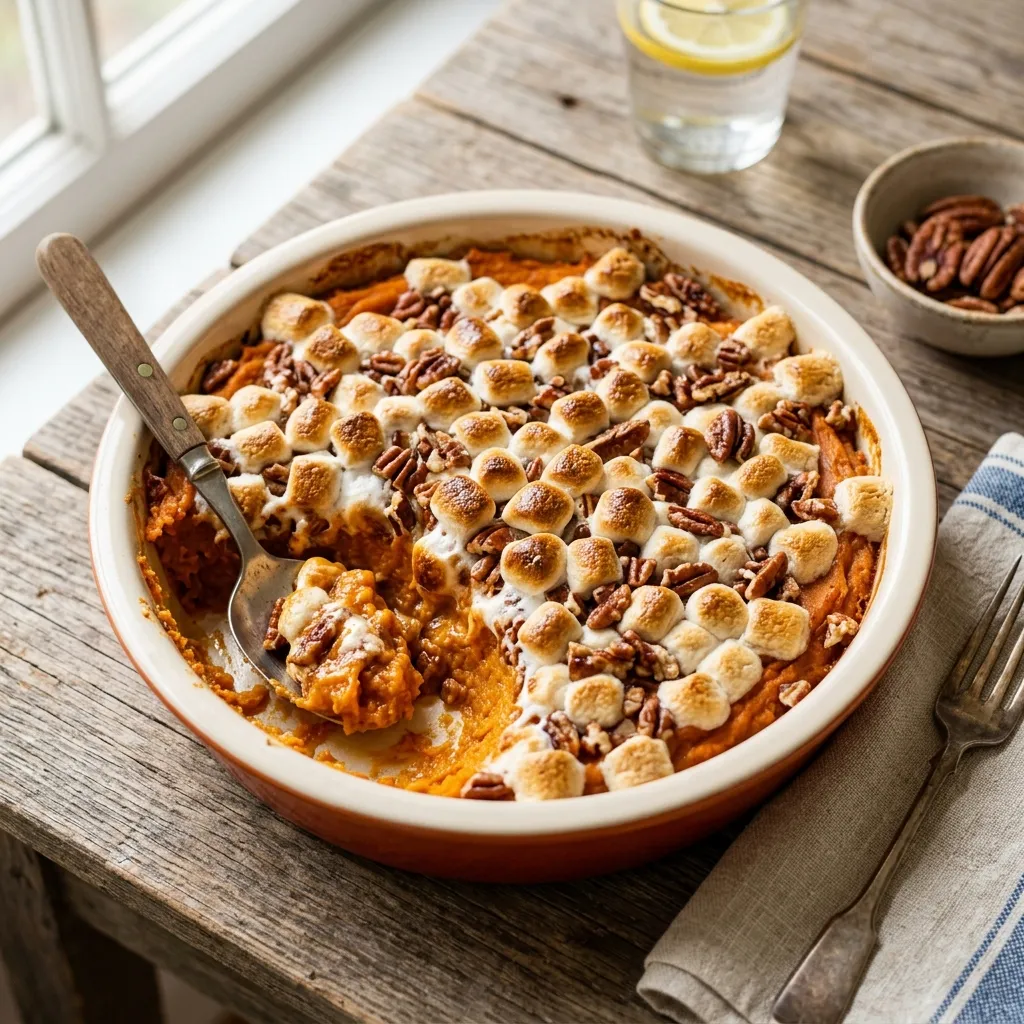
Sweet potato casserole emerged as a Thanksgiving staple in the early 20th century, catalyzed by the marshmallow industry's aggressive recipe marketing in the 1910s and 1920s. The dish typically layers mashed sweet potatoes enriched with butter, eggs, and warm spices beneath a topping of either marshmallows or a brown sugar-pecan streusel. This version uses the pecan streusel approach, which provides textural contrast and a more complex flavor profile than the marshmallow alternative. Sweet potatoes (Ipomoea batatas) are distinct from yams (Dioscorea species) despite widespread mislabeling in American grocery stores. True sweet potatoes contain beta-carotene, vitamin C, and complex carbohydrates that break down slowly during roasting, converting starches to maltose and creating the characteristic sweetness without added sugar. The roasting method used here concentrates these natural sugars more effectively than boiling, which leaches water-soluble nutrients. In Ayurvedic terms, sweet potato is one of the most nourishing root vegetables available — sweet in taste, cooling in energy, and sweet in post-digestive effect, with heavy and oily qualities that build all major tissue layers. Combined with warming spices (cinnamon, nutmeg, ginger), the casserole gains digestive intelligence that plain mashed sweet potatoes lack. The spices counteract the inherent heaviness and ensure that the dense starches are processed rather than creating ama.
Strongly pacifies vata through sweet taste, heavy quality, and grounding energy. Increases kapha due to the concentrated sweetness, heaviness, and oily quality of butter, sugar, and nuts combined. Mildly pacifies pitta through cooling energy and sweet taste, though the warming spices add a small amount of pitta stimulation.
Sweet potato casserole provides concentrated nourishment for vata-type depletion, recovery from illness, and underweight conditions. The beta-carotene content supports rakta dhatu and skin health. The combination of complex carbohydrates with fat and warming spices creates sustained energy release that stabilizes blood sugar and calms vata's erratic metabolism.
Ingredients
- 3 pounds sweet potatoes (orange-fleshed variety)
- 4 tablespoons unsalted butter (melted, for filling)
- 0.33 cup brown sugar (packed, for filling)
- 2 large eggs
- 0.33 cup whole milk
- 1 teaspoon vanilla extract
- 1 teaspoon cinnamon
- 0.25 teaspoon nutmeg (freshly grated)
- 0.5 teaspoon ground ginger
- 0.5 teaspoon sea salt
- 1 cup pecans (roughly chopped, for topping)
- 0.33 cup brown sugar (packed, for topping)
- 0.25 cup all-purpose flour (for topping)
- 3 tablespoons unsalted butter (cold, cubed, for topping)
Instructions
- Preheat the oven to 400°F (205°C). Pierce each sweet potato several times with a fork and place directly on the oven rack with a baking sheet below to catch drips. Roast for 45-55 minutes until completely soft when squeezed (use an oven mitt). Roasting rather than boiling concentrates sweetness and eliminates the waterlogged texture that makes boiled sweet potato casseroles mushy.
- Once the sweet potatoes are cool enough to handle, split them open and scoop the flesh into a large bowl. Discard the skins. You should have about 4 cups of roasted sweet potato flesh. The flesh will be deeply caramelized at the edges — include these darker bits, as they carry the most concentrated flavor.
- Reduce the oven temperature to 350°F (175°C). Mash the sweet potato flesh with a potato masher or fork until smooth. Add 4 tablespoons of melted butter, 1/3 cup brown sugar, eggs, milk, vanilla, cinnamon, nutmeg, ginger, and salt. Stir until uniformly combined. Taste and adjust sweetness — well-roasted sweet potatoes may need less added sugar.
- Spread the sweet potato mixture evenly into a buttered 9x13-inch baking dish or a deep 10-inch round casserole dish. Smooth the top with a spatula.
- Prepare the pecan streusel topping. Combine chopped pecans, 1/3 cup brown sugar, flour, and cold cubed butter in a bowl. Use your fingertips to pinch and rub the butter into the dry ingredients until the mixture resembles coarse, clumpy sand with visible pea-sized butter pieces. These butter pieces will melt during baking and create the crispy, irregular streusel texture.
- Scatter the streusel evenly over the sweet potato filling. Do not pack it down — the loose, irregular layer bakes into a better crust than a compressed one.
- Bake at 350°F for 25-30 minutes until the topping is golden brown and the filling is bubbling at the edges. The center should be set — it will jiggle slightly like custard but should not be liquid.
- Let the casserole cool for 15 minutes before serving. The filling firms as it cools, making it easier to serve clean portions. Serve warm as a side dish — this pairs with roasted poultry, baked ham, or as part of a vegetarian spread with greens and grain.
Nutrition
These values are estimates calculated from the ingredient list and may vary based on brands, cooking methods, and serving size. Not a substitute for medical or dietary advice.
How This Recipe Affects Each Dosha
Vata
Sweet potato casserole is an excellent vata-pacifying dish. The sweet taste — present in the sweet potato, brown sugar, butter, milk, and pecans — is the primary taste for calming vata. The heavy, oily, and soft qualities directly oppose vata's light, dry, and rough nature. The warming spices (cinnamon, ginger, nutmeg) stimulate vata's often-weak digestive fire without creating excessive heat. The eggs and butter add nourishing substance that builds depleted tissues. This is comfort food in the Ayurvedic sense — it grounds, warms, and stabilizes.
Pitta
The cooling energy and sweet taste of sweet potato make the base of this casserole pitta-calming. However, the additions — brown sugar, cinnamon, ginger, and nutmeg — are all heating and tip the balance toward mild pitta provocation. The net effect is roughly neutral for pitta in moderate portions. The real concern is the concentrated sweetness, which can ferment in pitta's strong digestive acid and cause sour eructation. Eat a modest serving rather than returning for seconds.
Kapha
Sweet potato casserole is among the most kapha-aggravating side dishes in American cuisine. Every quality that makes it comforting — the sweet taste, heavy texture, oily butter, soft consistency — directly increases kapha. The brown sugar adds pure sweet taste without nutritional complexity. The pecans add further heaviness and oiliness. Even the warming spices, while mildly kapha-balancing, cannot offset the cumulative effect. Kapha types should eat a very small portion or opt for a different side.
The heavy, dense quality of sweet potato casserole requires moderate to strong agni. The warming spices — cinnamon, ginger, and nutmeg — provide meaningful agni support, making this more digestible than a plain sweet potato preparation. However, the brown sugar and butter add richness that can overwhelm weak digestion. The eggs provide structure that moderates the rate of sugar absorption.
Nourishes: rasaraktamamsamedashukra
Adjustments by Constitution
For Vata Types
This dish is already ideal for vata. Enhance it further by adding a pinch of cardamom to the filling and using ghee instead of butter for deeper tissue nourishment. A drizzle of warm honey (added after cooking) on the served portion provides additional grounding sweetness. Eat a generous portion — this is precisely the kind of substantial, sweet, warm food that vata thrives on during cold months.
For Pitta Types
Reduce brown sugar to 2 tablespoons in the filling and replace the rest with a mashed ripe banana for natural sweetness. Eliminate ginger and reduce cinnamon to 1/2 teaspoon. Add 1/4 teaspoon of cardamom, which is cooling and sweet. Replace pecans in the streusel with coconut flakes for a cooling fat source. Increase vanilla to 2 teaspoons — vanilla is sweet and mildly cooling. Serve alongside bitter greens to balance the sweetness.
For Kapha Types
Replace brown sugar entirely with a small amount of raw honey mixed in after baking. Reduce butter by half and omit the milk — the roasted sweet potatoes should be moist enough without it. Double the ginger and add 1/4 teaspoon of black pepper to the filling. For the topping, replace the streusel with a thin layer of toasted sunflower seeds mixed with a pinch of cinnamon. Serve a small portion (1/2 cup) alongside pungent and bitter vegetables like sauteed kale with mustard seeds.
Seasonal Guidance
Perfectly aligned with late fall and winter eating. Sweet potatoes are harvested in autumn, and the heavy, grounding qualities suit the cold season when the body naturally seeks caloric density. The warming spices support the body's increased need for internal heat. Avoid during spring when kapha accumulation from winter needs clearing, not adding to.
Best time of day: Best served at lunch or as part of an early dinner. The heavy, sweet qualities provide sustained energy but take time to digest. Avoid as a late-evening dish when agni is winding down.
Cultural Context
Sweet potato casserole occupies a unique space in American cuisine as a dish that blurs the line between side dish and dessert. Its association with Thanksgiving reflects the holiday's emphasis on abundance and harvest celebration. Sweet potatoes themselves were a survival food for enslaved African Americans in the antebellum South — easy to grow, calorie-dense, and nutritionally complete. The transformation of this subsistence crop into a holiday centerpiece reflects the broader pattern of Southern Black culinary traditions being absorbed into mainstream American food culture. George Washington Carver's extensive work on sweet potato cultivation and its dozens of uses further elevated the tuber's status in American agriculture and cuisine.
Deeper Context
Origins
Sweet potato cultivation spans West Africa, Southeast Asia, Polynesia, and pre-Columbian South America — an unusually global pre-Columbian crop, the distribution of which is a continuing botanical mystery (the Polynesian-South-American connection pre-dates known contact). American Southern sweet potato tradition is primarily African-American driven. The marshmallow topping specifically dates to a 1917 recipe contest sponsored by the Angelus Marshmallow company, which cemented the dish in 20th-century American holiday canon.
Food as Medicine
Sweet potato is one of the most nutrient-dense root vegetables — very high vitamin A (beta-carotene), vitamin C, potassium, and fiber. Classical convalescent food across African, Caribbean, and Pacific Islander medicine. Pediatric first-food across multiple cultures. Pecans are native to the Mississippi Valley and Texas and carry Indigenous Southeastern and Southern US folk-medicinal status for joint and heart support.
Ritual & Seasonal Role
Thanksgiving, Christmas, African-American Sunday dinner, Southern family holiday tables. Autumn and winter peak during sweet-potato harvest. The dish functions as a holiday-canon side alongside turkey and dressing in most American homes; African-American Southern tradition often treats the casserole as a vegetable side rather than a dessert, despite its sweetness.
Classical Pairings & Cautions
Turkey, ham, collard greens, cornbread. Cautions: the sugar-starch-fat combination is a substantial glycemic load — diabetic restriction applies; Kapha aggravation substantial in winter; pecan allergies are tree-nut-family severe; the marshmallow topping contains gelatin (animal-derived — excludes Jain and strict vegetarian diets); high potassium contraindicates in advanced renal disease.
Cross-Tradition View
How other medical and food-wisdom traditions read this dish. Each tradition names the same physiological reality in its own language — the agreements across them are where universal principles live.
Traditional Chinese Medicine
Sweet potato is sweet-warm and Spleen-tonifying — classical TCM Qi-builder for post-illness and elderly constitutions; butter is warm-wet; brown sugar is Spleen-tonifying; pecans are Kidney-Yang tonifying; cinnamon warms the middle. A comprehensive Spleen-and-Kidney tonic with moderate heaviness. Appropriate for cold-deficient types and for elderly patients rebuilding after winter.
Greek Humoral
Hot-wet. Sanguine-melancholic-balance. A feast-day dish by classical temperament. Galenic physicians would have recognized the combination as well-constructed for celebration eating — the warming spices and fat balancing the substantial starch.
Ayurveda
Cooling virya (sweet potato is cooling), sweet vipaka. Pacifies Vata through heaviness and unctuousness; aggravates Kapha substantially through the starch-sugar-fat combination; mildly aggravates Pitta through the baking process. The cinnamon adds the only real Kapha-reducing element.
Indigenous & African-American Southern
Sweet potato is a West African cultivar that crossed with the American Southern food system during the transatlantic slave trade. Both Cherokee and enslaved-African traditions used sweet potato extensively — it was one of the few crops that could be grown and stored on plantation subsistence plots. The casserole form with marshmallow topping is an African-American mid-century Southern innovation that became Thanksgiving canonical after WWII and now functions as one of the single most culturally-identifiable American holiday dishes.
Chef's Notes
Roasting the sweet potatoes a day ahead saves significant time and improves flavor — the flesh continues to develop sweetness as it cools. Store the roasted flesh refrigerated and bring to room temperature before assembling. For a deeper, more complex flavor, substitute 2 tablespoons of the brown sugar with sorghum syrup or dark maple syrup. The filling also freezes well for up to 3 months without the topping — add a fresh streusel when ready to bake.
Frequently Asked Questions
Is Sweet Potato Casserole good for my dosha?
Strongly pacifies vata through sweet taste, heavy quality, and grounding energy. Increases kapha due to the concentrated sweetness, heaviness, and oily quality of butter, sugar, and nuts combined. Mildly pacifies pitta through cooling energy and sweet taste, though the warming spices add a small amount of pitta stimulation. Sweet potato casserole is an excellent vata-pacifying dish. The cooling energy and sweet taste of sweet potato make the base of this casserole pitta-calming. Sweet potato casserole is among the most kapha-aggravating side dishes in American cuisine.
When is the best time to eat Sweet Potato Casserole?
Best served at lunch or as part of an early dinner. The heavy, sweet qualities provide sustained energy but take time to digest. Avoid as a late-evening dish when agni is winding down. Perfectly aligned with late fall and winter eating. Sweet potatoes are harvested in autumn, and the heavy, grounding qualities suit the cold season when the body naturally seeks caloric density. The w
How can I adjust Sweet Potato Casserole for my constitution?
For Vata types: This dish is already ideal for vata. Enhance it further by adding a pinch of cardamom to the filling and using ghee instead of butter for deeper tissu For Pitta types: Reduce brown sugar to 2 tablespoons in the filling and replace the rest with a mashed ripe banana for natural sweetness. Eliminate ginger and reduce c
What are the Ayurvedic properties of Sweet Potato Casserole?
Sweet Potato Casserole has sweet taste (rasa), cooling energy (virya), and sweet post-digestive effect (vipaka). Its qualities (gunas) are heavy,oily,soft. It nourishes rasa,rakta,mamsa,meda,shukra. The heavy, dense quality of sweet potato casserole requires moderate to strong agni. The warming spices — cinnamon, ginger, and nutmeg — provide meaningful agni support, making this more digestible than a plain sweet potato preparation. However, the brown sugar and butter add richness that can overwhelm weak digestion. The eggs provide structure that moderates the rate of sugar absorption.