Smoothie Bowl
American Recipe
Overview
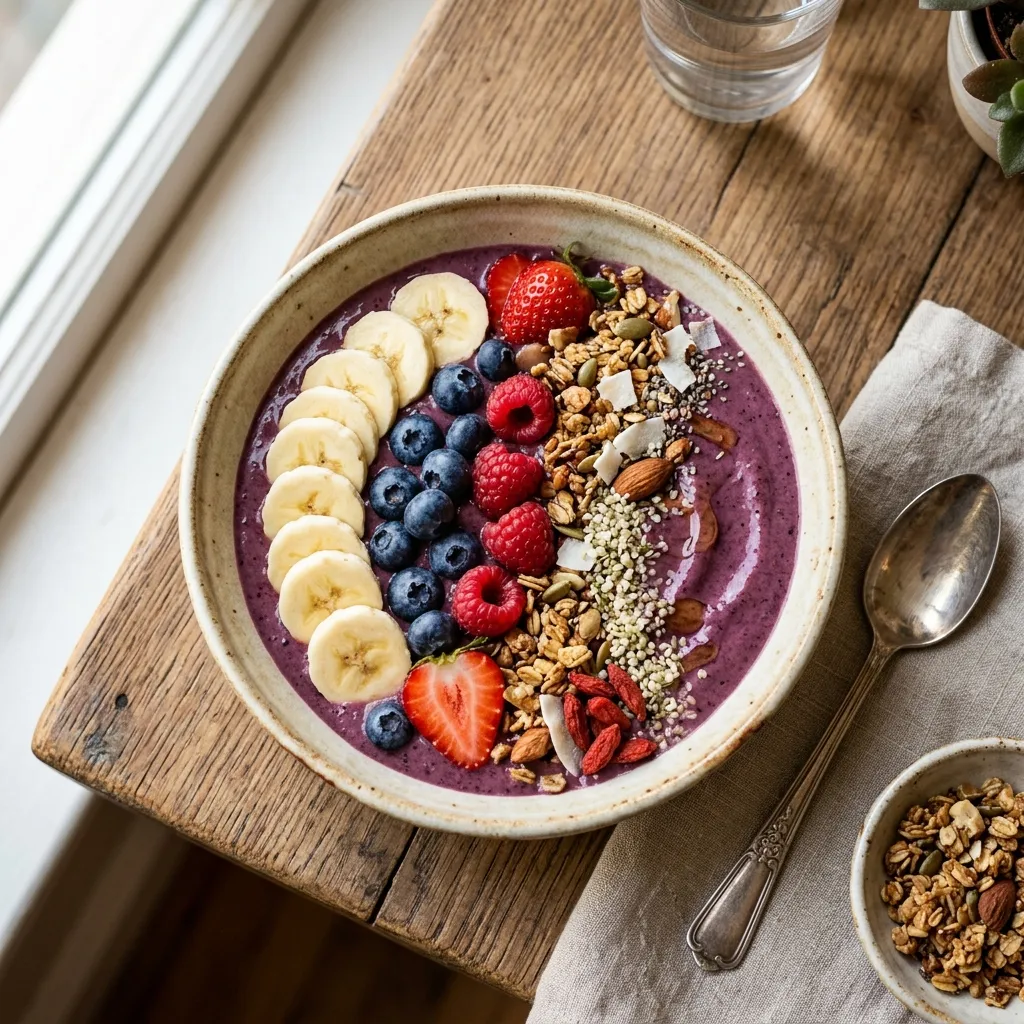
The smoothie bowl emerged from Brazilian acai bowl culture in the 2010s, spreading through Instagram and health-food cafes in California and Hawaii before becoming a nationwide breakfast trend. The format is straightforward: a smoothie blended thick enough to eat with a spoon, poured into a bowl, and topped with an array of fruits, seeds, nuts, and granola. The thickness distinguishes it from a drinkable smoothie — the frozen fruit base should hold toppings on its surface without sinking. This version uses a mixed berry and banana base — blueberries, strawberries, and banana provide the color, sweetness, and body, while a splash of liquid allows blending without thinning. The toppings contribute crunch, additional nutrients, and visual appeal: granola for texture, fresh berries for brightness, coconut flakes for healthy fat, and chia seeds for omega-3 fatty acids and fiber that swells into a gel-like consistency. Ayurvedically, smoothie bowls present the same fundamental challenge as their drinkable counterparts — cold temperature, raw fruit, and combined food categories create a preparation that demands robust agni to process. The improvement over a liquid smoothie is the spoon-eating format, which slows consumption and engages the chewing mechanism through the toppings, stimulating digestive enzyme production. The fruit diversity also introduces multiple rasas (sweet from banana, sour-sweet from berries, astringent from blueberry skin), creating a more digestively intelligent profile than a single-fruit smoothie.
Moderately increases kapha through cold temperature, sweet taste, and heavy, smooth quality of the blended base. Mixed effect on vata — sweet and smooth qualities calm, but cold temperature and raw fruit aggravate. Mildly pacifies pitta through cooling energy and sweet-sour taste profile, making this the most pitta-appropriate American breakfast bowl option.
Ingredients
- 2 cups frozen mixed berries (blueberries and strawberries)
- 1 large frozen banana (broken into chunks)
- 0.5 cup almond milk (unsweetened, or liquid of choice)
- 1 tablespoon honey (or maple syrup)
- 0.33 cup granola
- 0.25 cup fresh blueberries
- 4 medium fresh strawberries (sliced)
- 2 tablespoons coconut flakes (unsweetened)
- 1 tablespoon chia seeds
- 1 tablespoon almond butter (drizzled on top)
- 1 tablespoon hemp seeds
Instructions
- Place frozen berries, frozen banana, and almond milk in a high-speed blender. Use minimal liquid — you want a thick, ice-cream-like consistency that holds its shape when scooped into a bowl. Start with 1/4 cup of almond milk and add more only if the blender stalls.
- Blend on high speed, using the tamper tool if your blender has one to push ingredients toward the blades. Stop and scrape down the sides as needed. The mixture should be uniformly smooth and thick — when you pull a spoon through it, the trail should hold for several seconds before slowly filling in.
- Add honey and blend briefly to incorporate. Taste the base — frozen berries vary significantly in sweetness depending on variety and season. Adjust sweetness as needed. The toppings will add additional sweetness through granola and fruit, so the base can lean slightly tart.
- Divide the blended mixture between two bowls, smoothing the surface with the back of a spoon. Work quickly — the base begins to melt immediately at room temperature, and once it thins, the toppings will sink rather than sit on the surface.
- Arrange the toppings in rows or sections on the smoothie surface. Place granola along one edge, sliced strawberries and fresh blueberries in the center, and scatter coconut flakes, chia seeds, and hemp seeds across the remaining area. Drizzle almond butter over the top in a thin stream.
- Serve immediately with a spoon. Eat from the edges inward, combining a bit of crunchy topping with each spoonful of the frozen base. The textural contrast between the cold, creamy base and the crunchy, room-temperature toppings is central to the eating experience. Unlike a liquid smoothie, this format encourages slower, more mindful eating.
Nutrition
These values are estimates calculated from the ingredient list and may vary based on brands, cooking methods, and serving size. Not a substitute for medical or dietary advice.
How This Recipe Affects Each Dosha
Vata
The smoothie bowl is problematic for vata on multiple levels. The intensely cold temperature directly aggravates vata by constricting blood vessels, suppressing agni, and creating internal coldness that vata's already-cold constitution cannot afford. Raw frozen fruit is difficult for vata's variable digestion to process. The smooth, liquid base bypasses chewing, though the toppings partially remedy this. The sweet taste and smooth texture provide some vata benefit, but the cold and raw qualities dominate. Vata types who eat smoothie bowls regularly often notice increased bloating, gas, and overall coldness.
Pitta
Smoothie bowls are the most pitta-appropriate meal in this format. The cold temperature directly pacifies pitta's heat. Berries provide antioxidants and a sweet-sour taste profile that pitta tolerates well. The almond milk base is milder than dairy. Coconut flakes add cooling fat. The astringent quality of blueberry skin and chia seeds helps tone pitta's tendency toward loose digestion. The main caution is overconsumption of sweet taste, which can aggravate pitta's secondary sweet sensitivity when eaten in large quantities. A moderately sized bowl is appropriate for pitta, especially in summer.
Kapha
Smoothie bowls aggravate kapha through cold temperature, sweet taste, smooth texture, and the heaviness of a blended fruit base enriched with nut butter and granola. The liquid-turned-solid format is dense and requires strong agni that kapha types often lack in the morning. The granola topping adds further heaviness. The berries' astringent quality and chia seeds' light, dry properties provide minor kapha counterbalance, but the overall effect remains kapha-increasing. Kapha types who eat smoothie bowls regularly may notice weight gain, morning sluggishness, and increased congestion.
Smoothie bowls suppress agni through their intensely cold temperature. The frozen base must be warmed from approximately 20°F (-7°C) to 98.6°F (37°C) by the body before digestion can begin — this requires significant metabolic energy that is diverted from the digestive process. The toppings' crunch triggers some digestive enzyme secretion through chewing, providing more agni support than a liquid smoothie. Adding warming spices (cinnamon, ginger) meaningfully counteracts the cold suppression.
Nourishes: rasarakta
Adjustments by Constitution
For Vata Types
Allow frozen fruit to partially thaw for 15-20 minutes before blending, reducing the extreme cold. Replace almond milk with warm oat milk for grounding warmth. Add 1/2 teaspoon each of cinnamon, cardamom, and ginger to the base. Replace granola topping with warm stewed fruit (apples, pears cooked with ghee and spices). Add a drizzle of ghee and a pinch of nutmeg on top. These modifications shift the bowl from cold-raw to warm-cooked, dramatically improving vata compatibility while maintaining the bowl format.
For Pitta Types
This format is already well-suited to pitta with minor adjustments. Use coconut milk instead of almond milk for enhanced cooling. Add fresh mint leaves to the base while blending. Top with cooling fruits — melon, mango, or sweet grapes instead of acidic berries. Replace granola with puffed rice for lighter crunch. Add a tablespoon of rose petal jam or a sprinkle of dried rose petals for additional pitta-pacifying sweetness. Use coconut cream instead of almond butter for the drizzle.
For Kapha Types
Replace banana entirely with 1/2 cup of cooked beets or steamed cauliflower for thickness without the sugar load — this sounds unusual but produces a surprisingly good base. Use only berries (no banana) and blend with warm ginger tea instead of cold milk. Reduce sweetener to zero — berries should provide sufficient sweetness. Top with toasted pumpkin seeds, a sprinkle of dried ginger, bee pollen, and a thin drizzle of raw honey instead of granola, coconut, and nut butter. Eat immediately while the warm ginger tea maintains temperature.
Seasonal Guidance
The cold, sweet, and heavy qualities are appropriate only for hot summer months when pitta needs cooling and the body can handle cold foods without digestive suppression. Consuming smoothie bowls in fall, winter, or spring works against the body's seasonal needs and suppresses agni during the times it most needs support.
Best time of day: Consume between 9-11 AM when morning agni has built to sufficient strength. Avoid as the first food of the day on an empty stomach — the cold shock suppresses the digestive fire that is just kindling after sleep. Eat something warm first (hot water with lemon, warm tea) before transitioning to the cold bowl.
Cultural Context
The smoothie bowl represents a convergence of Brazilian acai tradition, Hawaiian surf culture, and Instagram food photography. Acai bowls have been consumed in the Amazon basin for centuries, where acai berries are a caloric staple mashed with water and eaten with farinha (cassava flour). The American adaptation added frozen banana for sweetness, elaborate toppings for visual appeal, and a variety of superfood additions (chia, hemp, goji) that reflect the wellness industry's influence on breakfast culture. The photogenic quality of arranged toppings on a purple or pink base made smoothie bowls one of the first 'Instagram foods' — meals optimized as much for visual documentation as for eating.
Deeper Context
Origins
Açaí bowls emerged in northern Brazilian (Amazonian) surf and jiu-jitsu culture in the 1980s and 1990s as an endurance-training food, moved to Hawaii through surf community exchange in the 1990s, and spread to mainland US surf-and-fitness culture in the 2000s. The dish went mainstream via Instagram in the mid-2010s, when photogenic bowls became a social-media-native food format. Açaí's Indigenous Amazonian origin predates all of this by millennia.
Food as Medicine
Açaí and blueberry anthocyanins have substantial modern research support for cardiovascular and cognitive benefit. Chia seeds are Aztec running-food — the Tarahumara long-distance runner tradition in northern Mexico uses chia-water (chia fresca) as endurance fuel. Coconut carries extensive Pacific Islander and Ayurvedic medicinal reputation. The combination is accidentally a collection of traditional endurance foods from separate continents.
Ritual & Seasonal Role
Not ceremonial. Summer food, exercise recovery, wellness-branded breakfast. Peak in fitness-culture cities (Los Angeles, Austin, Miami, Honolulu). Associated with Instagram wellness aesthetics and post-workout nutrition. Year-round in warm climates; seasonal summer in temperate climates.
Classical Pairings & Cautions
Granola, additional fruit, nut butter, honey, coconut flakes already assembled into the standard bowl. Cautions: substantial glycemic load from the honey, granola, and fruit combination; Ayurvedic viruddha ahara concerns for fruit-and-dairy combinations; tree-nut allergies in commercial granola; coconut sensitivity is rare but present; the dish is calorically dense despite its healthy image.
Cross-Tradition View
How other medical and food-wisdom traditions read this dish. Each tradition names the same physiological reality in its own language — the agreements across them are where universal principles live.
Traditional Chinese Medicine
Mixed berries are cool-sour-sweet and move Liver Qi; banana is cool-sweet and moistens Lung and Intestine Yin; granola (oats) is Spleen-tonifying; chia is cool-wet and Yin-building; coconut is cool-sweet and Yin-building. A cool Yin-building dish overall — summer-appropriate, poorly suited to cold climates or cold-dominant constitutions. TCM physicians would flag this for damp-accumulation risk in habitual consumers.
Greek Humoral
Cold-wet phlegmatic throughout, with no hot-dry correction. Galenic reading: summer-only, choleric-excess corrective. Inappropriate for phlegmatic or melancholic baseline types without substantial added ginger, cinnamon, or other hot-dry accompaniment.
Ayurveda
Cooling virya, sweet vipaka. Pitta-pacifying; Kapha-aggravating through the cold-heavy qualities; Vata-aggravating through rawness and cold. When yogurt or milk is added, the banana-berries combination raises classical viruddha ahara concerns — fruit combined with dairy is considered digestively incompatible and believed to generate ama.
Hawaiian & Brazilian Surf Culture
Açaí bowls — the direct ancestor of smoothie bowls — originated in northern Brazilian (Amazonian) surf and jiu-jitsu culture in the 1980s and 1990s as an endurance-training food. Hawaiian surfers adopted the format in the 1990s; mainland US surf-and-fitness culture followed in the 2000s and 2010s. The smoothie-bowl format of grain-topped chilled fruit purée traces to Brazilian tigela de açaí specifically — the Indigenous Amazonian palm fruit meeting Pacific surf aesthetics.
Chef's Notes
The blender quality determines whether you can achieve true smoothie-bowl thickness. A high-speed blender (Vitamix, Blendtec) handles frozen fruit with minimal liquid. A standard blender requires more liquid, which thins the base. If working with a weaker blender, freeze the almond milk into ice cubes and use those instead of liquid milk — this maintains thickness while giving the blades something to grip. Acai puree packets (available frozen in most grocery stores) can replace half the berries for a more traditional acai bowl version.
Frequently Asked Questions
Is Smoothie Bowl good for my dosha?
Moderately increases kapha through cold temperature, sweet taste, and heavy, smooth quality of the blended base. Mixed effect on vata — sweet and smooth qualities calm, but cold temperature and raw fruit aggravate. Mildly pacifies pitta through cooling energy and sweet-sour taste profile, making this the most pitta-appropriate American breakfast bowl option. The smoothie bowl is problematic for vata on multiple levels. Smoothie bowls are the most pitta-appropriate meal in this format. Smoothie bowls aggravate kapha through cold temperature, sweet taste, smooth texture, and the heaviness of a blended fruit base enriched with nut butter and granola.
When is the best time to eat Smoothie Bowl?
Consume between 9-11 AM when morning agni has built to sufficient strength. Avoid as the first food of the day on an empty stomach — the cold shock suppresses the digestive fire that is just kindling after sleep. Eat something warm first (hot water with lemon, warm tea) before transitioning to the cold bowl. The cold, sweet, and heavy qualities are appropriate only for hot summer months when pitta needs cooling and the body can handle cold foods without digestive suppression. Consuming smoothie bowls in f
How can I adjust Smoothie Bowl for my constitution?
For Vata types: Allow frozen fruit to partially thaw for 15-20 minutes before blending, reducing the extreme cold. Replace almond milk with warm oat milk for groundin For Pitta types: This format is already well-suited to pitta with minor adjustments. Use coconut milk instead of almond milk for enhanced cooling. Add fresh mint leave
What are the Ayurvedic properties of Smoothie Bowl?
Smoothie Bowl has sweet,sour,astringent taste (rasa), cooling energy (virya), and sweet post-digestive effect (vipaka). Its qualities (gunas) are cold,heavy,smooth. It nourishes rasa,rakta. Smoothie bowls suppress agni through their intensely cold temperature. The frozen base must be warmed from approximately 20°F (-7°C) to 98.6°F (37°C) by the body before digestion can begin — this requires significant metabolic energy that is diverted from the digestive process. The toppings' crunch triggers some digestive enzyme secretion through chewing, providing more agni support than a liquid smoothie. Adding warming spices (cinnamon, ginger) meaningfully counteracts the cold suppression.