Risotto ai Funghi
Italian Recipe
Overview
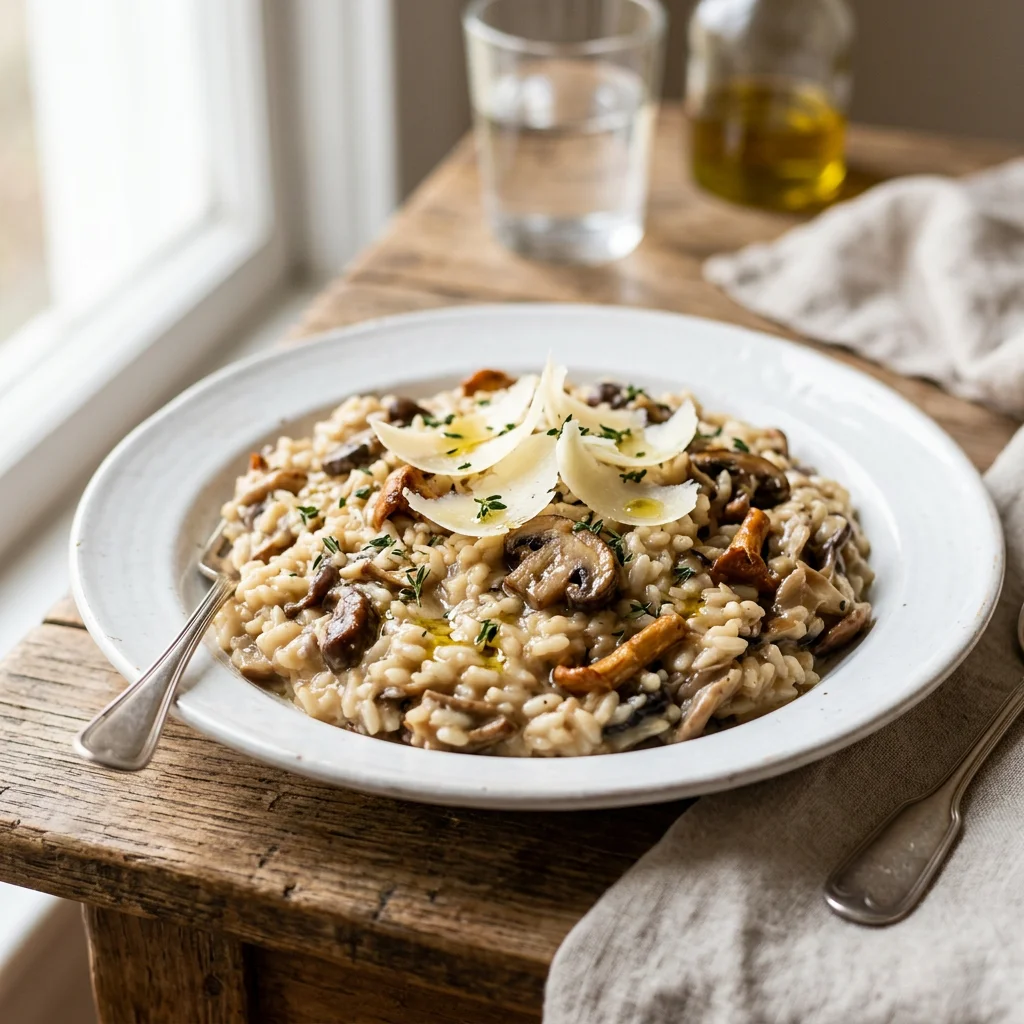
Risotto ai funghi is Northern Italy's meditation on patience and technique — Arborio or Carnaroli rice stirred slowly with warm broth until each grain releases its starch into a creamy, flowing mass, then finished with a generous handful of porcini and other wild mushrooms. It is the dish that separates a confident cook from a tentative one, because risotto requires constant attention, instinct for timing, and the willingness to stand at the stove stirring for twenty minutes without distraction. The mushroom version is perhaps the most celebrated of all risotti. In Piedmont and Lombardy, where the dish originates, the autumn forests yield porcini, chanterelles, and other wild fungi that define the local table for months. Dried porcini are used year-round, their soaking liquid becoming a concentrated broth that carries an intensity fresh mushrooms cannot match. The final mantecatura — the vigorous stirring-in of cold butter and Parmigiano off the heat — transforms the rice into something almost sauce-like, flowing across the plate in a wave rather than sitting in a mound. Ayurvedically, risotto ai funghi is heavy, warm, and deeply grounding. Mushrooms in Ayurveda are considered tamasic in some traditions, though modern Ayurvedic practitioners recognize their immune-supporting and earth-element qualities. The combination of rice starch, butter, and aged cheese creates a dish that strongly builds tissue and calms the nervous system, but can overwhelm weaker digestive fires.
Strongly pacifies Vata. Increases Kapha substantially due to heaviness, starch, dairy, and density. Mildly increases Pitta from garlic and aged cheese.
Ingredients
- 1.5 cups Arborio or Carnaroli rice
- 400 g Mixed mushrooms (cremini, shiitake, or wild — sliced)
- 30 g Dried porcini mushrooms (soaked in 1 cup hot water for 20 min)
- 5 cups Vegetable or mushroom broth (kept warm on the stove)
- 4 tbsp Unsalted butter (divided — 2 for cooking, 2 cold for finishing)
- 2 tbsp Extra-virgin olive oil
- 1 medium Onion (finely diced)
- 2 cloves Garlic (minced)
- 1/2 cup Dry white wine
- 3/4 cup Parmigiano-Reggiano (finely grated)
- 1 tsp Fresh thyme (leaves only)
- 2 tbsp Fresh parsley (finely chopped)
- 1 tsp Salt (or to taste)
- 1/2 tsp Black pepper (freshly ground)
Instructions
- Drain the soaked porcini, reserving their liquid. Strain the liquid through a fine sieve or coffee filter to remove grit, and add it to the warm broth. Roughly chop the rehydrated porcini.
- Heat 1 tablespoon each of butter and olive oil in a wide, heavy-bottomed pan over medium-high heat. Add the fresh mushrooms in a single layer — do not crowd — and cook without stirring for 3-4 minutes until golden. Flip and cook another 2 minutes. Add the chopped porcini, thyme, and a pinch of salt. Transfer to a plate.
- In the same pan, add the remaining butter and olive oil over medium heat. Add the onion and cook gently for 5 minutes until translucent. Add the garlic and cook 30 seconds more.
- Add the rice and stir constantly for 2 minutes, toasting the grains until they become translucent at the edges. Pour in the wine and stir until it is fully absorbed.
- Begin adding the warm broth one ladleful at a time, stirring frequently. Wait until each addition is mostly absorbed before adding the next. This process takes 18-20 minutes. The rice should be al dente — tender with a slight resistance at the center.
- Remove the pan from heat. Add the sauteed mushrooms, the remaining 2 tablespoons of cold butter, and the grated Parmigiano. Stir vigorously for 30 seconds — this is the mantecatura, and it creates the signature creamy texture.
- Season with salt and pepper. The risotto should flow like lava when you tilt the pan — if it is stiff, add another splash of warm broth. Serve immediately on warm plates, garnished with parsley and additional Parmigiano.
Nutrition
These values are estimates calculated from the ingredient list and may vary based on brands, cooking methods, and serving size. Not a substitute for medical or dietary advice.
How This Recipe Affects Each Dosha
Vata
Risotto is excellent for Vata — the warm, oily, heavy, and sticky qualities are precisely what the cold, dry, mobile Vata dosha needs. The slow cooking breaks down the rice thoroughly, the butter and cheese provide rich lubrication, and the mushrooms add earthy grounding. This is a deeply stabilizing dish for anxious or scattered Vata states.
Pitta
The aged Parmigiano and garlic add some heat, and the wine (even cooked) can be slightly aggravating. The mushrooms are generally neutral to mildly heating. Pitta types can enjoy this in cooler seasons but should monitor their response during summer or inflammatory states.
Kapha
This is a challenging dish for Kapha. The sticky, heavy rice starch combined with butter, cheese, and dense mushrooms creates exactly the damp, heavy, congesting quality that Kapha constitutions accumulate. It can increase mucus production and sluggishness. Kapha types should eat this rarely and in small portions.
The density and stickiness of risotto can slow agni if eaten in excess. The garlic and black pepper provide some counterbalance, but this is not a dish for weak digestion. Best eaten when agni is strong.
Nourishes: Rasa (plasma), Mamsa (muscle), Meda (fat), Majja (nerve/marrow)
Adjustments by Constitution
For Vata Types
Use the full amount of butter and Parmigiano. Add a pinch of saffron for warmth and digestive support. Include sage leaves sauteed in butter as a garnish. Serve with an extra drizzle of good olive oil.
For Pitta Types
Reduce Parmigiano to half a cup and use only one clove of garlic or omit it. Replace white wine with a squeeze of lemon juice added at the end. Add fresh basil as a garnish instead of thyme. Use cooling fennel broth as a base.
For Kapha Types
Reduce butter to 1 tablespoon total and skip the mantecatura butter. Use minimal Parmigiano. Add generous black pepper and dried red pepper flakes. Include light bitter greens like radicchio stirred in at the end. Reduce the portion size and serve alongside a bitter salad.
Seasonal Guidance
Risotto ai funghi is an autumn dish by nature — aligned with wild mushroom season in Northern Italy (September through November). The heavy, grounding qualities are perfectly suited to the Vata season of early autumn and the cold of winter. In spring, it becomes too heavy as the body needs to shed winter accumulation. In summer, the density is inappropriate. If making in warmer months, lighten with asparagus or peas instead of mushrooms.
Best time of day: Lunch or early dinner — never late at night. The heaviness requires strong agni and time to digest before sleep.
Cultural Context
Risotto belongs to the rice-growing flatlands of the Po Valley in Northern Italy — Lombardy, Piedmont, and the Veneto — where paddy fields have been cultivated since the late Middle Ages. It is an entirely different tradition from the pasta cultures of the south. Every city has its canonical risotto: Milan has risotto alla Milanese (with saffron), Venice has risi e bisi (with peas), and the forested hills of Piedmont and Emilia-Romagna claim the mushroom version as their own. In Italian homes, making risotto is a statement of care — you cannot multitask while stirring risotto, and that focused attention is a gift to whoever you are cooking for.
Deeper Context
Origins
Italian rice cultivation began in the 15th century after Arab traders introduced rice varieties from Iberia to Sicily, then northward through Italian ports. The Po River valley became Italy's rice belt; Lombardy, Piedmont, and Veneto each developed regional risotto traditions. Arborio, Carnaroli, and Vialone Nano varieties are classical risotto rices, each with specific starch-release characteristics. Porcini mushroom (Boletus edulis) foraging is an ancient Alpine-foothills tradition, protected by Italian Protected Designation of Origin regulations in several regions.
Food as Medicine
Porcini mushrooms provide substantial B-vitamins, selenium, zinc, and ergosterol (vitamin D precursor). Modern research on Boletus edulis supports antioxidant and immune-modulating activity. Arborio rice provides easily-digested carbohydrate and modest protein. The Parmigiano-Reggiano adds probiotic content and calcium. A therapeutically-dense preparation when porcini is high quality.
Ritual & Seasonal Role
Autumn Lombard dish — porcini peak season (September-November) defines seasonality. Featured at trattoria menus year-round using dried or frozen porcini. Not religiously ceremonial but tightly associated with Alpine-foothills autumn-foraging tradition.
Classical Pairings & Cautions
A simple arugula salad, a glass of Barolo or Barbaresco. Cautions: mushroom allergies; lactose sensitivity; gluten-free by default; commercial dried porcini may carry high sodium when salted; Kapha aggravation in winter; the slow-stirred preparation time (30 minutes of active cooking) limits this to occasion or weekend cookery.
Cross-Tradition View
How other medical and food-wisdom traditions read this dish. Each tradition names the same physiological reality in its own language — the agreements across them are where universal principles live.
Traditional Chinese Medicine
Arborio rice is Spleen-Qi-tonifying; porcini mushrooms build Yin and Kidney essence (classical TCM tonic); Parmigiano-Reggiano is Yin-building and Kidney-essence-supporting; butter is warm-moistening; white wine is Blood-moving. A comprehensive Yin-and-Kidney-Essence tonic with Qi-moving accent — TCM physicians would recognize porcini mushroom risotto as a genuine therapeutic preparation for Yin-deficient elderly constitutions.
Greek Humoral
Hot-wet sanguine-building. The slow-stirred technique matches Galenic endorsement of extended cookery for digestion-weak constitutions. The mushroom-wine combination specifically appears in Byzantine and medieval European convalescent cookery.
Ayurveda
Heating virya, sweet vipaka. Pacifies Vata substantially through unctuousness. Kapha-aggravating through the rice-cheese-butter combination. Pitta-neutral. Mushrooms are tamas-promoting in classical Ayurveda, which reserves them for specific therapeutic contexts rather than daily eating.
Lombard Milanese
Rice cultivation in Lombardy began in the 15th century after Arab traders introduced rice to Italy via Sicily. The Po River valley became the center of Italian rice agriculture, and Milan's risotto tradition crystallized in the 18th-19th century. Porcini mushroom foraging in Alpine foothills is an ancient Lombard-Piedmontese tradition, with Boletus edulis ('cep' or 'porcino') reaching prime quality in autumn (September-November). Risotto ai funghi is the classical Lombard autumn dish.
Chef's Notes
Carnaroli rice holds its structure better than Arborio and is the professional choice for risotto — it forgives a minute of over- or under-cooking. Never rinse risotto rice, as you need the surface starch for creaminess. Keep your broth at a gentle simmer the entire time; adding cold broth shocks the rice and breaks the cooking rhythm. The mantecatura (final stirring of cold butter and cheese off heat) is non-negotiable — it is what transforms cooked rice into risotto. If your risotto sits for even two minutes, it will seize up; serve immediately.
Frequently Asked Questions
Is Risotto ai Funghi good for my dosha?
Strongly pacifies Vata. Increases Kapha substantially due to heaviness, starch, dairy, and density. Mildly increases Pitta from garlic and aged cheese. Risotto is excellent for Vata — the warm, oily, heavy, and sticky qualities are precisely what the cold, dry, mobile Vata dosha needs. The aged Parmigiano and garlic add some heat, and the wine (even cooked) can be slightly aggravating. This is a challenging dish for Kapha.
When is the best time to eat Risotto ai Funghi?
Lunch or early dinner — never late at night. The heaviness requires strong agni and time to digest before sleep. Risotto ai funghi is an autumn dish by nature — aligned with wild mushroom season in Northern Italy (September through November). The heavy, grounding qualities are perfectly suited to the Vata season
How can I adjust Risotto ai Funghi for my constitution?
For Vata types: Use the full amount of butter and Parmigiano. Add a pinch of saffron for warmth and digestive support. Include sage leaves sauteed in butter as a garn For Pitta types: Reduce Parmigiano to half a cup and use only one clove of garlic or omit it. Replace white wine with a squeeze of lemon juice added at the end. Add fr
What are the Ayurvedic properties of Risotto ai Funghi?
Risotto ai Funghi has Sweet, Salty, Umami (Astringent undertone) taste (rasa), Heating energy (virya), and Sweet post-digestive effect (vipaka). Its qualities (gunas) are Heavy, Warm, Oily, Dense, Sticky. It nourishes Rasa (plasma), Mamsa (muscle), Meda (fat), Majja (nerve/marrow). The density and stickiness of risotto can slow agni if eaten in excess. The garlic and black pepper provide some counterbalance, but this is not a dish for weak digestion. Best eaten when agni is strong.