Pot-au-Feu
French Recipe
Overview
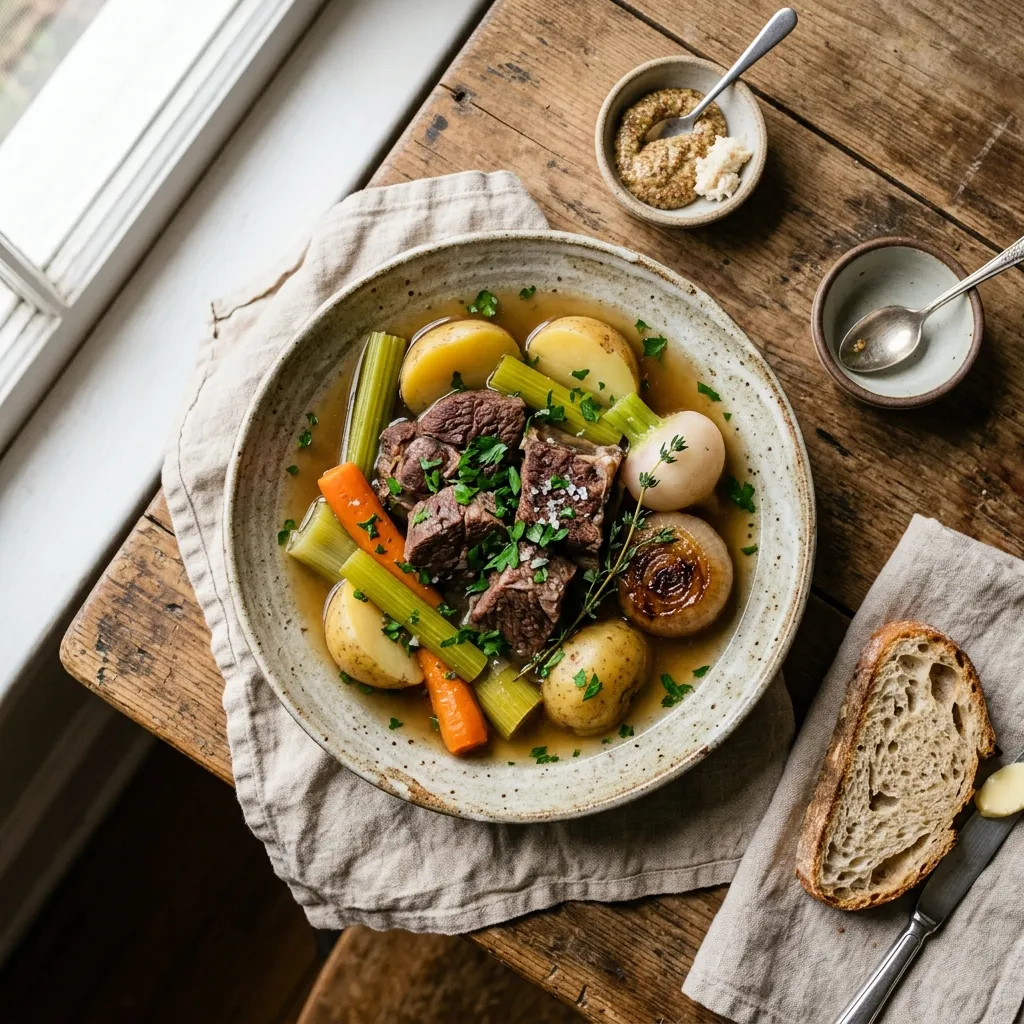
Pot-au-feu — 'pot on the fire' — is the original French home meal, documented since the Middle Ages as the dish that simmered perpetually over every hearth in France. King Henri IV famously declared in the 16th century that every family in France should have a chicken in their pot-au-feu every Sunday. The dish is nothing more than meat and vegetables simmered in water for hours until the broth becomes rich and golden, the meat falls apart at the touch of a fork, and the root vegetables have absorbed the essence of the cooking liquid. It is both the simplest and most fundamental dish in French cuisine. The Ayurvedic significance of pot-au-feu lies in its broth. Hours of gentle simmering extract gelatin from the beef's connective tissue, minerals from the bones (particularly when a split marrow bone is included), and water-soluble vitamins from the vegetables. This broth — clear, golden, and deeply savory — is among the most nourishing and easily digestible liquids in any culinary tradition. In Ayurvedic terms, it is a direct rasa dhatu builder: warm, liquid, slightly oily from the beef fat, and rich in the madhura rasa that nourishes all seven tissue layers. The traditional serving method separates the components: the broth is served first as a clear soup (often with toasted bread and grated cheese), followed by the sliced meats and vegetables on a platter with accompaniments of mustard, cornichons, coarse salt, and horseradish. This two-course approach from a single pot reflects the peasant economy of extracting maximum nourishment from minimal ingredients.
Pot-au-feu is the quintessential vata-pacifying food: warm, liquid, nourishing, heavy, and oily from the rendered beef fat. The broth alone is among the most therapeutically valuable preparations for vata imbalance. Pitta is moderately increased by the meat's heating quality. Kapha is increased by the heaviness and oiliness, though the broth's liquid nature is less kapha-aggravating than solid rich foods.
The gelatin-rich bone broth is therapeutic for gut lining repair, joint health, and overall tissue rebuilding. Pot-au-feu broth is one of the most frequently recommended healing foods across both Western traditional medicine and Ayurveda for convalescence, post-surgical recovery, and chronic vata conditions. The marrow provides concentrated fat-soluble nutrients including vitamins A, D, and K2.
Ingredients
- 3 pounds Beef chuck roast (in one piece)
- 2 pounds Beef short ribs (bone-in)
- 2 pieces Marrow bones (3 inches each, tied in cheesecloth to keep marrow intact)
- 3 large Leeks (trimmed, halved lengthwise, washed)
- 4 large Carrots (peeled, cut into 3-inch pieces)
- 3 medium Turnips (peeled and quartered)
- 3 large Celery stalks (cut into 3-inch pieces)
- 1 large Yellow onion (studded with 4 cloves)
- 4 cloves Garlic (smashed)
- 1 bundle Bouquet garni (thyme, bay leaves, parsley stems tied together)
- 1 teaspoon Whole black peppercorns
- 1 tablespoon Coarse sea salt
- 16 cups Water (enough to cover by 2 inches)
- 4 tablespoons Dijon mustard (for serving)
- 1/2 cup Cornichons (for serving)
- 2 teaspoons Fleur de sel (for serving)
Instructions
- Place the beef chuck and short ribs in a very large stockpot or Dutch oven. Cover with cold water by 2 inches — starting with cold water is essential, as it draws out impurities gradually rather than sealing them inside the meat. Bring to a boil slowly over medium heat.
- As the water approaches boiling, a grey foam (scum) will rise to the surface. Skim this foam thoroughly with a ladle or large spoon for 10-15 minutes. This meticulous skimming is the difference between a crystal-clear, golden broth and a cloudy, murky one. Do not skip or rush this step.
- Once the foam subsides, reduce heat to the gentlest possible simmer — you want occasional lazy bubbles, not a rolling boil. Boiling makes the broth cloudy and toughens the meat. Add the salt, peppercorns, onion studded with cloves, garlic, and bouquet garni.
- Simmer the meat very gently, partially covered, for 2 hours. The broth should barely move. Check periodically and skim any fat or foam that rises. Add the marrow bones (in their cheesecloth wrapping) after 1.5 hours — they need less time than the meat.
- After 2 hours of simmering the meat, add the carrots, turnips, celery, and leeks. These vegetables need 45 minutes to 1 hour of gentle cooking. Adding them too early turns them to mush; adding them too late leaves them raw inside. Continue the barely-there simmer.
- Test the meat at the 3-hour mark: it should be spoon-tender, pulling apart without resistance. The vegetables should be fully tender but holding their shape. The broth should be clear and golden.
- Carefully remove the meat and place on a cutting board. Let rest for 10 minutes, then slice the chuck against the grain into thick slices. Separate the short rib meat from the bones. Unwrap the marrow bones. Remove the vegetables with a slotted spoon and arrange on a warm platter alongside the sliced meat.
- Strain the broth through a fine-mesh sieve lined with cheesecloth if you want crystal clarity. Taste and adjust salt — pot-au-feu broth often needs more salt than you expect since the large volume of water dilutes the seasoning.
- Serve in the traditional two-course manner: first, ladle the clear broth into bowls. Spread the marrow on toasted bread with a sprinkle of fleur de sel and serve alongside the broth. For the second course, present the sliced meat and vegetables on the platter with Dijon mustard, cornichons, coarse salt, and horseradish on the side.
- Each diner selects their preferred cuts, vegetables, and condiments. The mustard and cornichons provide pungent and sour counterpoints to the rich, sweet meat and broth — this contrast is essential to the dish's balance.
Nutrition
These values are estimates calculated from the ingredient list and may vary based on brands, cooking methods, and serving size. Not a substitute for medical or dietary advice.
How This Recipe Affects Each Dosha
Vata
Pot-au-feu might be the single most vata-pacifying dish in all of French cooking. The slow-simmered broth delivers warm, liquid, slightly oily nourishment in the most digestible form possible. The gelatin from the connective tissue provides direct support for vata's joints, gut lining, and skin. The root vegetables — carrots and turnips — are grounding earth-element foods. The tender meat provides madhura rasa protein that builds all seven dhatus. The warmth counters vata's cold nature. The moisture counters vata's dryness. Every element of this dish addresses vata's fundamental needs.
Pitta
Beef is heating and can increase pitta, particularly in large portions. The long cooking process concentrates the meat's warming qualities into the broth. However, the gentle preparation — no browning, no searing, no high-heat cooking — avoids the intense Maillard-reaction heating that grilled or roasted meats carry. The root vegetables and the broth's overall nourishing sweetness are calming for pitta. The condiments (mustard, cornichons) are pitta-increasing but consumed in small amounts as accents. Overall, pot-au-feu is acceptable for pitta in moderate portions during cooler weather.
Kapha
The heavy, rich, oily qualities of pot-au-feu increase kapha substantially. The beef fat renders into the broth, creating a nourishing but heavy liquid. The root vegetables add additional earth-element density. The overall preparation provides the building, grounding energy that kapha types typically have in surplus. However, the broth's liquid nature is less kapha-aggravating than solid rich foods like cassoulet or quiche. The peppercorns and condiments provide mild kapha-reducing action. Kapha types should focus on the broth and vegetables, limiting the fattier meat cuts.
The warm broth gently opens and stimulates agni without challenging it. This is one of the most agni-friendly rich foods in existence — the long simmering pre-digests the proteins, the liquid form requires less digestive effort than solid food, and the warmth itself supports the digestive fire. Bone marrow provides concentrated nourishment that is absorbed with minimal digestive work.
Nourishes: rasaraktamamsaasthimajja
Adjustments by Constitution
For Vata Types
Pot-au-feu is already ideal for vata. To optimize, add a 1-inch piece of fresh ginger to the broth for additional warming and digestive support. Serve the broth with a teaspoon of ghee stirred in for extra unctuousness. Eat the marrow on toast — it is concentrated vata medicine. Add a pinch of hing (asafoetida) to your bowl if root vegetables cause gas. Drink the leftover broth between meals as a therapeutic tonic.
For Pitta Types
Replace half the beef with chicken, which is lighter and less heating. Add fennel bulbs to the vegetable mix for cooling balance. Skip the horseradish condiment, which is intensely pitta-aggravating. Use a mild mustard rather than hot Dijon. Skim the fat from the broth more aggressively before serving — the defatted broth retains its nourishing quality with less heating potency. Add fresh cilantro as a garnish. Serve at warm rather than hot temperature.
For Kapha Types
Skim all visible fat from the broth surface — use it for cooking if desired but do not consume it in the broth. Increase the turnips and celery (both have lightening, bitter qualities) and reduce the carrots. Add parsnips and cabbage wedges for additional lightness and slight pungency. Skip the marrow bones — their richness is pure kapha increase. Use lean cuts only and remove visible fat from the meat. Season each bowl with generous black pepper, grated ginger, and a squeeze of lemon to counteract the heaviness.
Seasonal Guidance
Pot-au-feu is a cold-weather staple, designed for the months when the body needs warming, building nourishment. It was historically a winter Sunday meal when families could tend the pot for hours. In spring and summer, the heaviness and warmth are excessive, and lighter preparations are more appropriate.
Best time of day: The traditional serving is Sunday lunch in France, when the family gathers and time allows for the leisurely two-course presentation. For weekday preparation, an early dinner (18:00-19:00) gives adequate digestion time before sleep.
Cultural Context
Pot-au-feu is often called 'the foundation of French cuisine' — Auguste Escoffier declared it the basis of all cooking, and many French chefs consider it the test of a cook's skill despite (or because of) its simplicity. Every region of France has a version: poule au pot in the southwest (chicken-based), potée auvergnate in Auvergne (with cabbage and sausage), garbure in Gascony. The dish crosses all class boundaries — it appeared on both the peasant table and the haute cuisine restaurant menu, the difference being only in the quality of ingredients and the number of cuts included. In Parisian fine dining, pot-au-feu was served with rare cuts like beef cheek and oxtail alongside the standard fare.
Deeper Context
Origins
Pot-au-feu descends from medieval European hearth cookery — the universal Indo-European peasant technique of slow-simmering meat and vegetables in a single pot over a low fire. Henri IV's 1593 declaration that 'every peasant should have a chicken in his pot every Sunday' cemented the Sunday-dinner cultural position. Escoffier formalized the haute-cuisine version in Le Guide Culinaire (1903). The dish is considered by many French food historians to be the most authentically French of all French dishes, predating the haute-cuisine developments of the 17th-19th centuries.
Food as Medicine
Bone marrow broth is documented across European folk medicine as a restorative for the ill, elderly, and postpartum. Modern gut-health dietary movements (GAPS, Weston A. Price Foundation) have formalized what peasant cookery knew — slow-cooked meat-and-marrow broths support digestive repair, joint health, and immune function through gelatin, glycine, proline, and mineral extraction. The long braise extracts fat-soluble vitamins from connective tissue.
Ritual & Seasonal Role
Sunday-dinner default across French households for centuries. Winter peak. Not religiously ceremonial but deeply woven into French cultural identity — Henri IV's political promise and the cultural position of Sunday pot-au-feu together make it a national symbol dish. Family-gathering food with no single regional origin, claimed by every French region with local variation.
Classical Pairings & Cautions
The broth served first as soup; the meat and vegetables served second with cornichons, coarse mustard, and coarse salt. A glass of red Burgundy or Beaujolais. Cautions: religious beef restrictions (Hindu, some Buddhist); gout patients should moderate the meat-and-marrow purine load; cardiovascular concerns from the rich broth in frequent consumption; the preparation time (4-6 hours) limits this to weekend cookery in modern households.
Cross-Tradition View
How other medical and food-wisdom traditions read this dish. Each tradition names the same physiological reality in its own language — the agreements across them are where universal principles live.
Traditional Chinese Medicine
Beef is a strong Blood-and-Qi tonic; marrow bones build Kidney Jing (Essence) specifically — the most prized tonic action in TCM materia medica; carrot is Blood-supporting; turnip is cool-bitter and moves Liver Qi; leek is warm-dispersing. A comprehensive Qi-Blood-Jing tonic — winter restoration archetype that TCM physicians would prescribe for post-partum recovery, elderly depletion, and serious convalescence.
Greek Humoral
Hot-wet sanguine-building aggressively. A Galenic feast-and-restoration preparation — the long-braised marrow-bone technique matches classical Hippocratic endorsements of extended cookery for weak digestion. Appropriate for melancholic and phlegmatic types needing substantial rebuilding; choleric types should moderate frequency.
Ayurveda
Heating virya, sweet vipaka. Pacifies Vata strongly through protein, marrow, and slow-braise-unctuous broth. Aggravates Kapha through heaviness. Beef is heavy and tamasic in classical Ayurveda, but the marrow-bone broth technique aligns with classical bone-broth preparations used for post-partum rebuilding in Indian traditional home medicine.
Medieval French Hearth
Pot-au-feu is the archetypal French peasant and bourgeois dish — a slow-simmered one-pot meat-and-vegetable preparation dating to medieval hearth cookery across every French region. Henri IV (1553-1610) reputedly declared 'la poule au pot' (chicken in the pot) as the ideal Sunday dinner for all French peasants, a political promise that became cultural shorthand. The bone-marrow component held particular cultural weight for its Essence-building richness, long before modern nutritional science characterized it.
Chef's Notes
Pot-au-feu requires no culinary skill — only patience and good ingredients. The simmer must be extraordinarily gentle: if the liquid is rolling, you have already failed. A kitchen thermometer should read between 190-200 degrees F — well below boiling. The initial skimming is tedious but non-negotiable; every minute spent removing impurities pays dividends in broth clarity. Traditional pot-au-feu includes a variety of beef cuts for different textures: chuck for its marbling, short ribs for their richness, and sometimes brisket or oxtail for additional gelatin. The marrow bones are considered the greatest delicacy — spread on toast with coarse salt, they are one of the most prized bites in French cuisine.
Frequently Asked Questions
Is Pot-au-Feu good for my dosha?
Pot-au-feu is the quintessential vata-pacifying food: warm, liquid, nourishing, heavy, and oily from the rendered beef fat. The broth alone is among the most therapeutically valuable preparations for vata imbalance. Pitta is moderately increased by the meat's heating quality. Kapha is increased by the heaviness and oiliness, though the broth's liquid nature is less kapha-aggravating than solid rich foods. Pot-au-feu might be the single most vata-pacifying dish in all of French cooking. Beef is heating and can increase pitta, particularly in large portions. The heavy, rich, oily qualities of pot-au-feu increase kapha substantially.
When is the best time to eat Pot-au-Feu?
The traditional serving is Sunday lunch in France, when the family gathers and time allows for the leisurely two-course presentation. For weekday preparation, an early dinner (18:00-19:00) gives adequate digestion time before sleep. Pot-au-feu is a cold-weather staple, designed for the months when the body needs warming, building nourishment. It was historically a winter Sunday meal when families could tend the pot for hours. In
How can I adjust Pot-au-Feu for my constitution?
For Vata types: Pot-au-feu is already ideal for vata. To optimize, add a 1-inch piece of fresh ginger to the broth for additional warming and digestive support. Serve For Pitta types: Replace half the beef with chicken, which is lighter and less heating. Add fennel bulbs to the vegetable mix for cooling balance. Skip the horseradish
What are the Ayurvedic properties of Pot-au-Feu?
Pot-au-Feu has madhura,lavana taste (rasa), ushna energy (virya), and madhura post-digestive effect (vipaka). Its qualities (gunas) are guru,snigdha,ushna,drava. It nourishes rasa,rakta,mamsa,asthi,majja. The warm broth gently opens and stimulates agni without challenging it. This is one of the most agni-friendly rich foods in existence — the long simmering pre-digests the proteins, the liquid form requires less digestive effort than solid food, and the warmth itself supports the digestive fire. Bone marrow provides concentrated nourishment that is absorbed with minimal digestive work.