Pho Bo
Vietnamese Recipe
Overview
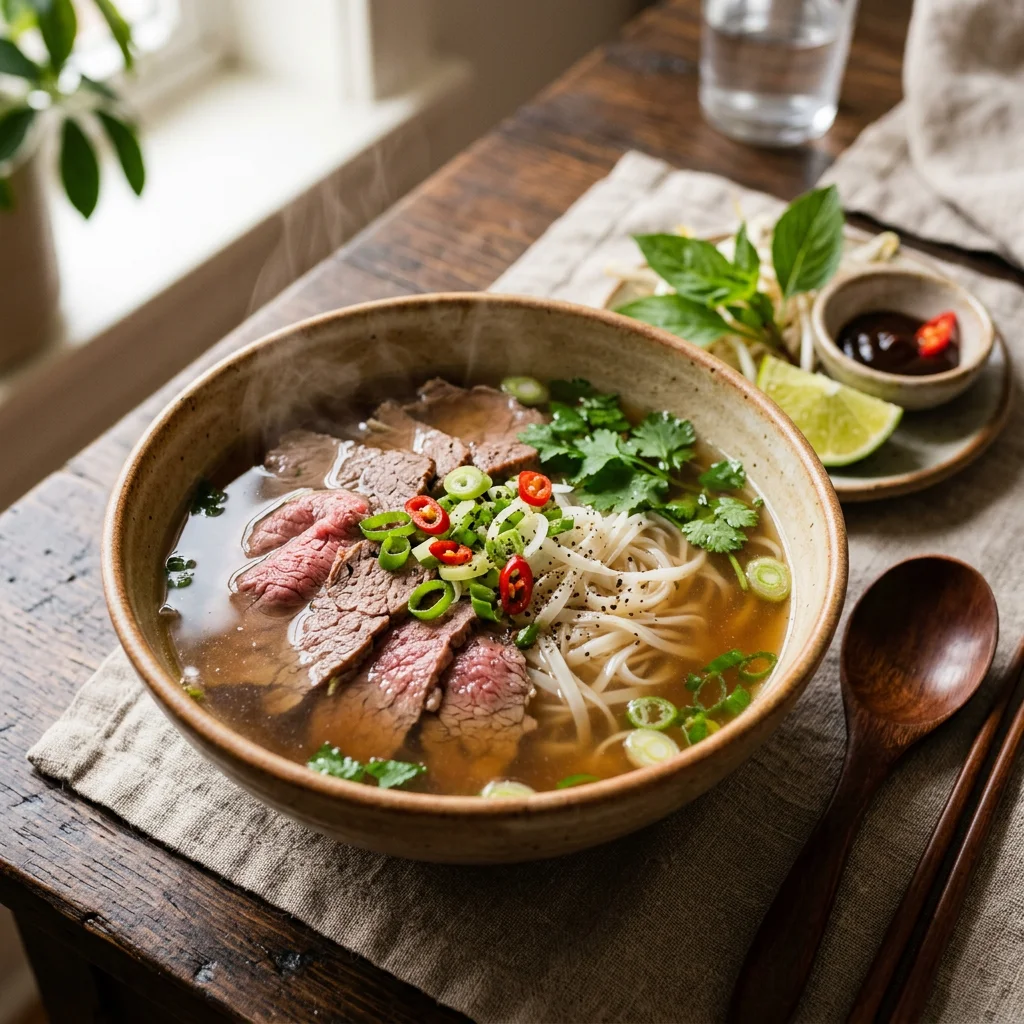
Pho bo is the defining dish of Vietnamese cuisine — a fragrant beef bone broth ladled over rice noodles with paper-thin slices of beef, finished tableside with a riot of fresh herbs, bean sprouts, lime, and chili. In Vietnam, it is first and foremost a breakfast food, eaten at street stalls starting before dawn, though its appeal transcends any single meal. The broth is the soul of the dish, built over hours from roasted beef bones, charred onion, and charred ginger, then perfumed with a carefully balanced spice sachet of star anise, cinnamon, cloves, cardamom, and coriander seeds. The origins of pho are debated — it emerged in northern Vietnam in the early twentieth century, likely influenced by both French colonial pot-au-feu and Chinese noodle soups, yet it became something entirely its own. Northern pho is austere, with a clear broth and minimal garnishes. Southern pho is exuberant, served with a basket overflowing with Thai basil, culantro, bean sprouts, lime wedges, and sliced chili. Both versions share the non-negotiable foundation: a broth that has been simmered with patience and care. From an Ayurvedic perspective, pho is a remarkable healing food. Long-simmered bone broth extracts collagen, minerals, and gelatin — deeply nourishing to rasa and asthi dhatus. The warming spice blend (star anise, cinnamon, cloves) kindles agni powerfully. The fresh herbs added at the table introduce prana (life force) and cooling balance. The five-element interplay — hot broth, cooling herbs, pungent chili, sour lime, salty fish sauce — mirrors the Ayurvedic principle of including all six tastes for complete satisfaction.
Strongly pacifies Vata due to warmth, oiliness, and nourishing broth. Mildly increases Pitta from heating spices and beef. Generally neutral for Kapha due to lightness of broth, though rice noodles add some heaviness.
Ingredients
- 3 lbs Beef bones (knuckle and marrow) (blanched and rinsed)
- 1 lb Beef brisket or flank (for the broth and slicing)
- 2 large Onion (halved and charred)
- 4 inches Fresh ginger (halved lengthwise and charred)
- 5 whole Star anise
- 1 whole Cinnamon stick (Vietnamese cinnamon preferred)
- 4 whole Whole cloves
- 1 tbsp Coriander seeds (lightly toasted)
- 3 tbsp Fish sauce (or to taste)
- 1 tbsp Rock sugar or yellow rock sugar (or regular sugar)
- 400 g Dried flat rice noodles (banh pho) (soaked per package directions)
- 1 bunch Thai basil (for serving)
- 4 wedges Lime wedges
- 2 cups Bean sprouts (for serving)
- 2 whole Fresh chili (Thai bird or serrano) (sliced)
Instructions
- Blanch the beef bones in rapidly boiling water for 10 minutes to remove impurities. Drain, rinse thoroughly under cold water, scrubbing off any scum, and place in a clean stockpot with 4 quarts of fresh cold water.
- While bones blanch, char the halved onions and ginger directly over a gas flame or under a broiler until deeply blackened on all sides — the char is essential for the broth's smoky depth. Rinse off loose char and add to the stockpot.
- Toast the star anise, cinnamon stick, cloves, and coriander seeds in a dry pan over medium heat for 2-3 minutes until fragrant. Tie in a cheesecloth sachet and add to the pot along with the whole brisket or flank.
- Bring the pot to a boil, then immediately reduce to a bare simmer — the surface should barely tremble. Skim any foam that rises. Simmer uncovered for 1.5 hours, then remove the brisket (it should be tender but not falling apart). Continue simmering the broth for another 1.5 hours.
- Strain the broth through a fine-mesh sieve lined with cheesecloth. Season with fish sauce and rock sugar. The broth should be deeply aromatic, clear, and golden — taste and adjust until the sweetness, saltiness, and depth are in harmony.
- Slice the reserved brisket across the grain into thin pieces. If using raw beef for the bowls, freeze it for 20 minutes then slice paper-thin.
- Cook the rice noodles according to package directions. Divide among bowls. Top with sliced cooked brisket and raw beef slices (if using).
- Bring the strained broth to a rolling boil and ladle it over the noodles and beef — the boiling broth will cook the raw beef instantly. Serve immediately with a plate of Thai basil, bean sprouts, lime wedges, sliced chili, and hoisin and sriracha on the side.
Nutrition
These values are estimates calculated from the ingredient list and may vary based on brands, cooking methods, and serving size. Not a substitute for medical or dietary advice.
How This Recipe Affects Each Dosha
Vata
Pho is one of the finest Vata-pacifying meals across all cuisines. The long-simmered bone broth is warm, oily, liquid, and deeply grounding — directly opposing Vata's cold, dry, light, mobile qualities. The collagen and gelatin nourish joints and connective tissue. The warming spice sachet (star anise, cinnamon, cloves) kindles agni without aggravating it. The fresh herbs at the table add prana. This is food as medicine for depleted Vata.
Pitta
The heating spices (star anise, cinnamon, cloves) and the warmth of beef broth can aggravate Pitta, particularly during summer or periods of inflammation. However, the fresh herbs, lime, and bean sprouts at the table provide significant cooling balance. Pitta types can enjoy pho by moderating chili, increasing lime and herbs, and choosing chicken broth over beef for a lighter version.
Kapha
The light, liquid quality of clear broth is beneficial for Kapha, and the pungent spices stimulate sluggish digestion. However, the rice noodles add heaviness, and the oily quality of bone broth can increase Kapha if consumed in large portions. Kapha types benefit from extra chili, extra lime, generous herbs, and reduced noodle portions.
The warming spice sachet — particularly star anise, cinnamon, and cloves — powerfully kindles agni. The long-simmered broth is pre-digested by the cooking process itself, making nutrients immediately available. Fish sauce adds a salty, pungent quality that further stimulates digestion. This is a meal that builds while being easy to assimilate.
Nourishes: Rasa (plasma), Rakta (blood), Mamsa (muscle), Asthi (bone), Majja (marrow)
Adjustments by Constitution
For Vata Types
Use generous amounts of broth and moderate noodles. Add extra star anise and cinnamon to the broth for deeper warmth. Include a drizzle of sesame oil in the bowl. Use the cooked brisket rather than raw beef slices, as cooked meat is easier for Vata digestion. Squeeze lime generously — sour taste pacifies Vata.
For Pitta Types
Reduce the spice sachet by half and omit cloves entirely. Skip the chili slices and hoisin sauce. Double the fresh Thai basil and add extra cilantro, which is powerfully cooling. Squeeze extra lime for its cooling sour quality. Consider using chicken bones instead of beef for a lighter broth.
For Kapha Types
Reduce rice noodles by half and add extra bean sprouts to make up volume. Load the bowl with Thai basil, cilantro, and sliced chili. Add a splash of rice vinegar for extra sharpness. Skip the hoisin sauce, which is heavy and sweet. Use the leanest beef cuts and skim all fat from the broth surface.
Seasonal Guidance
Ideal during Vata season (autumn) and Kapha-Vata season (winter) when the body craves warmth, moisture, and deep nourishment. The bone broth's collagen is especially valuable during cold, dry months when joints stiffen and skin cracks. In spring, lighten the bowl with extra vegetables and herbs. In summer, pho can still work as a lighter preparation — reduce spices, use chicken broth, and lean heavily on the cooling herbs and lime. In Vietnam, pho is eaten year-round regardless of temperature, a testament to the body's wisdom in craving warm broth even in tropical heat.
Best time of day: Traditional breakfast food in Vietnam, but excellent at any meal. The warm broth is especially therapeutic first thing in the morning when agni is kindling.
Cultural Context
Pho is Vietnam's national dish and its most potent cultural export. It emerged in the Nam Dinh and Hanoi areas of northern Vietnam around the turn of the twentieth century, possibly influenced by the French colonial presence (the charring of onions echoes pot-au-feu technique, and the word "pho" may derive from "feu"). After 1954, when Vietnam was partitioned, northern refugees brought pho south, where it evolved into the more garnish-heavy southern style. After 1975, Vietnamese refugees carried pho worldwide. Today it stands alongside ramen and chicken soup as one of the world's great healing broths — prescribed by Vietnamese grandmothers for colds, fatigue, heartbreak, and hangovers with equal conviction.
Deeper Context
Origins
Pho bo crystallized in northern Vietnam during the early 20th century in Nam Dinh province near Hanoi. The French colonial period (1887-1954) introduced beef consumption to Vietnam (which had been primarily pork-and-fish-eating), and the long-simmered-beef-bone-broth format may have been influenced by French pot-au-feu. The star-anise-cinnamon-cardamom spice architecture reflects Chinese-influenced Vietnamese cookery. Pho migrated south during the 1954 partition of Vietnam, with southern-Vietnamese pho developing sweeter broth and more elaborate herb garnishes. Pho became internationally iconic through post-1975 Vietnamese diaspora.
Food as Medicine
Beef bone broth provides gelatin, glycine, proline, and minerals with modern gut-health research validation. Star anise contains shikimic acid (the pharmaceutical precursor to oseltamivir/Tamiflu) and has extensive traditional use for respiratory and digestive support. A nutritionally and therapeutically-dense preparation with substantial restoration value.
Ritual & Seasonal Role
Classical Vietnamese breakfast — pho was originally a breakfast street-food preparation. Year-round with winter peak. Not religiously ceremonial but deeply tied to Vietnamese national identity and to post-1975 Vietnamese diaspora cultural preservation.
Classical Pairings & Cautions
Fresh herbs (Thai basil, cilantro, mint), bean sprouts, lime wedge, sliced chile, hoisin and sriracha sauces on the side. Vietnamese iced coffee or tea. Cautions: religious beef restrictions (Hindu, some Buddhist); shellfish-derived fish sauce; gluten-free by default (rice noodles); star anise in excess can cause nausea; gout patients should moderate the beef-bone purine content; the 8-12 hour preparation time limits this to restaurant or occasion cookery.
Cross-Tradition View
How other medical and food-wisdom traditions read this dish. Each tradition names the same physiological reality in its own language — the agreements across them are where universal principles live.
Traditional Chinese Medicine
Beef bones build Kidney Jing (Essence) substantially through the long-cooked marrow and collagen extraction; star anise is warm and moves Liver Qi and supports Kidney; rice noodles are Spleen-Qi-tonifying; fish sauce is salty-warm; Thai basil is warm-aromatic. A comprehensive Qi-Yin-Jing-and-Blood tonic — TCM physicians would recognize pho bo as classical restoration food, similar in therapeutic class to Japanese tonkotsu ramen.
Greek Humoral
Hot-wet sanguine-building. A Galenic-suitable restoration broth — the long-simmered bone-broth-with-aromatic-spices matches classical Mediterranean convalescent preparations.
Ayurveda
Heating virya, sweet vipaka. Pacifies Vata substantially through marrow and protein density. Pitta mildly aggravated through warming-spice-combination. Kapha-reducing through dispersing spices (star anise, cinnamon, ginger).
Vietnamese French-Colonial (1900s)
Pho bo crystallized in northern Vietnam (Nam Dinh province, near Hanoi) during the early 20th century — the French colonial period (1887-1954) contributed the beef consumption tradition (Vietnam had been primarily pork-and-fish before French influence) and possibly the soup-and-bread-combination concept (vaguely adjacent to pot-au-feu). The specific star-anise-cinnamon-cardamom spice architecture is Chinese-influenced; the basil-cilantro-lime finish is Vietnamese. One of the youngest internationally-iconic dishes — approximately 120 years old.
Chef's Notes
The single most important rule: never let the broth boil vigorously after the initial boil. A rolling boil emulsifies the fat into the broth and makes it cloudy. A gentle simmer — barely a bubble breaking the surface — produces the clear, luminous broth that defines great pho. Toast the spices until fragrant but not burnt; over-toasted spices make the broth bitter. Vietnamese cinnamon (Saigon cinnamon) is stronger and sweeter than Ceylon — use it if available. The broth freezes beautifully for months, making it worthwhile to double the recipe.
Frequently Asked Questions
Is Pho Bo good for my dosha?
Strongly pacifies Vata due to warmth, oiliness, and nourishing broth. Mildly increases Pitta from heating spices and beef. Generally neutral for Kapha due to lightness of broth, though rice noodles add some heaviness. Pho is one of the finest Vata-pacifying meals across all cuisines. The heating spices (star anise, cinnamon, cloves) and the warmth of beef broth can aggravate Pitta, particularly during summer or periods of inflammation. The light, liquid quality of clear broth is beneficial for Kapha, and the pungent spices stimulate sluggish digestion.
When is the best time to eat Pho Bo?
Traditional breakfast food in Vietnam, but excellent at any meal. The warm broth is especially therapeutic first thing in the morning when agni is kindling. Ideal during Vata season (autumn) and Kapha-Vata season (winter) when the body craves warmth, moisture, and deep nourishment. The bone broth's collagen is especially valuable during cold, dry months w
How can I adjust Pho Bo for my constitution?
For Vata types: Use generous amounts of broth and moderate noodles. Add extra star anise and cinnamon to the broth for deeper warmth. Include a drizzle of sesame oil For Pitta types: Reduce the spice sachet by half and omit cloves entirely. Skip the chili slices and hoisin sauce. Double the fresh Thai basil and add extra cilantro,
What are the Ayurvedic properties of Pho Bo?
Pho Bo has Sweet, Salty, Pungent, Sour taste (rasa), Heating energy (virya), and Sweet post-digestive effect (vipaka). Its qualities (gunas) are Warm, Light, Oily, Liquid. It nourishes Rasa (plasma), Rakta (blood), Mamsa (muscle), Asthi (bone), Majja (marrow). The warming spice sachet — particularly star anise, cinnamon, and cloves — powerfully kindles agni. The long-simmered broth is pre-digested by the cooking process itself, making nutrients immediately available. Fish sauce adds a salty, pungent quality that further stimulates digestion. This is a meal that builds while being easy to assimilate.