Pad Thai
Thai Recipe
Overview
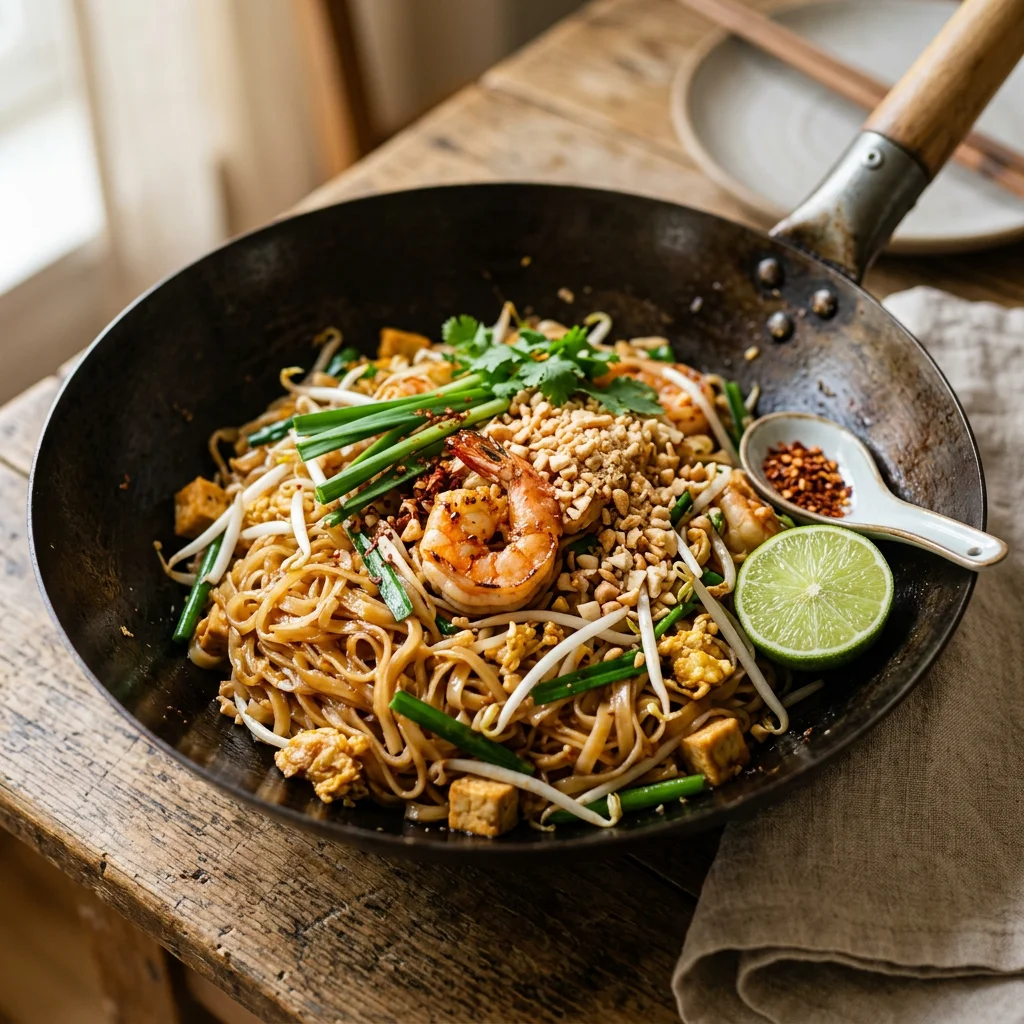
Pad Thai is Thailand's most internationally recognized dish — flat rice noodles stir-fried in a wok over blazing heat with a tamarind-based sauce, eggs, tofu, dried shrimp, and bean sprouts, finished with crushed peanuts and a wedge of lime. The dish has a surprisingly recent origin: it was promoted during the 1930s and 1940s by Prime Minister Plaek Phibunsongkhram as part of a national identity campaign, encouraging Thais to eat noodles made from domestic rice rather than imported wheat. What began as a government initiative became one of the world's great street foods. Authentic Pad Thai depends entirely on the sauce — a precise balance of tamarind paste (sour), palm sugar (sweet), and fish sauce (salty and umami). The noodles must be soaked but not fully softened before hitting the wok, where the residual firmness allows them to absorb the sauce without becoming mushy. The wok must be screaming hot. Each component — noodles, egg, protein, garnish — goes in at exactly the right moment in a rapid-fire sequence. From an Ayurvedic standpoint, Pad Thai is a complex dish touching all six tastes: the tamarind brings sour, the palm sugar brings sweet, the fish sauce brings salty, the chilies bring pungent, the lime brings astringent, and the dried shrimp brings a deep bitter-umami undertone. This six-taste completeness is why a well-made Pad Thai feels so satisfying — no single taste dominates, and the body registers fullness and contentment rather than craving.
Mildly increases all three doshas if overconsumed due to the complex combination of heavy protein, heating spices, and sour-salty tastes. In moderation, the six-taste balance provides satisfaction across all constitutions.
Ingredients
- 250 g Dried flat rice noodles (soaked in room-temperature water for 30 minutes, drained)
- 3 tbsp Tamarind paste (seedless, dissolved in 2 tbsp warm water)
- 3 tbsp Fish sauce
- 2 tbsp Palm sugar (shaved or crushed)
- 200 g Shrimp (peeled and deveined)
- 150 g Firm tofu (pressed and cut into small cubes)
- 2 large Eggs
- 4 cloves Garlic (minced)
- 2 medium Shallots (thinly sliced)
- 2 cups Bean sprouts (divided — half for cooking, half for garnish)
- 1 bunch Garlic chives (cut into 2-inch lengths)
- 1/3 cup Roasted peanuts (roughly crushed)
- 1 whole Lime (cut into wedges)
- 3 tbsp Vegetable oil
- 2 tbsp Dried shrimp (optional)
Instructions
- Prepare the Pad Thai sauce by combining tamarind paste, fish sauce, and palm sugar in a small bowl. Stir until the sugar dissolves. Taste — it should be a balanced sweet-sour-salty combination. Adjust as needed.
- Heat a wok or large skillet over the highest heat possible until smoking. Add 2 tablespoons of oil. Sear the shrimp for 30 seconds per side, then push to the side. Add the tofu cubes and fry until golden on at least two sides, about 2 minutes. Remove both to a plate.
- Add the remaining oil to the wok. Fry the garlic and shallots for 15 seconds until fragrant. If using dried shrimp, add them here.
- Add the drained rice noodles to the wok. Pour the sauce over them and toss vigorously using tongs or two spatulas, ensuring the noodles are evenly coated. Cook for 2-3 minutes, tossing frequently, until the noodles are tender but still have slight chew.
- Push the noodles to one side. Crack the eggs into the empty side of the wok, scramble roughly, then fold the noodles over the eggs to incorporate.
- Return the shrimp and tofu to the wok. Add half the bean sprouts and all the garlic chives. Toss everything together for 30 seconds.
- Plate immediately. Top with crushed peanuts, remaining fresh bean sprouts, a wedge of lime, and extra chili flakes if desired.
Nutrition
These values are estimates calculated from the ingredient list and may vary based on brands, cooking methods, and serving size. Not a substitute for medical or dietary advice.
How This Recipe Affects Each Dosha
Vata
The oily, warm, and nourishing qualities of Pad Thai are generally supportive for Vata. The tamarind, salt, and fat content are grounding, and the noodles provide carbohydrate satisfaction that Vata needs. However, the dry, light quality of bean sprouts and the sharp wok-fired cooking method can mildly increase Vata if the dish is eaten dry or without enough sauce.
Pitta
The sour tamarind, heating garlic, and any chili addition can provoke Pitta. The high-heat wok cooking also imparts a sharp, intense energy. Pitta types should eat Pad Thai in moderate portions and watch the chili content, particularly during warm months.
Kapha
The noodles and peanuts add heaviness that Kapha does not need. However, the sharp, pungent elements and the light quality of bean sprouts offer some balancing effect. Kapha types should favor extra sprouts and chili while reducing the noodle portion.
The high-heat wok cooking and sharp tamarind sauce stimulate agni effectively. The garlic, shallots, and chili provide direct digestive fire support. However, the combination of multiple proteins (shrimp, egg, tofu) can challenge weaker digestive systems.
Nourishes: Rasa (plasma), Mamsa (muscle), Meda (fat)
Adjustments by Constitution
For Vata Types
Increase the palm sugar slightly and add a splash of coconut milk to the sauce for extra richness. Use extra tofu for grounding protein. Serve warm with a generous squeeze of lime. Add fresh Thai basil at the end for aromatic warmth.
For Pitta Types
Reduce tamarind by half and omit chilies entirely. Increase the lime garnish for cooling sourness instead. Swap shrimp for pan-fried tofu. Add fresh cucumber slices on the side. Use cilantro as the primary garnish instead of chives.
For Kapha Types
Use less noodles and double the bean sprouts and garlic chives. Omit peanuts. Add extra Thai bird chilies and a pinch of white pepper to the sauce. Use shrimp rather than tofu as the protein, and keep the sauce lighter on palm sugar.
Seasonal Guidance
Pad Thai can be eaten year-round with seasonal adjustments. In winter, increase the warming elements (more garlic, more chili, serve steaming hot). In summer, emphasize the lime and fresh herbs, serve with a side of cooling cucumber, and reduce chili. In spring, make it lighter with extra vegetables and less noodle.
Best time of day: Lunch when agni is at its peak — the complex protein and noodle combination benefits from strong digestive fire
Cultural Context
Pad Thai's story is inseparable from Thai nation-building. In the late 1930s, Thailand was constructing a modern national identity, and food became a tool of policy. The government promoted rice noodle dishes as distinctly Thai, distributed standardized recipes, and encouraged street vendors to sell them. The dish caught on not because of the propaganda but because it was genuinely delicious and practical — quick to cook, endlessly adaptable, and balanced across all Thai flavor principles. Today, Pad Thai remains one of the most popular street foods in Bangkok, where vendors with specialized wok stations turn out plates in under three minutes. The quality of street Pad Thai in Thailand bears almost no resemblance to the sweetened, westernized versions found abroad.
Deeper Context
Origins
Pad thai was deliberately created in 1938 under Prime Minister Plaek Phibunsongkhram's nationalist food program as part of Thailand's effort to establish national culinary identity distinct from Chinese cuisine. The Chinese-origin stir-fried-noodle technique was adapted with rice noodles (Thai), tamarind (Southeast Asian), palm sugar, and fish sauce to create something explicitly Thai. Government-sponsored pad thai promotion campaigns during the 1940s-50s cemented the dish as national cuisine. Modern pad thai reflects approximately 85 years of continuous refinement from an explicitly-political origin.
Food as Medicine
Not therapeutically designed. Rice noodles gluten-free; peanut protein and magnesium; tamarind dietary fiber; lime vitamin C. A balanced meal through accidental construction.
Ritual & Seasonal Role
Year-round Thai street-food and restaurant staple. Not religiously ceremonial. Global signature Thai dish — most commonly-ordered Thai menu item in Western Thai restaurants.
Classical Pairings & Cautions
Lime wedge, chili flakes, chopped peanuts, additional fish sauce. Thai iced tea. Cautions: peanut allergies (major); egg allergies; shellfish-derived fish sauce; shrimp versions bring shellfish allergy; gluten-free by default (rice noodles); Kapha aggravation from sugar and noodle combination.
Cross-Tradition View
How other medical and food-wisdom traditions read this dish. Each tradition names the same physiological reality in its own language — the agreements across them are where universal principles live.
Traditional Chinese Medicine
Rice noodles are Spleen-Qi-tonifying; tamarind is sour-cool and moves Liver Qi; palm sugar tonifies Spleen; fish sauce is salty-warm; peanuts build Kidney essence. A Qi-building Liver-moving preparation — TCM physicians would class pad thai as balanced everyday food with good constitutional accessibility.
Greek Humoral
Hot-wet sanguine-building. Galenic-suitable noodle preparation.
Ayurveda
Heating virya, sweet vipaka. Pacifies Vata through unctuousness and protein. Mild Pitta aggravation through chile-and-fish-sauce combination. Kapha mildly aggravated through noodle-and-peanut density.
Thai Nationalist (1930s)
Pad thai is a 1938 creation of Thai Prime Minister Plaek Phibunsongkhram's nationalist food program — the dish was deliberately created and promoted as 'national Thai noodle dish' to establish Thai culinary identity distinct from Chinese cuisine (at a time when Chinese noodle dishes dominated Thai urban eating). The deliberate deployment of rice noodles (Thai) rather than wheat noodles (Chinese), and the tamarind-palm-sugar profile, were political-culinary design. One of the most explicitly-manufactured national dishes in any cuisine.
Chef's Notes
The single most important element is wok heat — restaurant Pad Thai gets its smoky character (wok hei) from industrial burners that home stoves cannot replicate. Work in batches if your pan is not large enough; overcrowding creates steam instead of sear. Soak the noodles in room-temperature (not hot) water to avoid over-softening; they should still be slightly stiff when they go into the wok. The sauce should taste too intense on its own — it will mellow when absorbed by the noodles. Preserved radish (chai poh) is a traditional addition that adds an earthy, salty crunch if you can find it at an Asian market.
Frequently Asked Questions
Is Pad Thai good for my dosha?
Mildly increases all three doshas if overconsumed due to the complex combination of heavy protein, heating spices, and sour-salty tastes. In moderation, the six-taste balance provides satisfaction across all constitutions. The oily, warm, and nourishing qualities of Pad Thai are generally supportive for Vata. The sour tamarind, heating garlic, and any chili addition can provoke Pitta. The noodles and peanuts add heaviness that Kapha does not need.
When is the best time to eat Pad Thai?
Lunch when agni is at its peak — the complex protein and noodle combination benefits from strong digestive fire Pad Thai can be eaten year-round with seasonal adjustments. In winter, increase the warming elements (more garlic, more chili, serve steaming hot). In summer, emphasize the lime and fresh herbs, serve
How can I adjust Pad Thai for my constitution?
For Vata types: Increase the palm sugar slightly and add a splash of coconut milk to the sauce for extra richness. Use extra tofu for grounding protein. Serve warm wi For Pitta types: Reduce tamarind by half and omit chilies entirely. Increase the lime garnish for cooling sourness instead. Swap shrimp for pan-fried tofu. Add fresh c
What are the Ayurvedic properties of Pad Thai?
Pad Thai has Sweet, Sour, Salty, Pungent, Astringent taste (rasa), Heating energy (virya), and Sweet post-digestive effect (vipaka). Its qualities (gunas) are Oily, Warm, Light, Sharp. It nourishes Rasa (plasma), Mamsa (muscle), Meda (fat). The high-heat wok cooking and sharp tamarind sauce stimulate agni effectively. The garlic, shallots, and chili provide direct digestive fire support. However, the combination of multiple proteins (shrimp, egg, tofu) can challenge weaker digestive systems.