Kimpira Gobo (Braised Burdock Root)
Japanese Recipe
Overview
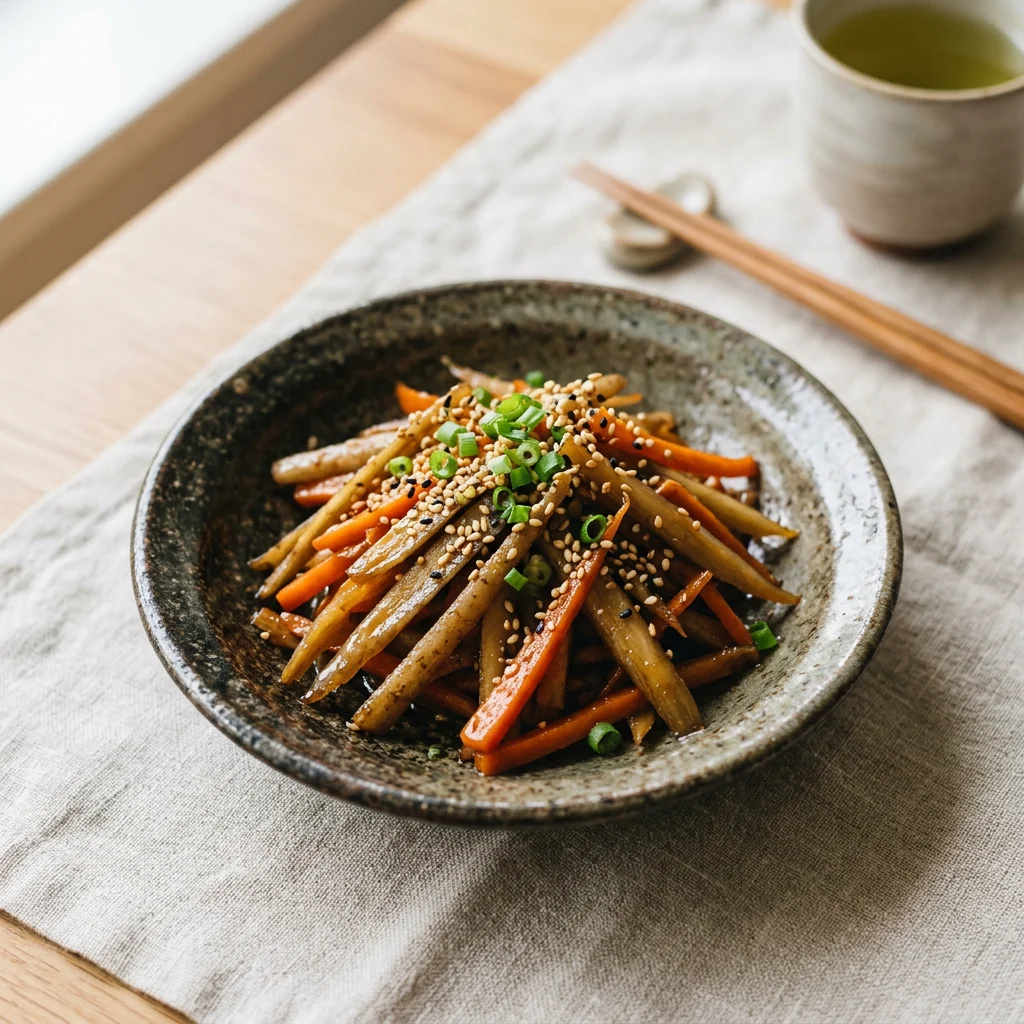
Kimpira gobo is a classic Japanese side dish of julienned burdock root (gobo) and carrot, stir-fried and braised in a soy sauce-mirin glaze until tender-crisp. The dish is named after the legendary strong man Kintaro's son Kintoki (also called Kimpira), whose strength was said to come from eating burdock root. It is one of Japan's most important obanzai (traditional homestyle side dishes) — the kind of quiet, everyday food that sustains a household. Burdock root is a uniquely earthy vegetable with a flavor somewhere between artichoke and parsnip. When cut into thin matchsticks and quickly stir-fried, it develops a satisfying crunch that yields to tenderness as you chew. The carrot adds color and a touch of sweetness. The braising liquid — soy sauce, mirin, sake, and a whisper of chili — creates a savory-sweet glaze that concentrates as it reduces. Ayurvedically, burdock root is among the most grounding of all root vegetables. It grows deep into the earth and carries strong downward-moving energy (apana vayu support). Its bitter, sweet taste and heating energy make it a valuable food for clearing accumulated toxins and supporting liver function. Japanese and Ayurvedic herbalism share a deep appreciation for this root — it appears in both traditions as a blood-purifying, detoxifying food.
Balances Kapha strongly due to light, dry, heating qualities. Balances Vata moderately when prepared with adequate sesame oil. May mildly aggravate Pitta due to heating energy and pungent taste.
Ingredients
- 200 g Burdock root (gobo) (peeled and cut into thin matchsticks)
- 1 medium Carrot (cut into thin matchsticks)
- 1 tbsp Sesame oil
- 2 tbsp Soy sauce
- 1.5 tbsp Mirin
- 1 tbsp Sake
- 1 tsp Sugar
- 1 small Dried red chili (seeds removed, thinly sliced)
- 1 tbsp Toasted sesame seeds (for garnish)
Instructions
- As you cut the burdock root into matchsticks, immediately place the pieces in a bowl of cold water with a splash of vinegar. This prevents oxidation (browning) and removes some of the bitterness. Soak for 5 minutes, then drain thoroughly.
- Heat the sesame oil in a heavy skillet or wok over high heat. Add the sliced chili and stir for 5 seconds.
- Add the drained burdock matchsticks and stir-fry vigorously for 2-3 minutes. The high heat and constant movement are important — you want to sear the surface while maintaining crunch.
- Add the carrot matchsticks and continue stir-frying for 1-2 minutes until the carrot just begins to soften.
- Add the sake first (it will sizzle and evaporate quickly), then the soy sauce, mirin, and sugar. Toss everything together.
- Continue cooking over medium-high heat, stirring frequently, until the liquid has reduced to a thin glaze that coats the vegetables — about 3-4 minutes. The vegetables should be tender-crisp, not soft.
- Remove from heat, scatter with toasted sesame seeds, and serve. Kimpira can be served warm, at room temperature, or cold.
Nutrition
These values are estimates calculated from the ingredient list and may vary based on brands, cooking methods, and serving size. Not a substitute for medical or dietary advice.
How This Recipe Affects Each Dosha
Vata
Burdock root's grounding, downward-moving energy supports Vata's need for earthiness, and the sesame oil provides essential lubrication. However, the root's dry, fibrous quality can aggravate Vata if consumed without enough oil or moisture. The warming spices and sweet mirin help offset this.
Pitta
The heating energy and pungent post-digestive effect can aggravate Pitta, and the soy sauce adds salt that concentrates Pitta's sharpness. However, burdock's bitter taste provides some Pitta-pacifying benefit. Pitta types should enjoy this in moderation and reduce the chili.
Kapha
This is a superb Kapha-clearing dish. The light, dry, heating qualities of burdock root directly counter Kapha's heavy, moist, cold tendencies. The pungent chili and warming sesame oil further stimulate sluggish Kapha. The bitter taste supports liver function and fat metabolism.
Strongly kindles agni. Burdock root stimulates digestive secretions, the sesame oil supports fat digestion, and the chili provides direct digestive fire. The bitter taste in burdock promotes bile flow and liver function.
Nourishes: Rasa (plasma), Rakta (blood), Mamsa (muscle)
Adjustments by Constitution
For Vata Types
Increase sesame oil to 2 tablespoons and add a splash of dashi to the braising liquid for moisture. Omit the chili. Include a few slices of lotus root for additional grounding. Serve alongside warm rice and miso soup rather than as a cold bento item.
For Pitta Types
Omit the dried red chili entirely. Reduce soy sauce to 1 tablespoon and increase mirin for sweetness. Add julienned snow peas or green beans for cooling balance. Use a lighter oil like sunflower if sesame feels too heating.
For Kapha Types
Increase the dried chili and add a generous pinch of shichimi togarashi (seven-spice) at the end. Reduce mirin and sugar to minimize sweetness. Add julienned daikon for extra pungent, drying quality. This dish needs no Kapha modifications — it is naturally ideal.
Seasonal Guidance
Burdock root is at its best in autumn and winter, when it is freshly harvested and when its grounding, warming energy is most needed. In autumn, it helps transition from Pitta season to Vata season by grounding the body. In winter, its heating quality and deep earthy flavor provide comfort. In spring, it helps clear winter Kapha accumulation — a lighter version with extra ginger is appropriate. Not a typical summer dish, though a small portion as a bento side is acceptable.
Best time of day: As a side dish at lunch or dinner. Excellent as part of a bento for midday nourishment.
Cultural Context
Kimpira gobo belongs to the category of traditional Japanese side dishes called sozai or okazu — the small, flavorful accompaniments that surround a bowl of rice and give a meal its variety and nutritional depth. The dish is part of the broader Japanese practice of eating root vegetables in autumn and winter for grounding energy, a practice that aligns precisely with Ayurvedic seasonal guidance. Burdock has been cultivated in Japan for centuries — while it grows wild across Europe and North America, Japan is the only country that cultivated it as a primary vegetable rather than treating it merely as a medicinal herb or weed.
Deeper Context
Origins
Kimpira gobo takes its name from Sakata Kimpira, the legendary hero son of Sakata Kintoki in Edo-period (1603-1868) popular theater. Kimpira was celebrated for extraordinary strength — so preparations requiring strong jaw-work to chew became 'kimpira-style.' The burdock-and-carrot combination is traditional Japanese peasant cookery, with the julienned-root-plus-dashi-and-mirin technique stabilized during the Edo period. Modern macrobiotic movement popularization (1960s-70s) brought the dish to Western wellness culture.
Food as Medicine
Burdock root contains inulin (a prebiotic fiber with documented gut-microbiome benefits), arctigenin (immune-modulating), and lignans (phytoestrogenic). Traditional TCM uses burdock for lymphatic support and skin conditions; modern research partly validates these uses. The dish is one of the more clearly therapeutic everyday Japanese preparations.
Ritual & Seasonal Role
Autumn and winter peak — burdock root reaches prime quality after the first frosts. Year-round availability through storage. Classical obento (lunchbox) component alongside rice and protein. Not religiously ceremonial but deeply tied to Japanese traditional vegetable-side-dish tradition.
Classical Pairings & Cautions
Rice, miso soup, grilled fish or tofu. Green tea. Cautions: burdock allergies are rare but severe (ragweed-family cross-reactivity); gluten intolerance affects soy sauce (tamari is gluten-free); soy allergies; mirin contains alcohol (mostly cooked off during preparation); sodium modulation for cardiovascular patients.
Cross-Tradition View
How other medical and food-wisdom traditions read this dish. Each tradition names the same physiological reality in its own language — the agreements across them are where universal principles live.
Traditional Chinese Medicine
Burdock root is cool-bitter and moves Blood while clearing Heat — classical TCM classifies burdock (Arctium lappa) as 'niu bang zi' in its seed form and uses the root in convalescent soups; carrot is Blood-supporting and moves Liver Qi; sesame oil is warm-moistening; soy sauce is salty-warm; mirin is sweet-warm. A Blood-moving Liver-Qi-moving preparation — TCM physicians would class this as appropriate for Blood-stasis patterns with Liver-Qi stagnation.
Greek Humoral
Hot-dry. Sanguine-melancholic balance. Galenic physicians praised burdock root for its blood-purifying and skin-supporting reputation in classical European materia medica — burdock entered Arab-Galenic medicine as 'bardana' with similar indications to the Japanese Kanpo use.
Ayurveda
Heating virya, pungent vipaka. Pacifies Vata through the oily cookery. Kapha-reducing through the dispersing-warming action. Pitta-mildly-aggravating through the sharp flavor. Burdock is not traditionally Ayurvedic but parallels the Indian gokshura family in therapeutic register.
Macrobiotics (Ohsawa)
Kimpira gobo holds particular status in George Ohsawa's macrobiotic system (founded 1960s) as a quintessentially yang root vegetable preparation — burdock root is the most yang of common vegetables in Ohsawa's classification, recommended for blood-purification, strengthening, and autumn-winter grounding. Macrobiotic practitioners worldwide preserved kimpira gobo as a signature therapeutic dish long before it entered Western wellness mainstream.
Chef's Notes
The key to great kimpira is the matchstick cut — thin, even pieces ensure consistent cooking and create the characteristic texture. A mandoline with a julienne blade makes this much faster. Burdock oxidizes quickly once cut, so work fast or keep cut pieces in acidulated water. Do not overcook — the vegetables should retain a pleasant crunch. Kimpira is one of the best make-ahead dishes in Japanese cooking; it keeps refrigerated for 5-7 days and tastes better the next day as the flavors penetrate. It is a staple of bento box preparation.
Frequently Asked Questions
Is Kimpira Gobo (Braised Burdock Root) good for my dosha?
Balances Kapha strongly due to light, dry, heating qualities. Balances Vata moderately when prepared with adequate sesame oil. May mildly aggravate Pitta due to heating energy and pungent taste. Burdock root's grounding, downward-moving energy supports Vata's need for earthiness, and the sesame oil provides essential lubrication. The heating energy and pungent post-digestive effect can aggravate Pitta, and the soy sauce adds salt that concentrates Pitta's sharpness. This is a superb Kapha-clearing dish.
When is the best time to eat Kimpira Gobo (Braised Burdock Root)?
As a side dish at lunch or dinner. Excellent as part of a bento for midday nourishment. Burdock root is at its best in autumn and winter, when it is freshly harvested and when its grounding, warming energy is most needed. In autumn, it helps transition from Pitta season to Vata season by
How can I adjust Kimpira Gobo (Braised Burdock Root) for my constitution?
For Vata types: Increase sesame oil to 2 tablespoons and add a splash of dashi to the braising liquid for moisture. Omit the chili. Include a few slices of lotus root For Pitta types: Omit the dried red chili entirely. Reduce soy sauce to 1 tablespoon and increase mirin for sweetness. Add julienned snow peas or green beans for cooli
What are the Ayurvedic properties of Kimpira Gobo (Braised Burdock Root)?
Kimpira Gobo (Braised Burdock Root) has Sweet, Bitter, Pungent, Salty taste (rasa), Heating energy (virya), and Pungent post-digestive effect (vipaka). Its qualities (gunas) are Light, Dry, Warm. It nourishes Rasa (plasma), Rakta (blood), Mamsa (muscle). Strongly kindles agni. Burdock root stimulates digestive secretions, the sesame oil supports fat digestion, and the chili provides direct digestive fire. The bitter taste in burdock promotes bile flow and liver function.