Imam Bayildi
Turkish Recipe
Overview
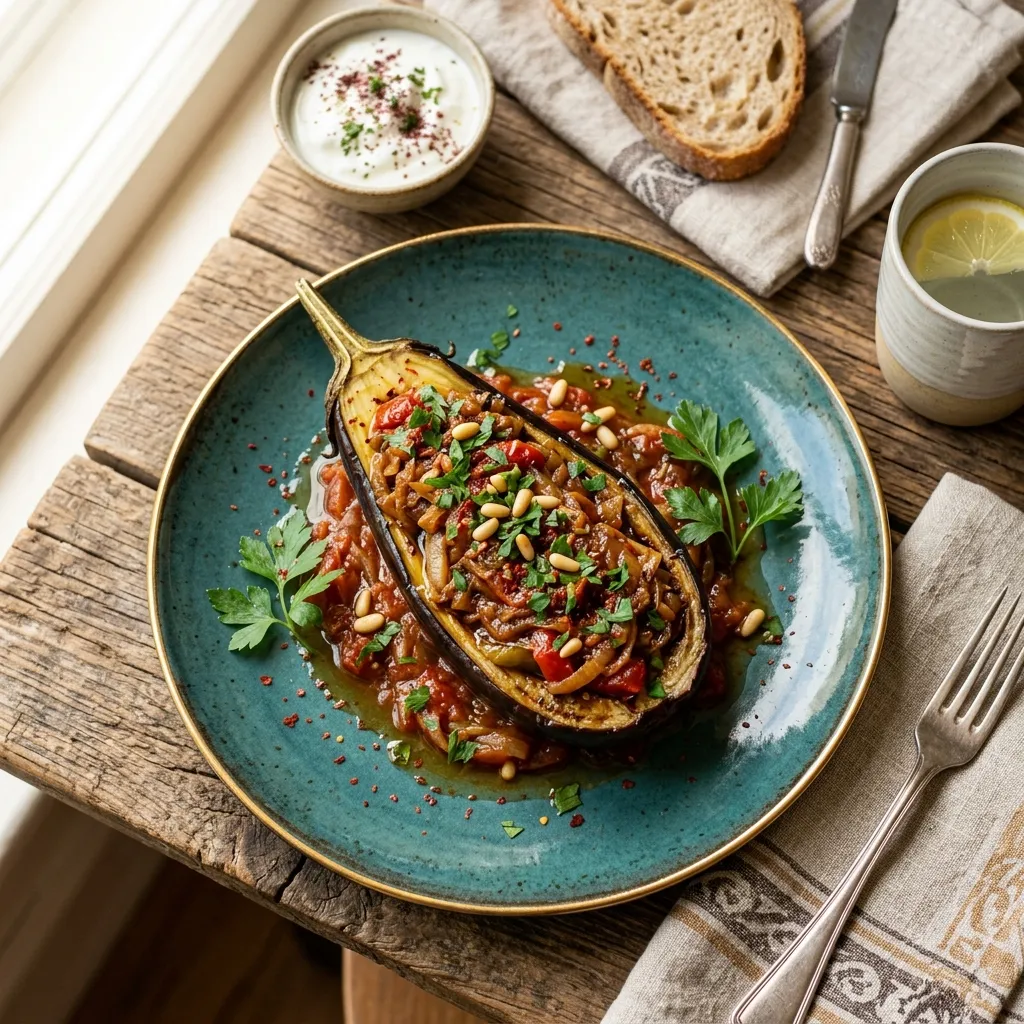
Imam bayildi — "the imam fainted" — is a Turkish dish of whole eggplants stuffed with a slow-cooked mixture of onions, garlic, and tomatoes, then braised in olive oil until the eggplant flesh turns silky and almost translucent. The name's origin story varies: some say the imam fainted from the deliciousness, others that he fainted at the quantity of expensive olive oil used. Either way, olive oil is the dish's defining element — it is the cooking medium, the braising liquid, and the sauce. The preparation requires patience. Eggplants are partially peeled in alternating stripes, slit lengthwise to create a pocket, and stuffed with a filling of slow-caramelized onions, ripe tomatoes, and garlic. The stuffed eggplants are arranged snugly in a pan, doused with olive oil and a little water, then braised at low temperature for 45 minutes to an hour until everything melds into a unified, unctuous whole. The dish is always served at room temperature or cold — never hot. In Ayurvedic terms, eggplant is considered somewhat difficult to digest on its own, but the generous olive oil and slow braising transform it into something far more bioavailable. The extended cooking breaks down the eggplant's cellular structure, and the oil-soluble nutrients from tomatoes and garlic become more accessible. This is a Pitta-season dish — cooling once at room temperature, lubricating, and satisfying without heaviness.
Best suited for Pitta pacification due to cooling nature and generous olive oil. The oily quality helps Vata in moderation, but the eggplant's inherent dryness and pungent vipaka can aggravate Vata if eaten excessively.
Ingredients
- 4 medium Italian eggplants (or 2 large globe eggplants)
- 1/2 cup Olive oil
- 3 large Onions (halved and thinly sliced)
- 6 cloves Garlic (thinly sliced)
- 4 medium Tomatoes (peeled and chopped)
- 1/2 cup Flat-leaf parsley (chopped)
- 1 tsp Sugar
- 1.5 tsp Salt
- 1/2 tsp Black pepper
- 1 tbsp Lemon juice
- 1/2 cup Water
Instructions
- Partially peel the eggplants in alternating lengthwise stripes, leaving the stem attached. Cut a deep lengthwise slit in each eggplant to create a pocket, being careful not to cut all the way through. Generously salt the inside and outside and let them rest for 20 minutes to draw out bitter juices. Rinse and pat dry.
- Heat 3 tablespoons of olive oil in a wide skillet over medium heat. Fry the eggplants on all sides until the skin blisters and the flesh softens slightly, about 3-4 minutes per side. Remove and set aside.
- In the same pan, add 2 more tablespoons of olive oil. Cook the sliced onions over medium-low heat for 12-15 minutes, stirring occasionally, until deeply golden and sweet. Add the garlic and cook for another 2 minutes.
- Add the chopped tomatoes, parsley, sugar, salt, and pepper to the onion mixture. Cook for 5 minutes until the tomatoes soften and release their juices. Remove from heat.
- Arrange the fried eggplants in a deep baking dish or heavy pot. Gently open the slits and spoon the onion-tomato filling generously into each pocket and over the top.
- Pour the remaining olive oil and water around the eggplants. Cover tightly with a lid or foil.
- Bake at 180C (350F) for 45 minutes, or braise on the stovetop over the lowest heat for 50-60 minutes, until the eggplants are completely tender and the sauce has thickened.
- Remove from oven and let cool completely to room temperature. Drizzle with lemon juice before serving. Serve with crusty bread to soak up the olive oil.
Nutrition
These values are estimates calculated from the ingredient list and may vary based on brands, cooking methods, and serving size. Not a substitute for medical or dietary advice.
How This Recipe Affects Each Dosha
Vata
Eggplant is inherently Vata-aggravating — dry, light, and rough. The generous olive oil partially compensates by adding oleation and weight, but this remains a dish to enjoy occasionally rather than regularly for Vata types. The slow-cooked onions and garlic do provide warming, grounding qualities.
Pitta
This is an excellent Pitta dish. Served at room temperature, the cooling quality of eggplant combined with the lubricating olive oil and sweet, slow-cooked onions calms Pitta without creating sluggishness. The absence of heating spices makes it safe even during peak Pitta season.
Kapha
The heavy, oily qualities from the generous olive oil can increase Kapha. However, the bitter and astringent tastes in eggplant and the pungent vipaka provide some counterbalance. Kapha types should eat this in moderate portions and ensure it accompanies lighter foods.
The slow-cooked nature and generous oil make this easy to digest despite eggplant's reputation for being heavy. However, it does not actively stimulate agni — it is a sustaining food rather than a kindling one.
Nourishes: Rasa (plasma), Medas (fat), Asthi (bone)
Adjustments by Constitution
For Vata Types
Add warming spices to the filling — a pinch of cumin, coriander, and black pepper. Use a splash of sesame oil alongside the olive oil for extra warming quality. Serve slightly warm rather than fully cold, and accompany with warm flatbread rather than crusty bread.
For Pitta Types
This dish needs minimal adjustment for Pitta. Add fresh mint to the parsley for additional cooling. Replace black pepper with a small pinch of fennel seeds in the filling. Increase the lemon juice at serving for extra cooling and digestive support.
For Kapha Types
Reduce olive oil by half and roast the eggplants in the oven instead of frying. Add a teaspoon of black pepper, a pinch of cayenne, and fresh ginger to the filling to increase the pungent quality. Serve in smaller portions as a side dish rather than a main course.
Seasonal Guidance
Best in late summer when eggplants and tomatoes are at peak ripeness and Pitta needs cooling, lubricating foods served at room temperature. Also suitable in early autumn. Too heavy and cold for winter eating, when the body craves warming foods.
Best time of day: Lunch or early dinner, served at room temperature. Allow at least 2 hours of cooling time after cooking.
Cultural Context
Imam bayildi belongs to the zeytinyagli category of Turkish cuisine — dishes cooked in olive oil and served cold, which form a cornerstone of Ottoman palace cooking and Aegean home kitchens alike. This category reflects the Mediterranean climate's influence on Turkish food culture, where summer heat makes cold, oil-rich dishes both practical and appealing. The dish likely originated in the Aegean or southeastern regions where both eggplants and olive oil were abundant. It remains one of the most recognized Turkish dishes internationally and is a fixture of meze spreads alongside hummus, dolma, and piyaz.
Deeper Context
Origins
Imam bayildi descends from Ottoman Turkish zeytinyağlı (olive-oil dishes) tradition — the category of vegetables slow-cooked in substantial olive oil and served cold as summer meze. The legend of the imam fainting exists in multiple versions across Turkish folklore, each offering different narrative justification for the dish's name. The dish reflects Ottoman imperial cuisine's valuation of olive oil and preserved-vegetable preparations across the empire.
Food as Medicine
Eggplant provides nasunin (neuroprotective anthocyanin) and fiber. Olive oil contributes substantial polyphenols with Mediterranean-diet cardiovascular benefits. Tomato lycopene is increased in bioavailability through cooking and olive-oil pairing. Garlic and onion add allium compounds. A therapeutically-rich Mediterranean-diet template preparation.
Ritual & Seasonal Role
Summer Turkish dish. Classical Ramadan iftar meze. Meze-array staple across Turkish restaurants globally. Not religiously ceremonial despite the name's religious reference.
Classical Pairings & Cautions
Crusty bread, additional Turkish meze (cacık, muhammara, ezme), rice pilaf. Cautions: nightshade sensitivity; FODMAP issues from garlic and onion; olive oil polyphenols are beneficial but caloric density substantial; vegan and vegetarian-friendly by default.
Cross-Tradition View
How other medical and food-wisdom traditions read this dish. Each tradition names the same physiological reality in its own language — the agreements across them are where universal principles live.
Traditional Chinese Medicine
Eggplant is cool-sweet and Liver-clearing; olive oil is cool-moistening; onion is warm-pungent; tomato is cool-sour and moves Liver Qi; garlic is warm-pungent. A cool Liver-clearing preparation with dispersing correction — TCM physicians would class imam bayildi as summer Liver-Qi-stagnation food.
Greek Humoral
Cold-wet with hot-dry correction. A Galenic-suitable summer preparation.
Ayurveda
Cooling virya, pungent vipaka. Mild Pitta aggravation through nightshade combination. Kapha-reducing through cooking technique. Vata mildly aggravated through cold presentation.
Ottoman Legend (The Imam Fainted)
Imam bayildi translates as 'the imam fainted' — the dish's name comes from an Ottoman legend. One version: a newly-married imam fainted upon learning how much precious olive oil his wife used to prepare the dish (economic-shock interpretation). Another version: the imam fainted from the dish's surpassing deliciousness (aesthetic-joy interpretation). Classical Ottoman Turkish cold meze; the olive-oil-cooked-eggplant architecture reflects Ottoman zeytinyağlı (olive-oil dishes) tradition served cold as summer food.
Chef's Notes
Do not skip the salting step — it draws out solanine and bitterness from the eggplant, which matters both for flavor and for reducing its Vata-aggravating properties. The dish must cool completely before serving; eating it hot misses the point. The olive oil will solidify slightly when cold, creating a rich, almost sauce-like coating. Leftovers taste better the next day as the flavors continue to meld. Choose eggplants that feel heavy for their size with taut, glossy skin.
Frequently Asked Questions
Is Imam Bayildi good for my dosha?
Best suited for Pitta pacification due to cooling nature and generous olive oil. The oily quality helps Vata in moderation, but the eggplant's inherent dryness and pungent vipaka can aggravate Vata if eaten excessively. Eggplant is inherently Vata-aggravating — dry, light, and rough. This is an excellent Pitta dish. The heavy, oily qualities from the generous olive oil can increase Kapha.
When is the best time to eat Imam Bayildi?
Lunch or early dinner, served at room temperature. Allow at least 2 hours of cooling time after cooking. Best in late summer when eggplants and tomatoes are at peak ripeness and Pitta needs cooling, lubricating foods served at room temperature. Also suitable in early autumn. Too heavy and cold for winter
How can I adjust Imam Bayildi for my constitution?
For Vata types: Add warming spices to the filling — a pinch of cumin, coriander, and black pepper. Use a splash of sesame oil alongside the olive oil for extra warmin For Pitta types: This dish needs minimal adjustment for Pitta. Add fresh mint to the parsley for additional cooling. Replace black pepper with a small pinch of fennel
What are the Ayurvedic properties of Imam Bayildi?
Imam Bayildi has Sweet, Bitter, Astringent taste (rasa), Cooling energy (virya), and Pungent post-digestive effect (vipaka). Its qualities (gunas) are Oily, Heavy, Soft. It nourishes Rasa (plasma), Medas (fat), Asthi (bone). The slow-cooked nature and generous oil make this easy to digest despite eggplant's reputation for being heavy. However, it does not actively stimulate agni — it is a sustaining food rather than a kindling one.