CCF Tea (Cumin-Coriander-Fennel)
Ayurvedic Medicated Recipe
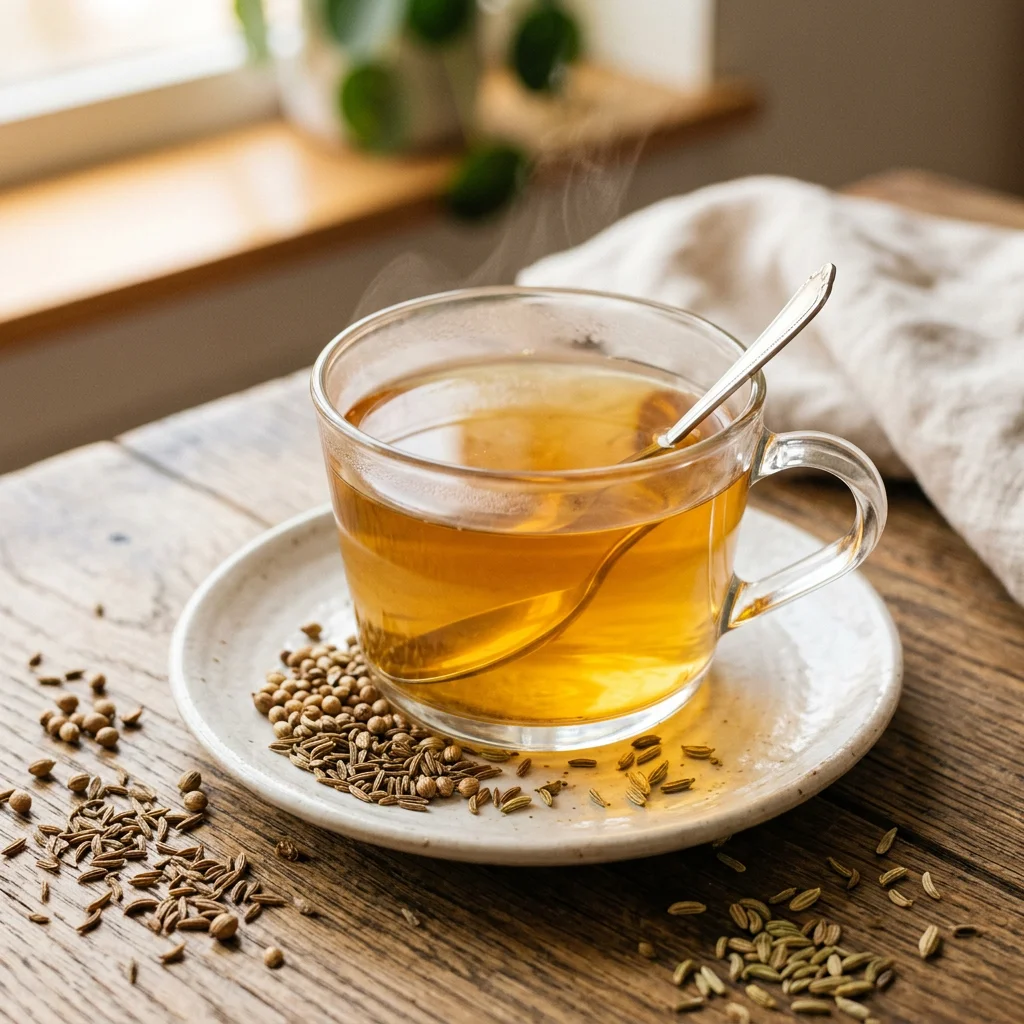
Overview
CCF tea — equal parts cumin, coriander, and fennel seeds steeped in hot water — is arguably the single most prescribed preparation in modern Ayurvedic practice. Its ubiquity might suggest simplicity, but this three-seed combination represents a masterful formulation that addresses the root cause of most health complaints: impaired digestion. Each seed brings a distinct pharmacological action, and together they create a synergistic effect greater than the sum of their parts. Cumin (jeeraka) is the fire-starter: its pungent, heating quality directly stimulates jatharagni, the central digestive fire. It promotes the secretion of pancreatic enzymes and bile, breaking down food that would otherwise sit and ferment. Coriander (dhanyaka) is the coolant and cleanser: its cooling virya prevents the cumin from generating excess heat while its diuretic action flushes metabolic waste through the urinary tract. Fennel (saunf) is the harmonizer: its sweet, cooling quality soothes the gastrointestinal lining, relieves gas and bloating, and brings a gentle sweetness to the tea that makes it pleasant to sip throughout the day. The genius of CCF tea is that it improves digestion without aggravating any dosha. Heating spices alone would aggravate Pitta. Cooling herbs alone would dampen Vata's already variable agni. The three-seed balance threads this needle perfectly — kindle fire without generating inflammation, cool without suppressing, move without depleting. This is why CCF tea is safe for virtually everyone, including pregnant women, children, and the elderly — a rare claim in herbal medicine.
Tridoshic — balances all three doshas. One of the few preparations safe for every constitution in every season.
Primary digestive reset and agni-kindling formula. Indicated for all forms of digestive dysfunction: bloating, gas, irregular appetite, acid reflux, constipation, loose stools, post-meal heaviness, and ama accumulation. Used as the foundational beverage during panchakarma preparation (purvakarma) and kitchari cleanses. Safe during pregnancy for morning nausea. First-line recommendation for any new Ayurvedic patient regardless of presenting complaint, as most conditions improve when digestion improves.
Ingredients
- 1 tsp Cumin seeds (whole)
- 1 tsp Coriander seeds (whole)
- 1 tsp Fennel seeds (whole)
- 4 cups Water (filtered)
Instructions
- Measure equal parts cumin, coriander, and fennel seeds. For a single serving, use 1/2 teaspoon of each in 1 cup of water. For a full day's supply, use 1 teaspoon each in 4 cups.
- Lightly crush the seeds with a mortar and pestle or the flat side of a knife. This cracks the seed coat and releases the volatile oils more quickly. Do not grind to powder — the whole seeds should remain visible.
- Bring water to a rolling boil in a saucepan. Add the crushed seeds.
- Reduce heat to low, cover, and simmer gently for 5-7 minutes. The water will turn a pale golden-amber color and the kitchen will fill with a warm, sweet, earthy aroma.
- Remove from heat and let steep covered for an additional 3 minutes.
- Strain through a fine mesh strainer into a thermos or teapot. Discard the seeds.
- Sip warm throughout the day — between meals is ideal. Reheat gently if needed, but do not microwave. Can be made fresh each morning.
Nutrition
These values are estimates calculated from the ingredient list and may vary based on brands, cooking methods, and serving size. Not a substitute for medical or dietary advice.
How This Recipe Affects Each Dosha
Vata
The warming cumin kindled by fennel's carminative action addresses Vata's core digestive issue: variable agni that alternates between sharp and sluggish. The combination reduces intestinal gas (a primary Vata complaint) and promotes regularity without being harsh or depleting. The slight warmth and gentle stimulation bring steadiness to Vata's erratic digestion. Over consistent use, CCF tea helps establish the digestive rhythm that Vata types chronically lack.
Pitta
Coriander's cooling virya prevents the tea from aggravating Pitta while cumin's enzymatic support helps Pitta's naturally strong fire work more efficiently rather than burning hotter. Fennel soothes the gastric lining, reducing the acid reflux and burning sensation that Pitta types are prone to. The combination channels Pitta's heat productively — toward complete digestion rather than inflammatory excess. This is the go-to digestive tea for Pitta because it supports without overheating.
Kapha
The light, clear, and slightly warm qualities gently counter Kapha's cold, heavy, and sluggish tendencies without being aggressive. Cumin's ability to stimulate enzyme production addresses Kapha's characteristic slow metabolism. Fennel's carminative action reduces the water retention and bloating that Kapha types experience. Coriander's mild diuretic effect helps process excess Kapha fluid through the urinary tract. The tea's drying quality, while gentle, slowly addresses the root of Kapha digestive stagnation.
This is the premier agni-kindling tea in Ayurveda — its entire purpose is digestive fire optimization. Cumin directly stimulates jatharagni through its pungent rasa and heating virya, promoting enzyme secretion and bile flow. Coriander prevents this stimulation from creating excess heat or inflammation in the GI tract. Fennel relaxes smooth muscle in the intestinal walls, relieving spasms and allowing food to pass through at the optimal pace. The three together address all five aspects of agni dysfunction: too low (mandagni), too sharp (tikshna agni), too variable (vishama agni), and toxic buildup (sama agni). Regular use for 7-14 days is often enough to reset compromised digestion to a baseline of healthy function.
Nourishes: Rasa (plasma), primarily through improved absorption of nutrients from food
Adjustments by Constitution
For Vata Types
Add a thin slice of fresh ginger for enhanced warming action. A pinch of ajwain (carom seeds) intensifies the anti-gas effect. If Vata digestion is severely depleted, steep the tea for 10 minutes instead of 7 for a stronger extraction. Drinking it warm with meals rather than between meals can help Vata types who struggle to maintain appetite.
For Pitta Types
Increase coriander to 1.5 teaspoons while keeping cumin and fennel at 1 teaspoon each. This tilts the formula toward cooling. Allow the tea to cool to warm rather than hot before drinking. Add a few fresh mint leaves during steeping for additional cooling. In summer, this Pitta-adjusted version can be enjoyed at room temperature.
For Kapha Types
Add 1/4 teaspoon of dried ginger powder and 2-3 whole black peppercorns to the simmer. Increase cumin to 1.5 teaspoons for stronger digestive stimulation. Drink the tea hot, not warm — the heat itself is therapeutic for Kapha. Sip 30 minutes before meals to prime the sluggish Kapha digestive system.
Seasonal Guidance
CCF tea is one of the rare preparations appropriate for every season without modification. In spring, its light and mildly drying qualities help clear Kapha congestion from the digestive tract. In summer, coriander's cooling influence prevents excess Pitta in the gut. In autumn, cumin's warmth steadies Vata's variable digestion as the cold sets in. In winter, the overall gentle warmth maintains digestive efficiency when cold weather naturally dampens agni. For seasonal cleanses, CCF tea is the primary beverage consumed throughout a kitchari-based detox in any season.
Best time of day: Sip between meals throughout the day. Most beneficial 30 minutes before lunch (when agni should peak) and in the late afternoon when digestion often dips. Avoid right before sleep as even its gentle stimulation may keep light sleepers alert.
Cultural Context
The CCF combination does not appear as a single named formulation in the classical Ayurvedic texts, but all three seeds are among the most frequently referenced substances in the Charaka Samhita and Sushruta Samhita. The popularization of the specific 1:1:1 blend as "CCF tea" is attributed to modern Ayurvedic educators, particularly Dr. Vasant Lad, who made it the cornerstone of his digestive protocols at the Ayurvedic Institute in Albuquerque. The combination draws on classical principles that each seed appears in — jeeraka (cumin) in agni-deepana (fire-kindling) formulas, dhanyaka (coriander) in pitta-shamana (pitta-calming) preparations, and saunf (fennel) in vata-anulomana (gas-relieving) combinations. The modern synthesis into a single daily tea represents practical genius — distilling thousands of pages of pharmacological theory into a preparation anyone can make in ten minutes.
Deeper Context
Origins
The three-seed combination is a classical Ayurvedic trikarsha (three-measure) formulation and a panchakarma dietary-period standard tea. References appear across Ayurvedic texts from the medieval period. Modern popular wellness culture adopted CCF tea through integrative-medicine publishing in the 2000s and 2010s, particularly through Ayurvedic practitioners like Dr. John Douillard and Dr. Vasant Lad who popularized the acronym.
Food as Medicine
Fennel functions as a galactagogue (milk supply for nursing mothers) and as an estrogen-modulator in some studies. Coriander has documented heavy-metal chelation activity — preliminary modern research supports the traditional use for internal cleansing. Cumin is a well-documented digestive stimulant with carminative, appetite-stimulating, and glucose-modulating effects. The combination functions as a classical panchakarma digestive-support tea across the entire detox protocol.
Ritual & Seasonal Role
Between meals, post-meal, during panchakarma detox protocols, during fasting periods, during winter digestive-sluggishness seasons. Year-round use is traditional. Panchakarma patients commonly drink 1-2 liters per day during their 7-21 day protocols as the primary non-water hydration fluid.
Classical Pairings & Cautions
Alone; occasionally with a small amount of honey after cooling. Cautions: fennel phytoestrogens are a mild concern for estrogen-sensitive conditions (breast cancer, endometriosis — consult practitioner); coriander allergies are rare but present; gastric ulcer patients may need dilution or reduced coriander; pregnancy use traditionally allowed in moderation but avoid excess fennel in first trimester.
Cross-Tradition View
How other medical and food-wisdom traditions read this dish. Each tradition names the same physiological reality in its own language — the agreements across them are where universal principles live.
Traditional Chinese Medicine
Cumin warms the middle burner; coriander descends Qi and disperses excess; fennel warms Kidney-and-Spleen. A middle-burner harmonizer — classical TCM three-seed digestive supporting Spleen and Stomach function. TCM physicians prescribe similar three-seed digestive teas across post-prandial and between-meal contexts for the same indications Ayurveda recognizes.
Greek Humoral
Hot-dry digestive carminative. Apicius's 4th-century Roman cookbook includes all three seeds individually for digestive complaints. Galen prescribed fennel specifically for liver function; coriander for heart complaints; cumin for digestion. The CCF combination would have been at home in any Roman or Byzantine hakim's kitchen.
Unani Tibb
Zeera (cumin), dhania (coriander), saunf (fennel) are the Unani kitchen-medicine trinity — used across hakim practice for every digestive complaint from dyspepsia to bloating to anorexia to post-prandial sluggishness. The combination appears in traditional Unani digestive formulas and in the after-meal tea-of-the-house in Indo-Persian hakim households for centuries.
Tibetan Sowa Rigpa
All three seeds appear in Tibetan digestive formulas. Cumin is particularly prominent in Phlegm-reducing preparations; fennel treats cold-digestion weakness; coriander addresses excess heat. A core Tibetan spice-tea for digestive complaints, often prescribed between meals to support the next digestive cycle.
Chef's Notes
Whole seeds are non-negotiable — pre-ground spices lose their volatile oils rapidly and produce a flat, dusty tea. Source whole seeds from a bulk spice vendor with good turnover. Fresh coriander seeds should smell bright and citrusy when crushed; stale ones smell like cardboard. The equal ratio is the standard prescription, but experienced practitioners adjust: more cumin for sluggish digestion, more coriander for urinary issues or heat conditions, more fennel for gas and bloating. Do not add sweetener — the fennel provides natural sweetness, and adding sugar or honey changes the pharmacological profile. Drink warm, not hot and not cold. Room temperature is acceptable but warm is optimal. This tea replaces water during digestive cleanses (ama pachana) and is often the first prescription an Ayurvedic practitioner gives, regardless of the presenting complaint.
Frequently Asked Questions
Is CCF Tea (Cumin-Coriander-Fennel) good for my dosha?
Tridoshic — balances all three doshas. One of the few preparations safe for every constitution in every season. The warming cumin kindled by fennel's carminative action addresses Vata's core digestive issue: variable agni that alternates between sharp and sluggish. Coriander's cooling virya prevents the tea from aggravating Pitta while cumin's enzymatic support helps Pitta's naturally strong fire work more efficiently rather than burning hotter. The light, clear, and slightly warm qualities gently counter Kapha's cold, heavy, and sluggish tendencies without being aggressive.
When is the best time to eat CCF Tea (Cumin-Coriander-Fennel)?
Sip between meals throughout the day. Most beneficial 30 minutes before lunch (when agni should peak) and in the late afternoon when digestion often dips. Avoid right before sleep as even its gentle stimulation may keep light sleepers alert. CCF tea is one of the rare preparations appropriate for every season without modification. In spring, its light and mildly drying qualities help clear Kapha congestion from the digestive tract. In sum
How can I adjust CCF Tea (Cumin-Coriander-Fennel) for my constitution?
For Vata types: Add a thin slice of fresh ginger for enhanced warming action. A pinch of ajwain (carom seeds) intensifies the anti-gas effect. If Vata digestion is se For Pitta types: Increase coriander to 1.5 teaspoons while keeping cumin and fennel at 1 teaspoon each. This tilts the formula toward cooling. Allow the tea to cool to
What are the Ayurvedic properties of CCF Tea (Cumin-Coriander-Fennel)?
CCF Tea (Cumin-Coriander-Fennel) has Sweet, Pungent, Bitter taste (rasa), Neutral energy (virya), and Sweet post-digestive effect (vipaka). Its qualities (gunas) are Light, Clear, Slightly Warm, Slightly Dry. It nourishes Rasa (plasma), primarily through improved absorption of nutrients from food. This is the premier agni-kindling tea in Ayurveda — its entire purpose is digestive fire optimization. Cumin directly stimulates jatharagni through its pungent rasa and heating virya, promoting enzyme secretion and bile flow. Coriander prevents this stimulation from creating excess heat or inflammation in the GI tract. Fennel relaxes smooth muscle in the intestinal walls, relieving spasms and allowing food to pass through at the optimal pace. The three together address all five aspects of agni dysfunction: too low (mandagni), too sharp (tikshna agni), too variable (vishama agni), and toxic buildup (sama agni). Regular use for 7-14 days is often enough to reset compromised digestion to a baseline of healthy function.