Causa
Peruvian Recipe
Overview
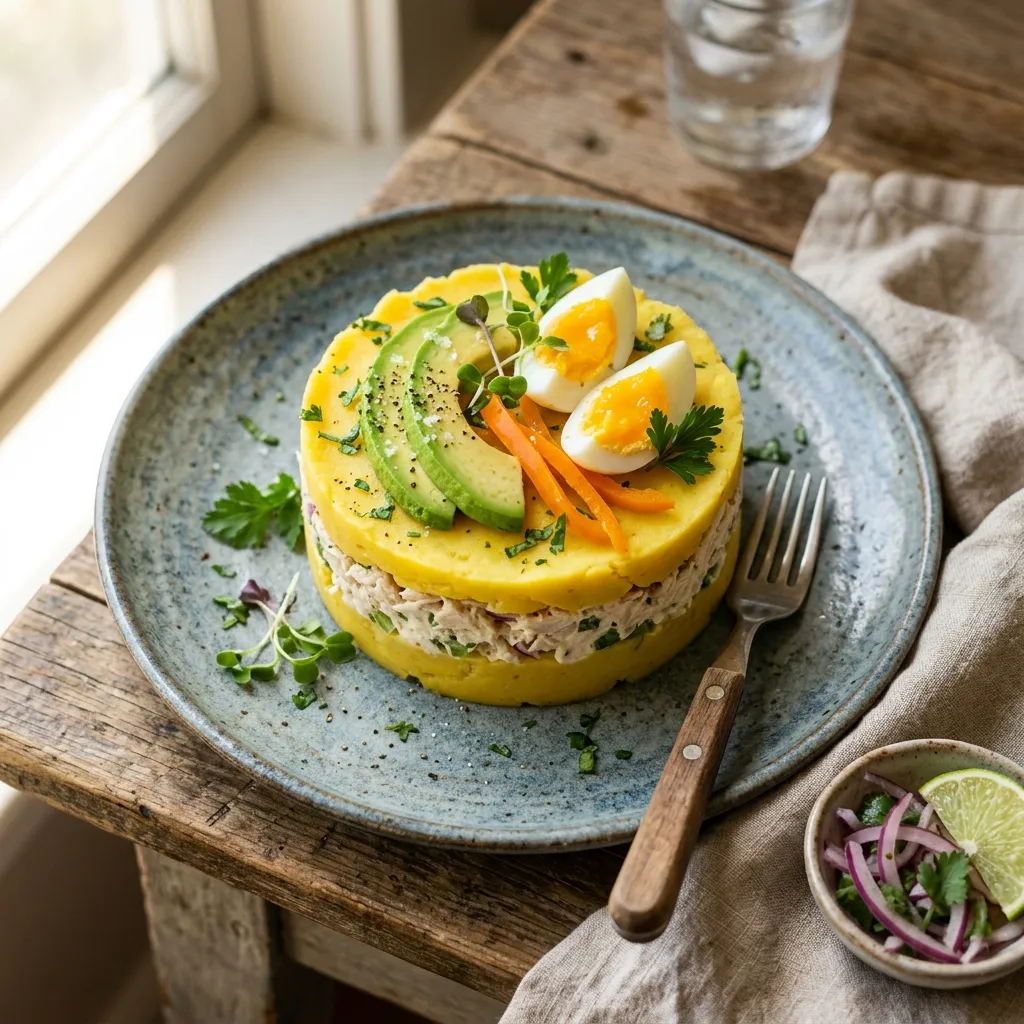
Causa is a layered Peruvian potato terrine — mashed yellow potatoes seasoned with lime juice, aji amarillo, and oil, pressed into a mold with a filling of chicken, tuna, or shrimp salad, then unmolded and served cold as a striking, multi-layered appetizer. The name comes from the Quechua word "kausay," meaning sustenance or life, reflecting the central role of potatoes in Andean civilization. The technique involves making two batches of vibrant yellow potato dough — smooth, seasoned with enough lime to brighten and enough aji amarillo to tint it golden — and pressing them into a mold with a layer of filling between. The classic filling is tuna or chicken mixed with mayonnaise, lime, and avocado. Once chilled and unmolded, the causa reveals clean, geometric layers of gold and white. It is garnished with hard-boiled egg, olives, and sometimes a drizzle of huancaina sauce. Ayurvedically, causa shares qualities with papa a la huancaina — sweet, heavy, grounding potatoes form the base, with sour and pungent accents from lime and aji. The cold preparation and the addition of mayonnaise and avocado make this a rich, building food. The lime juice provides a sharp digestive counterpoint to the starchy density, and the aji ensures some warming quality despite the cold serving temperature.
Grounding and building. The cold, heavy, sweet qualities increase Kapha significantly. The lime and aji add mild digestive stimulation. Can pacify Pitta in summer through cooling, sweet quality. May aggravate Vata through cold serving temperature.
Ingredients
- 1 kg Yellow potatoes (Yukon Gold)
- 2 tbsp Aji amarillo paste
- 3 tbsp Lime juice
- 3 tbsp Vegetable oil
- 1.5 tsp Salt
- 2 cans Canned tuna (drained, or 250g cooked shredded chicken)
- 3 tbsp Mayonnaise
- 1 ripe Avocado (thinly sliced)
- 2 tbsp Red onion (very finely minced)
- 2 whole Hard-boiled eggs (sliced, for garnish)
- 6 pieces Black olives (for garnish)
Instructions
- Boil the potatoes in salted water until very tender, about 20-25 minutes. Drain, peel while still hot, and pass through a ricer or mash until completely smooth — no lumps.
- While the potato is still warm, add the aji amarillo paste, lime juice, vegetable oil, and salt. Mix thoroughly until the dough is smooth, uniformly golden, and holds together when pressed. Adjust lime and aji to taste. Let cool to room temperature.
- Prepare the filling: mix the drained tuna (or shredded chicken) with mayonnaise, 1 tablespoon lime juice, minced red onion, and a pinch of salt. The mixture should be cohesive but not wet.
- Line a rectangular mold, loaf pan, or individual ring molds with plastic wrap, leaving overhang on all sides.
- Press half the potato dough into the bottom of the mold in an even layer. Spread the tuna filling evenly over the potato. Layer the avocado slices over the filling. Press the remaining potato dough on top, smoothing it flat.
- Fold the plastic wrap over the top and refrigerate for at least 1 hour until firm.
- Unmold by inverting onto a serving plate and peeling away the plastic. Garnish with sliced boiled eggs, black olives, and a drizzle of aji amarillo oil or huancaina sauce.
- Slice into portions with a sharp knife dipped in hot water for clean cuts.
Nutrition
These values are estimates calculated from the ingredient list and may vary based on brands, cooking methods, and serving size. Not a substitute for medical or dietary advice.
How This Recipe Affects Each Dosha
Vata
The heavy, grounding potato base addresses Vata's lightness, but the cold serving temperature and the lime's sharp quality can aggravate Vata's cold, dry tendencies. The avocado and oil provide necessary oleation. Best for Vata in small portions at room temperature rather than refrigerator-cold.
Pitta
The sweet potato base, cooling avocado, and cold preparation make this gentle on Pitta. The aji amarillo adds mild warmth but not enough to provoke in moderate amounts. This is one of the more Pitta-appropriate Peruvian dishes when served cold.
Kapha
Heavy, sweet, oily, cold, and dense — causa increases Kapha across nearly every quality. The potato, mayonnaise, avocado, and oil combine to create significant density. Kapha types should treat this as a small appetizer, not a meal.
The lime juice and aji amarillo provide some agni stimulation, but the cold, heavy, dense nature of the potato-based dish tends to dampen digestive fire overall. Best eaten as a starter in small quantity, followed by warm food.
Nourishes: Rasa (plasma), Mamsa (muscle), Medas (fat)
Adjustments by Constitution
For Vata Types
Allow the causa to come to room temperature before eating. Increase the aji amarillo in the potato dough for extra warmth. Add a pinch of cumin and black pepper to the potato mixture. Serve alongside warm soup for contrast.
For Pitta Types
Reduce aji amarillo to 1 tablespoon and increase lime. Replace mayonnaise in the filling with mashed avocado for a lighter, more cooling effect. Add fresh cilantro to the filling.
For Kapha Types
Replace half the potato with mashed cauliflower. Skip the mayonnaise and use plain yogurt thinned with lime juice. Omit the avocado layer. Increase aji amarillo and add black pepper to the potato. Serve a thin slice as an appetizer, not a substantial portion.
Seasonal Guidance
Best in summer when the body tolerates cold, dense food and craves cooling preparations. The heavy nature is too much for spring Kapha season, and the cold temperature is inappropriate for autumn and winter eating.
Best time of day: Lunch appetizer or light lunch. The cold, heavy quality is not appropriate for dinner when digestive fire is declining.
Cultural Context
Causa predates the Spanish conquest — the Quechua name kausay reveals its pre-Columbian origins as a simple seasoned potato preparation. The layered, molded version developed during the colonial and republican periods as Peruvian cuisine absorbed European presentation aesthetics. During Peru's war of independence and later conflicts, causa was sold by women at rallies and marches to feed the cause — the double meaning of causa (food and political cause) became part of the dish's identity. Today it appears at every Peruvian celebration, from casual gatherings to formal events, and the filling variations (tuna, chicken, shrimp, octopus) continue to multiply.
Deeper Context
Origins
Causa's name derives from Quechua 'kausay' (sustenance of life) — reflecting the dish's ancient pre-Columbian Incan origins. Peruvian yellow potato (papa amarilla, the native Andean variety) differs substantially from the commercial potato varieties that reached Europe during the 16th century. Peru's Andes remain the global genetic center for potato — thousands of native varieties are cultivated at different altitudes. Modern causa with tuna and avocado layering is a 20th-century evolution; pre-Columbian causa was primarily seasoned mashed yellow potato served as everyday sustenance.
Food as Medicine
Peruvian yellow potato is nutritionally denser than commercial russet potato, with higher carotenoid content (responsible for the yellow color) and unique resistant-starch profiles. Avocado provides monounsaturated fat and potassium; tuna contributes omega-3 fatty acids and selenium; lime enhances iron absorption from the tuna. A therapeutically-dense traditional preparation with legitimate nutritional depth.
Ritual & Seasonal Role
Summer Peruvian dish. Lima restaurant staple. Pre-Columbian everyday sustenance, modern restaurant presentation. Not religiously ceremonial but carries substantial cultural weight as symbol of Andean potato heritage. Peru's National Potato Day (May 30) celebrates the continuing Andean potato tradition.
Classical Pairings & Cautions
Olives (aceitunas), hard-boiled egg, Inca Kola or chilled Peruvian white wine. Cautions: mercury in tuna (pregnancy should favor lower-mercury varieties); nightshade sensitivity from potato; capsaicin aggravation from aji amarillo; avocado allergies; Peruvian yellow potato may be difficult to source outside Peru (substitution with Yukon Gold is imperfect but workable).
Cross-Tradition View
How other medical and food-wisdom traditions read this dish. Each tradition names the same physiological reality in its own language — the agreements across them are where universal principles live.
Traditional Chinese Medicine
Yellow potato is sweet-neutral and Spleen-Qi-tonifying; aji amarillo is hot-pungent and disperses cold; lime is cool-sour and moves Liver Qi; avocado is Yin-building; tuna is Yin-Blood-building. A Yin-and-Qi-building preparation with dispersing-sour accents — TCM physicians would class causa as appropriate summer complete-meal food.
Greek Humoral
Cool-wet preparation with hot-dry aji-amarillo correction. Galenic-suitable summer layered-preparation.
Ayurveda
Cooling virya, sweet vipaka. Pacifies Pitta through the avocado-and-lime combination. Mild Kapha aggravation through potato-and-avocado density. Vata mildly aggravated through cool-layered presentation.
Incan-Andean Potato Heritage
Causa dates to pre-Columbian Incan period — the dish's name derives from Quechua 'kausay' (sustenance of life). Peruvian yellow potato (papa amarilla, the native Andean variety) is distinct from the New World commercial potato that spread to Europe. The Peruvian Andes cultivate thousands of native potato varieties, making Peru the global genetic heritage center for Solanum tuberosum. Modern causa with tuna layering is 20th-century addition; pre-Columbian causa was primarily mashed potato with aji chile.
Chef's Notes
The potatoes must be riced or pressed through a fine sieve while hot — cold potatoes become gluey when mashed. The texture should be completely smooth, like play dough. Too much lime juice makes the dough wet and hard to mold; too little and it tastes flat. Peruvian cooks often prepare causa the night before, as it firms up beautifully overnight and slices more cleanly when very cold. Individual ring molds create elegant single-serve presentations. The avocado layer should be thin — it is a textural element, not a dominant flavor.
Frequently Asked Questions
Is Causa good for my dosha?
Grounding and building. The cold, heavy, sweet qualities increase Kapha significantly. The lime and aji add mild digestive stimulation. Can pacify Pitta in summer through cooling, sweet quality. May aggravate Vata through cold serving temperature. The heavy, grounding potato base addresses Vata's lightness, but the cold serving temperature and the lime's sharp quality can aggravate Vata's cold, dry tendencies. The sweet potato base, cooling avocado, and cold preparation make this gentle on Pitta. Heavy, sweet, oily, cold, and dense — causa increases Kapha across nearly every quality.
When is the best time to eat Causa?
Lunch appetizer or light lunch. The cold, heavy quality is not appropriate for dinner when digestive fire is declining. Best in summer when the body tolerates cold, dense food and craves cooling preparations. The heavy nature is too much for spring Kapha season, and the cold temperature is inappropriate for autumn and
How can I adjust Causa for my constitution?
For Vata types: Allow the causa to come to room temperature before eating. Increase the aji amarillo in the potato dough for extra warmth. Add a pinch of cumin and bl For Pitta types: Reduce aji amarillo to 1 tablespoon and increase lime. Replace mayonnaise in the filling with mashed avocado for a lighter, more cooling effect. Add f
What are the Ayurvedic properties of Causa?
Causa has Sweet, Sour, Pungent taste (rasa), Cooling energy (virya), and Sweet post-digestive effect (vipaka). Its qualities (gunas) are Heavy, Cold, Oily, Smooth, Dense. It nourishes Rasa (plasma), Mamsa (muscle), Medas (fat). The lime juice and aji amarillo provide some agni stimulation, but the cold, heavy, dense nature of the potato-based dish tends to dampen digestive fire overall. Best eaten as a starter in small quantity, followed by warm food.