Cassoulet
French Recipe
Overview
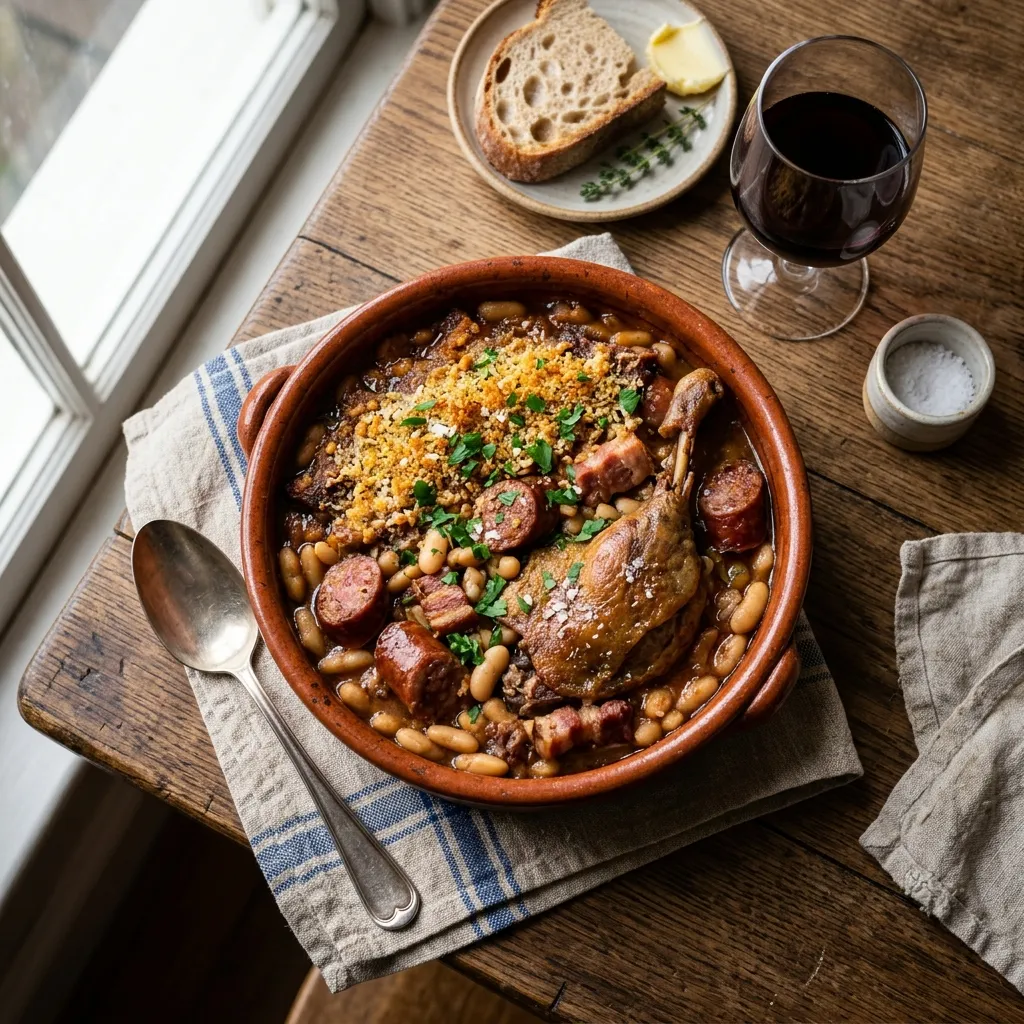
Cassoulet takes its name from the cassole — a deep, conical earthenware pot from the town of Issel, near Castelnaudary, in the Languedoc region of southwestern France. The dish is a slow-baked casserole of white beans with various meats, and its origins are claimed by three towns with equal ferocity: Castelnaudary (which uses pork, sausage, and sometimes goose), Carcassonne (which adds lamb), and Toulouse (which insists on Toulouse sausage, duck confit, and mutton). The legendary origin story ties cassoulet to the Hundred Years' War, when besieged citizens of Castelnaudary pooled their remaining provisions into a communal pot. From an Ayurvedic perspective, cassoulet is among the heaviest dishes in the French canon. White beans (haricots blancs) are guru (heavy), somewhat gas-producing, and require sustained digestive fire to break down fully. The combination of multiple animal proteins — pork belly, sausages, and preserved duck or goose — layers heaviness upon heaviness, creating a dish that demands the strongest agni. The slow baking process (traditionally 6-8 hours) partially mitigates this by pre-digesting the proteins and softening the beans' cellular structure. The traditional technique of breaking the crust that forms on top of the cassoulet and pushing it down into the beans is repeated multiple times during baking — anywhere from three to seven times depending on the cook's tradition. Each reformed crust adds another layer of browned, caramelized flavor and helps the beans absorb the fat rendered from the meats. This process transforms the dish from a simple bean stew into a layered, texturally complex casserole where the top is crackling and golden while the interior is creamy and rich.
Cassoulet is extremely guru (heavy) and snigdha (oily), making it the most kapha-increasing dish in this collection. The warmth and richness powerfully pacify vata. The combination of meats and rendered fats increases pitta moderately, though the heaviness itself can be pitta-calming in small portions.
The extreme building quality of cassoulet makes it useful for individuals needing to gain weight, recover from prolonged illness, or rebuild depleted tissue. The beans and multiple meats provide comprehensive amino acid profiles that support mamsa (muscle) and asthi (bone) dhatu formation. This is a recovery food for the emaciated and the profoundly cold-natured, not a therapeutic food for general use.
Ingredients
- 1 pound Dried white beans (Great Northern or cannellini, soaked overnight)
- 4 pieces Duck confit legs (store-bought or homemade)
- 12 ounces Pork belly (skin-on, cut into 2-inch pieces)
- 1 pound Toulouse sausage (or garlic pork sausage, in large links)
- 2 large Yellow onion (diced)
- 2 medium Carrots (diced)
- 8 cloves Garlic (minced)
- 1 14-ounce can Canned whole tomatoes (crushed by hand)
- 4 cups Chicken broth
- 6 sprigs Fresh thyme
- 3 whole Bay leaves
- 3 whole Cloves
- 3 tablespoons Duck fat (or olive oil)
- 1 cup Breadcrumbs (coarse, fresh or panko)
- 3 tablespoons Fresh parsley (chopped)
- 2 teaspoons Salt
- 1 teaspoon Black pepper
Instructions
- Drain the soaked beans and place in a large pot. Cover with fresh cold water by 3 inches. Add 1 bay leaf, 3 cloves, and a halved onion (taken from the 2 diced onions — dice the remainder). Bring to a boil, then reduce to a gentle simmer and cook for 45-60 minutes until the beans are tender but not falling apart. They will cook further in the oven. Drain, reserving 2 cups of the cooking liquid. Discard the bay leaf, cloves, and onion.
- While the beans cook, brown the pork belly pieces in 1 tablespoon of duck fat in a large skillet over medium-high heat, turning to sear all sides, about 8 minutes total. Transfer to a plate. Brown the sausage links in the same fat until the casings are golden, about 3 minutes per side. Transfer to the plate. Cut the sausage into 2-inch pieces when cool enough to handle.
- In the same skillet, cook the diced onion and carrots in the remaining duck fat over medium heat until softened, about 6 minutes. Add the garlic and cook for 1 minute. Add the crushed tomatoes and cook for 5 minutes until the mixture thickens. Season with salt, pepper, and the remaining thyme sprigs and bay leaves.
- Preheat the oven to 325 degrees F. If using a traditional cassole or deep casserole dish, rub the interior with a cut garlic clove. If using a Dutch oven, that works well too.
- Layer the cassoulet: spread one-third of the beans in the bottom of the dish. Arrange the pork belly pieces and half the sausage over the beans. Add another third of the beans, then the remaining sausage. Top with the final third of beans. Nestle the duck confit legs, skin-side up, into the top layer of beans so they are partially submerged.
- Pour the tomato-onion mixture and the chicken broth over the layers. Add enough reserved bean liquid to bring the liquid level just below the top layer of beans — the beans should be moist but not swimming. Scatter the breadcrumbs evenly over the surface and drizzle with 1 tablespoon of melted duck fat.
- Bake uncovered at 325 degrees F for 1.5 hours. A golden crust will form on top. Use the back of a large spoon to gently break and push this crust into the beans. This step is essential — it enriches the interior with the flavorful crust while allowing a new one to form.
- Continue baking for another 30-45 minutes until a second crust forms. Break and push this crust into the beans as well. Add a splash of broth if the beans look dry. Bake for a final 30 minutes to form a third and final golden crust.
- The cassoulet is done when the top is deeply golden and crackling, the beans are creamy and melting, and the interior bubbles lazily around the edges. The duck confit skin should be crispy where it protrudes above the beans.
- Let the cassoulet rest for 15 minutes before serving. Sprinkle with fresh parsley. Serve directly from the baking dish, scooping deeply to get all layers — beans, meat, and crust — in each portion.
Nutrition
These values are estimates calculated from the ingredient list and may vary based on brands, cooking methods, and serving size. Not a substitute for medical or dietary advice.
How This Recipe Affects Each Dosha
Vata
Cassoulet is deeply grounding for vata — perhaps excessively so. The white beans, while gas-producing in their raw state, become far more digestible after overnight soaking, parboiling, and 3 hours of baking. The rendered duck fat and pork fat provide the snigdha quality that vata craves. The warmth of the dish, both in temperature and virya, directly counters vata's cold nature. The earthy, substantial quality of the beans and meats provides the most grounding meal imaginable. The only concern is the complexity of multiple animal proteins combined with beans — vata's digestion may struggle with this much variety unless agni is strong.
Pitta
The rendered fats, garlic, and multiple meats create a moderately heating profile that pitta types should approach with caution in warm weather. However, the beans themselves are not particularly pitta-aggravating, and the slow, long baking process reduces the sharp heating quality of the meats. The duck confit, preserved in its own fat, carries less acute heat than freshly seared meat. For pitta, cassoulet works as a winter indulgence in moderate portions but should be avoided during pitta-season (late summer through early fall) when internal heat is already elevated.
Kapha
Cassoulet represents almost everything kapha should minimize: heavy white beans, fatty meats, rendered duck fat, bread topping, and dense, slow-cooked preparation. The guru and snigdha qualities are extreme. Regular consumption would increase mucus production, weight, lethargy, and congestion in kapha-dominant individuals. The garlic and black pepper provide token kapha-reducing pungency, but it is overwhelmed by the dish's fundamental heaviness. Kapha types who enjoy cassoulet should reserve it for rare special occasions and keep portions small.
Cassoulet demands the strongest agni of any dish in this collection. The combination of beans and multiple heavy meats requires sustained, powerful digestive fire over an extended period. The garlic, black pepper, and cloves provide agni support, but they are minor relative to the digestive challenge. Eating cassoulet with weak agni will almost certainly produce ama, gas, and heaviness.
Nourishes: rasamamsamedaasthimajja
Adjustments by Constitution
For Vata Types
Add 1 teaspoon of ground cumin and 1/2 teaspoon of asafoetida to the bean cooking water to reduce gas production. Serve a small portion with a side of steamed greens dressed with lemon — the bitter-astringent greens help balance the extreme heaviness and support digestion. Drink warm ginger-lemon tea before the meal to stoke agni. Ensure the beans are very well cooked — any firmness remaining in the beans will challenge vata digestion.
For Pitta Types
Replace the pork belly with turkey breast and use chicken thighs instead of duck confit for a less heating protein base. Reduce the garlic to 3 cloves and add 2 diced fennel bulbs for cooling sweetness. Use olive oil instead of duck fat. Add fresh sage and marjoram, which are milder than thyme. Increase the tomato slightly for its mild cooling quality (despite its acidity). Serve smaller portions alongside a green salad dressed with lemon.
For Kapha Types
Replace the white beans with red lentils or black beans, both of which are lighter and more kapha-reducing. Remove the duck confit and pork belly entirely — use chicken breast and turkey sausage for leaner protein. Skip the breadcrumb topping and duck fat. Add 1 teaspoon each of cumin, dried ginger, and mustard seeds to the bean base. Include abundant celery, leeks, and turnips for lightening vegetables. Increase the garlic and add cayenne pepper for metabolic stimulation. Keep portions to one modest bowl.
Seasonal Guidance
Cassoulet is a deep-winter food, designed for the coldest months when the body's digestive fire burns at its strongest and caloric needs are highest. It is inappropriate for any other season — too heavy for spring, too heating for summer, and too dense for early fall. Reserve this dish for the depths of January and February.
Best time of day: A late lunch or early dinner is ideal, ensuring adequate time for digestion before sleep. Do not eat cassoulet late at night — the extreme heaviness will sit in the stomach and disturb sleep. Allow 4-5 hours between cassoulet and bed.
Cultural Context
The three towns claiming cassoulet — Castelnaudary, Carcassonne, and Toulouse — each defend their version as the only authentic one, a culinary rivalry that has persisted for centuries. Prosper Montagné, author of the original Larousse Gastronomique, proposed a diplomatic hierarchy: Castelnaudary's cassoulet is the Father, Carcassonne's the Son, and Toulouse's the Holy Spirit. In practice, each version reflects local ingredients and traditions. The cassole pot itself — wider at the top than the bottom — is specifically designed to maximize the surface area available for crust formation while keeping the interior beans submerged in liquid. Cassoulet is peasant food elevated to regional religion.
Deeper Context
Origins
Cassoulet's origin legend (the 1355 siege of Castelnaudary) is probably apocryphal but captures the cultural weight — the dish functions as Languedoc regional identity food in exactly the way the legend describes. Tarbais beans received Protected Designation of Origin status in 2000. The Brotherhood of the Cassoulet (Grande Confrérie du Cassoulet) formalizes traditional preparation protocols. The Castelnaudary, Carcassonne, and Toulouse versions differ by meat inclusion: Castelnaudary is pork-and-goose; Carcassonne adds partridge; Toulouse substitutes Toulouse sausage and sometimes lamb.
Food as Medicine
Legume-and-meat protein complementation provides complete amino acid profiles that either alone cannot match. Preserved duck (confit) has extensive Gascon folk-medicine reputation as a restoration food for winter laborers and shepherds. Garlic contributes well-documented cardiovascular and antimicrobial support. The dish functions as concentrated winter-labor sustenance — substantial calories, substantial micronutrients, substantial satiety.
Ritual & Seasonal Role
Winter feast dish. Celebrations, family gatherings, regional identity meals. Languedoc festivals and fairs feature massive communal cassoulet preparations. Not religiously ceremonial but deeply culturally ritualized — the traditional 48-hour preparation protocol is almost liturgical in its specificity and regional variation.
Classical Pairings & Cautions
Red wine from Madiran, Corbières, or a rustic Côtes du Rhône. Simple green salad for balance. Crusty bread to soak juices. Cautions: religious pork restrictions (Jewish, Muslim, Hindu, some Buddhist, Adventist); gout patients should moderate the purine-heavy meat combination; Kapha and cardiovascular concerns; the 48-hour preparation time makes this feasible only as occasion cookery; legume-gas-producing for weak agni.
Cross-Tradition View
How other medical and food-wisdom traditions read this dish. Each tradition names the same physiological reality in its own language — the agreements across them are where universal principles live.
Traditional Chinese Medicine
White beans build Kidney essence and tonify Spleen Qi; duck confit is Yin-building; pork belly is Yin-and-Qi tonifying; sausage is Yin-building and salty; garlic is warm-dispersing. An extensive Yin-building Qi tonic with genuine winter-restoration character — TCM physicians would recognize the long-braise-with-legumes-and-preserved-meat as a classical cold-season Essence-and-Blood builder.
Greek Humoral
Hot-wet sanguine-building aggressively. A Galenic feast food for melancholic and phlegmatic types depleted by winter labor or prolonged fasting. The Hippocratic endorsement of fatty meats for thin nervous constitutions and the Galenic praise of long-braised preparations for hard meats both apply — appropriate as winter occasion food.
Ayurveda
Heating virya, sweet vipaka. Pacifies Vata substantially through unctuousness, protein, and warmth. Aggravates Kapha very substantially through the heavy-oily-meat-legume combination. Pitta mildly aggravated through cured-meat content. A classical Vata-recovery dish when occasion-appropriate; inappropriate for frequent consumption.
Languedocian Occitan
Cassoulet is the defining dish of Languedoc — three towns (Castelnaudary, Carcassonne, Toulouse) each claim the authentic preparation, with different meat combinations marking regional identity. Legend traces the dish to a 1355 siege of Castelnaudary during the Hundred Years War, when townspeople pooled their remaining food (beans, preserved duck, pork) into one massive pot. Tarbais beans hold PDO status; true cassoulet requires a 48-hour slow preparation with seven breakings of the crust.
Chef's Notes
Cassoulet is not a weeknight project — it is a weekend endeavor that rewards patience and planning. The beans must be soaked overnight; the meats must be browned properly; the baking requires 2.5-3 hours of attention for crust-breaking. Do not rush any step. The quality of the sausage matters enormously — seek out a true Toulouse-style sausage with garlic and coarse grind, or a good-quality garlic pork sausage. If duck confit is unavailable, chicken thighs confited in duck fat (or even well-browned skin-on thighs) are an acceptable substitute. Cassoulet reheats better than almost any dish — many argue it improves on the second and third day.
Frequently Asked Questions
Is Cassoulet good for my dosha?
Cassoulet is extremely guru (heavy) and snigdha (oily), making it the most kapha-increasing dish in this collection. The warmth and richness powerfully pacify vata. The combination of meats and rendered fats increases pitta moderately, though the heaviness itself can be pitta-calming in small portions. Cassoulet is deeply grounding for vata — perhaps excessively so. The rendered fats, garlic, and multiple meats create a moderately heating profile that pitta types should approach with caution in warm weather. Cassoulet represents almost everything kapha should minimize: heavy white beans, fatty meats, rendered duck fat, bread topping, and dense, slow-cooked preparation.
When is the best time to eat Cassoulet?
A late lunch or early dinner is ideal, ensuring adequate time for digestion before sleep. Do not eat cassoulet late at night — the extreme heaviness will sit in the stomach and disturb sleep. Allow 4-5 hours between cassoulet and bed. Cassoulet is a deep-winter food, designed for the coldest months when the body's digestive fire burns at its strongest and caloric needs are highest. It is inappropriate for any other season — too hea
How can I adjust Cassoulet for my constitution?
For Vata types: Add 1 teaspoon of ground cumin and 1/2 teaspoon of asafoetida to the bean cooking water to reduce gas production. Serve a small portion with a side of For Pitta types: Replace the pork belly with turkey breast and use chicken thighs instead of duck confit for a less heating protein base. Reduce the garlic to 3 cloves
What are the Ayurvedic properties of Cassoulet?
Cassoulet has madhura,lavana taste (rasa), ushna energy (virya), and madhura post-digestive effect (vipaka). Its qualities (gunas) are guru,snigdha,ushna. It nourishes rasa,mamsa,meda,asthi,majja. Cassoulet demands the strongest agni of any dish in this collection. The combination of beans and multiple heavy meats requires sustained, powerful digestive fire over an extended period. The garlic, black pepper, and cloves provide agni support, but they are minor relative to the digestive challenge. Eating cassoulet with weak agni will almost certainly produce ama, gas, and heaviness.