Apple Pie
American Recipe
Overview
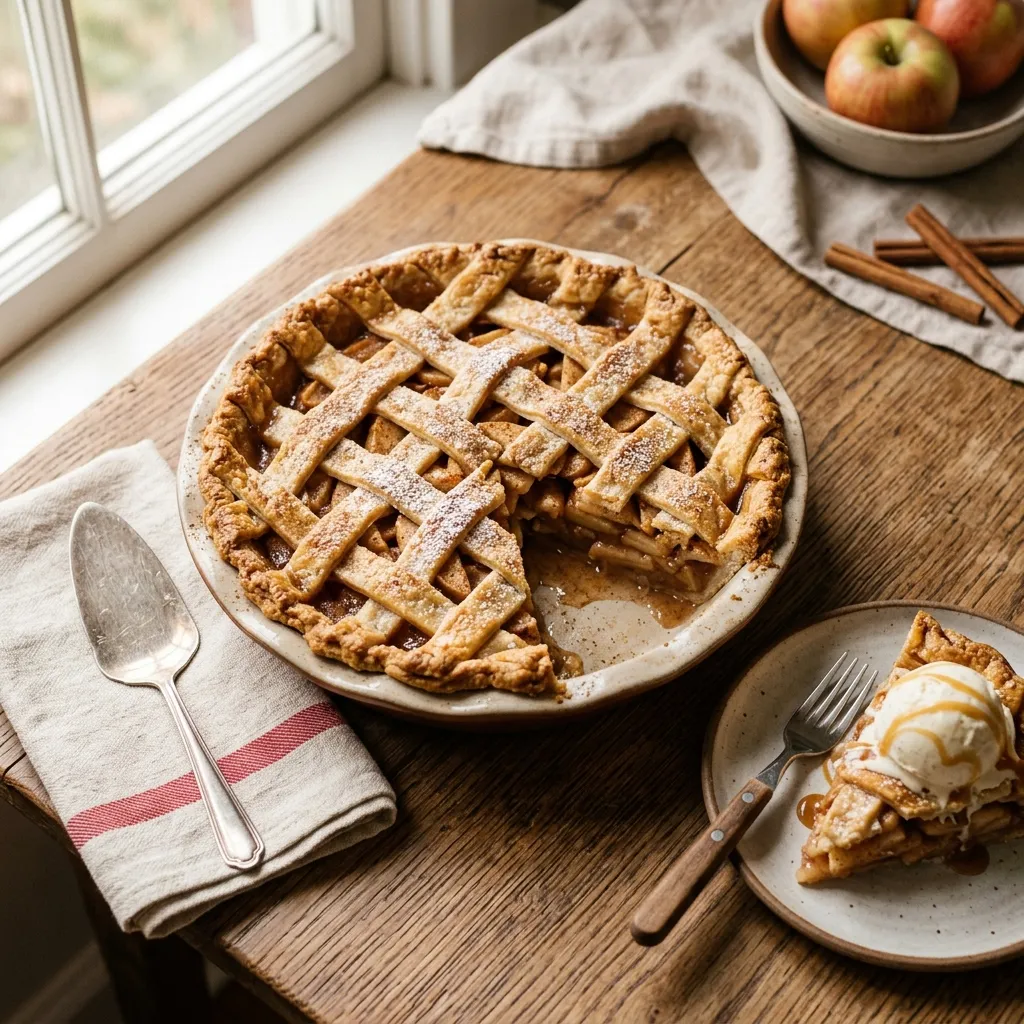
Apple pie became an American cultural symbol in the early 20th century, but the dish originated in 14th-century England, where apples, sugar, and spices were enclosed in pastry called a 'coffin' — a utilitarian crust meant as a container rather than an eating element. American apple pie evolved to feature a tender, flaky crust made with cold fat cut into flour, creating layers that separate during baking as butter melts and water converts to steam. The filling depends entirely on apple variety. Granny Smith provides tartness and holds its shape. Honeycrisp offers balanced sweet-tart flavor and a satisfying texture. Golden Delicious collapses into a soft, sweet sauce. This recipe combines two varieties for complexity — a firm tart apple for structure and a sweet apple for depth. The spice blend of cinnamon, nutmeg, and allspice transforms raw apple's simple sweetness into a warm, aromatic filling. Ayurveda views cooked apple as one of the most sattvic (pure, harmonious) foods available. Raw apple is astringent, light, and drying — difficult for vata and not particularly nourishing. Cooking with ghee, spices, and sweetener completely transforms its qualities, producing a sweet, warm, soft, and oily preparation that calms the mind and nourishes rasa dhatu. Apple pie, despite its dessert status, carries genuine Ayurvedic merit when prepared mindfully.
Pacifies vata through sweet taste, warm temperature, and oily pastry crust. Mildly increases pitta through the heating spices and sugar, though the cooked apple's cooling quality partially offsets this. Increases kapha due to the heavy, sweet, and oily combination of butter crust, sugar, and cooked fruit.
Warm apple pie with digestive spices serves as a mild sedative and grounding food for vata-type anxiety, insomnia, and nervous system agitation. The combination of sweet taste, warm temperature, and heavy quality calms vata's upward-moving prana and settles the mind. Not a daily therapeutic — effective as an occasional restorative.
Ingredients
- 2.5 cups all-purpose flour
- 1 teaspoon sea salt
- 1 tablespoon sugar (for crust)
- 16 tablespoons unsalted butter (cold, cubed)
- 6-8 tablespoons ice water
- 3 large Granny Smith apples (peeled, cored, sliced 1/4 inch thick)
- 3 large Honeycrisp apples (peeled, cored, sliced 1/4 inch thick)
- 0.67 cup sugar (for filling)
- 2 tablespoons brown sugar
- 1.5 teaspoons cinnamon
- 0.25 teaspoon nutmeg (freshly grated)
- 0.25 teaspoon allspice
- 1 tablespoon lemon juice
- 2 tablespoons cornstarch
- 1 large egg (beaten, for egg wash)
- 1 tablespoon turbinado sugar (for topping)
Instructions
- Make the crust. Whisk flour, salt, and 1 tablespoon sugar in a large bowl. Add the cold cubed butter and toss to coat. Using a pastry cutter or your fingertips, work the butter into the flour until the mixture contains pieces ranging from pea-sized to flat, dime-sized shards. These irregular pieces are critical — they create the flaky layers. Do not overwork into a uniform meal.
- Drizzle 6 tablespoons of ice water over the mixture and toss with a fork until the dough begins to come together in shaggy clumps. If dry spots remain, add water 1 tablespoon at a time. Gather the dough onto a lightly floured surface and press it into a cohesive mass using the heel of your hand — 2-3 passes only. Divide in half, shape into discs, wrap in plastic, and refrigerate for at least 1 hour.
- Prepare the filling. Toss the sliced apples with both sugars, cinnamon, nutmeg, allspice, lemon juice, and cornstarch in a large bowl. Let the mixture sit for 30 minutes, stirring occasionally. The sugar draws moisture from the apples — this pre-maceration step prevents a soggy bottom crust by releasing excess liquid before baking.
- Preheat the oven to 425°F (220°C) with a rack in the lower third. Roll one dough disc on a floured surface into a 12-inch circle, about 1/8 inch thick. Transfer to a 9-inch pie dish by rolling the dough around the rolling pin and unrolling it over the dish. Press gently into the bottom and sides without stretching — stretched dough shrinks during baking.
- Drain the accumulated liquid from the apple mixture (there will be several tablespoons — discard or save for tea). Mound the apple slices into the crust, packing them tightly and doming them slightly in the center. The filling will shrink during baking, so overfill slightly to avoid a gap between crust and filling.
- Roll the second dough disc into a 12-inch circle. Drape it over the filling. Trim the overhanging dough to 1 inch beyond the rim, then fold the top crust edge under the bottom crust edge and crimp by pressing with a fork or pinching with your fingers. Cut 4-5 vent slits in the top crust to allow steam to escape.
- Brush the top crust with beaten egg and sprinkle with turbinado sugar. The egg wash creates a golden, glossy finish, and the coarse sugar adds sparkle and crunch. Place the pie on a rimmed baking sheet to catch any drips.
- Bake at 425°F for 20 minutes to set the crust and begin browning. Reduce the temperature to 375°F (190°C) and continue baking for 35-40 minutes until the crust is deep golden brown and the filling is bubbling vigorously through the vents. If the edges brown too quickly, cover them with foil strips.
- Cool the pie on a wire rack for at least 2 hours before slicing. This resting period is essential — the cornstarch in the filling needs time to set as it cools. Cutting too early produces a runny filling. Serve warm or at room temperature with a scoop of vanilla ice cream or a dollop of whipped cream.
Nutrition
These values are estimates calculated from the ingredient list and may vary based on brands, cooking methods, and serving size. Not a substitute for medical or dietary advice.
How This Recipe Affects Each Dosha
Vata
Cooked apple with warming spices is a classical vata-pacifying food in Ayurveda, and apple pie delivers this in an especially grounding format. The butter crust provides oily, heavy qualities that stabilize vata. The sweet taste — from both sugar and the apples' natural maltose developed during baking — is vata's most important rasa. Cinnamon, nutmeg, and allspice warm the digestive tract and prevent the gas formation that raw apples cause in vata types. Serve warm for maximum benefit. A warm slice of apple pie is legitimate Ayurvedic self-care for vata in cold weather.
Pitta
The cooked apple base is pitta-calming — sweet, mildly cooling, and soft. However, the added sugar, warming spices, and butter crust shift the balance toward mild pitta increase. Cinnamon in particular is heating, and the quantity used here (1.5 teaspoons) is noticeable. The sour element from lemon juice and tart apples also mildly provokes pitta. In moderate portions, especially during cooler months, apple pie is manageable for pitta types. During summer or when pitta is already elevated, the combination of sugar and heat may manifest as skin breakouts or acid reflux.
Kapha
Apple pie concentrates several kapha-aggravating qualities. The butter crust is heavy and oily. The sugar — both white and brown — is pure sweet taste without nutritional complexity. Cooked apples lose the astringent quality that makes raw apples somewhat kapha-balancing. The heavy, warm, oily finished product promotes tissue accumulation and can increase lethargy after eating. The warming spices provide some kapha counterbalance but are insufficient against the overall weight of the dish. Keep portions small.
The warming spices in apple pie — cinnamon, nutmeg, allspice — actively support agni, making this dessert more digestively intelligent than many sweets. However, the heavy butter crust and concentrated sugar can dampen agni if consumed in large portions. The balance depends on serving size — a moderate slice stimulates and satisfies, while an oversized portion overwhelms.
Nourishes: rasamedashukra
Adjustments by Constitution
For Vata Types
Add 1 teaspoon of cardamom and a pinch of clove to the spice blend for deeper warming. Replace some white sugar with jaggery for a more grounding sweetness. Serve warm with a scoop of vanilla ice cream or warm custard — the additional dairy nourishes vata's dry tissues. Use ghee in the crust instead of butter for enhanced digestibility. A cup of warm spiced milk alongside the pie creates a deeply nourishing vata-calming evening treat.
For Pitta Types
Reduce cinnamon to 3/4 teaspoon and replace the remaining amount with cardamom, which is sweet and cooling. Use only sweet apple varieties (Honeycrisp, Golden Delicious) and omit the Granny Smith tartness. Replace half the white sugar with maple syrup, which is less heating than refined sugar. Serve at room temperature rather than hot. Pair with coconut whipped cream instead of dairy ice cream for a cooler accompaniment.
For Kapha Types
Use a single bottom crust only — skip the top crust to halve the butter and flour. Reduce sugar in the filling to 1/3 cup and add 1 tablespoon of honey after baking (drizzled on top). Double the cinnamon and ginger, add 1/4 teaspoon of black pepper, and include a pinch of clove — these stimulating spices help metabolize the sweetness. Use tart apples only (all Granny Smith) for their astringent quality, which is kapha-balancing. Serve a small slice without ice cream or cream, accompanied by ginger tea.
Seasonal Guidance
Apple pie is perfectly seasonal for autumn when fresh apples are at peak quality and the body transitions toward heavier, warmer foods. The warming spices support the body through the vata season. Equally appropriate in winter. Less suitable in spring and summer when lighter desserts serve the body better.
Best time of day: Best enjoyed as an afternoon or early evening dessert when there are still several hours of active digestion ahead. The heavy crust and sweet filling take time to process. Avoid late at night, when the sugar and butter sit undigested and create ama.
Cultural Context
The phrase 'as American as apple pie' entered the vernacular in the early 1900s despite the dish's English origins and the apple's Central Asian ancestry (Malus sieversii from Kazakhstan's Tian Shan mountains). What made apple pie American was its democratic ubiquity — apples grew in every state, sugar became affordable, and the pie format worked in both farmhouse and urban kitchens. Johnny Appleseed (John Chapman, 1774-1845) planted nurseries across the frontier primarily for cider production, but those orchards also supplied baking apples. The cultural weight carried by apple pie — invoked in wartime propaganda, political speeches, and Norman Rockwell paintings — reflects a collective association between this simple fruit pastry and an idealized domestic stability.
Deeper Context
Origins
Apple pie is not American in origin — English apple pie recipes appear in the 14th-century Forme of Cury cookbook, and Dutch, Swedish, and German versions predate American settlement by centuries. The dish crossed the Atlantic with European colonists in the 1600s and 1700s and was culturally reframed as American over the 19th century. The phrase 'as American as apple pie' reflects adoption, not invention — a fact that does nothing to reduce the dish's national symbolic weight.
Food as Medicine
The apple-cinnamon combination has a documented folk record as a cold-and-cough remedy and as a digestive after large meals. Cinnamon remains a classical Unani and Ayurvedic medicine for blood sugar dysregulation; folk American grandmothers' practice of serving warm apple pie with cinnamon for settling a rich meal parallels Ayurvedic agni-support principles without naming them as such. The cooking process also breaks down pectin into a more bioavailable form.
Ritual & Seasonal Role
Thanksgiving, harvest festivals, state fairs, Fourth of July dinners — apple pie is the archetypal American ceremonial dessert despite its European origin. Autumn peak through early winter, coinciding with the apple harvest. In some New England traditions it is served as breakfast, captured in the old saying that apple pie for breakfast makes a man who can split wood. The dish's ceremonial role is disproportionate to its actual recipe difficulty.
Classical Pairings & Cautions
Served with vanilla ice cream (a la mode) or sharp cheddar cheese (an old British-American pairing that has largely fallen from use). Coffee or black tea alongside. Cautions: the combination of sugar, butter-flour crust, and apple-starch makes this a substantial glycemic load — diabetic, Kapha, and metabolic-syndrome patients should limit severely. Gluten intolerance precludes standard preparations; almond-flour crusts work as substitutions.
Cross-Tradition View
How other medical and food-wisdom traditions read this dish. Each tradition names the same physiological reality in its own language — the agreements across them are where universal principles live.
Traditional Chinese Medicine
Apple is cool-sweet-sour and moistens Lung Yin; butter is warm-nourishing; cinnamon enters the Kidney and Spleen meridians, warms the middle, and disperses cold; sugar clogs the Spleen in excess. The overall effect is a moderately-warming Yin-moistening preparation — useful for dry autumn coughs but damp-heat-generating in quantity. The cinnamon is the therapeutic ingredient; the rest is food. Classical TCM physicians prescribed cinnamon-apple decoctions for winter cough without the sugar-flour vehicle.
Greek Humoral
Apples are cold-wet to neutral depending on variety; butter wet, sugar wet-hot, cinnamon hot-dry, crust hot-dry. The whole sits in the hot-wet quadrant — sanguine-building. Galenic reading: a convalescent dish suitable for melancholic types needing cheer and moisture, inappropriate for choleric or sanguine excess. Monastic infirmaries used warm apple-cinnamon preparations for winter fevers that had broken.
Ayurveda
Heating virya from the cinnamon and butter; sweet vipaka. Pacifies Vata through unctuousness and warmth; aggravates Kapha through sweetness and heaviness; may aggravate Pitta through the sugar heat. Cinnamon carries its own classical materia medica as a digestive and circulatory stimulant that partly compensates for the sugar load — the combination is a restoration dessert rather than everyday food.
European Folk Medicine
Apples and cinnamon have paired in northern European folk medicine since at least the medieval period — a documented folk remedy for winter colds, digestive sluggishness, and seasonal malaise. Monastic herbals from the 9th-century Carolingian period list both as spice-cupboard staples. Apple pie as we know it descends from medieval English coffyn pies (shortcut pastry cases filled with fruit), gradually sweetened as cane sugar became affordable after the 17th century.
Chef's Notes
The maceration step — salting and sugaring the apples before filling — is what separates exceptional apple pie from mediocre. By drawing out and discarding the excess liquid, you prevent the notorious soggy bottom and concentrate the apple flavor. If you want an even more intensely flavored filling, reduce the drained apple juice in a saucepan to 2 tablespoons of syrup and toss it back into the apples before filling. Every apple variety behaves differently — avoid Red Delicious (mealy when cooked) and Fuji (too soft). Braeburn, Northern Spy, and Jonagold are also excellent choices.
Frequently Asked Questions
Is Apple Pie good for my dosha?
Pacifies vata through sweet taste, warm temperature, and oily pastry crust. Mildly increases pitta through the heating spices and sugar, though the cooked apple's cooling quality partially offsets this. Increases kapha due to the heavy, sweet, and oily combination of butter crust, sugar, and cooked fruit. Cooked apple with warming spices is a classical vata-pacifying food in Ayurveda, and apple pie delivers this in an especially grounding format. The cooked apple base is pitta-calming — sweet, mildly cooling, and soft. Apple pie concentrates several kapha-aggravating qualities.
When is the best time to eat Apple Pie?
Best enjoyed as an afternoon or early evening dessert when there are still several hours of active digestion ahead. The heavy crust and sweet filling take time to process. Avoid late at night, when the sugar and butter sit undigested and create ama. Apple pie is perfectly seasonal for autumn when fresh apples are at peak quality and the body transitions toward heavier, warmer foods. The warming spices support the body through the vata season. Equ
How can I adjust Apple Pie for my constitution?
For Vata types: Add 1 teaspoon of cardamom and a pinch of clove to the spice blend for deeper warming. Replace some white sugar with jaggery for a more grounding swee For Pitta types: Reduce cinnamon to 3/4 teaspoon and replace the remaining amount with cardamom, which is sweet and cooling. Use only sweet apple varieties (Honeycrisp
What are the Ayurvedic properties of Apple Pie?
Apple Pie has sweet,sour,astringent taste (rasa), heating energy (virya), and sweet post-digestive effect (vipaka). Its qualities (gunas) are heavy,oily,warm. It nourishes rasa,meda,shukra. The warming spices in apple pie — cinnamon, nutmeg, allspice — actively support agni, making this dessert more digestively intelligent than many sweets. However, the heavy butter crust and concentrated sugar can dampen agni if consumed in large portions. The balance depends on serving size — a moderate slice stimulates and satisfies, while an oversized portion overwhelms.