Arroz con Pollo
Peruvian Recipe
Overview
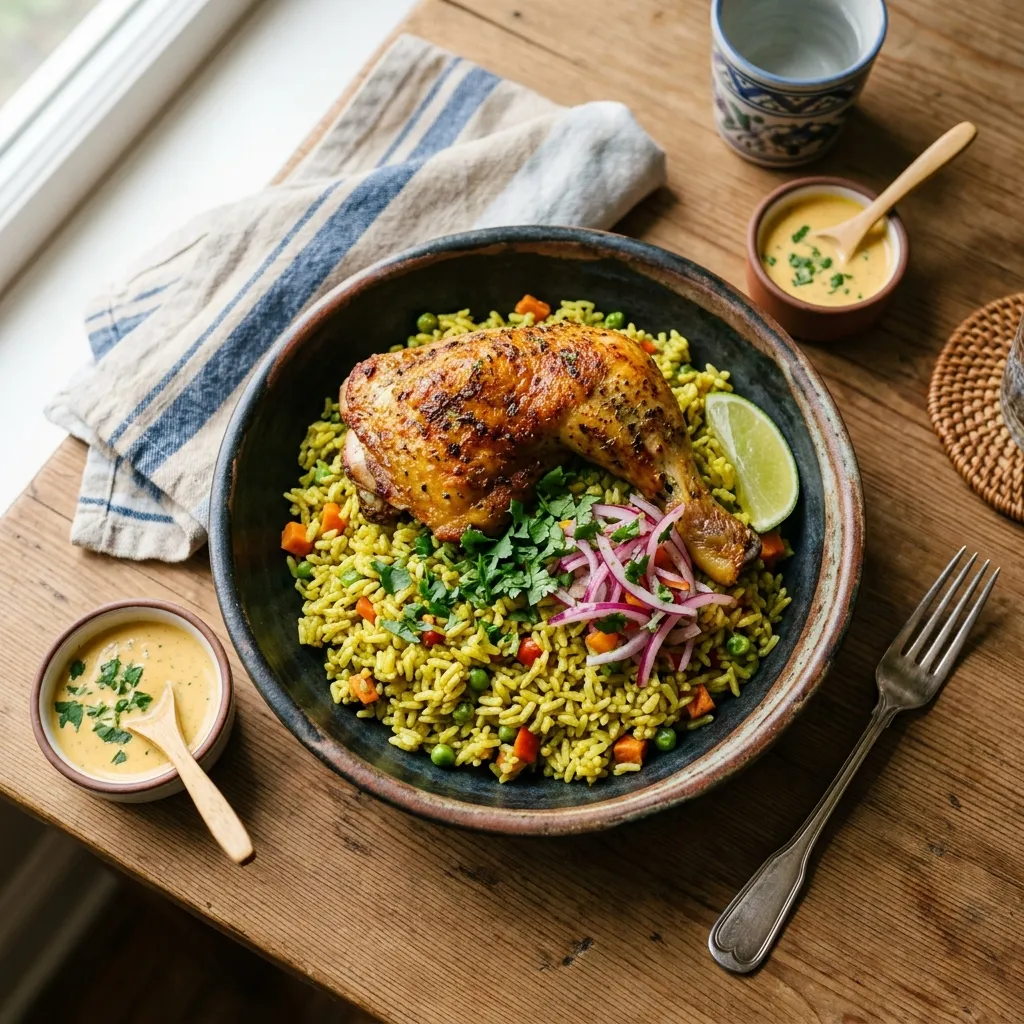
Arroz con pollo is Peru's green-tinted chicken and rice — chicken pieces browned and then braised with rice in a deeply flavored broth colored emerald green by blended cilantro and spinach. While chicken and rice exists across Latin America, the Peruvian version is distinct for its vivid green color, the use of dark beer in the braising liquid, and the generous cilantro that suffuses every grain. The technique involves browning seasoned chicken pieces, building an aromatic sofrito of onion, garlic, aji amarillo, and cumin, then adding rice and a green-tinted broth (chicken stock blended with cilantro, spinach, and sometimes culantro or huacatay). Everything cooks together in one pot — the rice absorbing the chicken juices and green broth until each grain is tender, separate, and infused with flavor. Peas, carrots, and corn are stirred in during the final minutes. Ayurvedically, this is a well-balanced, moderate-heat preparation. Chicken is lighter than red meat and provides nourishment without excessive heaviness. The cilantro and spinach add cooling, detoxifying properties that counterbalance the heating garlic, cumin, and aji. The rice provides sweet, grounding energy. Of all the Peruvian meat-and-starch dishes, this is the most suitable for a wide range of constitutions.
A balanced, moderately heating dish. Pacifies Vata through warmth, oleation, and sustaining protein-starch combination. The cilantro and spinach partially offset Pitta provocation from garlic and cumin. Increases Kapha mildly through the rice-chicken-oil combination.
Ingredients
- 6 pieces Chicken thighs (bone-in, skin-on)
- 2 cups Long-grain white rice
- 1 large bunch Fresh cilantro (stems and leaves, blended with 1/2 cup water)
- 1 cup Spinach (packed, blended with the cilantro)
- 2.5 cups Chicken broth
- 1/2 cup Dark beer (or additional broth)
- 1 tbsp Aji amarillo paste
- 1 large Onion (finely diced)
- 4 cloves Garlic (minced)
- 1 tsp Cumin
- 1/2 cup Peas (fresh or frozen)
- 1 medium Carrot (diced small)
- 2 tbsp Vegetable oil
- 1.5 tsp Salt
- 1/2 tsp Black pepper
Instructions
- Season the chicken thighs generously with salt, pepper, and half the cumin. Heat oil in a large, deep pot or Dutch oven over medium-high heat. Brown the chicken pieces skin-side down for 4-5 minutes until deeply golden. Flip and brown the other side for 2 minutes. Remove and set aside.
- In the same pot, reduce heat to medium. Cook the onion for 4 minutes until softened. Add garlic, remaining cumin, and aji amarillo paste. Stir for 1 minute until very fragrant.
- Blend the cilantro, spinach, and 1/2 cup water until smooth. Set aside.
- Add the rice to the pot and stir to coat in the sofrito for 1-2 minutes. Add the chicken broth, dark beer, cilantro-spinach puree, and diced carrot. Stir to combine.
- Nestle the browned chicken pieces into the rice, pressing them down slightly so they are partially submerged. Bring to a boil, then reduce heat to the lowest setting. Cover tightly.
- Cook undisturbed for 20 minutes. Add the peas, gently folding them in without disturbing the chicken. Cover and cook for 5 more minutes.
- Remove from heat and let rest, covered, for 10 minutes. The rice will finish absorbing liquid and become fluffy.
- Serve with the chicken pieces on top of mounds of green rice, with a crisp salad and salsa criolla (onion relish) on the side.
Nutrition
These values are estimates calculated from the ingredient list and may vary based on brands, cooking methods, and serving size. Not a substitute for medical or dietary advice.
How This Recipe Affects Each Dosha
Vata
Warm, moist, oily, and protein-rich — this dish addresses Vata's primary needs effectively. The combination of chicken, rice, and the aromatic broth creates a deeply settling meal. The cilantro provides a detoxifying element without cooling the dish excessively. The bone-in cooking method releases minerals that nourish Vata's depleted tissues.
Pitta
The garlic, cumin, aji amarillo, and chicken skin add heating quality, but the cilantro and spinach in the broth provide meaningful cooling counterbalance. This lands in a moderate range for Pitta — acceptable in cooler weather, worth modifying in summer.
Kapha
Rice, chicken skin, oil, and the overall heavy quality increase Kapha. However, the pungent spicing and the bitter quality from the green herbs prevent complete stagnation. Kapha types can enjoy this with modifications to portions and accompaniments.
The sofrito of cumin, garlic, and aji stimulates agni in the opening minutes of digestion. The chicken and rice are moderately easy to process when cooked together in broth, and the cilantro-spinach element adds a mild detoxifying quality that supports agni without burdening it.
Nourishes: Rasa (plasma), Rakta (blood), Mamsa (muscle), Medas (fat), Asthi (bone)
Adjustments by Constitution
For Vata Types
Use ghee instead of oil for browning. Add a cinnamon stick to the broth for extra warmth. Serve with warm buttered bread. The standard recipe is already well-suited for Vata.
For Pitta Types
Remove the chicken skin before browning. Omit the aji amarillo and reduce garlic to 2 cloves. Increase the cilantro and spinach by half. Add fresh dill to the green blend. Serve with a cooling cucumber salad.
For Kapha Types
Remove chicken skin. Use brown rice or quinoa instead of white rice. Increase the peas and carrots, and add broccoli or green beans. Skip the oil — use a non-stick pot for browning. Add extra cumin, black pepper, and a pinch of cayenne.
Seasonal Guidance
Appropriate through most of the year except peak summer, when the heating spices and heavy rice-meat combination can overwhelm Pitta. In winter, this is ideal — warming, sustaining, and deeply satisfying. In spring, reduce oil and increase the green vegetable content.
Best time of day: Dinner — the one-pot format creates a complete, satisfying evening meal that does not require multiple side dishes
Cultural Context
Arroz con pollo arrived in Peru with Spanish colonists and was transformed by local ingredients — particularly cilantro, aji amarillo, and Peruvian dark beer. The green color distinguishes the Peruvian version from the yellow (saffron or achiote-tinted) versions found in the Caribbean, Colombia, and Spain. In Lima, arroz con pollo is the quintessential weekday family dinner — practical, one-pot, satisfying, and beloved by children and adults alike. It is also a fixture of communal celebrations and potlucks, where it can be scaled to feed dozens from a single large pot.
Deeper Context
Origins
Arroz con pollo exists as a shared pan-Latin-American dish with distinct regional versions — Caribbean (typically with tomato and saffron), Mexican (often with chiles), Peruvian (aji amarillo and cilantro-forward). Spanish colonial origins reflect medieval Iberian paella-adjacent rice-cookery meeting regional Latin-American ingredients. The Peruvian aji-amarillo-and-cilantro profile distinguishes it from other regional versions and reflects Peruvian Criollo kitchen innovation over the 16th-19th centuries.
Food as Medicine
Complete-meal preparation: protein (chicken), carbohydrate (rice), phytonutrients (cilantro, aji), warming spices (cumin). Cilantro provides preliminary research support for heavy-metal chelation. Aji amarillo contributes capsaicin (metabolic support) and carotenoids. A balanced everyday family meal across Peruvian Criollo households.
Ritual & Seasonal Role
Year-round Peruvian home cooking. Sunday family lunch staple. Not religiously ceremonial but deeply tied to Peruvian Criollo domestic food identity.
Classical Pairings & Cautions
Peas-and-carrot salad (ensalada rusa), Criolla onion salsa, Inca Kola or chicha morada. Cautions: capsaicin aggravation from aji amarillo; religious chicken restrictions rare; gluten-free by default; FODMAP sensitivity from garlic and onion in the sofrito base.
Cross-Tradition View
How other medical and food-wisdom traditions read this dish. Each tradition names the same physiological reality in its own language — the agreements across them are where universal principles live.
Traditional Chinese Medicine
Chicken is Qi-building and warming; rice is Spleen-Qi-tonifying; cilantro clears Heat; aji amarillo is hot-pungent and disperses cold; cumin warms the middle. A comprehensive Qi-building preparation — TCM physicians would class this as appropriate everyday complete-meal food across constitutional types.
Greek Humoral
Hot-wet sanguine-building. Galenic-suitable complete-meal preparation — the rice-and-chicken architecture is pan-Mediterranean (Spanish paella, Italian risotto with chicken, Greek kotopoulo me rizi) reflecting shared Mediterranean rice-and-poultry cookery.
Ayurveda
Heating virya, sweet vipaka. Pacifies Vata through warmth and protein. Pitta mildly aggravated through aji amarillo. Kapha-neutral. A classical Vata-pacifying complete meal.
Criollo Spanish Colonial
Arroz con pollo is pan-Latin-American dish with distinct regional versions across the Caribbean, Mexico, Central America, and South America. The Peruvian version emphasizes Andean aji amarillo chile and cilantro, giving a distinctive green-yellow color and Andean-forward flavor profile. Spanish colonial origins (Iberian paella-adjacent rice-cookery) meet Andean ingredients. Every Peruvian Criollo home has a grandmother's version.
Chef's Notes
Do not lift the lid during the 20-minute cooking period — the steam is what cooks the rice, and each peek extends the cooking time. The cilantro-spinach blend must be very smooth; any leaf chunks create an uneven color. Dark beer adds a malty depth that chicken broth alone cannot — stout or porter works well. If skipping beer, add a tablespoon of Worcestershire sauce for complexity. The rice should be fluffy and separate, not sticky — do not stir once you cover the pot. Bone-in, skin-on thighs are essential; boneless chicken dries out during the long cooking.
Frequently Asked Questions
Is Arroz con Pollo good for my dosha?
A balanced, moderately heating dish. Pacifies Vata through warmth, oleation, and sustaining protein-starch combination. The cilantro and spinach partially offset Pitta provocation from garlic and cumin. Increases Kapha mildly through the rice-chicken-oil combination. Warm, moist, oily, and protein-rich — this dish addresses Vata's primary needs effectively. The garlic, cumin, aji amarillo, and chicken skin add heating quality, but the cilantro and spinach in the broth provide meaningful cooling counterbalance. Rice, chicken skin, oil, and the overall heavy quality increase Kapha.
When is the best time to eat Arroz con Pollo?
Dinner — the one-pot format creates a complete, satisfying evening meal that does not require multiple side dishes Appropriate through most of the year except peak summer, when the heating spices and heavy rice-meat combination can overwhelm Pitta. In winter, this is ideal — warming, sustaining, and deeply satisfy
How can I adjust Arroz con Pollo for my constitution?
For Vata types: Use ghee instead of oil for browning. Add a cinnamon stick to the broth for extra warmth. Serve with warm buttered bread. The standard recipe is alrea For Pitta types: Remove the chicken skin before browning. Omit the aji amarillo and reduce garlic to 2 cloves. Increase the cilantro and spinach by half. Add fresh dil
What are the Ayurvedic properties of Arroz con Pollo?
Arroz con Pollo has Sweet, Pungent, Bitter taste (rasa), Heating energy (virya), and Sweet post-digestive effect (vipaka). Its qualities (gunas) are Warm, Oily, Heavy, Moist. It nourishes Rasa (plasma), Rakta (blood), Mamsa (muscle), Medas (fat), Asthi (bone). The sofrito of cumin, garlic, and aji stimulates agni in the opening minutes of digestion. The chicken and rice are moderately easy to process when cooked together in broth, and the cilantro-spinach element adds a mild detoxifying quality that supports agni without burdening it.