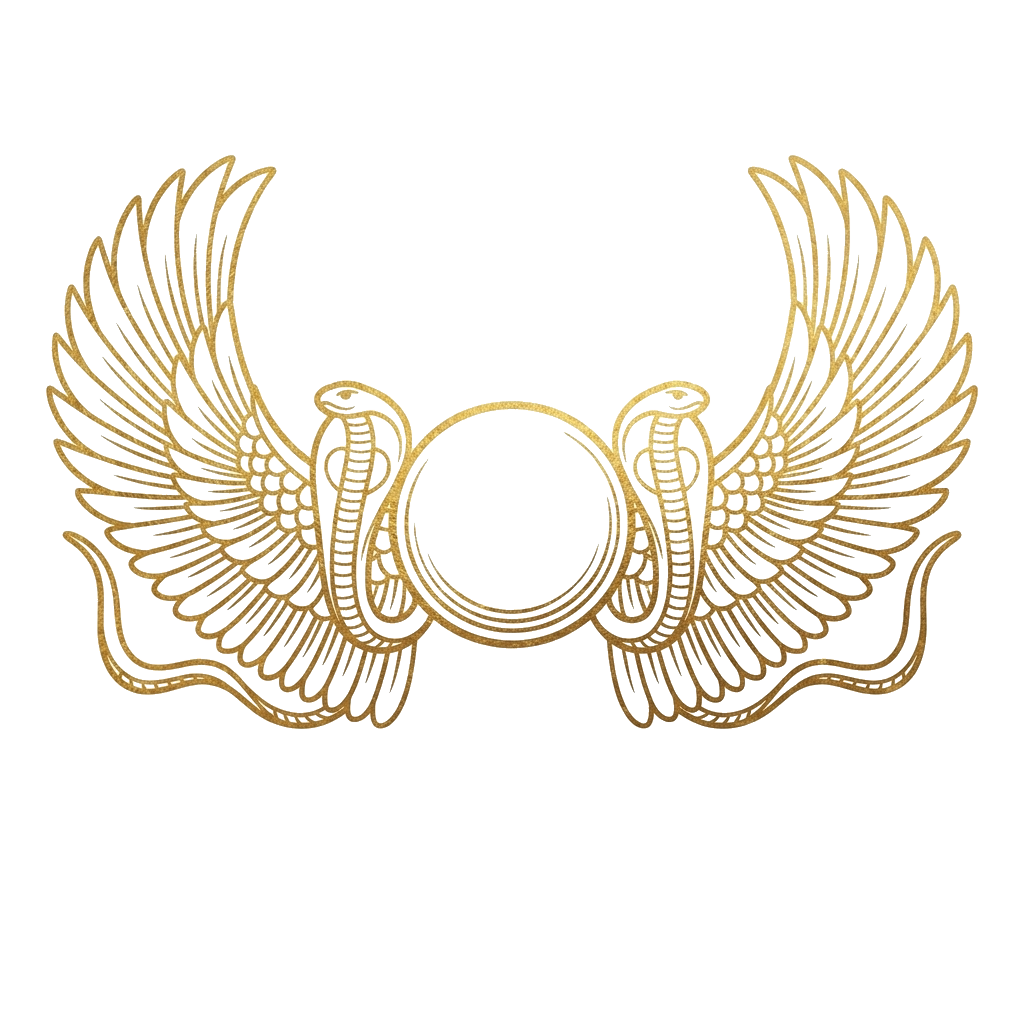
Winged Sun Disk
The supreme solar emblem of ancient Egypt, Mesopotamia, and Persia — wings of protection flanking the divine sun, marking the threshold between human and sacred space.
About Winged Sun Disk
The Winged Sun Disk appeared independently across at least four major civilizations of the ancient Near East — Egyptian, Assyrian, Hittite, and Persian — each rendering it in their own artistic idiom while preserving its core visual logic. At its core, the symbol depicts a solar disk — representing the divine, the absolute, the source of all light and life — flanked by outstretched wings that convey protection, sovereignty, and the capacity of spirit to move freely between worlds. In many renditions, two serpents (uraei) descend from either side of the disk, adding layers of meaning related to duality, kundalini-like life force, and the guardianship of sacred thresholds.
The symbol's earliest known appearances date to the mid-third millennium BCE in both Egypt and Mesopotamia, where it arose in remarkably similar forms despite the vast geographic and cultural distance between the two civilizations. In Egypt, it became inseparable from the mythology of Horus of Edfu (Behdety), the falcon god who defeated the enemies of Ra and was rewarded by having his winged form placed above every temple door in the land. In Mesopotamia, the symbol was associated with Shamash, the sun god of justice and truth, and later with Ashur, the supreme deity of the Assyrian empire.
The Winged Sun Disk is extraordinary not for its age or beauty alone, but for its persistence. It traveled from Egyptian temple lintels to Phoenician trade goods, from Persian royal inscriptions to Hittite rock reliefs, from Zoroastrian fire temples to Freemasonic lodges, and ultimately into the iconography of modern esoteric movements. Wherever it appeared, it carried the same essential message: the divine light is real, it protects those who align with it, and it reigns supreme over all earthly and cosmic forces.
The symbol's remarkable cross-cultural resonance suggests it encodes something deeper than any single mythology — a universal archetype of the relationship between consciousness (the sun), freedom (the wings), and the dual forces of creation (the serpents). It is, in many respects, a map of the human soul rendered in a single image.
Visual Description
In its most complete Egyptian form, the Winged Sun Disk consists of a central solar orb — typically rendered in gold or deep red — from which two broad falcon wings extend horizontally. The wings are depicted with extraordinary detail: individual flight feathers are carefully delineated, often painted in alternating bands of blue, green, red, and gold. The feathers curve slightly downward at the tips, suggesting both the act of flight and the gesture of protective embrace.
Two cobras (uraei) emerge from behind the disk, one on each side, their hoods flared and their bodies curving downward along the inner edge of each wing. These serpents often wear the crowns of Upper and Lower Egypt — the White Crown (Hedjet) on one side and the Red Crown (Deshret) on the other — signifying the union of the Two Lands under divine protection. In some variants, the cobras are replaced by or supplemented with the ankh (life) and was (power) symbols.
The Mesopotamian version differs in several respects. The central disk is often a ring or a rosette rather than a solid orb, and the wings tend to be more stylized, with fewer naturalistic feather details. In Assyrian renditions, a human figure — often interpreted as Ashur or a divine king — is depicted within or emerging from the disk, holding a bow or making a gesture of authority. The Hittite variant frequently incorporates a crescent beneath the disk, blending solar and lunar symbolism.
The Zoroastrian version, known as the Faravahar, adds a human torso emerging from the center of the disk, facing right, with one hand raised in blessing and the other holding a ring of sovereignty. The wings in this version are broad and symmetrical, often with three tiers of feathers representing good thoughts, good words, and good deeds. A tail-like element with three sections hangs below, representing the consequences of bad thoughts, bad words, and bad deeds.
Across all variants, the composition is bilaterally symmetrical, conveying order, balance, and the cosmic harmony that the symbol embodies. The visual impact is one of awe and protection simultaneously — a presence watching from above, shielding all who pass beneath it.
Esoteric Meaning
The Winged Sun Disk encodes a complete map of spiritual anatomy and the process of awakening. The central sun represents the atman or divine spark — the irreducible point of pure awareness that exists at the core of every being. It is not the physical sun but the spiritual sun, the inner light that illuminates consciousness itself. In the yogic framework, this corresponds to the sahasrara (crown chakra) or the bindu point — the gateway between individual and universal consciousness.
The two wings represent the dual channels of subtle energy that must be balanced and activated for spiritual flight to occur. In the Vedic system, these are ida and pingala — the lunar and solar nadis that wind around the central sushumna channel. In Egyptian mysticism, they are the two eyes of Horus: the left eye (the Moon, representing intuition, receptivity, and the subconscious) and the right eye (the Sun, representing will, action, and conscious awareness). The wings' extension signifies the moment when these dual forces are brought into perfect equilibrium, allowing the practitioner to transcend the limitations of ordinary embodied existence.
The two serpents carry immense esoteric weight. They represent the kundalini force in its dual aspect — the ascending and descending currents of creative energy that, when properly harnessed, awaken each energy center in sequence. The serpents wearing the crowns of Upper and Lower Egypt signify the union of opposites: heaven and earth, spirit and matter, the above and the below. This is the same principle encoded in the caduceus of Hermes, the intertwined serpents of Mesoamerican tradition, and the DNA double helix that modern science would discover millennia later.
The placement of the Winged Sun Disk above doorways is itself a profound esoteric teaching. The doorway or threshold represents the liminal space between states of consciousness — between the profane and the sacred, between sleep and waking, between life and death, between one level of initiation and the next. The symbol above the door declares that the divine presence guards and sanctifies every such transition. To pass beneath the Winged Sun Disk is to pass under the protection of the highest principle, to be reminded that every threshold crossing is an opportunity for transformation.
In the Egyptian mystery schools, the Winged Sun Disk was associated with the final stages of initiation. The aspirant who had purified their lower nature, balanced the dual forces within, and awakened the inner sun was said to have 'become Behdety' — to have realized the divine winged nature that was always latent within them. This is the ultimate esoteric meaning: the Winged Sun Disk is not merely a symbol to be contemplated from the outside but a state of being to be realized from within.
Exoteric Meaning
On the outer level of meaning, the Winged Sun Disk served as a powerful emblem of royal authority, divine protection, and cosmic order throughout the ancient Near East. In Egypt, it was first and foremost the symbol of the pharaoh's divine right to rule. The pharaoh was understood to be the living embodiment of Horus on earth, and the Winged Sun Disk above the temple door was a visible declaration that the space within was under the protection of both the god and his earthly representative.
The myth that gave the symbol its Egyptian significance is preserved in the text known as 'The Legend of the Winged Disk' from the Temple of Edfu. In this narrative, Horus of Edfu (Behdety) takes the form of a great winged disk and flies ahead of Ra's solar barque to defeat the god's enemies — the forces of chaos, rebellion, and isfet (disorder). After his victory, Ra decrees that the image of the winged disk shall be placed over every shrine, temple, and sacred building in Egypt as a permanent ward against evil. This mythological origin explains the symbol's ubiquitous presence in Egyptian architecture from the Old Kingdom onward.
In Mesopotamia, the winged disk served a similar function of legitimizing royal power. Assyrian kings placed the symbol on their stelae, cylinder seals, and palace reliefs to indicate that their military campaigns and administrative decisions were sanctioned by the supreme god Ashur. The symbol appeared prominently in scenes of battle, tribute, and ritual sacrifice, always hovering above the king's head as an indication that divine authority accompanied his every action.
For the Hittites of Anatolia, the winged sun disk was a royal emblem par excellence, appearing on official seals and monumental inscriptions. It represented the Storm God and the Sun Goddess together — the two supreme deities of the Hittite pantheon — and its presence on a document or monument indicated the highest possible level of official authority.
In the Zoroastrian tradition, the symbol (as the Faravahar) represents the fravashi — the divine guardian spirit that accompanies each soul through life. On the exoteric level, it serves as a reminder of the core Zoroastrian ethical teaching: to choose good thoughts, good words, and good deeds, and thereby align oneself with Ahura Mazda, the supreme deity of light and truth. It remains the most recognizable symbol of Zoroastrian identity to this day.
Usage
The Winged Sun Disk has been used continuously for over four thousand years, making it one of the longest-serving sacred symbols in human history. Its applications span the full range from the most exalted religious contexts to everyday protective amulets.
In ancient Egypt, the symbol's primary architectural use was as a lintel decoration above temple doorways, shrine entrances, and the false doors of tombs. It appeared at the top of stelae (commemorative stone slabs), on the prows of sacred barques, and on the pectorals and amulets worn by pharaohs, priests, and the deceased. Scarabs and seal impressions frequently incorporated the winged disk as a mark of divine protection. In funerary contexts, the symbol was painted on coffin lids and the ceilings of burial chambers, where it served to protect the deceased on their journey through the Duat (underworld) and to ensure their successful transformation into an akh (transfigured spirit).
In Mesopotamia and Assyria, the winged disk appeared on cylinder seals — the small carved cylinders used to authenticate documents and mark property. It was carved into palace walls, stamped onto bricks, and incorporated into the design of royal jewelry and ceremonial weapons. Assyrian kings wore it on their garments during important rituals and had it carved above the entrances to their throne rooms.
In Persian and Zoroastrian contexts, the Faravahar has been used on fire temple facades, religious manuscripts, and community buildings for over two millennia. Following the Islamic conquest of Persia, the symbol went underground but was never lost. The Parsi communities of India preserved it, and it experienced a powerful revival during the 19th and 20th centuries as a marker of Zoroastrian cultural identity. Today it appears on Zoroastrian community centers, publications, and personal jewelry worldwide.
In modern esoteric and occult traditions, the Winged Sun Disk has been adopted by Theosophical societies, Rosicrucian orders (particularly AMORC, which uses it as their primary emblem), Masonic lodges, and various Western mystery schools. It appears on the seals and letterheads of these organizations as a universal symbol of divine wisdom and spiritual aspiration. Contemporary spiritual practitioners use it in meditation as a visualization aid, in energy work as a protective sigil, and in sacred space design as a threshold guardian.
In Architecture
The Winged Sun Disk is arguably the single most prevalent decorative motif in ancient Egyptian monumental architecture. Its presence defined the character of sacred space for over three thousand years, and its architectural applications reveal much about how the ancient Egyptians understood the relationship between built form, cosmic order, and divine presence.
In Egyptian temples, the symbol appeared most prominently above the main entrance gateway (pylon) and was repeated above every interior doorway, creating a continuous chain of divine protection from the outermost gate to the innermost sanctum. At the Temple of Edfu — the best-preserved temple in Egypt and the cult center of Horus Behdety — the Winged Sun Disk appears in dozens of variations throughout the complex, from massive carved lintels spanning several meters to small relief panels tucked into corners. Each iteration is slightly different, with varying numbers of feathers, different arrangements of uraei, and distinct color schemes, suggesting that each placement was individually consecrated.
The Temple of Hathor at Dendera features particularly elaborate Winged Sun Disk compositions, where the symbol is integrated into complex astronomical ceiling panels alongside depictions of the zodiac, the decans, and the hours of the night. At Karnak, the great hypostyle hall preserves winged disks on column capitals and architraves that would have been among the first sacred images visible to priests entering the dim interior from the blinding Egyptian sunlight.
In Assyrian architecture, the winged disk appears carved in low relief on the massive stone slabs (lamassu) that lined the walls of palace complexes at Nimrud, Nineveh, and Khorsabad. It hovers above scenes of royal hunts, military campaigns, and religious ceremonies, functioning as both a decorative element and a theological statement about the divine sanction of Assyrian imperial power.
The Hittite rock sanctuary at Yazilikaya near Hattusa preserves winged sun disks carved into living rock alongside processions of deities, demonstrating that the symbol was used not only on built structures but also in natural sacred sites. The rock-cut tombs of the Achaemenid Persian kings at Naqsh-e Rostam feature the Faravahar prominently above the entrance to each tomb, where it served as both a royal emblem and a protective guardian for the deceased king.
In the modern era, Rosicrucian buildings, Masonic temples, and Theosophical lodges frequently incorporate the Winged Sun Disk into their facade designs, entrance decorations, and interior ritual spaces. The symbol appears on the headquarters of AMORC in San Jose, California, on various Masonic temples across Europe and North America, and on the entrance to the Egyptian Museum in Cairo — a fitting placement that greets visitors as they cross the threshold into the world of ancient Egypt.
Significance
Egypt, Assyria, Persia, and the Hittite empire each independently elevated the Winged Sun Disk to the highest register of their sacred architecture. This cross-civilizational adoption — spanning three millennia and four distinct cultural systems — points to something deeper than artistic borrowing. Its significance operates on multiple levels simultaneously — political, theological, cosmological, and initiatory — and its endurance across millennia speaks to something fundamental about the human need to give visible form to the invisible realities of spirit, sovereignty, and protection.
Politically, the symbol served as perhaps the most powerful legitimizing device available to ancient rulers. To place the Winged Sun Disk above one's palace or on one's seal was to claim nothing less than divine sanction for one's authority. The pharaohs of Egypt, the great kings of Assyria, the shahs of Persia, and the rulers of the Hittite empire all used this same essential image to communicate the same essential message: my power comes from above, my rule is part of the cosmic order, and to oppose me is to oppose the gods themselves. The remarkable fact that four independent imperial traditions arrived at the same symbolic solution to the problem of legitimacy suggests that the winged disk taps into something archetypal about how human beings perceive and accept authority.
Theologically, the symbol encodes the ancient Near Eastern understanding of the sun as the supreme manifestation of divine power in the physical world. The sun gives life, banishes darkness, measures time, and cannot be looked upon directly — qualities that made it the natural analog for the supreme deity in nearly every tradition that contemplated it. The addition of wings elevates the solar principle beyond mere celestial mechanics into the realm of active, purposeful divine agency. The sun does not merely shine; it flies, it protects, it conquers, it watches.
Cosmologically, the bilateral symmetry of the Winged Sun Disk encodes the ancient understanding of cosmic order as a balance of complementary forces. The two wings, two serpents, and two crowns all point to the fundamental duality that underlies manifest existence — light and dark, male and female, order and chaos, spirit and matter. The central disk holds these dualities in perfect equilibrium, suggesting that the highest principle is neither one pole nor the other but the unity that contains and transcends both.
For the student of comparative symbolism and perennial philosophy, the Winged Sun Disk is a master key. Its presence across so many traditions — each of which developed it independently, adapted it to local theology, and transmitted it across centuries — demonstrates that certain symbolic forms arise not from cultural borrowing alone but from the structure of consciousness itself. The winged sun is, in this sense, a symbol that discovered itself through human culture rather than being invented by it.
Connections
The Winged Sun Disk sits at the center of a vast web of symbolic, mythological, and historical connections that link the major civilizations of the ancient Near East and extend forward into the modern esoteric landscape.
The most direct connection is to the Horus mythology of Egypt, particularly the tradition of Horus of Edfu (Behdety). The falcon god's association with the sun and sky made the winged solar disk a natural expression of his power, and the 'Legend of the Winged Disk' text from the Ptolemaic period Temple of Edfu provides the mythological charter for the symbol's placement above doorways throughout Egypt. This connects the Winged Sun Disk to the broader Horus-Osiris-Isis mythological cycle that formed the backbone of Egyptian religion for three millennia.
In Mesopotamia, the connection to Shamash (Sumerian Utu) links the symbol to the traditions of solar justice, divination, and the regulation of cosmic law. Shamash was the god who saw all things, judged all deeds, and maintained the boundary between the living and the dead. His winged disk appeared on the famous Code of Hammurabi stele, connecting the symbol directly to one of the foundational documents of human law and governance.
The Zoroastrian Faravahar connects the symbol to the entire Zoroastrian theological framework of cosmic dualism, ethical choice, and eschatological hope. Through Zoroastrianism's documented influence on Judaism, Christianity, and Islam during and after the Babylonian exile, elements of the winged sun's symbolism — the guardian angel, the divine judgment, the triumph of light over darkness — entered the Abrahamic traditions in transmuted forms.
The Phoenicians served as crucial vectors for the symbol's transmission across the Mediterranean world. Phoenician trade goods carrying winged disk motifs have been found from Carthage to Sardinia to the Iberian Peninsula, and the symbol influenced Greek depictions of Helios and Apollo as solar charioteers. Through Greek and Roman channels, solar wing imagery entered European visual culture, where it would later be rediscovered and reinterpreted by Renaissance alchemists, Enlightenment Freemasons, and 19th-century occultists.
The Theosophical movement of the late 19th century explicitly identified the Winged Sun Disk as evidence of a universal 'ancient wisdom' underlying all religions — a position that, while oversimplified, captured something genuine about the symbol's cross-cultural resonance. The Rosicrucian order AMORC adopted the winged disk as their primary emblem, ensuring its continued visibility in Western esoteric circles. Today, the symbol appears in contexts ranging from academic Egyptology to New Age spirituality to the national iconography of modern Iran, where the Faravahar has been embraced as a symbol of pre-Islamic Persian identity.
Further Reading
- Ogden Goelet, The Egyptian Book of the Dead: The Book of Going Forth by Day — context for funerary use of the winged disk
- E.A. Wallis Budge, The Gods of the Egyptians, Vol. 1 — detailed treatment of Horus Behdety and the Edfu legend
- Henri Frankfort, Kingship and the Gods — comparative analysis of solar kingship in Egypt and Mesopotamia
- Mary Boyce, Zoroastrians: Their Religious Beliefs and Practices — the Faravahar in Zoroastrian context
- Othmar Keel, The Symbolism of the Biblical World — winged disk motifs in Levantine and biblical archaeology
- Manly P. Hall, The Secret Teachings of All Ages — esoteric interpretation of the winged sun across traditions
- Richard H. Wilkinson, Symbol and Magic in Egyptian Art — the visual grammar of Egyptian sacred imagery
- Jenny Rose, Zoroastrianism: An Introduction — modern scholarly treatment of Faravahar symbolism
Frequently Asked Questions
What does the Winged Sun Disk symbolize?
The Winged Sun Disk encodes a complete map of spiritual anatomy and the process of awakening. The central sun represents the atman or divine spark — the irreducible point of pure awareness that exists at the core of every being. It is not the physical sun but the spiritual sun, the inner light that illuminates consciousness itself. In the yogic framework, this corresponds to the sahasrara (crown chakra) or the bindu point — the gateway between individual and universal consciousness.
Where does the Winged Sun Disk originate?
The Winged Sun Disk originates from the Egyptian (Behdety/Horus of Edfu) and Mesopotamian (Shamash) — parallel development tradition. It dates to c. 2500 BCE — present. It first appeared in Egypt, Mesopotamia, Persia, Anatolia.
How is the Winged Sun Disk used today?
The Winged Sun Disk has been used continuously for over four thousand years, making it one of the longest-serving sacred symbols in human history. Its applications span the full range from the most exalted religious contexts to everyday protective amulets.