Tree of Life
The most universal sacred symbol in human civilization — appearing in every major culture as the axis connecting heaven, earth, and underworld, mapping the structure of reality and the path of the soul.
About Tree of Life
The Tree of Life appears independently across every inhabited continent and persists from the earliest known civilizations to the present day — Sumerian, Egyptian, Norse, Celtic, Mesoamerican, Hindu, Buddhist, Kabbalistic, and Christian traditions all generated their own versions. From Sumerian cylinder seals dating to 3000 BCE, to the intricate diagrams of medieval Kabbalists, to the cosmic ash tree of Norse mythology, to the ceiba of the Maya and the sacred fig of the Buddha — cultures separated by thousands of miles and thousands of years arrived at the same archetypal image: a great tree whose roots reach into the underworld, whose trunk stands in the world of the living, and whose branches extend into the heavens.
The remarkable thing is not the Tree's frequency of appearance but its consistency of meaning. Across traditions, the tree serves as axis mundi — the central axis around which reality is organized. It is simultaneously a cosmological map (describing the structure of the universe), an ontological diagram (showing how being descends from unity into multiplicity), a psychological model (charting the territories of consciousness), and a practical guide (providing a path for the soul's ascent back to its source). The tree is alive, rooted, growing, branching — and this organic quality distinguishes it from other cosmic diagrams. It suggests that reality itself is not mechanical but living, that the cosmos grows as a tree grows, that what connects heaven and earth is not a ladder or a pillar but something with sap running through it.
In the Western esoteric tradition, the Tree of Life reached its most elaborate expression in the Kabbalistic Sefer Yetzirah and Zohar, where it became a precise diagram of ten sefirot (divine emanations) connected by twenty-two paths corresponding to the Hebrew letters. This Kabbalistic Tree became the master glyph of Western esotericism — adopted by Christian Kabbalists, Hermeticists, the Golden Dawn, and virtually every school of ceremonial magic since the Renaissance. But the Kabbalistic diagram, however central it became to Western occultism, represents only one branch of a symbol whose roots run far deeper and wider than any single tradition.
Visual Description
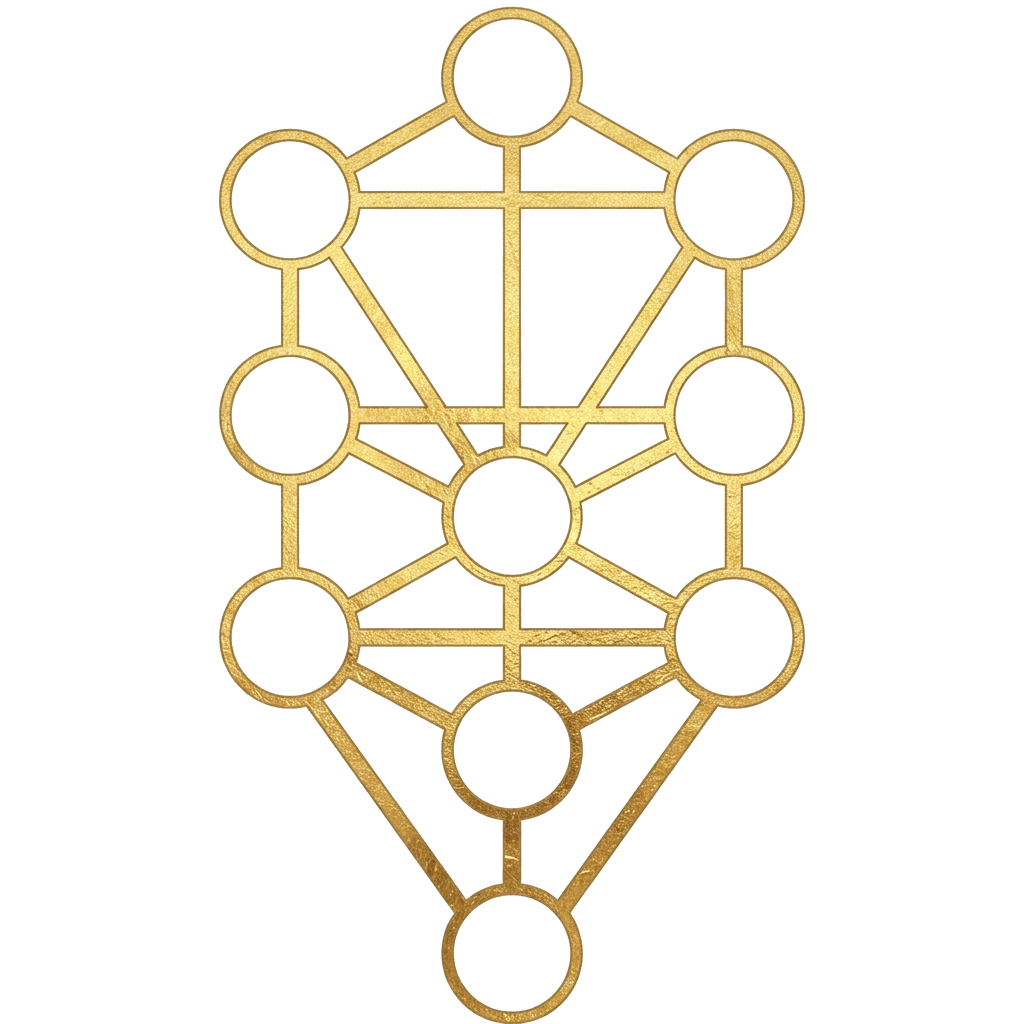
In its Kabbalistic form, the Tree of Life is a geometric diagram of ten circles (sefirot) arranged in a specific pattern and connected by twenty-two lines (paths). The ten sefirot are arranged in three vertical columns — the Pillar of Mercy on the right (containing Chokmah, Chesed, and Netzach), the Pillar of Severity on the left (containing Binah, Gevurah, and Hod), and the Middle Pillar of Balance (containing Keter at the crown, Tiferet at the center, Yesod below, and Malkuth at the base). An eleventh hidden sefirah, Da'at (Knowledge), sometimes appears on the Middle Pillar between Keter and Tiferet, occupying the space across the Abyss that separates the three supernal sefirot from the seven lower ones. The overall shape suggests a human figure standing upright — Keter at the head, Chokmah and Binah at the shoulders, Chesed and Gevurah at the arms, Tiferet at the heart, Netzach and Hod at the hips, Yesod at the generative center, and Malkuth at the feet. This anthropomorphic correspondence is intentional: the Kabbalists taught that Adam Kadmon, the primordial human, was itself the shape of the divine.
The twenty-two paths connecting the sefirot correspond to the twenty-two letters of the Hebrew alphabet, and by extension to the twenty-two Major Arcana of the Tarot (a correspondence developed primarily by Eliphas Levi and systematized by the Golden Dawn). Each path represents a specific mode of consciousness, a transition between divine states. The paths are sometimes depicted with Hebrew letters, sometimes with Tarot imagery, sometimes with astrological correspondences — the three mother letters assigned to elements, the seven double letters to planets, and the twelve simple letters to zodiac signs, following the system of the Sefer Yetzirah.
In its universal, non-Kabbalistic form, the Tree of Life appears as an actual tree — a great cosmic tree whose form varies by culture but whose structure is consistent. The Norse Yggdrasil is a massive ash tree with three roots reaching to three wells (Urd, Mimir, and Hvergelmir), an eagle perched in its crown, a serpent (Nidhogg) gnawing at its roots, and a squirrel (Ratatoskr) running between them carrying messages. The Mesopotamian depictions typically show a stylized palm or pine tree flanked by symmetrical figures (often winged beings or kings), sometimes with a winged disc above — a formal, heraldic composition found on cylinder seals, palace reliefs, and textiles from Sumer through Assyria. The Hindu Ashvattha (sacred fig or banyan) is described in the Bhagavad Gita as growing with its roots above and branches below — an inverted tree with its source in Brahman and its manifestation spreading downward into the material world. The Celtic Crann Bethadh (Tree of Life) was typically an oak or ash, and the Norse tradition held that the first humans (Ask and Embla) were created from trees. The Mesoamerican world tree — Wacah Chan to the Maya, often depicted as a ceiba — stands at the center of the cosmos connecting the thirteen heavens, the earth, and the nine underworld levels, with a bird at its crown and roots extending into Xibalba.
What unites all these visual forms is the tripartite vertical structure: roots below (underworld, unconscious, origin), trunk in the middle (manifest world, waking consciousness, the present), and crown above (heaven, superconsciousness, the divine). The tree is always a connector, always alive, always the center of the world.
Esoteric Meaning
The Kabbalistic Sefirot as Divine Attributes
In Kabbalistic teaching, the ten sefirot are not merely abstract categories but living emanations of the divine — the means by which Ein Sof (the Infinite, utterly unknowable God) creates and sustains all reality without diminishing itself. Each sefirah is both a divine attribute and a world unto itself. Keter (Crown) is the first stirring of divine will, the point before thought. Chokmah (Wisdom) is the primordial flash of creative insight, pure undifferentiated knowing. Binah (Understanding) is the womb that receives Chokmah's flash and gives it form, structure, and differentiation — she is the supernal mother. Together, Keter, Chokmah, and Binah form the three supernal sefirot, existing above the Abyss in a realm beyond ordinary human comprehension.
Below the Abyss, Chesed (Lovingkindness/Mercy) represents expansive, boundless generosity — the impulse to give without limit. Gevurah (Strength/Judgment) represents contraction, discipline, and the power to set boundaries — necessary because unlimited Chesed would dissolve all form. Tiferet (Beauty/Harmony) sits at the very heart of the Tree, balancing Chesed and Gevurah into integrated wholeness — it is the sefirah most associated with the human soul and with the awakened heart. Netzach (Victory/Eternity) carries the energy of desire, passion, artistic inspiration, and the driving force of nature. Hod (Splendor/Glory) is the realm of intellect, communication, language, and ritual precision. Yesod (Foundation) is the channel through which all the upper energies are gathered and transmitted to the final sefirah — it is associated with the astral plane, dreams, sexuality, and the unconscious. Malkuth (Kingdom) is the manifest world, the physical body, the earth, the final recipient of all divine influence — and paradoxically, the place from which the journey of return begins.
The Lightning Flash and the Serpent's Path
The order of emanation — Keter to Chokmah to Binah to Chesed to Gevurah to Tiferet to Netzach to Hod to Yesod to Malkuth — traces a zigzag pattern across the Tree known as the Lightning Flash or Flaming Sword. This is the path of creation: divine energy descending from unity into multiplicity, from the abstract to the concrete, from spirit into matter. It moves from right to left to right, column to column, like lightning. The reverse journey — the soul's ascent from Malkuth back to Keter — follows the paths upward and is sometimes called the Serpent's Path, winding up through the Tree as the kundalini serpent winds up the spine. This ascending journey is the great work of the mystic: to reunite the lowest with the highest, to carry the awareness of Malkuth all the way back to Keter, to realize that the Kingdom and the Crown were never separate.
The Three Pillars
The Tree's three-column structure encodes a fundamental teaching about the nature of reality. The right-hand Pillar of Mercy (Chokmah, Chesed, Netzach) represents the active, expansive, masculine, giving principle. The left-hand Pillar of Severity (Binah, Gevurah, Hod) represents the receptive, contracting, feminine, form-giving principle. Neither pillar alone is complete or sustainable — pure mercy without judgment dissolves into chaos, pure judgment without mercy hardens into tyranny. The Middle Pillar (Keter, Da'at, Tiferet, Yesod, Malkuth) represents the path of balance, integration, and consciousness itself. The Middle Pillar is the path of the mystic who has reconciled the opposites within — and it corresponds directly to the central channel of the subtle body in yogic and tantric traditions.
The Four Worlds
Kabbalah teaches that the entire Tree of Life exists simultaneously in four interpenetrating worlds: Atziluth (the World of Emanation — pure divinity, archetypes), Beriah (the World of Creation — the archangelic realm, the first emergence of form), Yetzirah (the World of Formation — the angelic realm, the astral plane, the world of feeling and image), and Assiah (the World of Action — the physical, material world). Each sefirah has expression in all four worlds, meaning the Tree is not flat but four-dimensional. The sefirah of Tiferet in Atziluth is the divine heart of God; Tiferet in Assiah is the physical heart beating in your chest. This teaching means that every level of reality — from the most abstract divine thought to the most concrete physical fact — is structured according to the same pattern.
The Universal Axis Mundi
Beyond Kabbalah, the Tree of Life as axis mundi appears in shamanic traditions worldwide as the World Tree — the central pillar of the cosmos that the shaman climbs to reach the upper world or descends to enter the underworld. Mircea Eliade documented this pattern across Siberian, Central Asian, South American, and North American indigenous traditions: the shaman enters trance, finds the cosmic tree at the center of the world, and climbs or descends it to communicate with spirits, retrieve lost souls, or gain knowledge. The tree is the highway between worlds, and the shaman is the one who knows how to travel it.
Yggdrasil, the Norse World Tree, is perhaps the most fully elaborated shamanic world tree in European mythology. It sustains the nine worlds of Norse cosmology — from Asgard (realm of the gods) to Midgard (realm of humans) to Niflheim (realm of the dead). Odin himself hung on Yggdrasil for nine nights, pierced by his own spear, sacrificing himself to himself in order to gain the runes — a shamanic initiatory ordeal that parallels the Crucifixion, the Hanged Man of the Tarot, and countless initiatory death-and-rebirth narratives worldwide. The tree is not just the structure of the cosmos but the instrument of transformation: you must hang on it, die on it, to be reborn with knowledge.
In Hindu cosmology, the Ashvattha tree of the Bhagavad Gita (Chapter 15) grows with its roots in Brahman above and its branches spreading downward into the manifest world. Krishna tells Arjuna that this tree must be cut down with the axe of non-attachment to reach the imperishable root — a teaching that parallels the Kabbalistic understanding that Malkuth (the world we see) is the final branch, not the root, and that liberation requires tracing the sap back to its source. The Bodhi tree under which Siddhartha Gautama attained enlightenment is another expression of this archetype: the tree as the still point at the center of the world where transformation becomes possible.
Sefirot and Chakras: Parallel Maps
The correspondence between the ten Kabbalistic sefirot and the seven chakras of the Hindu-yogic system has been noted by scholars and practitioners across traditions. Both are maps of consciousness arranged along a vertical axis within the human body. Malkuth corresponds to Muladhara (root), Yesod to Svadhisthana (sacral), Hod and Netzach together to Manipura (solar plexus), Tiferet to Anahata (heart), Gevurah and Chesed to Vishuddha (throat), Binah and Chokmah to Ajna (third eye), and Keter to Sahasrara (crown). The Lightning Flash descending the Tree parallels the descent of consciousness into matter; the kundalini rising through the chakras parallels the Serpent's Path ascending the Tree. These are not identical systems — the sefirot are ten, the chakras seven; the Kabbalistic framework emphasizes divine attributes while the yogic framework emphasizes energy centers — but the structural parallel suggests they are mapping the same territory from different vantage points.
Exoteric Meaning
In its most accessible meaning, the Tree of Life represents the interconnectedness of all life and the continuity between generations. It is a symbol of growth, strength, renewal, and rootedness. Trees are among the longest-lived organisms on earth — some bristlecone pines have survived for nearly five thousand years — and they embody the qualities humans most aspire to: deep roots that provide stability, a strong trunk that withstands storms, branches that reach toward light, and the ability to shed leaves in winter and regenerate them in spring. The tree is life persisting through cycles of death and renewal.
In many cultures, the Tree of Life carries familial meaning — the family tree, the genealogical branches, the idea that we are connected to ancestors through roots we cannot see and to descendants through branches we may never witness in bloom. This is not merely metaphorical. In Celtic tradition, the clan's sacred tree (the bile) stood at the center of the tribal territory, and its destruction by enemies was considered one of the gravest possible acts of war. The tree was the living embodiment of the people's identity, their connection to the land, and their continuity across time.
In the Abrahamic traditions, the Tree of Life appears in Genesis alongside the Tree of Knowledge of Good and Evil in the Garden of Eden. After Adam and Eve eat from the Tree of Knowledge, they are expelled from the garden specifically to prevent them from also eating from the Tree of Life and living forever (Genesis 3:22-24). The Tree of Life reappears at the end of the biblical narrative in Revelation 22:2, bearing twelve kinds of fruit and leaves for the healing of the nations — suggesting that what was lost in the garden is restored at the end of history. This arc — from paradise lost to paradise regained, with the tree at the center of both — became one of the foundational narratives of Western civilization.
In Islamic tradition, the Tuba tree grows in paradise with its roots in the highest heaven and its branches shading all of Jannah. The Sidrat al-Muntaha (Lote Tree of the Uttermost Boundary) marks the limit beyond which no created being — not even the angel Jibril — may pass. The Prophet Muhammad alone passed beyond it during the Mi'raj (night journey), entering the direct presence of God. The tree here functions as a threshold between the knowable and the unknowable, the created and the uncreated.
In secular and ecological contexts, the Tree of Life has become a powerful symbol for biodiversity and evolutionary connection. Darwin's first diagram of evolution was literally a tree — branching lines showing how species diverge from common ancestors. The phylogenetic tree of life, mapping the relationships among all living organisms, carries forward the ancient intuition that all life is one interconnected organism, rooted in a single origin and branching into infinite diversity.
Usage
The Tree of Life is one of the most actively used symbols in contemporary spiritual practice, far beyond its historical and mythological significance. Its applications span contemplative, magical, therapeutic, and artistic domains.
Kabbalistic Meditation and Pathworking
In the Western esoteric tradition, practitioners use the Tree of Life as a structured meditation map. Pathworking — a practice developed by the Golden Dawn and refined by Dion Fortune, Israel Regardie, and others — involves entering a meditative or trance state and imaginatively traveling along the twenty-two paths connecting the sefirot. Each path has specific imagery, colors, sounds, and symbols drawn from Tarot, astrology, and Hebrew letter correspondences. The practitioner begins at Malkuth and works upward, path by path, integrating the qualities of each sefirah. A complete traversal of all thirty-two elements (ten sefirot plus twenty-two paths) constitutes a comprehensive curriculum in Western esoteric training. This practice is still central to groups like the Builders of the Adytum (BOTA), the Servants of the Light (SOL), and numerous independent Kabbalistic study circles.
Prayer and Devotion
In Jewish mystical practice, the Tree of Life provides the framework for kavvanah (intentional meditation) during prayer. The liturgy is mapped onto the sefirot — certain prayers correspond to certain sefirot, and the progression through the daily service mirrors the ascent of the Tree. The Sabbath itself is associated with the harmonization of the entire Tree, and the Friday evening Kabbalistic service (Kabbalat Shabbat) was designed by the Safed Kabbalists of the sixteenth century as a ritual enactment of divine union. In Hasidic Judaism, the sefirot provide a psychological-spiritual vocabulary for understanding one's inner states: a person who is overly harsh is told they have too much Gevurah and too little Chesed; a person who cannot set boundaries has the reverse imbalance.
Ritual and Ceremonial Magic
The Tree of Life serves as the organizing framework for virtually all Western ceremonial magic. The Golden Dawn, Thelema, and related traditions use the Tree to classify and organize every element of magical practice — from the hierarchy of divine names, archangels, angels, and spirits assigned to each sefirah, to the correspondences between sefirot and planets, elements, colors, incenses, gemstones, and ritual implements. Aleister Crowley's 777 is essentially a massive table of correspondences organized by the Tree. When a magician performs a ritual to invoke the energies of a particular sefirah, they wear specific colors, burn specific incense, trace specific symbols, and invoke specific names — all determined by the Tree's correspondence system.
Therapeutic and Psychological Applications
The Tree of Life has been adapted as a framework for psychological self-understanding, particularly in Jungian and transpersonal psychology. Each sefirah can be understood as a psychological function — Chesed as the capacity for generosity, Gevurah as the capacity for discipline and discernment, Tiferet as the integrated self, Yesod as the unconscious and dream life. Some therapists use the Tree as a diagnostic and developmental map, helping clients identify which functions are overdeveloped, underdeveloped, or out of balance. The narrative therapy approach developed by practitioners working with trauma survivors in various cultural contexts has also drawn on the Tree of Life as a metaphor for resilience — roots as heritage and values, trunk as skills and abilities, branches as hopes and dreams, leaves as significant people, fruits as gifts given to others.
Art, Jewelry, and Material Culture
The Tree of Life is one of the most widely reproduced sacred symbols in contemporary material culture. It appears on jewelry, wall hangings, tattoos, tapestries, stained glass, pottery, and clothing worldwide. Celtic, Kabbalistic, and universal forms are all popular. The symbol's appeal transcends any single tradition — it speaks to a nearly universal human longing for connection, growth, and meaning. In sacred art, the Tree appears in illuminated manuscripts, cathedral windows (the Jesse Tree depicting Christ's genealogy as a literal tree growing from Jesse's body), Islamic geometric tile work, Hindu temple carvings, and Buddhist thangka paintings.
In Architecture
The Tree of Life appears in the built environment across virtually every civilization that produced monumental architecture, from the earliest known temples to contemporary sacred spaces.
In ancient Mesopotamia, the tree appears on the carved stone reliefs of Assyrian palaces — notably at Nimrud and Nineveh — where it is depicted as a formalized, symmetrical tree flanked by winged genii (protective spirits) who tend it with ritual implements. These reliefs decorated throne rooms and audience halls, placing the cosmic tree at the very center of imperial power. The tree was not merely decorative but cosmological: the king's authority derived from his role as guardian of the cosmic order that the tree represented.
In Egyptian architecture, the sycamore and persea trees appear on tomb paintings and temple walls as the trees of the goddess Hathor (or Nut), who feeds and shelters the dead. The Djed pillar — often interpreted as a stylized tree trunk or the backbone of Osiris — was erected during the Sed festival as a ritual raising of the cosmic axis, and its form influenced column design in Egyptian temples.
In European Christian architecture, the Jesse Tree appears in cathedral stained glass and stone sculpture from the Romanesque period onward — Chartres Cathedral (c. 1150) has one of the most celebrated examples. The tree grows from the sleeping figure of Jesse (father of King David), branching upward through the kings of Judah to the Virgin Mary and Christ at the apex. This genealogical tree merges the symbol of the Tree of Life with the lineage of salvation history. Gothic cathedral design itself has been read as a forest of stone — the soaring columns, ribbed vaults, and branching tracery evoking a great forest canopy through which light (divine grace) filters down.
In Islamic architecture, the tree appears in the arabesque — the infinitely branching, interweaving vegetal patterns that cover the surfaces of mosques, madrasas, and palaces from Cordoba to Isfahan. The arabesque is understood as a meditation on divine infinity made visible through organic growth. The Alhambra, the great Mosque of Cordoba, and the Shah Mosque of Isfahan all feature elaborate tree and garden motifs that reference the Quranic paradise, where rivers flow beneath trees that never lose their leaves.
In Hindu and Buddhist temple architecture, the cosmic tree appears as decorative motif and structural principle. The kalpavriksha (wish-fulfilling tree) adorns the facades and pillars of Indian temples. The Bodhi tree itself has been architecturally enshrined since the earliest Buddhist monuments — the Mahabodhi Temple at Bodh Gaya is built around a descendant of the original tree, and the temple's spire rises above it like a crown above a trunk. Stupa design, with its axis (yasti) rising from base to finial, has been interpreted as an architectural expression of the world tree.
In the modern era, the Tree of Life appears in synagogue architecture (often as the Etz Chaim motif decorating the Torah ark), in Baha'i temples, and in the work of architects like Antoni Gaudi, whose Sagrada Familia in Barcelona transforms its interior columns into a literal stone forest, with branching supports that split and spread like tree canopies to hold the vaulted ceiling — making the entire church a walk through the World Tree.
Significance
From Sumerian cylinder seals to Kabbalistic diagrams to Norse cosmology, the Tree of Life appears in essentially every major civilization on earth, across every inhabited continent, with substantially the same meaning. This universality demands explanation. Unlike symbols that spread through cultural contact and trade routes (such as the swastika or the cross, which also have wide distribution), the Tree of Life appears in traditions with no known historical connection — Mesoamerican, Norse, Mesopotamian, Hindu, and Australian Aboriginal cosmologies all developed tree-of-life symbolism apparently independently.
This suggests that the Tree of Life is not merely a cultural artifact but an archetype in the deepest sense — an image that arises spontaneously from the structure of human consciousness encountering the natural world. Trees are among the most prominent living beings in the human environment, and their form — rooted in earth, standing upright, branching toward sky — naturally maps onto the human experience of being embodied: feet on the ground, head in the heavens, and the whole of life a process of growth from seed to fruition to decay and return.
In the history of esotericism, the Kabbalistic Tree of Life has served as a master diagram — the closest thing the Western tradition has to a unified field theory of consciousness, cosmology, and practice. It integrates theology (the nature of God), cosmology (the structure of the universe), psychology (the faculties of the soul), ethics (the balance of mercy and judgment), and practice (the path of spiritual ascent) into a single coherent diagram. This density of meaning and breadth of application is unmatched in the Western symbolic tradition.
The Tree of Life also carries deep ecological significance in an era of environmental crisis. The recognition that human civilizations across the globe independently arrived at the same sacred image — a living tree at the center of the world, whose health is the health of everything — speaks to an ancient understanding that humanity's fate is inseparable from the fate of the living world. The destruction of forests, in this symbolic framework, is not merely an environmental problem but a spiritual catastrophe: the felling of the World Tree, the severing of the connection between heaven and earth.
Connections
Sefer Yetzirah — The earliest Kabbalistic text (c. 2nd-6th century CE) that introduces the concept of the ten sefirot and twenty-two letters as the building blocks of creation. Though it does not describe the Tree of Life diagram as later Kabbalists would draw it, the Sefer Yetzirah provides the foundational elements — ten sefirot and twenty-two paths — from which the Tree was constructed. Its cosmology of spatial dimensions (the six directions, the three axes) and its mapping of letters to elements, planets, and zodiac signs became the basis for the correspondence system that the Tree of Life organizes.
Zohar — The central text of Kabbalah (composed c. 1280-1286 CE, attributed to Shimon bar Yochai), which provides the most extensive and poetic exploration of the sefirot and their interactions. The Zohar describes the sefirot as aspects of the divine personality, explores the dynamics between the Pillars of Mercy and Severity, develops the concept of the four worlds (Atziluth, Beriah, Yetzirah, Assiah), and introduces the drama of cosmic exile and repair (shevirat ha-kelim and tikkun) that gives the Tree its narrative dimension. Without the Zohar, the Tree of Life would be a diagram; with it, the Tree becomes a living story of divine self-expression and human participation in cosmic healing.
Chakras — The seven energy centers of the Hindu-yogic subtle body system offer a striking structural parallel to the Kabbalistic sefirot. Both systems map consciousness along a vertical axis within the human body, from the base (Muladhara/Malkuth) to the crown (Sahasrara/Keter). Both describe a process of spiritual ascent in which dormant energy at the base (kundalini/the Shekhinah in exile) rises through intermediate stations, each associated with specific qualities, powers, and states of awareness, until it reaches the crown and achieves union with the divine source. The parallels between individual sefirot and chakras — Tiferet and Anahata as the heart center of integration, Yesod and Svadhisthana as the center of sexuality and the unconscious, Keter and Sahasrara as the point of contact with the infinite — suggest that Jewish mystics and Indian yogis were mapping the same interior territory through different cultural lenses.
The Norse Yggdrasil tradition connects to Odin and the runic system — Odin's self-sacrifice on the World Tree to gain the runes parallels the mystic's ascent of the Kabbalistic Tree to gain divine knowledge. Both are stories of voluntary death and rebirth at the cosmic axis. The Mesoamerican World Tree connects to the Mayan calendar system and the concept of the four directions, with the ceiba tree at the center establishing the fifth direction — the vertical axis connecting upper and lower worlds through the human heart.
Further Reading
- Gershom Scholem, Major Trends in Jewish Mysticism (1941) — The foundational academic treatment of Kabbalah, including the development of the sefirot concept and the Tree of Life diagram from the Sefer Yetzirah through the Zohar to Lurianic Kabbalah.
- Gershom Scholem, Kabbalah (1974) — A comprehensive reference work that includes detailed analysis of the sefirot, the four worlds, and the history of the Tree of Life as a symbolic and meditative tool.
- Aryeh Kaplan, Sefer Yetzirah: The Book of Creation (1990) — A translation and commentary on the earliest Kabbalistic text, with extensive analysis of the relationship between the sefirot, the Hebrew letters, and the structure of creation.
- Daniel C. Matt, The Essential Kabbalah (1995) — An accessible anthology of Kabbalistic texts organized around the sefirot, providing primary source material for understanding each sefirah's meaning and function.
- Dion Fortune, The Mystical Qabalah (1935) — The classic Western esoteric interpretation of the Tree of Life, integrating Kabbalistic, Hermetic, and psychological perspectives. Remains one of the most influential introductions to the Tree as a practical spiritual tool.
- Z'ev ben Shimon Halevi (Warren Kenton), A Kabbalistic Universe (1977) — A clear, diagram-rich exploration of the four worlds and the Tree of Life as a complete cosmological system.
- Mircea Eliade, Shamanism: Archaic Techniques of Ecstasy (1951) — The classic study of shamanic traditions worldwide, including extensive documentation of the World Tree / axis mundi as a universal shamanic symbol.
- Roger Cook, The Tree of Life: Image for the Cosmos (1974) — A richly illustrated cross-cultural survey of Tree of Life symbolism from ancient Mesopotamia to modern art.
- Israel Regardie, A Garden of Pomegranates (1932) — A systematic introduction to the Tree of Life as used in the Golden Dawn tradition, mapping the correspondences between sefirot, paths, Tarot, astrology, and divine names.
Frequently Asked Questions
What does the Tree of Life symbolize?
In Kabbalistic teaching, the ten sefirot are not merely abstract categories but living emanations of the divine — the means by which Ein Sof (the Infinite, utterly unknowable God) creates and sustains all reality without diminishing itself. Each sefirah is both a divine attribute and a world unto itself. Keter (Crown) is the first stirring of divine will, the point before thought. Chokmah (Wisdom) is the primordial flash of creative insight, pure undifferentiated knowing. Binah (Understanding) is the womb that receives Chokmah's flash and gives it form, structure, and differentiation — she is the supernal mother. Together, Keter, Chokmah, and Binah form the three supernal sefirot, existing above the Abyss in a realm beyond ordinary human comprehension.
Where does the Tree of Life originate?
The Tree of Life originates from the Mesopotamian (earliest known depictions); Kabbalistic (most developed system) tradition. It dates to c. 3000 BCE — present. It first appeared in Universal (Mesopotamia, Egypt, Scandinavia, India, Mesoamerica, Europe).
How is the Tree of Life used today?
The Tree of Life is one of the most actively used symbols in contemporary spiritual practice, far beyond its historical and mythological significance. Its applications span contemplative, magical, therapeutic, and artistic domains.