Hexagram
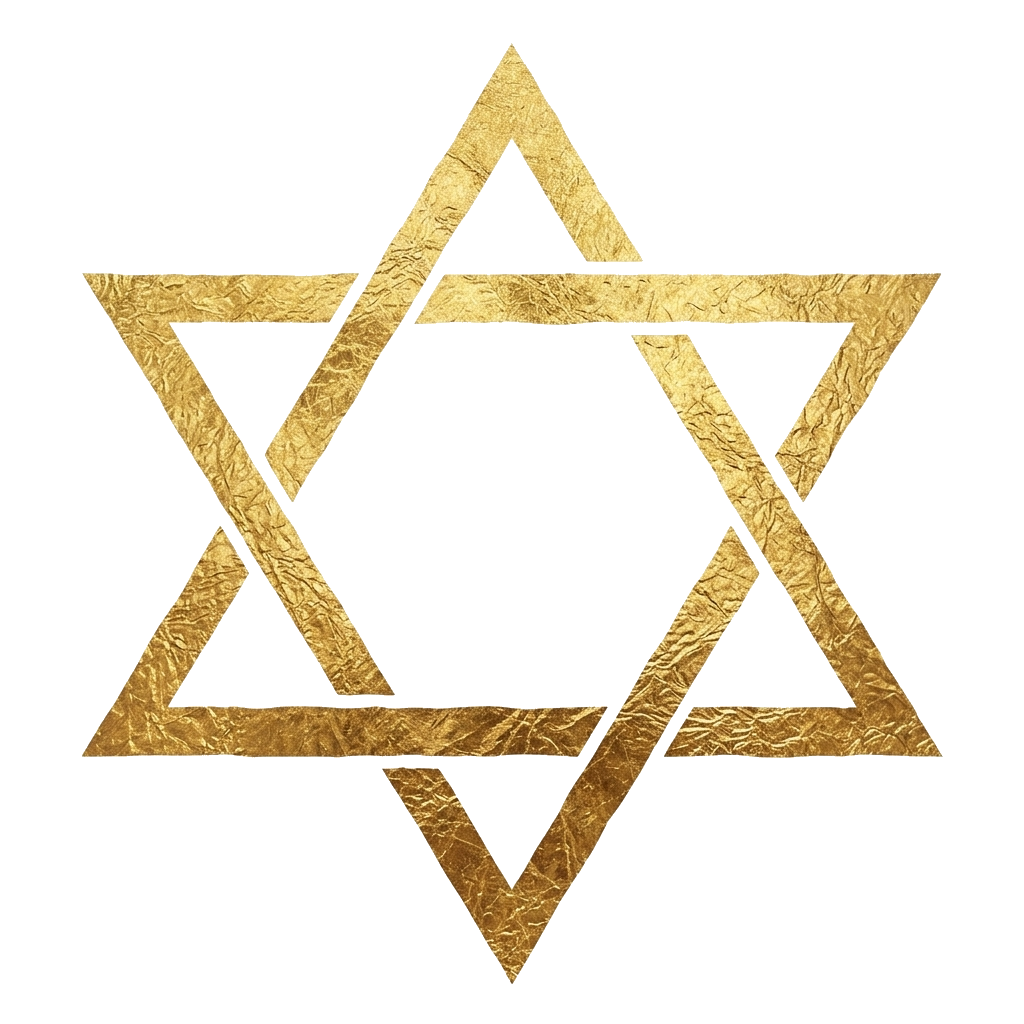
The six-pointed star formed by two interlocking triangles — known as the Star of David in Judaism and the Seal of Solomon in magical tradition, representing the union of fire and water, heaven and earth, macrocosm and microcosm.
About Hexagram
The hexagram is a six-pointed star created by the superimposition of two equilateral triangles — one pointing upward, one pointing downward — so that they interlock to form a symmetrical figure with six small triangles arranged around a central hexagon. It is one of the most widely distributed sacred symbols in human history, appearing independently across civilizations separated by thousands of miles and thousands of years. In the West it is most immediately associated with Judaism and the State of Israel, where it is called the Magen David (Shield of David). In the Islamic and Western magical traditions it is the Seal of Solomon — the signet ring by which King Solomon commanded the jinn and demons. In Hinduism it is the Shatkona, the union of Shiva and Shakti, and appears at the center of the Anahata (heart) chakra yantra. In Hermeticism and alchemy it encodes the axiom 'as above, so below' in pure geometric form.
The hexagram's power as a symbol derives from its elegant expression of polarity reconciled. Every tradition that employs it reads the same fundamental meaning into its geometry: two opposing forces — masculine and feminine, fire and water, spirit and matter, ascent and descent — brought into perfect equilibrium. The upward triangle is the blade, the fire, the aspiring soul; the downward triangle is the chalice, the water, the descending grace. Where they overlap, a third thing is born that transcends both. This is why the hexagram appears so consistently in mystical and esoteric contexts: it is the geometric proof that opposites not only coexist but require each other for completion.
Unlike many ancient symbols that have faded into obscurity, the hexagram remains intensely alive — politically, spiritually, and esoterically. It flies on the flag of Israel, hangs in synagogues worldwide, adorns the amulets of Western ceremonial magicians, is drawn in the yantras of Hindu tantra, and appears in the sacred geometry of Islamic art. Its universality is both its strength and its complication: no single tradition can claim it, yet several have tried. Understanding the hexagram requires holding all of its meanings simultaneously — the devotional and the magical, the political and the metaphysical, the ancient and the modern.
Visual Description
The hexagram consists of two equilateral triangles of identical size, superimposed so that one points upward and the other points downward, their bodies overlapping to create a regular hexagon at the center with six smaller equilateral triangles radiating outward from each side. The result is a perfectly symmetrical six-pointed star. In its simplest rendering, it is composed of twelve line segments forming six vertices, with internal lines visible where the two triangles cross. The proportions are mathematically precise: the ratio of the outer radius to the inner hexagon's side is 1:1, and the figure can be inscribed perfectly in a circle.
In Jewish ceremonial art, the hexagram is often rendered in blue (particularly on the Israeli flag, where it appears as a blue outline on a white field between two horizontal blue stripes). In Hindu yantras, particularly the Anahata chakra diagram, the two triangles are often shown in different colors — red or white for the upward (Shiva/Purusha) triangle and blue or green for the downward (Shakti/Prakriti) triangle — emphasizing their distinct identities even in union. In alchemical manuscripts, the hexagram frequently appears with elemental symbols inscribed in or around its triangles: fire (upward), water (downward), air (upward with horizontal bar), earth (downward with horizontal bar).
In Western magical tradition, the hexagram is often drawn within a circle and may include a central point, additional internal lines, or planetary sigils at the six points. The Testament of Solomon describes the original Seal as a ring engraved with the hexagram and the ineffable name of God — a design that passed into grimoire tradition as the basis for elaborate talismanic configurations. Islamic geometric art frequently incorporates the hexagram into tessellating patterns, where it emerges naturally from the intersection of triangular grids, appearing as a decorative motif in tilework, metalwork, and manuscript illumination from Andalusia to Mughal India.
Esoteric Meaning
The hexagram is the Hermetic axiom 'as above, so below' rendered in geometry. The upward-pointing triangle represents the ascending principle — fire, spirit, the microcosm reaching toward the divine, the aspiration of consciousness toward its source. The downward-pointing triangle represents the descending principle — water, matter, the macrocosm pouring its grace into manifestation, the divine reaching toward creation. Where they interpenetrate, the central hexagon represents the point of perfect equilibrium — the heart, the place where heaven and earth meet, where the human becomes the bridge between worlds. This is not mere metaphor but a precise geometric encoding of the most fundamental esoteric teaching: that the cosmos is structured as a mirror, and that what exists in the highest realm is reflected in the lowest, and vice versa.
In Hindu tantra, the hexagram appears as the Shatkona — literally 'six-cornered' — and is the central yantra of the Anahata (heart) chakra. The upward triangle is Shiva (pure consciousness, the masculine, the unmanifest), and the downward triangle is Shakti (creative power, the feminine, the manifest). Their union at the heart center represents the fundamental non-duality of existence — the realization that consciousness and energy, stillness and movement, awareness and its content, are not two things but one thing expressing itself in two directions simultaneously. The Shatkona also appears in Sri Yantra configurations, where multiple interlocking triangles (four upward representing Shiva, five downward representing Shakti) create increasingly complex hexagram-derived patterns that map the entire process of cosmic manifestation and dissolution.
In alchemy, the hexagram encodes the reconciliation of the four classical elements. Fire (upward triangle) and water (downward triangle) are the primary pair; air (upward triangle with horizontal bar) and earth (downward triangle with horizontal bar) are the secondary pair. The hexagram formed by the union of fire and water represents the coniunctio oppositorum — the marriage of opposites that is the goal of the Great Work. The Philosopher's Stone itself is sometimes symbolized by the hexagram, because it is the substance in which all opposites are perfectly reconciled: fixed and volatile, solar and lunar, sulphur and mercury. The central hexagon is the quintessence — the fifth element that emerges only when the four elemental polarities achieve balance.
In the Solomonic magical tradition, the hexagram is the supreme symbol of divine authority over the spirit world. The Testament of Solomon relates how the archangel Michael gave Solomon a ring engraved with the hexagram (the 'Seal of Solomon') that allowed him to command demons, compel their obedience, and bind them to labor on the Temple. This tradition passed into both Jewish and Islamic magic, and from there into the Western grimoire tradition. The hexagram here represents the magician's mastery over both the celestial and the infernal — the ability to call upon angelic and demonic forces alike because the hexagram unites both directions of spiritual reality under a single symbol of divine sovereignty. In the Golden Dawn system, the hexagram ritual (the Star Ruby and the Greater Ritual of the Hexagram) is used for planetary invocation and banishing, with different configurations of the two triangles corresponding to the seven classical planets.
The hexagram also maps directly onto the Kabbalistic Tree of Life. The six points correspond to the six Sephiroth of Zer Anpin (Chesed, Geburah, Tiphareth, Netzach, Hod, Yesod), with Tiphareth — Beauty, the Son, the mediating principle — at the center. The upward triangle connects Chesed-Geburah-Tiphareth (the ethical triad), and the downward triangle connects Tiphareth-Netzach-Hod (the astral triad), with Yesod as the lower point of manifestation. This mapping reinforces the hexagram's role as a symbol of the mediating function — the principle that stands between the infinite and the finite and makes their communication possible.
Exoteric Meaning
In its most widely recognized modern context, the hexagram is the Magen David (Shield of David) — the central symbol of Jewish identity. It appears on the flag of the State of Israel, on synagogues worldwide, on Jewish gravestones, ceremonial objects, and jewelry. Despite its deep association with Judaism today, this identification is relatively recent. The hexagram was used as a decorative motif in Jewish contexts as early as the 3rd century CE (it appears on a synagogue stone in Capernaum), but it carried no specifically Jewish meaning until the medieval period. The earliest clear use as a Jewish communal symbol dates to 1354, when King Charles IV of Bohemia granted the Jews of Prague a red flag bearing the hexagram. By the 17th century it had become established as the primary Jewish communal symbol, partly through its association with the legendary Seal of Solomon and partly through its adoption by the Zionist movement in the late 19th century.
The hexagram's association with King David is legendarily traced through his son Solomon, who received the hexagram as a divine gift and used it as his royal seal. In Jewish folk tradition, the Magen David is a protective talisman — the shape of David's actual shield, or a symbol inscribed on his shield — though there is no biblical basis for this attribution. The historical David predates any known use of the hexagram as a Jewish symbol by well over a thousand years. Nevertheless, the emotional and communal meaning is now inseparable from the geometric form: to display the hexagram is to declare Jewish identity, solidarity, and belonging.
The hexagram has also become a symbol of interfaith dialogue and universal spirituality, precisely because of its cross-cultural presence. When people discover that the same six-pointed star appears in Judaism, Hinduism, Islam, and Western esotericism, it can function as a visual argument for the underlying unity of spiritual traditions. This universalist reading coexists uneasily with the hexagram's political specificity as a symbol of Israel and Jewish identity — a tension that reflects the broader challenge of holding particular and universal meanings simultaneously. In secular contexts, the hexagram appears frequently in corporate logos, architectural ornament, and popular culture (video games, fantasy literature, occult fiction), where it often carries a vaguely 'mystical' or 'ancient' connotation without reference to any specific tradition.
Usage
The hexagram is actively employed across a remarkable range of spiritual, magical, devotional, and secular contexts.
Jewish Liturgical and Communal Use: The Magen David adorns Torah ark curtains (parochet), Torah shields, kiddush cups, mezuzot cases, hanukkiyot, ketubbot (marriage contracts), and synagogue architecture. It is the central element of the Israeli flag. Jewish memorial art universally employs it on gravestones and Holocaust memorials. It functions as an immediate marker of Jewish communal space.
Hindu Tantric Practice: The Shatkona appears in yantra meditation as the central form of the Anahata chakra diagram. Practitioners visualize or draw the interlocking triangles during heart-chakra meditations, mantra recitation (the bija mantra YAM), and tantric rituals involving the union of Shiva-Shakti. It also appears in more complex yantra configurations, including forms of the Sri Yantra, where nested triangles create increasingly elaborate hexagram-derived patterns.
Western Ceremonial Magic: The hexagram is central to planetary magic. In the Golden Dawn system, the Greater Ritual of the Hexagram assigns each of the seven classical planets to a specific configuration of the two triangles. Practitioners trace hexagrams in the air during ritual invocation and banishing of planetary forces. The Unicursal Hexagram (a hexagram drawn in one continuous line, popularized by Aleister Crowley) is used in Thelemic ritual. The hexagram also appears on talismans, in the construction of magical circles, and in the design of ritual implements.
Islamic Art and Architecture: The hexagram (known in Arabic as Khatam Sulayman, the Seal of Solomon) appears extensively in Islamic geometric art — in mosque tilework, Quran illumination, metalwork, and textile design. It is generated naturally by the intersection of triangular grids that underlie much of Islamic geometric pattern-making. In Islamic magical tradition (ruhaniyyat), it appears on amulets and talismans for protection and spiritual authority, continuing the Solomonic tradition.
Alchemical and Hermetic Practice: Alchemists use the hexagram to represent the union of elemental opposites and the achievement of the Great Work. It appears in manuscript illustrations, laboratory diagrams, and symbolic engravings throughout the European alchemical tradition from the medieval period onward. The hexagram with a central dot or eye sometimes represents the Philosopher's Stone or the achievement of aurum potabile (drinkable gold).
Freemasonry: The interlocking triangles appear in Masonic symbolism, sometimes as the 'Star of David' and sometimes in configurations combining the square and compasses. The hexagram's association with Solomon's Temple makes it natural Masonic material, given that the building of the Temple is the central allegory of Craft Masonry.
In Architecture
The hexagram is one of the most architecturally productive symbols in history, appearing in structures sacred and secular across multiple civilizations.
Synagogue Architecture: The Magen David is ubiquitous in synagogue design from the 18th century onward. It appears in stained glass windows (often in blue or gold), carved stone facades, wrought iron gates, mosaic floors, and ceiling rosettes. The Great Synagogue of Budapest (Dohany Street Synagogue, 1859) features prominent hexagrams in its Moorish Revival facade. The Hurva Synagogue in Jerusalem incorporates the hexagram into its restored 19th-century design. In American synagogue architecture, the hexagram became a standard ornamental element during the synagogue-building boom of the 1950s and 1960s.
Islamic Architecture: The hexagram appears with extraordinary frequency in Islamic architecture, where it is generated by the geometric principles underlying girih (knotwork) patterns. The Alhambra in Granada contains multiple hexagram-based tile patterns. The Dome of the Rock in Jerusalem — itself a structure of profound symbolic geometry — incorporates hexagrams in its tilework. Mughal architecture in India (including elements of the Taj Mahal complex) uses hexagram patterns in jali (perforated stone screens) and inlay work. Ottoman mosque decoration, particularly the Iznik tile traditions of the 15th-17th centuries, frequently employs hexagram rosettes.
Hindu Temple Architecture: The Shatkona appears in temple yantra carvings, particularly in South Indian and tantric North Indian temples. Stone yantras incorporating the hexagram are found at temple entrances and in sanctum floor designs. The hexagram also appears in the geometric planning of certain temple ground plans, where it governs the proportional relationships between the sanctum, halls, and entrance structures.
Christian Architecture: Despite its later strong association with Judaism, the hexagram appears in medieval Christian churches as a decorative and symbolic element — often in floor mosaics, rose windows, and carved stonework. It was read as a symbol of the six days of creation or the union of divine and human natures in Christ. Chartres Cathedral and other Gothic churches incorporate hexagram patterns in their geometric ornament programs.
Modern Civic and Memorial Architecture: The hexagram is central to Israeli state architecture and memorial design. Yad Vashem (Israel's Holocaust memorial) and numerous other memorial sites worldwide use the hexagram as the primary visual element of commemoration. The Knesset Menorah sculpture in Jerusalem incorporates hexagrams into its relief panels.
Significance
The hexagram holds a singular position among sacred symbols: it is both ancient and modern, both universal and particular, both mystical and political. No other geometric figure carries such a complex layering of meanings across so many traditions simultaneously.
Its geometric significance is foundational. The hexagram is the simplest possible visual representation of the union of opposites — a concept that lies at the root of virtually every metaphysical, alchemical, and mystical system humanity has produced. The marriage of upward and downward triangles encodes in a single image what takes volumes of theological and philosophical prose to articulate: that reality is structured as a polarity, that the poles are not enemies but partners, and that their union produces something greater than either alone. This is why the hexagram recurs independently across cultures — not because of historical diffusion (though that also occurred) but because the geometry itself is a universal insight.
Its spiritual significance varies by tradition but converges on a common theme. In Judaism, it is identity, protection, and the covenant between God and Israel. In Hinduism, it is the union of consciousness and energy at the heart center — the experiential core of non-dual realization. In Hermeticism, it is the correspondence between macrocosm and microcosm that makes all magic and all spiritual practice possible. In alchemy, it is the goal of the Great Work: the reconciliation of all opposites in the Philosopher's Stone. In Islamic spirituality, it is Solomon's authority — the wise ruler who commands both the visible and invisible worlds because he understands their unity.
Its political significance cannot be separated from its spiritual meaning. The adoption of the hexagram as the Jewish national symbol, its presence on the Israeli flag, and its use during the Holocaust (the yellow star forced on Jews by the Nazis) have given it a weight and specificity that no amount of universalist interpretation can dissolve. The hexagram is simultaneously a symbol of cosmic unity and a symbol of particular historical suffering and resilience. This dual nature is itself a kind of hexagram — the universal and the particular interlocking like the two triangles, each incomplete without the other.
Connections
The hexagram connects to a vast web of traditions, texts, and practices across the Satyori library.
Sacred Texts: The Testament of Solomon is the foundational text for the hexagram's magical identity, narrating how Solomon received the ring bearing this seal from the archangel Michael and used it to interrogate and bind 36 demons and numerous spirits. The Zohar and Kabbalistic literature elaborate the hexagram's relationship to the Sephiroth, particularly the six directions of space and the six lower Sephiroth of Zer Anpin. The Sefer Yetzirah provides the cosmological framework (the six directions, the three mother letters, the relationship between number and form) within which the hexagram's geometry acquires its Kabbalistic meaning.
Chakras: The hexagram is the primary yantra of the Anahata (heart) chakra — the fourth energy center, associated with air, love, compassion, and the integration of upper and lower energies. The positioning of the hexagram at the heart center is not arbitrary: it reflects the heart's role as the mediating point between the three lower (earth-oriented) chakras and the three upper (spirit-oriented) chakras. The hexagram at Anahata is the geometric expression of this integrative function.
Mystery Schools: The hexagram features prominently in the symbolism and ritual practice of multiple mystery school traditions. The Hermetic Order of the Golden Dawn made the hexagram central to its planetary magic system. Freemasonry incorporates the interlocking triangles into its symbolic vocabulary through the Solomon's Temple narrative. Rosicrucianism employs the hexagram as an emblem of the union of microcosm and macrocosm. Hermeticism broadly treats the hexagram as the visual form of the Emerald Tablet's central teaching.
Sacred Geometry: The hexagram is a fundamental figure in sacred geometry, related to the Flower of Life (from which it can be derived), the Metatron's Cube (which contains it), and the Vesica Piscis (the almond-shaped intersection of two circles, from which the hexagram's proportions emerge). Its mathematical properties — six-fold symmetry, self-similarity, relationship to the golden ratio — connect it to the deep geometric structures that sacred geometers identify as the architecture of creation.
Alchemy: The hexagram encodes the four-element system and the goal of the magnum opus. It connects to the broader alchemical symbol system: Ouroboros (cyclical unity), the alchemical wedding (union of Sol and Luna), and the Philosopher's Stone as the reconciliation of all polarities.
Further Reading
- Scholem, Gershom. The Star of David: History of a Symbol (1948) — The definitive scholarly treatment of the hexagram's adoption as a Jewish symbol, tracing its history from decorative motif to national emblem.
- Mathers, S.L. MacGregor. The Key of Solomon the King (Clavicula Salomonis) — The primary Western grimoire containing hexagram-based talismanic magic, edited by the Golden Dawn co-founder from British Museum manuscripts.
- Scholem, Gershom. Kabbalah (1974) — Essential context for understanding the hexagram's role in Kabbalistic cosmology, Sephirothic mapping, and Jewish mysticism broadly.
- Khanna, Madhu. Yantra: The Tantric Symbol of Cosmic Unity (1979) — The standard reference for understanding the hexagram (Shatkona) within Hindu tantric practice and yantra meditation.
- Regardie, Israel. The Golden Dawn (1937) — Contains the complete Greater and Lesser Rituals of the Hexagram as practiced in the Hermetic Order of the Golden Dawn, with planetary attributions and commentary.
- Critchlow, Keith. Islamic Patterns: An Analytical and Cosmological Approach (1976) — Demonstrates how the hexagram emerges from the geometric principles underlying Islamic art and architecture.
- Lawlor, Robert. Sacred Geometry: Philosophy and Practice (1982) — Places the hexagram within the broader tradition of sacred geometry, exploring its mathematical properties and metaphysical implications.
- Dennis, Geoffrey W. The Encyclopedia of Jewish Myth, Magic and Mysticism (2007) — Comprehensive reference covering the hexagram's roles in Jewish magical tradition, from amulets to the Seal of Solomon.
Frequently Asked Questions
What does the Hexagram symbolize?
The hexagram is the Hermetic axiom 'as above, so below' rendered in geometry. The upward-pointing triangle represents the ascending principle — fire, spirit, the microcosm reaching toward the divine, the aspiration of consciousness toward its source. The downward-pointing triangle represents the descending principle — water, matter, the macrocosm pouring its grace into manifestation, the divine reaching toward creation. Where they interpenetrate, the central hexagon represents the point of perfect equilibrium — the heart, the place where heaven and earth meet, where the human becomes the bridge between worlds. This is not mere metaphor but a precise geometric encoding of the most fundamental esoteric teaching: that the cosmos is structured as a mirror, and that what exists in the highest realm is reflected in the lowest, and vice versa.
Where does the Hexagram originate?
The Hexagram originates from the Ancient and cross-cultural; Jewish identification relatively late (17th century Prague) tradition. It dates to c. 800 BCE — present. It first appeared in Middle East, India, Europe — worldwide.
How is the Hexagram used today?
The hexagram is actively employed across a remarkable range of spiritual, magical, devotional, and secular contexts.