Masoor Dal Tadka
Indian Recipe
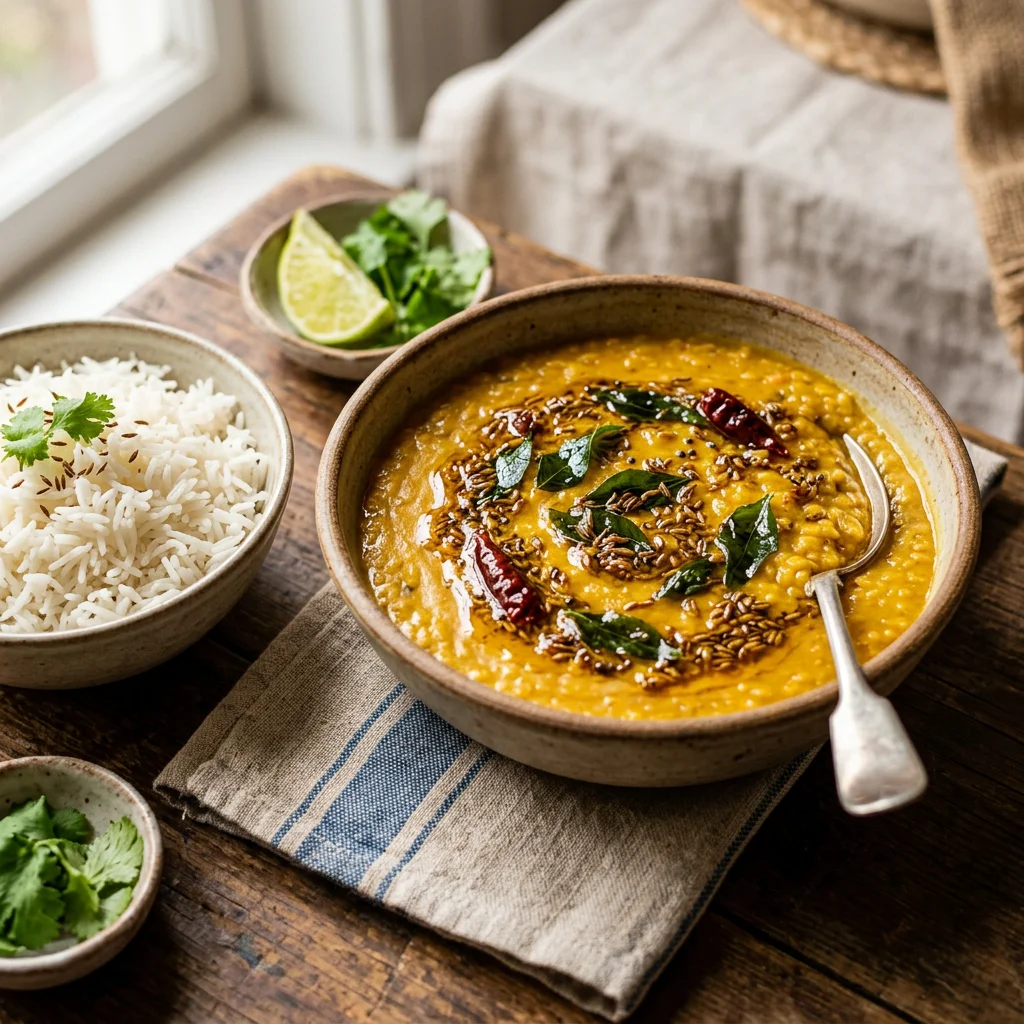
Overview
Masoor dal tadka is the everyday lentil soup of North India — red lentils simmered until they dissolve into a creamy, golden broth, then finished with a sizzling tempering of whole spices bloomed in hot ghee. The word "tadka" (also called "chaunk" or "baghar") refers to this final tempering technique, where whole spices are flash-fried in fat and poured over the finished dish, creating an aromatic explosion that transforms humble lentils into something vibrant. Red lentils (masoor dal) are among the fastest-cooking legumes, requiring no soaking and breaking down in under 20 minutes. This makes masoor dal tadka a weeknight staple across the Indian subcontinent — quick to prepare, deeply satisfying, and nutritionally dense. It is typically served with rice or chapati, a squeeze of lemon, and perhaps a side of pickle. Ayurvedically, red lentils are lighter than most legumes and easier on digestion, though they carry more heat than mung dal. The tadka technique itself is therapeutic — blooming spices in fat makes their volatile compounds bioavailable, turning each bite into a delivery system for cumin, mustard, and turmeric.
Balances Vata and Kapha. May mildly increase Pitta due to heating spices and tomato.
Ingredients
- 1.5 cups Red lentils (masoor dal) (rinsed)
- 4 cups Water
- 1/2 tsp Turmeric powder
- 1 tsp Salt
- 2 tbsp Ghee
- 1 tsp Cumin seeds
- 1/2 tsp Mustard seeds
- 2 whole Dried red chilies (broken in half)
- 1/4 tsp Asafoetida (hing)
- 4 cloves Garlic (thinly sliced)
- 1 medium Onion (finely chopped)
- 1 medium Tomato (chopped)
- 3 tbsp Fresh cilantro (chopped)
- 1 tbsp Lemon juice
Instructions
- Rinse the red lentils in a fine mesh strainer until the water runs clear. Place them in a pot with 4 cups of water, turmeric, and salt.
- Bring to a boil over high heat, skimming any foam that rises. Reduce heat to medium-low, cover, and simmer for 18-20 minutes until the lentils have completely dissolved into a smooth, soupy consistency.
- While the dal simmers, prepare the tadka. Heat ghee in a small pan over medium-high heat until it shimmers.
- Add cumin seeds and mustard seeds. When the mustard seeds begin to pop and the cumin darkens, add the dried red chilies and asafoetida. Stir for 5 seconds.
- Add the sliced garlic and fry until golden, about 30 seconds. Then add the chopped onion and cook until translucent and lightly browned, about 3-4 minutes.
- Add the chopped tomato and cook until softened, about 2-3 minutes.
- Pour the entire tadka — ghee, spices, and aromatics — over the simmered dal. It will sizzle dramatically. Stir to combine.
- Add lemon juice, adjust salt, and garnish with fresh cilantro. Serve hot with basmati rice or warm chapati.
Nutrition
These values are estimates calculated from the ingredient list and may vary based on brands, cooking methods, and serving size. Not a substitute for medical or dietary advice.
How This Recipe Affects Each Dosha
Vata
The warm, soupy consistency and ghee content make this deeply comforting for Vata. Red lentils are lighter than most legumes, making them less gas-producing. The tempering spices — cumin and asafoetida in particular — actively reduce Vata in the digestive tract.
Pitta
Red lentils are slightly more heating than mung dal, and the garlic, onion, tomato, and chili in the tadka add heat. Pitta types can enjoy this in moderation but should be mindful during summer or periods of Pitta aggravation.
Kapha
This is an excellent Kapha-balancing meal. The light, dry quality of lentils combined with heating spices helps move stagnation and stimulate sluggish digestion. The pungent and astringent tastes are exactly what Kapha needs.
The tadka spices strongly kindle agni. Cumin, mustard, and asafoetida are all classic digestive stimulants in Ayurveda. This makes the dish more digestible than plain-cooked lentils.
Nourishes: Rasa (plasma), Rakta (blood), Mamsa (muscle)
Adjustments by Constitution
For Vata Types
Omit tomato and reduce chili. Increase ghee to 3 tablespoons and add a generous pinch of black pepper. Serve with a side of warm basmati rice and a dollop of ghee on top.
For Pitta Types
Replace red lentils with yellow mung dal. Omit garlic, onion, mustard seeds, and red chili. Use fennel seeds and coriander in the tadka instead. Add fresh mint along with cilantro as garnish.
For Kapha Types
Reduce ghee to 1 tablespoon and use mustard oil instead for extra heat. Add extra ginger, black pepper, and a pinch of cayenne. Serve with millet roti instead of rice to keep the meal lighter.
Seasonal Guidance
Best during cooler months when the body craves warming, hearty foods. In autumn and winter, use a generous hand with ghee and warming spices. In spring, lighten the dish by reducing ghee and adding greens like spinach or kale. Avoid making this a daily staple during the hottest summer months — switch to mung dal-based preparations for Pitta season.
Best time of day: Lunch or early dinner, served warm
Cultural Context
Dal tadka is arguably the most universal dish in India — it crosses every regional, economic, and religious boundary. From the dhabas (roadside eateries) of Punjab to the thali plates of Gujarat, some version of tempered lentils appears at nearly every meal. The tadka technique predates written recipes and represents one of the most ancient cooking methods on the subcontinent: the deliberate blooming of spices in hot fat to release fat-soluble flavor compounds. Each household has its own tadka signature — some use curry leaves, others mustard oil, still others a pinch of sugar.
Deeper Context
Origins
Masoor cultivation in South Asia predates Vedic civilization — carbonized lentils recovered from Harappan-era sites in the Indus Valley (c. 2500 BCE) confirm the crop's presence well before the Aryan migrations, suggesting lentil-based stews are among the oldest continuously-prepared dishes on the subcontinent. The tadka technique itself developed later, refined through Mughal-era kitchen exchanges with Persian cooks who brought bloom-in-fat methods east. The specific pairing of split red lentils with a post-cooking tempering, rather than a sauce-based preparation, reflects a hybrid of indigenous legume cookery with Central Asian spice-blooming.
Food as Medicine
Charaka lists masoor (called masura in the Sushruta Samhita) among the light, quickly-digested dals recommended during convalescence, fevers, and postpartum recovery. The Astanga Hridayam places it among legumes suitable for rekindling agni after illness, though it notes the light-rough quality requires fat to be digestion-friendly. In modern Ayurvedic practice, masoor dal tadka is a standard dish during the post-panchakarma dietary window, where ghee and warming spices support the newly-cleansed digestive fire without the heaviness of mung preparations.
Ritual & Seasonal Role
Dal tadka is rarely ceremonial — it belongs to the everyday register of Indian cookery, the baseline food against which festival meals are contrasted. Its ubiquity is the point: in dhaba culture, in thali meals, in hospital cafeterias, this is what shows up when nothing special is needed. Observant Hindus avoid it during strict Ekadashi fasts, where legumes and grains are both prohibited, and it is notably absent from the sattvic widow's diet in some Brahminical traditions due to the onion and garlic in the tadka. A garlic-free Jain tadka variant uses asafoetida (hing) alone to carry the aromatic load.
Classical Pairings & Cautions
Classical pairings are basmati rice or chapati, a spoon of cow's ghee stirred in at serving, and a wedge of lemon whose sour finish completes the six-taste meal. Ayurveda pairs this well with bitter greens (sag, methi) and avoids doubling up with other drying legumes (chana, rajma) in the same sitting. Pitta types who salt heavily or add extra chili will find this aggravating; kidney-compromised patients should limit lentil frequency; the astringent vipaka can worsen constipation in Vata types if served without adequate ghee or oil.
Cross-Tradition View
How other medical and food-wisdom traditions read this dish. Each tradition names the same physiological reality in its own language — the agreements across them are where universal principles live.
Traditional Chinese Medicine
TCM classifies red lentils as neutral to slightly warming with a sweet flavor, entering the Spleen and Stomach meridians. The dish tonifies Qi and supports dampness-transformation — the tempering's pungent agents (cumin, mustard, garlic) disperse Spleen dampness, making this a practical autumn and winter dish for weak digestion. The ghee contributes Yin fluids without waterlogging the middle burner, and turmeric's aromatic pungency moves Liver Qi alongside the grain.
Greek Humoral
Classical Galenic theory places plain lentils in the cold-and-dry quadrant — they thicken blood and build black bile when eaten unadorned. The tadka is what makes this dish safe under that schema: ghee adds moisture, the warming spices push the temperament toward hot-and-wet, and the lemon finish counteracts astringency. Hippocratic physicians would have recognized this exact correction for melancholic temperaments — lentils made hospitable through fat and aromatic heat.
Unani Tibb
Mizaj is hot in the first degree, dry in the second — a bard-yabis base that ghee's kaffi quality balances toward equilibrium. Traditional hakims use masoor to treat phlegmatic conditions (balgham) and recommend it during convalescence from damp illness. The pairing is contraindicated in excess bile (ghalaba-e-safra) or kidney stones, where the astringent finish concentrates waste rather than moving it.
Tibetan Sowa Rigpa
Red lentils fall under the light-rough-cool category governed by Wind (rLung) when eaten unadorned, but the oil tempering shifts them toward Bile (mKhris-pa) activation — useful in mid-day meals when Bile is strongest. Tibetan physicians would prescribe this with added ginger and a pinch of rock salt for patients convalescing from cold disorders (grang-ba'i nad), where cold dampness has settled in the middle burner.
Chef's Notes
The secret to a great tadka is having all your ingredients prepped and ready — the spices go in rapid succession and burn quickly. Listen for the mustard seeds to pop; that is your cue that the oil is hot enough. If the dal thickens too much as it sits, thin it with hot water — it should be soupy, not stiff. For a richer dal, stir a tablespoon of butter into the pot just before serving. This dish improves overnight as flavors meld, making it excellent for meal prep.
Frequently Asked Questions
Is Masoor Dal Tadka good for my dosha?
Balances Vata and Kapha. May mildly increase Pitta due to heating spices and tomato. The warm, soupy consistency and ghee content make this deeply comforting for Vata. Red lentils are slightly more heating than mung dal, and the garlic, onion, tomato, and chili in the tadka add heat. This is an excellent Kapha-balancing meal.
When is the best time to eat Masoor Dal Tadka?
Lunch or early dinner, served warm Best during cooler months when the body craves warming, hearty foods. In autumn and winter, use a generous hand with ghee and warming spices. In spring, lighten the dish by reducing ghee and adding gr
How can I adjust Masoor Dal Tadka for my constitution?
For Vata types: Omit tomato and reduce chili. Increase ghee to 3 tablespoons and add a generous pinch of black pepper. Serve with a side of warm basmati rice and a do For Pitta types: Replace red lentils with yellow mung dal. Omit garlic, onion, mustard seeds, and red chili. Use fennel seeds and coriander in the tadka instead. Add f
What are the Ayurvedic properties of Masoor Dal Tadka?
Masoor Dal Tadka has Sweet, Astringent, Pungent taste (rasa), Heating energy (virya), and Sweet post-digestive effect (vipaka). Its qualities (gunas) are Light, Warm, Slightly Oily. It nourishes Rasa (plasma), Rakta (blood), Mamsa (muscle). The tadka spices strongly kindle agni. Cumin, mustard, and asafoetida are all classic digestive stimulants in Ayurveda. This makes the dish more digestible than plain-cooked lentils.