Croque Monsieur
French Recipe
Overview
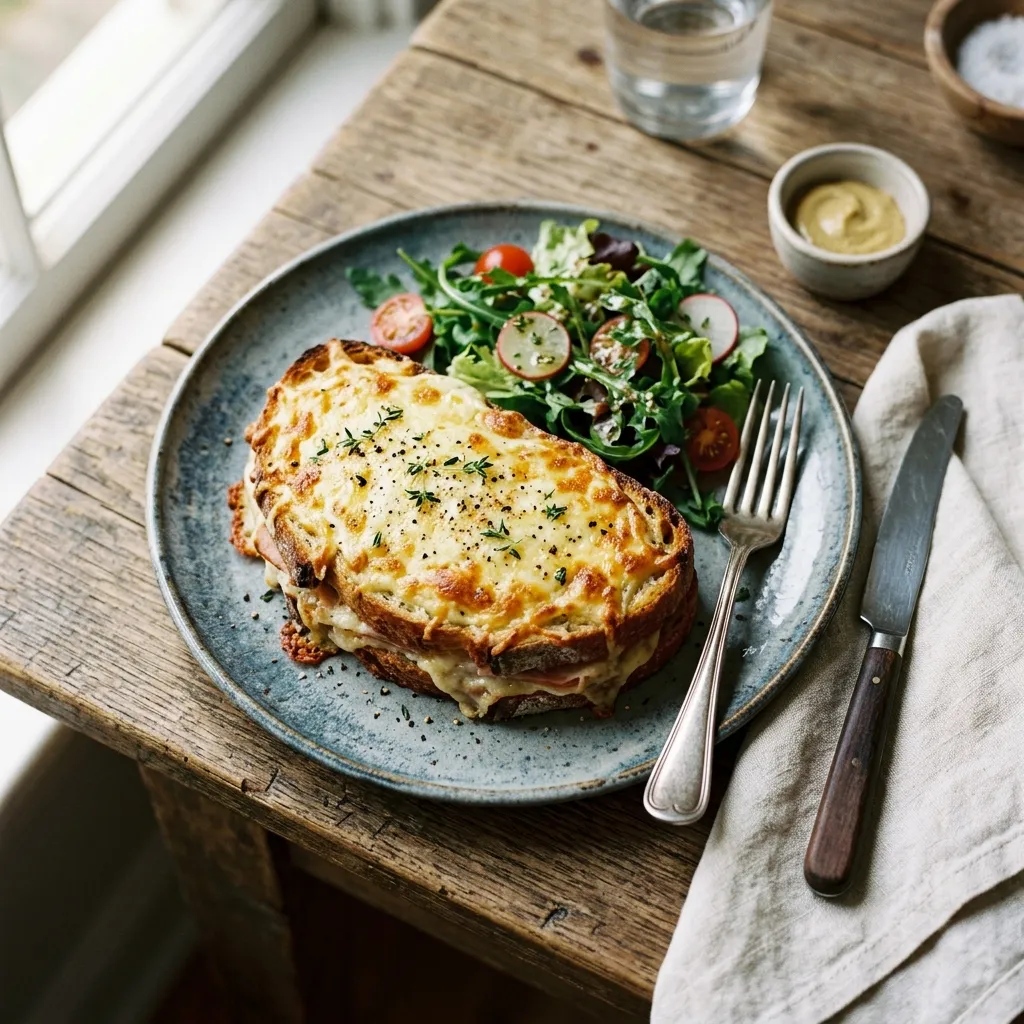
The croque monsieur first appeared on Parisian café menus around 1910, with the earliest documented reference in Proust's 1918 novel 'In Search of Lost Time.' The name translates roughly to 'mister crunch' — a reference to the crispy, golden exterior that shatters when bitten into. The sandwich consists of sliced ham and Gruyère between two pieces of white bread, coated in béchamel sauce, then baked or broiled until the surface forms a bubbly, golden crust. From an Ayurvedic standpoint, the croque monsieur is a study in concentrated guru (heavy) and snigdha (oily) qualities. The béchamel — a cooked roux of butter, flour, and milk — adds a layer of richness that transforms a simple ham and cheese sandwich into something requiring genuine digestive capacity. The white bread, butter, cheese, and cream sauce create an almost purely madhura (sweet) and lavana (salty) rasa profile, which strongly nourishes and grounds but also strongly increases kapha. The béchamel is what distinguishes a croque monsieur from an ordinary grilled cheese with ham. This flour-thickened milk sauce dates to the court of Louis XIV, where it was named after the Marquis de Béchameil. The sauce acts as both a moisture barrier (preventing the bread from drying out) and a browning agent, creating the characteristic golden crust that gives the sandwich its name.
Strongly increases kapha through the triple combination of wheat bread, dairy-based béchamel, and melted cheese. The warmth and heaviness provide excellent vata grounding. The salty ham and heated dairy moderately increase pitta.
Useful as a deeply grounding, calorie-dense meal for individuals needing to restore weight, combat chronic cold conditions, or provide sustained energy during periods of high physical output. Not appropriate for therapeutic use in conditions involving congestion, excess weight, or sluggish digestion.
Ingredients
- 8 slices White sandwich bread (Pullman or pain de mie preferred, 1/2 inch thick)
- 4 tablespoons Unsalted butter (divided — 2 for béchamel, 2 for bread)
- 2 tablespoons All-purpose flour
- 1 cup Whole milk (warmed)
- 1/8 teaspoon Nutmeg (freshly grated)
- 2 teaspoons Dijon mustard
- 2 cups Gruyère cheese (grated, about 6 ounces, divided)
- 8 ounces Ham (thinly sliced, good quality, such as jambon de Paris)
- 1/4 teaspoon Salt
- 1/8 teaspoon White pepper
Instructions
- Prepare the béchamel: Melt 2 tablespoons of butter in a small saucepan over medium heat. Add the flour and whisk continuously for 2 minutes to cook out the raw flour taste — the roux should smell nutty and turn a pale blond color without browning.
- Slowly pour in the warmed milk while whisking constantly. Adding cold milk to hot roux creates lumps; warming the milk prevents this. Continue whisking over medium heat for 3-4 minutes until the sauce thickens enough to coat the back of a spoon. Remove from heat and stir in the nutmeg, salt, and white pepper.
- Preheat the broiler with a rack positioned 6 inches below the heating element. Line a baking sheet with parchment paper or aluminum foil.
- Lightly butter one side of each bread slice using the remaining 2 tablespoons of butter. Place 4 slices buttered-side down on the prepared baking sheet.
- Spread a thin layer of Dijon mustard on the top (unbuttered) side of each base slice. Layer 2 ounces of sliced ham on each, folding to fit. Top with 1/4 cup of grated Gruyère. Place the remaining bread slices on top, buttered-side up.
- Spoon 2-3 tablespoons of béchamel sauce over the top of each sandwich, spreading it to the edges with the back of the spoon. The béchamel should cover the entire top surface — any exposed bread will burn under the broiler rather than turning golden.
- Sprinkle the remaining Gruyère generously over the béchamel-topped sandwiches, pressing gently so the cheese adheres to the sauce.
- Broil for 4-5 minutes, watching closely, until the cheese is bubbly and deeply golden with charred spots at the edges. Rotate the baking sheet halfway through if your broiler has hot spots.
- Remove from the oven and let rest for 2-3 minutes — the béchamel and cheese are extremely hot. Transfer to plates and serve immediately while the exterior is still crackling.
Nutrition
These values are estimates calculated from the ingredient list and may vary based on brands, cooking methods, and serving size. Not a substitute for medical or dietary advice.
How This Recipe Affects Each Dosha
Vata
The croque monsieur is deeply satisfying for vata, providing the warm, heavy, oily, grounding qualities that this constitution craves. The soft bread, melted cheese, and creamy béchamel are all comforting and easy for moderate vata digestion to handle. The madhura rasa dominates, which is vata's primary balancing taste. The salt from the ham provides additional vata-pacifying lavana rasa. The only challenge is the wheat bread, which some vata types with grain sensitivity may find difficult. Overall, this is a nourishing, stabilizing lunch choice for vata.
Pitta
For pitta, the croque monsieur is a mixed picture. The heavy, sweet, dairy-rich composition is calming to pitta's sharp and hot qualities in moderate amounts. However, the aged Gruyère carries heating properties from the aging process, and the ham adds additional salt and preservative-related heat. The broiling process creates browned, slightly charred surfaces that carry additional pitta-aggravating qualities. Pitta types should treat this as an occasional indulgence rather than a staple, and pair it with a cooling side salad.
Kapha
The croque monsieur concentrates nearly every kapha-increasing quality into a single dish: heavy wheat bread, butter, milk-based béchamel, melted cheese, and processed meat. The guru and snigdha gunas dominate to an extreme degree. Kapha types will experience increased mucus production, congestion, sluggishness, and weight gain from regular consumption. The dish provides almost none of the lightness, dryness, or pungency that kapha needs for balance. Even the warmth of the broiled surface is insufficient to counteract the overwhelming heaviness.
The concentrated richness of béchamel, cheese, and butter demands strong digestive fire. Those with weak or irregular agni may experience heaviness, bloating, or sluggishness after consumption. The nutmeg and mustard provide mild agni support but are insufficient for weak digestion to fully process this dish.
Nourishes: rasamamsamedaasthi
Adjustments by Constitution
For Vata Types
The croque monsieur is already well-suited for vata. To optimize, use sourdough bread instead of white for improved digestibility through the natural fermentation process. Add a thin layer of sautéed spinach beneath the ham for additional mineral content. Pair with a warm cup of cumin-coriander-fennel tea to support digestion of the heavy cheese and cream. Ensure the sandwich is served hot — lukewarm food increases vata.
For Pitta Types
Replace the ham with sliced turkey breast or thinly sliced avocado for a less heating protein. Use mild, fresh mozzarella instead of Gruyère to reduce the heating quality of aged cheese. Add fresh arugula or watercress inside the sandwich for a cooling, bitter counterpoint. Reduce the amount of béchamel and add a teaspoon of fresh dill to the sauce. Skip the broiling step — instead, bake at 350 degrees F until the cheese melts without browning.
For Kapha Types
Replace white bread with thin rye crispbread or toasted sprouted grain bread. Skip the béchamel entirely — its purpose is richness that kapha does not need. Use a minimal amount of sharp, low-moisture cheese rather than generous Gruyère. Add sliced tomato, mustard greens, and a generous spread of grainy mustard for pungency. Open-face the sandwich to halve the bread. Serve alongside a peppery arugula salad dressed with lemon juice to introduce lightness and bitterness.
Seasonal Guidance
The croque monsieur is a cold-weather food that provides the insulation and caloric density the body needs during frigid months. It is too heavy and heating for summer consumption, when lighter fare is more appropriate. In spring, consume sparingly as the body transitions from winter's heavier diet.
Best time of day: Lunch is the ideal time, when digestive fire peaks and the body can metabolize the concentrated dairy and wheat. Eating a croque monsieur for dinner creates too heavy a load for evening digestion, potentially disturbing sleep.
Cultural Context
The croque monsieur is the quintessential Parisian café lunch — ordered at zinc-topped counters alongside a glass of wine or a café crème. Marcel Proust's 1918 reference places it firmly in the Belle Époque café culture, and it has remained a fixture of French casual dining for over a century. The croque madame variant — topped with a fried egg — appeared later and is said to have been named because the egg resembles a woman's hat. Every brasserie in France serves its own version, and opinions about the correct cheese, bread, and sauce ratio are held with genuine conviction.
Deeper Context
Origins
Invented in 1910 at a Paris café on Boulevard des Capucines — appearing shortly thereafter on the menu of Le Bel Âge brasserie. The origin story is one of kitchen improvisation: the chef allegedly ran out of proper baguette and used leftover white sandwich bread toasted with ham and gruyère. The name derives from 'croque' (crunch) and 'monsieur' (to distinguish it from the later croque-madame variation with fried egg). Marcel Proust references the dish in Remembrance of Things Past, giving it early literary-cultural weight.
Food as Medicine
Not therapeutically designed. Functions as substantial working-lunch nutrition — the ham-and-cheese combination provides complete protein, and the bread-and-butter base delivers rapid calories. Gruyère is a well-aged cheese with significant enzymatic, mineral, and vitamin K2 content. The béchamel sauce in gratinéed versions adds fat-soluble vitamin delivery.
Ritual & Seasonal Role
Not religiously ceremonial. A Parisian brasserie lunch staple, year-round, with slight winter peak when the warm-melted-cheese format is particularly welcome. Featured on nearly every Parisian café and brasserie menu. Associated with mid-20th-century French café culture and with the pre-war bohemian literary community.
Classical Pairings & Cautions
Green salad (small, to balance the richness), a glass of white wine or a café express. Cautions: substantial saturated fat and sodium load; gluten intolerance precludes the bread base; lactose sensitivity affects the cheese and béchamel; religious restrictions on pork (Jewish, Muslim, Hindu, some Buddhist, Adventist) preclude the ham — turkey or chicken variants work imperfectly; Kapha substantial aggravation.
Cross-Tradition View
How other medical and food-wisdom traditions read this dish. Each tradition names the same physiological reality in its own language — the agreements across them are where universal principles live.
Traditional Chinese Medicine
Bread is Spleen-Qi-tonifying; gruyère is Yin-building and Kidney-supporting; ham is salty-warm Yin-building; butter is warm-moistening; milk is cool-Yin-building. A Yin-building Qi-tonic — TCM physicians would class this as restoration food for thin constitutions, though excessive for habitual consumption due to damp-heat risk.
Greek Humoral
Hot-wet sanguine-building. A Galenic café-lunch preparation — melancholic-dispelling through the melted cheese-and-ham richness, sanguine-generating through the grilled-bread crust. Appropriate for winter laborers and for convalescents needing calorie density.
Ayurveda
Heating virya, sweet vipaka. Pacifies Vata substantially through unctuousness and warmth. Aggravates Kapha substantially through the bread-cheese-ham combination. Pitta-neutral to mildly-aggravating. A winter restoration dish; inappropriate for Kapha imbalance.
Parisian Café
Invented in 1910 at a Paris café on Boulevard des Capucines, where (by one origin legend) the owner ran out of baguette and used sliced white bread instead for a workers' lunch. The croque-madame variation adds a fried egg on top. Classic Parisian brasserie lunch staple through the 20th century. Proust mentions the dish in Remembrance of Things Past (1918), giving it immediate literary-cultural weight.
Chef's Notes
The quality of ham matters enormously in a sandwich this simple. Seek out jambon de Paris (French-style boiled ham) or a good-quality uncured ham from a deli counter — watery, pre-sliced supermarket ham will produce a watery, flavorless sandwich. The bread should be a tight-crumbed white loaf like pain de mie, not an airy artisan bread that will collapse under the weight of the sauce and cheese. To make a croque madame, place a fried egg on top of the finished sandwich — the runny yolk becomes an additional sauce.
Frequently Asked Questions
Is Croque Monsieur good for my dosha?
Strongly increases kapha through the triple combination of wheat bread, dairy-based béchamel, and melted cheese. The warmth and heaviness provide excellent vata grounding. The salty ham and heated dairy moderately increase pitta. The croque monsieur is deeply satisfying for vata, providing the warm, heavy, oily, grounding qualities that this constitution craves. For pitta, the croque monsieur is a mixed picture. The croque monsieur concentrates nearly every kapha-increasing quality into a single dish: heavy wheat bread, butter, milk-based béchamel, melted cheese, and processed meat.
When is the best time to eat Croque Monsieur?
Lunch is the ideal time, when digestive fire peaks and the body can metabolize the concentrated dairy and wheat. Eating a croque monsieur for dinner creates too heavy a load for evening digestion, potentially disturbing sleep. The croque monsieur is a cold-weather food that provides the insulation and caloric density the body needs during frigid months. It is too heavy and heating for summer consumption, when lighter fare i
How can I adjust Croque Monsieur for my constitution?
For Vata types: The croque monsieur is already well-suited for vata. To optimize, use sourdough bread instead of white for improved digestibility through the natural For Pitta types: Replace the ham with sliced turkey breast or thinly sliced avocado for a less heating protein. Use mild, fresh mozzarella instead of Gruyère to reduce
What are the Ayurvedic properties of Croque Monsieur?
Croque Monsieur has madhura,lavana taste (rasa), ushna energy (virya), and madhura post-digestive effect (vipaka). Its qualities (gunas) are guru,snigdha. It nourishes rasa,mamsa,meda,asthi. The concentrated richness of béchamel, cheese, and butter demands strong digestive fire. Those with weak or irregular agni may experience heaviness, bloating, or sluggishness after consumption. The nutmeg and mustard provide mild agni support but are insufficient for weak digestion to fully process this dish.