Clam Chowder
American Recipe
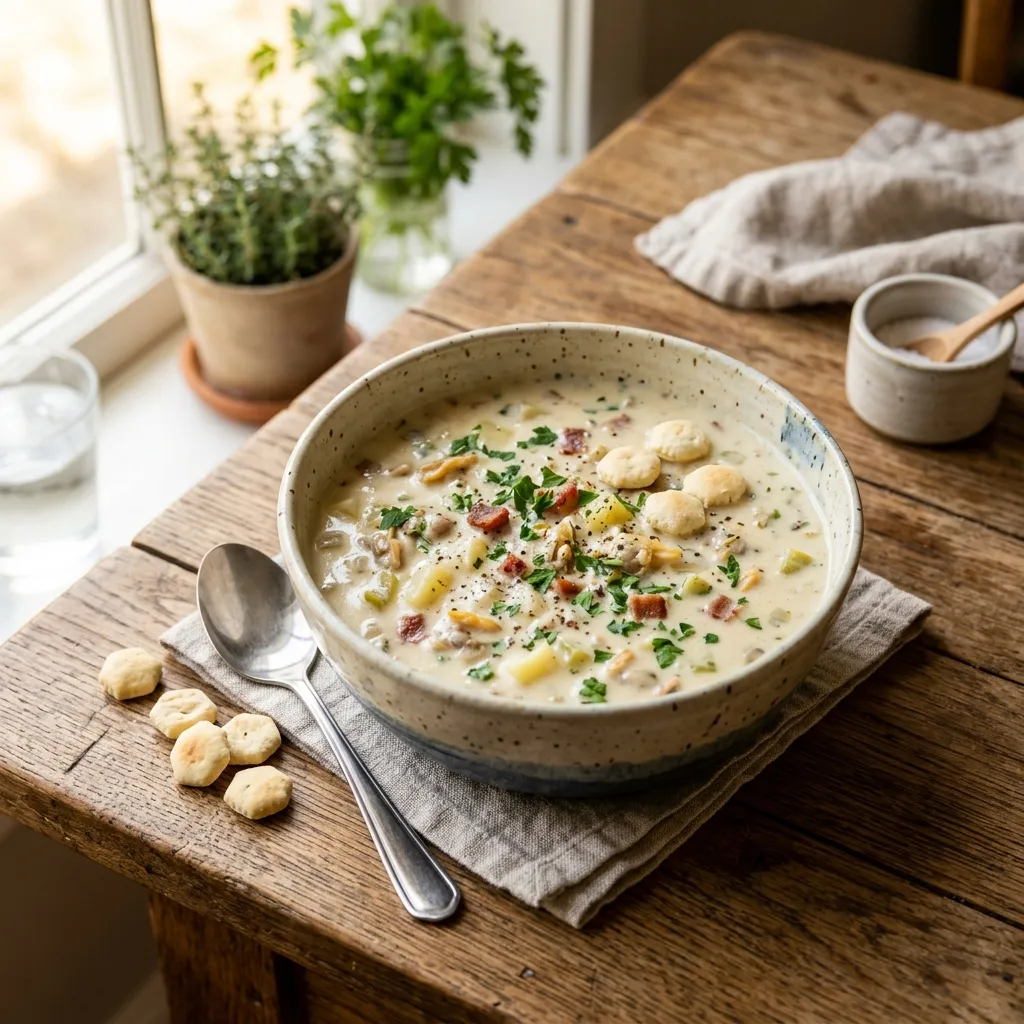
Overview
New England clam chowder — the cream-based version with potatoes, salt pork, and onions — traces to the fishing communities of coastal Massachusetts in the early 1700s, where it developed from French and British fish stew traditions. The word 'chowder' likely derives from the French 'chaudiere,' the large cauldron in which Breton fishermen cooked communal stews. A heated rivalry with Manhattan-style (tomato-based) chowder culminated in a 1939 Maine bill that sought to outlaw the use of tomatoes in chowder, a cultural sentiment that persists informally today. Ayurvedically, clam chowder is a deeply nourishing, heavy, and building preparation. Clams carry sweet and salty rasas with a cooling virya — unusual among animal proteins, most of which are heating. The cream base adds sweet rasa, cooling virya, and heavy, oily gunas that compound the soup's grounding nature. Potatoes contribute sweet, heavy, and stabilizing qualities. The salt pork and onion provide necessary heating counterpoints that prevent the overall preparation from becoming excessively cold and sluggish. Celery offers mild bitter and astringent tastes that partially lighten the density. This is a deeply kapha-provoking soup in its traditional form — heavy, moist, cool, sweet, and dense describe both kapha dosha and clam chowder with equal accuracy. For vata constitutions, however, this is near-ideal comfort food: warm, liquid, unctuously rich, grounding, and full of the sweet and salty tastes that vata craves and benefits from. The key to making clam chowder work across constitutions lies in adjusting the cream content and adding warming spices.
Clam chowder is profoundly kapha-aggravating in its traditional form due to its heavy, moist, cool, and sweet composition. Vata benefits enormously from these same qualities. Pitta finds it relatively neutral — the cooling virya of clams and cream is favorable, but the heaviness can slow pitta's sharp digestion.
Clam chowder's deeply nourishing, tissue-building qualities make it suitable for convalescence, particularly after depletion from illness, overwork, or emotional exhaustion. Clams provide iron, vitamin B12, and zinc — nutrients critical for blood building and immune function. The warm liquid base hydrates tissues while the fats carry fat-soluble vitamins for absorption.
Ingredients
- three 6.5-oz cans canned chopped clams (drain and reserve juice separately)
- 4 oz salt pork or thick-cut bacon (cut into 1/4-inch dice)
- 1 large yellow onion (diced)
- 2 stalks celery (diced)
- 2 cloves garlic (minced)
- 1.5 lbs Yukon Gold potatoes (peeled and cut into 1/2-inch cubes)
- 3 tablespoons all-purpose flour
- 1 8-oz bottle bottled clam juice (in addition to reserved canned juice)
- 1.5 cups whole milk
- 1 cup heavy cream
- 2 leaves bay leaf
- 3 sprigs fresh thyme (or 1/2 tsp dried)
- 1/4 teaspoon white pepper
- to taste salt (careful — clam juice is salty)
- 2 tablespoons butter
- 2 tablespoons fresh parsley (chopped, for garnish)
Instructions
- Drain the canned clams through a fine-mesh strainer set over a bowl, pressing gently to extract all the juice. Reserve the clam juice — you should have roughly 1.5 cups from three cans. Set the clams aside separately; they will be added at the very end to prevent them from becoming rubbery.
- In a large Dutch oven or heavy-bottomed pot, cook the diced salt pork over medium heat for 6-8 minutes, stirring occasionally, until the fat has rendered and the pieces are golden and crisp. If using bacon, cook until crisp. Remove the pork pieces with a slotted spoon and set aside for garnish, leaving the rendered fat in the pot.
- Add the butter to the rendered fat. Once melted, add the diced onion and celery. Cook for 5-6 minutes until softened and the onion is translucent. Add the minced garlic and cook for 30 seconds until fragrant.
- Sprinkle the flour over the vegetables and stir continuously for 2 minutes to cook out the raw flour taste. This roux will thicken the chowder. The mixture should look paste-like and slightly golden.
- Slowly pour in the reserved clam juice and bottled clam juice while stirring constantly. Adding the liquid gradually prevents lumps from forming in the roux. Stir until smooth, then add the cubed potatoes, bay leaves, thyme sprigs, and white pepper.
- Bring to a simmer and cook for 15-18 minutes until the potatoes are tender when pierced with a knife but not falling apart. Stir every few minutes to prevent sticking on the bottom. Some of the potato edges will break down and naturally thicken the chowder — this is desirable.
- Reduce heat to low and add the milk and cream. Stir well and heat through for 5 minutes without allowing the chowder to boil — boiling cream causes it to break and turn grainy. Remove and discard the bay leaves and thyme sprigs.
- Add the reserved chopped clams and stir gently. Cook for just 2-3 minutes to warm the clams through. Overcooked clams become tough and chewy. Taste and adjust salt and pepper — the clam juice contributes significant salt, so add carefully.
- Ladle into bowls and garnish with the reserved crispy salt pork pieces and chopped fresh parsley. Serve with oyster crackers or crusty sourdough bread. The chowder improves significantly the next day as flavors meld — reheat gently over low heat.
Nutrition
These values are estimates calculated from the ingredient list and may vary based on brands, cooking methods, and serving size. Not a substitute for medical or dietary advice.
How This Recipe Affects Each Dosha
Vata
Clam chowder addresses nearly every vata imbalance simultaneously. Its warm liquid format soothes vata's dry membranes and channels. The heavy, moist, oily qualities of cream and butter directly counteract vata's light, dry, and rough characteristics. The sweet and salty tastes are the two most vata-pacifying rasas. The potato provides stabilizing, grounding carbohydrate energy. The overall effect is deeply calming and nourishing for an aggravated vata constitution. This is a therapeutic-grade vata food.
Pitta
The cooling virya of clams provides welcome relief for pitta's inherent heat, and cream is generally pitta-pacifying due to its sweet and cooling nature. However, the salt pork and onion add heating elements, and the salty rasa from both the pork and concentrated clam juice can aggravate pitta's tendency toward inflammation when consumed in excess. The overall effect is mildly favorable for pitta — the cooling outweighs the heating, particularly when salt is kept in check. The heaviness may slow pitta's normally efficient digestion.
Kapha
Every defining quality of clam chowder maps directly to kapha's existing tendencies: heavy, moist, dense, cool, and sweet. Cream, butter, potatoes, and flour compound heaviness and moisture that kapha constitutions store rather than metabolize. The sweet vipaka promotes further tissue accumulation. The salt content promotes water retention. Kapha types who eat clam chowder regularly will experience increased congestion, weight gain, and lethargy. Significant modification is required for kapha compatibility.
The heavy, moist, and dense qualities of clam chowder require strong agni to digest properly. The roux-thickened cream base is particularly demanding on digestive fire. The salt and pork fat provide some digestive stimulation, but the overall effect is agni-dampening. Those with weak or sluggish digestion may feel heavy, bloated, or foggy after eating a full bowl, indicating ama production rather than proper nourishment.
Nourishes: Rasa (plasma), Rakta (blood), Mamsa (muscle), Meda (fat), Majja (nerve/marrow)
Adjustments by Constitution
For Vata Types
This soup is already excellent for vata in its traditional form. To optimize further, add a generous pinch of ground ginger and a pinch of black pepper to the broth during cooking — these warming spices stimulate vata's often unpredictable agni without changing the flavor profile significantly. A squeeze of lemon juice at serving brightens the rich soup and adds sour rasa, which is the third most vata-pacifying taste. Serve with warm sourdough bread spread with ghee.
For Pitta Types
Replace the salt pork with a smaller amount of butter for rendering flavor — this eliminates the most heating, salty element. Use light cream or half-and-half instead of heavy cream to reduce overall richness. Add fresh fennel bulb (diced) alongside the celery for its sweet, cooling quality that directly pacifies pitta. Reduce garlic to one clove or omit. Add a teaspoon of ground coriander to the broth and garnish with fresh cilantro instead of parsley. Use less bottled clam juice and supplement with plain water to reduce the concentrated salt.
For Kapha Types
Replace heavy cream entirely with unsweetened oat milk or a light coconut milk. Omit the butter and use only the rendered salt pork fat, then reduce the salt pork to 2 oz. Cut the potato quantity in half and add diced turnip or parsnip for a lighter root vegetable alternative. Add 1/2 teaspoon each of black pepper and dried ginger powder, and a pinch of cayenne to the broth — these pungent spices stimulate kapha's metabolism and counteract the soup's inherent heaviness. Reduce flour to 1.5 tablespoons for a thinner consistency. Serve in smaller portions.
Seasonal Guidance
Clam chowder belongs to cold weather. Its heavy, warming, and building qualities match autumn and winter when the body needs insulation and the external cold strengthens agni enough to handle the density. Eating clam chowder in spring invites kapha accumulation and seasonal congestion. Summer consumption is inadvisable for all constitutions — the heaviness opposes the body's natural desire for lighter fare, and pitta types face aggravation from the salt content during their most vulnerable season.
Best time of day: Serve at lunch when digestive capacity peaks. As a dinner, consume early (before 6 PM) and keep the portion moderate to allow thorough digestion before sleep. The heavy, grounding nature of chowder can promote sleepiness — useful at dinner if sleep is the goal, counterproductive at lunch if afternoon productivity matters.
Cultural Context
Clam chowder's roots lie in the maritime communities of New England's Atlantic coast, where Narragansett and Wampanoag peoples had harvested clams for centuries before European contact. French and English settlers adapted their fish-stew traditions using local ingredients, and by the 1730s, chowder recipes appeared in New England newspapers. The cream-based version solidified as the New England standard by the mid-1800s, distinguishing it from the tomato-based Manhattan variant that emerged among Italian immigrant communities in New York. The rivalry is real — Bostonians consider tomato-based chowder heresy, and the dish functions as a regional identity marker.
Deeper Context
Origins
Clam chowder's name derives from the French chaudière — a large cauldron used for communal coastal stews. New England clam chowder (cream-based) emerged in the colonial period as Indigenous and French-Canadian fishing community influences met European dairy traditions. Manhattan clam chowder (tomato-based) is a 19th-century Italian-immigrant variant. The cream-versus-tomato debate is so heated that Maine introduced an anti-Manhattan-chowder bill in 1939 attempting to criminalize the tomato version.
Food as Medicine
Shellfish broths have classical status across Greek, Roman, and East Asian medicine as zinc-and-mineral-rich convalescent food. Clams specifically carry a classical anti-anemia reputation due to their high iron and B12 content. Modern seafood nutrition research validates these traditional uses. Cream-and-potato stews work as calorie-dense recovery food for labor workers and convalescents, and fishing communities across the North Atlantic have prepared versions of this dish as working food for four centuries.
Ritual & Seasonal Role
Strongly regional — a New England dish first, Atlantic-coast American dish second. The clambake (beach preparation of clams, corn, potatoes, lobster) is a seasonal summer ritual in coastal New England communities that carries ceremonial weight in family traditions. Friday-night clam chowder in Catholic Italian-American communities is a separate tradition dating to pre-Vatican-II meatless-Friday observance.
Classical Pairings & Cautions
Oyster crackers, sourdough bread bowl (Pacific version), a glass of chardonnay. Cautions: shellfish allergies are severe and common; mercury and heavy-metal accumulation in shellfish affects pregnancy planning; pork fat in the salt pork aggravates Kapha and Pitta substantially; dairy sensitivity; high cholesterol and sodium load in commercial versions.
Cross-Tradition View
How other medical and food-wisdom traditions read this dish. Each tradition names the same physiological reality in its own language — the agreements across them are where universal principles live.
Traditional Chinese Medicine
Clams are cool-salty, clear Heat and build Yin fluids; cream is cool-sweet and builds Yin; potato is sweet-neutral and tonifies Spleen Qi; salt pork is salty-warm and adds Yang-warming balance; thyme is warm-pungent and disperses cold. A Yin-building, cold-clearing dish with just enough warming pork-and-thyme to prevent damp accumulation. Particularly good for summer Heat with Yin deficiency, or for urinary-tract inflammation patterns.
Greek Humoral
Cold-wet (clams, cream, potato) with a hot-dry corrective (salt pork, thyme). Classical Galenic construction — phlegmatic base with choleric balancing. Appropriate for summer cold in coastal climates; Hippocratic physicians specifically praised shellfish broths for summer heat and convalescence. A proper Galenic chowder would have added hyssop or savory to further correct.
Ayurveda
Cooling virya, sweet vipaka. Pacifies Pitta through the cream and clams. Mixed for Vata — heaviness helps, but cold and watery qualities aggravate. Increases Kapha substantially through the dairy-potato combination. Shellfish in general are considered heavy and somewhat tamasic in Ayurvedic classification, and chowder inherits this weight.
Indigenous Wampanoag / New England Coastal
Shellfish chowders are the direct descendants of Wampanoag and Narragansett clam preparations — seasonal clam-bake traditions in what is now Massachusetts, Rhode Island, and Maine predate European contact by millennia. The addition of potato (post-Columbian) and dairy (European) turned an Indigenous shellfish dish into the New England clam chowder of colonial and later cookery. One of the clearest examples of creolized colonial American food.
Chef's Notes
The single most important technique in clam chowder is adding the clams at the very end and cooking them for no more than 2-3 minutes. Canned clams are already cooked — extended simmering turns them into erasers. Fresh clams (2 dozen littlenecks or cherrystones) steamed open and chopped produce superior chowder — steam them in 1 cup of water, use the steaming liquid as your clam broth, and add the chopped meat at the end as with canned. Yukon Gold potatoes hold their shape better than russets, which disintegrate into starch. The chowder thickens considerably as it cools — when reheating, add a splash of milk to restore the proper consistency. Traditional New England chowder houses let the soup rest overnight before serving; the next-day version is genuinely better.
Frequently Asked Questions
Is Clam Chowder good for my dosha?
Clam chowder is profoundly kapha-aggravating in its traditional form due to its heavy, moist, cool, and sweet composition. Vata benefits enormously from these same qualities. Pitta finds it relatively neutral — the cooling virya of clams and cream is favorable, but the heaviness can slow pitta's sharp digestion. Clam chowder addresses nearly every vata imbalance simultaneously. The cooling virya of clams provides welcome relief for pitta's inherent heat, and cream is generally pitta-pacifying due to its sweet and cooling nature. Every defining quality of clam chowder maps directly to kapha's existing tendencies: heavy, moist, dense, cool, and sweet.
When is the best time to eat Clam Chowder?
Serve at lunch when digestive capacity peaks. As a dinner, consume early (before 6 PM) and keep the portion moderate to allow thorough digestion before sleep. The heavy, grounding nature of chowder can promote sleepiness — useful at dinner if sleep is the goal, counterproductive at lunch if afternoon productivity matters. Clam chowder belongs to cold weather. Its heavy, warming, and building qualities match autumn and winter when the body needs insulation and the external cold strengthens agni enough to handle the dens
How can I adjust Clam Chowder for my constitution?
For Vata types: This soup is already excellent for vata in its traditional form. To optimize further, add a generous pinch of ground ginger and a pinch of black peppe For Pitta types: Replace the salt pork with a smaller amount of butter for rendering flavor — this eliminates the most heating, salty element. Use light cream or half-
What are the Ayurvedic properties of Clam Chowder?
Clam Chowder has Sweet, Salty taste (rasa), Cooling energy (virya), and Sweet post-digestive effect (vipaka). Its qualities (gunas) are Heavy, Moist, Dense. It nourishes Rasa (plasma), Rakta (blood), Mamsa (muscle), Meda (fat), Majja (nerve/marrow). The heavy, moist, and dense qualities of clam chowder require strong agni to digest properly. The roux-thickened cream base is particularly demanding on digestive fire. The salt and pork fat provide some digestive stimulation, but the overall effect is agni-dampening. Those with weak or sluggish digestion may feel heavy, bloated, or foggy after eating a full bowl, indicating ama production rather than proper nourishment.