Caesar Salad
American Recipe
Overview
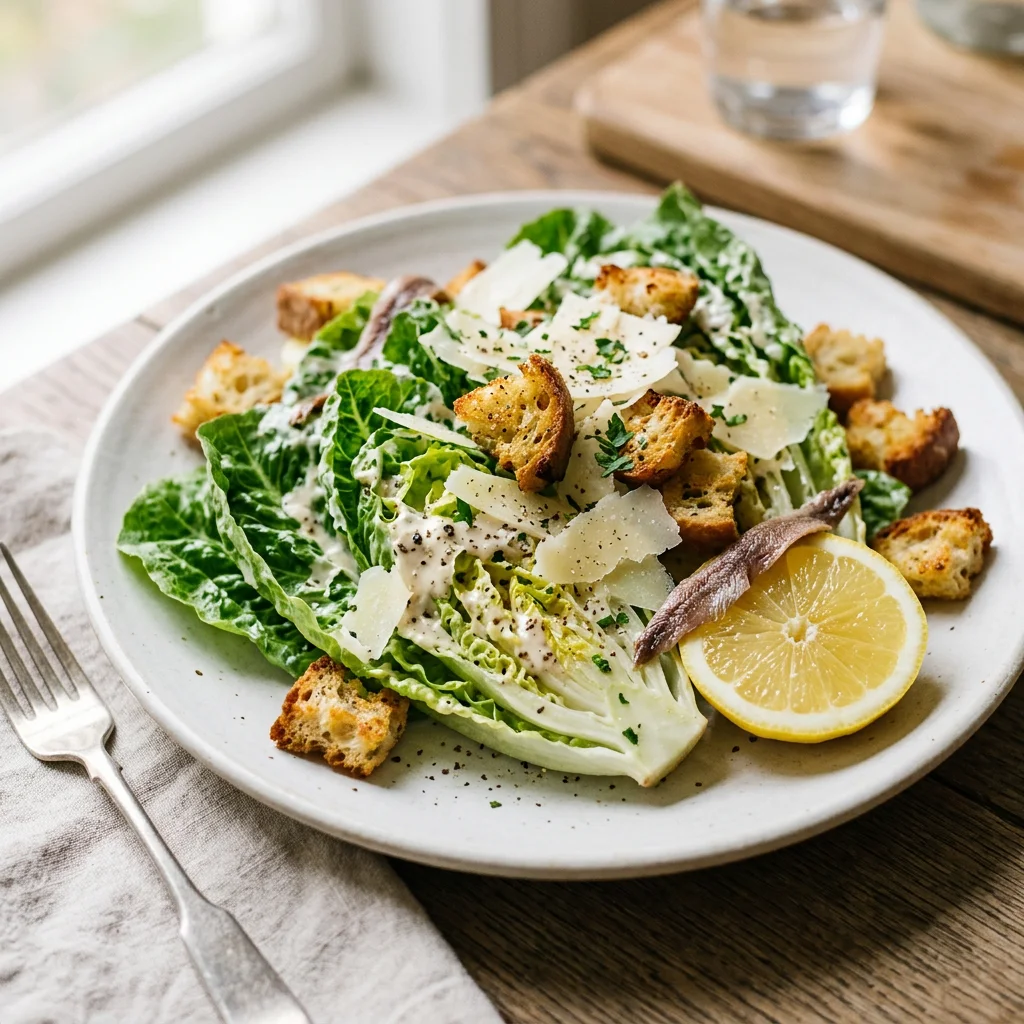
Caesar salad stands apart from every other dish on this list because it is the only one built on a foundation of bitter and astringent tastes rather than sweet. Romaine lettuce is cool, light, dry, and bitter — the energetic opposite of mac and cheese, mashed potatoes, and every other item here. And that opposition is precisely what makes it valuable in the American diet, where bitter and astringent are the two most neglected of the six Ayurvedic tastes. The Standard American Diet is dominated by sweet, salty, and sour. Caesar salad, for all its mainstream familiarity, is one of the few dishes that brings bitter and astringent to the table in a form Americans will voluntarily eat. But a Caesar salad is not just lettuce. The dressing transforms it into something far more complex: olive oil adds oily and heavy qualities, lemon juice brings sour taste that stimulates agni, garlic contributes pungent and heating energy, anchovies provide salty and strongly heating qualities with a deep savory flavor, Parmesan cheese adds salty and sweet with heavy and oily gunas, and the egg yolk brings sweet, heavy, and nourishing energy. The croutons add a warm, heavy, crunchy element. So while the base is cooling and light, the dressing and toppings create a dish that spans nearly all six tastes: bitter (lettuce), sour (lemon), pungent (garlic), salty (anchovies, Parmesan), sweet (croutons, egg, oil), with astringent from the romaine as well. This is what makes Caesar salad genuinely interesting through an Ayurvedic lens — it is one of the most rasa-balanced dishes in American cuisine, and that balance is why it satisfies in a way that a plain green salad never does. The dressing is doing serious Ayurvedic work: it makes the raw greens warmer and oilier (more digestible), it brings tastes that the lettuce lacks, and it provides enough fat for the body to absorb the fat-soluble nutrients in the romaine. This is a salad that was accidentally designed along Ayurvedic principles.
One of the most balanced American dishes across all doshas. Mildly Pitta-aggravating from garlic and lemon. Best for Kapha due to light, bitter, astringent qualities. Vata types should eat it with caution due to raw, cold, and light qualities.
Ingredients
- 2 heads Romaine lettuce (washed, dried, and torn into bite-sized pieces)
- 1/3 cup Olive oil
- 3 tbsp Lemon juice (freshly squeezed)
- 2 cloves Garlic (minced or pressed)
- 4 fillets Anchovy fillets (minced, or 2 tsp anchovy paste)
- 1 tsp Dijon mustard
- 1 large Egg yolk (at room temperature)
- 1/2 cup Parmesan cheese (freshly grated, plus more for serving)
- 1 tsp Worcestershire sauce
- 1/2 tsp Black pepper (freshly cracked)
- 1/4 tsp Salt (the anchovies and Parmesan provide most of the salt)
- 2 cups Crusty bread (cut into 1/2-inch cubes for croutons)
- 2 tbsp Olive oil (for croutons)
- 1/4 tsp Garlic powder (for croutons)
Instructions
- Make the croutons first: toss the bread cubes with 2 tablespoons of olive oil, garlic powder, and a pinch of salt. Spread on a baking sheet and bake at 375 F for 10-12 minutes, tossing halfway through, until golden and crunchy. Let cool while you make the dressing.
- In a wooden or glass bowl, mash the minced garlic with the anchovy fillets using the back of a fork until it forms a rough paste. This is the flavor foundation of the entire dressing.
- Add the egg yolk and Dijon mustard to the garlic-anchovy paste. Whisk until smooth.
- Slowly drizzle in the olive oil while whisking constantly, creating a thick, emulsified dressing. This is the same principle as making mayonnaise — patience here means a creamy, cohesive dressing rather than a broken, oily one.
- Whisk in the lemon juice, Worcestershire sauce, half the Parmesan, salt, and black pepper. The dressing should be thick enough to cling to the lettuce but thin enough to pour. Add a teaspoon of water if it seems too thick.
- Place the torn romaine in a large bowl. Pour the dressing over the lettuce and toss with your hands or tongs until every leaf is coated. This is not a drizzle-on-top situation — the dressing needs to touch every surface.
- Add the croutons and remaining Parmesan. Toss once more and serve immediately on chilled plates. Add a final crack of black pepper and a few Parmesan shavings on top.
Nutrition
These values are estimates calculated from the ingredient list and may vary based on brands, cooking methods, and serving size. Not a substitute for medical or dietary advice.
How This Recipe Affects Each Dosha
Vata
Raw salad is classically challenging for Vata, and Caesar is no exception. The cold, light, dry, rough qualities of raw romaine aggravate Vata's already mobile, airy nature. However, Caesar salad is better for Vata than a plain green salad because the dressing adds oil, salt, and heaviness — qualities that partially counterbalance the raw greens. The croutons add warming, grounding substance. Still, a Vata-dominant person eating a large Caesar salad for dinner on a cold evening will likely feel ungrounded, gassy, or bloated. It is a lunch food for Vata, not a dinner food, and best eaten in warm weather.
Pitta
The bitter and astringent qualities of romaine are cooling and Pitta-pacifying — exactly what Pitta needs. However, the garlic, lemon, anchovies, and black pepper in the dressing are all heating, creating a mild Pitta push. On balance, Caesar salad is neutral to mildly aggravating for Pitta — fine as a regular lunch, especially in summer, but the dressing can tip the balance in a Pitta-prone person who is already running hot. The cheese adds a touch of heating quality as well.
Kapha
This is an excellent dish for Kapha. The bitter and astringent romaine directly counters Kapha's sweet, heavy tendencies. The light, dry quality of raw greens is exactly what sluggish Kapha digestion needs. The pungent garlic and black pepper stimulate agni, while the lemon provides sour taste that cuts through Kapha stagnation. Even the croutons are lighter than a bread roll. Kapha types should make Caesar salad a regular rotation item — it is one of the rare American dishes that actively reduces Kapha.
Mildly stimulates agni through the pungent garlic and black pepper, the sour lemon juice, and the bitter taste of the romaine (bitter taste kindles agni indirectly by drying excess moisture in the digestive tract). However, the raw and cold qualities of the lettuce base require agni to work harder to process. This is why raw salads are often hard on weak digestion — the body must first warm the food internally before it can break it down.
Nourishes: Rasa (plasma), Rakta (blood)
Adjustments by Constitution
For Vata Types
Wilt the romaine slightly by tossing it in a warm pan for 30 seconds — just enough to take the raw edge off without cooking it. Increase the olive oil in the dressing for more grounding oleation. Add warm grilled chicken on top for protein and warmth. Double the croutons. Use a creamy dressing base (more egg yolk or a spoon of mayonnaise) rather than a vinaigrette-style one. Eat at lunch, not dinner, and ideally in warm weather.
For Pitta Types
Reduce or omit the garlic. Use less lemon juice and more olive oil for a milder, less acidic dressing. Skip the Worcestershire sauce and reduce the black pepper. Add cooling elements: sliced cucumber, avocado, or fresh dill. The anchovy provides enough salt and umami — no additional heating seasonings needed. This is a great summer lunch for Pitta when prepared with these modifications.
For Kapha Types
Go heavier on the garlic, lemon, and black pepper in the dressing. Skip the croutons entirely or replace them with toasted pumpkin seeds for a lighter crunch. Use less olive oil and more lemon juice to keep the dressing lighter. Add raw red onion rings and extra Parmesan. This should be a large, substantial salad — not a side — as the main event of the meal, possibly with a small cup of warming soup alongside.
Seasonal Guidance
Ideal for warm-weather months when the body welcomes cooling, lighter food. In spring (Kapha season), the bitter and astringent qualities actively help the body shed winter heaviness. In summer (Pitta season), the cooling romaine base provides relief from heat, though the dressing should be moderated for Pitta types. In autumn and winter, Caesar salad fights against what the body needs — warm, heavy, grounding food — and eating it regularly in cold months can aggravate Vata. If eating in cold weather, pair with warm soup and keep the salad as a side rather than the main course.
Best time of day: Lunch, when agni is strongest and can handle raw food most effectively. Ayurveda consistently warns against raw food at dinner when agni is declining — a large Caesar salad at 8pm will likely cause bloating, gas, or that uncomfortable feeling of food sitting undigested.
Cultural Context
Caesar salad was invented in 1924 by Caesar Cardini, an Italian immigrant running a restaurant in Tijuana, Mexico — which makes its status as an American staple amusingly ironic. The story goes that Cardini improvised the salad from what was left in his kitchen after a Fourth of July rush depleted his supplies. The original was a whole-leaf affair: diners picked up the romaine spears by hand and ate them like breadsticks, which is why the original dressing was designed to cling to leaves rather than pool at the bottom of a bowl. The salad crossed the border into California and spread across the country through restaurant culture, eventually becoming the most-ordered salad in America. Its staying power comes from the fact that it solves a fundamental problem: how do you make a salad that a steak-and-potatoes eater will voluntarily order? The answer is anchovy, garlic, Parmesan, and croutons — you make the salad taste like something more than leaves.
Deeper Context
Origins
Caesar salad was invented by Italian immigrant Caesar Cardini at his Tijuana restaurant (Hotel Caesar's) on July 4, 1924. The legend runs that a Fourth-of-July kitchen rush forced Cardini to improvise a salad from whatever remained in the walk-in. The original dressing contained no anchovy — it had Worcestershire sauce, which is itself anchovy-based. Pure anchovy entered the recipe through American restaurant interpretation over the next three decades.
Food as Medicine
Anchovy carries extensive Mediterranean folk-medicine use as a restorative for fishermen and a source of fat-soluble vitamins (A, D) and omega-3s. Romaine lettuce has classical Roman reputation as a sleep aid through lactucarium — the opium-family latex present in older varieties, still present in smaller amounts in modern ones. Parmigiano-Reggiano is an aged cheese with substantial enzymatic and mineral content, and has been a medicinal food in northern Italian tradition since medieval times.
Ritual & Seasonal Role
Not ceremonial. Year-round restaurant staple with summer peak. The tableside-prepared Caesar — croutons tossed fresh, dressing made in a wooden bowl with coddled egg and mashed anchovy — became a fine-dining tableside ritual in the 1950s and 1960s and survives in some classic restaurants as a piece of menu theater. The dish's role in American restaurant memory is disproportionate to its actual ingredient list.
Classical Pairings & Cautions
Served as a starter before steak or grilled chicken; standalone with grilled shrimp or chicken added. Cautions: raw egg in traditional dressing carries salmonella risk for pregnant, elderly, and immunocompromised eaters; anchovy allergies; dairy sensitivity; romaine recalls for E. coli occasionally disrupt supply and have contaminated multiple commercial lines. The lemon-and-anchovy salt load is substantial.
Cross-Tradition View
How other medical and food-wisdom traditions read this dish. Each tradition names the same physiological reality in its own language — the agreements across them are where universal principles live.
Traditional Chinese Medicine
Romaine is cool-bitter and clears Heat from the Heart and Liver; parmesan is salty-warm and tonifies Kidney essence; anchovy is salty-warm and builds Blood and marrow; lemon is cool-sour and moves Liver Qi; olive oil is cool-moistening. A Yin-moistening Heart-and-Liver-clearing dish — useful for early-summer heat patterns, Liver Fire headaches, and Yin deficiency with underlying Blood weakness.
Greek Humoral
Cold-wet lettuce, hot-wet parmesan, hot-dry anchovy, cold-wet lemon, cool-wet olive oil — averages to cool-neutral temperament, a Galenic-balanced preparation across seasons. Suitable across temperaments with seasonal adjustment (more anchovy and oil in winter, more lemon in summer). A rare example of an accidentally well-composed Galenic dish.
Ayurveda
Cooling virya, pungent vipaka. Pacifies Pitta strongly through romaine and lemon; Kapha-neutral through the oil; Vata-aggravating through raw cold texture. Raw salads are classically suspect in Ayurveda — the dressing's fat and sour notes temper the rawness but do not fully correct it, so Vata types should eat Caesar salad warmed slightly or with grilled chicken on top.
Mediterranean
The composed-salad tradition of the northern Mediterranean — Italian insalata composta, Provençal salade niçoise — is where Caesar salad originated despite its American-menu prevalence. Caesar Cardini invented it in Tijuana in 1924 from Italian pantry staples. The parmesan-anchovy-lemon-garlic pairing is pure Genoese cookery; the American additions were romaine-as-vehicle and dramatic tableside preparation.
Chef's Notes
The raw egg yolk is traditional and creates the creamy body of the dressing. If you prefer to avoid raw egg, substitute 2 tablespoons of good mayonnaise — it is already emulsified egg and oil. Do not skip the anchovies even if you think you dislike them — they dissolve completely and provide a savory depth that salt alone cannot achieve. If you leave them out, the salad will taste flat and you will not understand why. Freshly grated Parmesan (from a block, not the green can) makes an enormous difference. Dress the salad right before serving — romaine wilts quickly once the acid and oil hit it. The lettuce must be thoroughly dry or the dressing will slide off.
Frequently Asked Questions
Is Caesar Salad good for my dosha?
One of the most balanced American dishes across all doshas. Mildly Pitta-aggravating from garlic and lemon. Best for Kapha due to light, bitter, astringent qualities. Vata types should eat it with caution due to raw, cold, and light qualities. Raw salad is classically challenging for Vata, and Caesar is no exception. The bitter and astringent qualities of romaine are cooling and Pitta-pacifying — exactly what Pitta needs. This is an excellent dish for Kapha.
When is the best time to eat Caesar Salad?
Lunch, when agni is strongest and can handle raw food most effectively. Ayurveda consistently warns against raw food at dinner when agni is declining — a large Caesar salad at 8pm will likely cause bloating, gas, or that uncomfortable feeling of food sitting undigested. Ideal for warm-weather months when the body welcomes cooling, lighter food. In spring (Kapha season), the bitter and astringent qualities actively help the body shed winter heaviness. In summer (Pitta
How can I adjust Caesar Salad for my constitution?
For Vata types: Wilt the romaine slightly by tossing it in a warm pan for 30 seconds — just enough to take the raw edge off without cooking it. Increase the olive oil For Pitta types: Reduce or omit the garlic. Use less lemon juice and more olive oil for a milder, less acidic dressing. Skip the Worcestershire sauce and reduce the bl
What are the Ayurvedic properties of Caesar Salad?
Caesar Salad has Bitter, Sour, Salty, Pungent, Sweet, Astringent taste (rasa), Cooling energy (virya), and Pungent post-digestive effect (vipaka). Its qualities (gunas) are Light, Cool, Slightly Oily, Crisp. It nourishes Rasa (plasma), Rakta (blood). Mildly stimulates agni through the pungent garlic and black pepper, the sour lemon juice, and the bitter taste of the romaine (bitter taste kindles agni indirectly by drying excess moisture in the digestive tract). However, the raw and cold qualities of the lettuce base require agni to work harder to process. This is why raw salads are often hard on weak digestion — the body must first warm the food internally before it can break it down.