BLT Sandwich
American Recipe
Overview
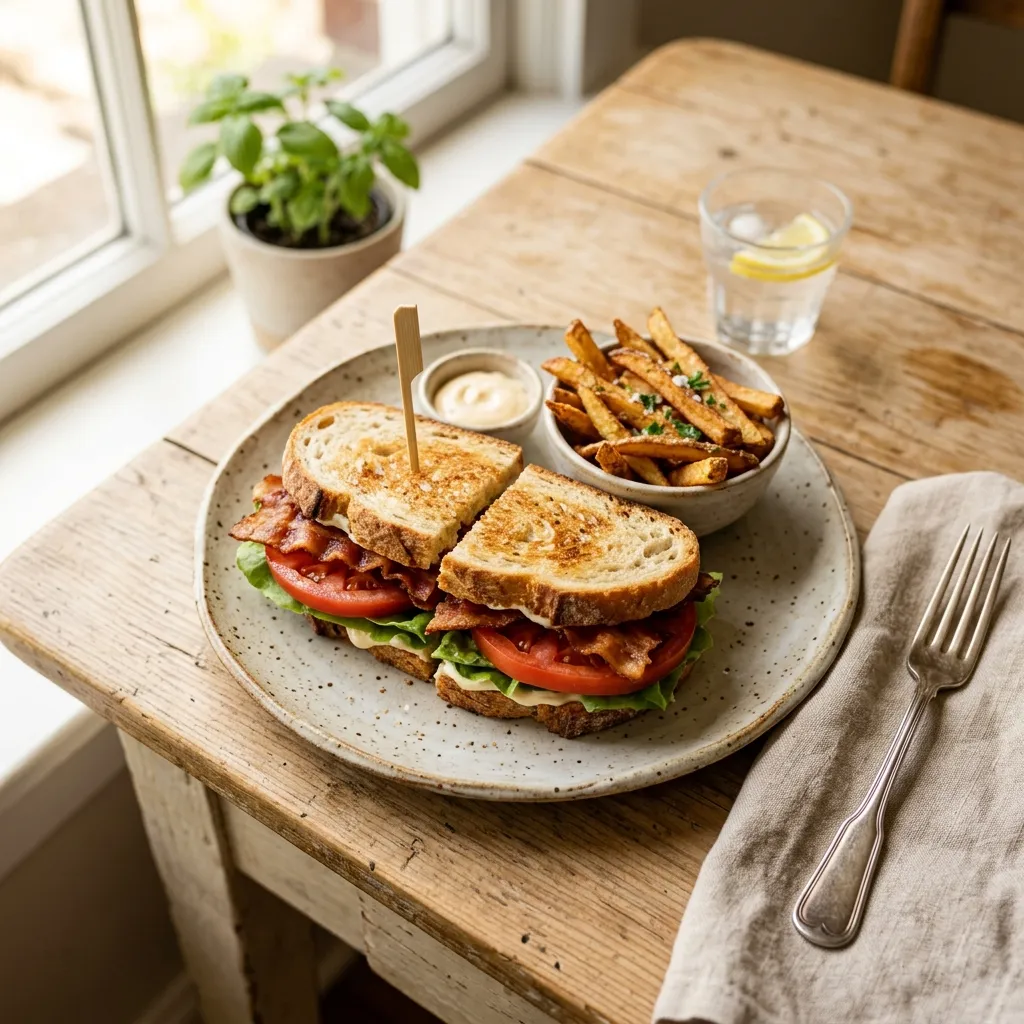
The BLT sandwich — bacon, lettuce, and tomato on toasted bread with mayonnaise — crystallized into its modern form in American diners during the 1950s, though bacon-and-tomato sandwiches appeared in British and American cookbooks as early as 1903. The acronym 'BLT' entered common usage by the 1970s. Its appeal lies in the interplay of textures and temperatures: crisp hot bacon against cool lettuce, soft tomato against crunchy toast, all bound by the rich emulsion of mayonnaise. Ayurvedically, the BLT is a study in conflicting energetics. Bacon brings heavy, oily, heating, and salty qualities that strongly stimulate pitta and kapha. The tomato adds sour rasa and additional heat. Lettuce provides the sole cooling counterbalance, but its light, astringent nature is overwhelmed by the bacon's density. Mayonnaise — an emulsion of egg yolk, oil, and acid — adds further heaviness and oiliness. The white toast contributes sweet rasa and dry guna but relatively little nutritive complexity. Despite its energetic intensity, the BLT can be modified to suit different constitutions by adjusting the bacon preparation, bread choice, and condiment. The sandwich format itself supports efficient digestion when not overstuffed, as the relatively contained portion size prevents the overconsumption that heavy foods invite. Eating at midday when agni is strongest allows the body to process the fat and protein most effectively.
The BLT's heavy, oily, salty, and heating qualities make it strongly pitta- and kapha-aggravating when consumed frequently. Vata benefits from the grounding heaviness and oiliness but may struggle with the dry toast element and the combination of raw and cooked foods.
Ingredients
- 4 slices thick-cut bacon
- 2 slices white or sourdough bread (toasted)
- 2-3 leaves romaine lettuce (crisp inner leaves)
- 1 medium tomato (ripe, sliced 1/4-inch thick)
- 1 tablespoon mayonnaise (per slice of bread)
- 1 pinch salt
- 1 pinch black pepper
Instructions
- Lay bacon slices in a single layer in a cold skillet — starting in a cold pan renders the fat more evenly and produces consistently crisp strips. Place the skillet over medium heat.
- Cook the bacon for 4-5 minutes per side, flipping once, until the edges are deeply browned and the meat has firmed but retains slight chewiness in the center. Thick-cut bacon takes longer than standard — do not rush with high heat, which burns the outside while leaving the center flabby.
- Transfer cooked bacon to a plate lined with paper towels to drain excess grease. The bacon will continue to crisp slightly as it cools.
- While bacon cooks, toast the bread slices until golden brown and firm enough to support the sandwich without collapsing from the tomato's moisture.
- Slice the tomato into rounds approximately 1/4-inch thick. Lightly salt the slices and place them on a paper towel for 1-2 minutes — this draws out excess moisture that would otherwise make the bread soggy.
- Spread mayonnaise evenly on both slices of toasted bread, covering edge to edge. This layer serves as a moisture barrier between the wet tomato and the crisp toast.
- Layer the romaine lettuce on the bottom slice of bread, then the salted tomato slices, then the bacon strips. Grind fresh black pepper over the tomato layer.
- Place the top slice of bread, press down gently, and cut diagonally. Serve immediately — the BLT degrades quickly as the toast softens.
Nutrition
These values are estimates calculated from the ingredient list and may vary based on brands, cooking methods, and serving size. Not a substitute for medical or dietary advice.
How This Recipe Affects Each Dosha
Vata
The BLT provides grounding heaviness through bacon fat and mayonnaise, which can pacify vata's light and mobile qualities. The oily guna of both bacon and mayo addresses vata's characteristic dryness. However, the combination of raw lettuce and raw tomato with hot bacon creates a mixed-temperature preparation that can confuse vata's sensitive digestion. The bread provides some stabilizing sweet rasa. Overall, the BLT is acceptable for vata in moderation, especially at lunch when digestion is strongest.
Pitta
This sandwich presents multiple pitta-aggravating elements: the salty and heating bacon, the sour and heating tomato, the oily mayonnaise, and the pungent vipaka of the overall combination. Pitta types may experience acid reflux, skin breakouts, or irritability after frequent consumption. The lettuce offers modest cooling relief but cannot counterbalance the aggregate heat. The sandwich is best consumed occasionally by pitta types, never during summer, and ideally with modifications.
Kapha
Bacon's heavy, oily, and dense qualities directly feed kapha's tendency toward stagnation and weight accumulation. Mayonnaise compounds this with additional oil and egg. The bread adds further heaviness without significant nutritive return. The salty taste promotes water retention, which kapha already struggles with. The only kapha-friendly element is the lettuce's light and dry quality. This sandwich requires significant modification to be appropriate for kapha-dominant individuals.
The BLT's salty and heating qualities moderately stimulate agni, but the heavy, oily combination of bacon and mayonnaise demands strong digestive fire to process. Those with robust agni will handle it well at midday; those with weak or variable agni may experience sluggishness and ama production, particularly if consumed as an evening meal when digestive capacity naturally wanes.
Nourishes: Rasa (plasma), Mamsa (muscle), Meda (fat)
Adjustments by Constitution
For Vata Types
Use sourdough bread instead of white for its fermented quality, which supports vata digestion. Warm the tomato slices briefly in the bacon pan to eliminate the raw-cold element that disturbs vata. Add a thin spread of ghee on the toast beneath the mayo for additional unctuousness. A sprinkle of cumin on the tomato helps prevent gas. Consider adding a few thin slices of avocado for its grounding, sweet, and oily qualities that deeply nourish vata.
For Pitta Types
Replace standard bacon with turkey bacon, which has less fat and a milder heating effect. Swap tomato for thin cucumber slices to remove the sour, heating nightshade element entirely. Use a lighter mayo or replace with mashed avocado, which is cooler. Add fresh cilantro leaves for their strongly pitta-cooling action. Choose a whole-grain bread that is less processed than white. A leaf of fresh mint tucked into the sandwich provides additional cooling.
For Kapha Types
Use center-cut bacon (leaner) cooked extra-crispy to render out maximum fat, and blot thoroughly with paper towels. Replace mayonnaise with a thin spread of spicy mustard, which is pungent, light, and stimulates kapha's sluggish digestion. Use toasted whole-grain or rye bread for its drier, lighter quality. Add extra lettuce and include arugula or watercress for their pungent, bitter, and metabolism-stimulating properties. A squeeze of lemon juice on the lettuce adds digestive stimulation.
Seasonal Guidance
Best consumed in cooler months when the body's digestive fire is naturally stronger and can handle the heavy, oily qualities. Avoid during summer when pitta is elevated and the heating combination of bacon and tomato can trigger inflammation. Peak tomato season (July-August) creates a conflict — the best tomatoes arrive when the sandwich is least appropriate ayurvedically. If making in summer, use the pitta modifications.
Best time of day: Strictly a lunch sandwich. The heavy, oily combination requires peak digestive fire to process, which occurs between 10 AM and 2 PM. Eating a BLT for dinner risks incomplete digestion and ama formation overnight.
Cultural Context
The BLT evolved from tea sandwiches served in British and American upper-class homes in the late 1800s, where bacon-and-tomato on bread was a light refreshment. Post-World War II America, with its expansion of supermarkets and diner culture, turned the BLT into a lunch-counter standard by the 1950s. The sandwich became so culturally embedded that its three-letter acronym requires no explanation anywhere in the English-speaking world. It appears on virtually every American diner and deli menu.
Deeper Context
Origins
The BLT as a named sandwich emerged in 1920s American diners, when the club sandwiches of the late 1800s simplified and cheapened. The specific three-ingredient formula (bacon, lettuce, tomato, mayonnaise on toast) stabilized in post-WWII cookbooks. Earlier British and Colonial-American bacon-on-bread preparations exist, but the BLT proper is a 20th-century American construct and one of the most ordered sandwiches in diner-era American food economy.
Food as Medicine
Bacon itself has a complicated health profile in contemporary science, but its traditional role across Appalachian and European peasant cultures as a strong food — providing long-burning calories and fat-soluble nutrients for physical labor — is documented in oral history. Lettuce carries classical Galenic sedative reputation from opium-family latex in older varieties. Tomato brings a modern anti-oxidant focus with lycopene content. The three together form an accidental mini-apothecary.
Ritual & Seasonal Role
Not ceremonial. A lunch-sandwich staple, year-round, peaking with summer tomato availability when farmers-market heirloom tomatoes transform the dish. Regional American variations include the club BLT (turkey added), the avocado BLT (BLTA), and the fried-green-tomato BLT of the American South. The sandwich is one of the few American dishes whose peak form depends entirely on a single ingredient's seasonal ripeness.
Classical Pairings & Cautions
Chips, pickles, a cup of tomato soup, iced tea. Cautions: high sodium, plus nitrates and nitrites from cured bacon (modern cancer-risk discussion applies); GERD and reflux aggravation from the tomato-bacon combination; religious restrictions (Jewish, Muslim, Hindu, some Buddhist, Adventist) preclude bacon; mayonnaise contains raw-egg variants inappropriate for pregnant or immunocompromised patients, though commercial mayo is pasteurized.
Cross-Tradition View
How other medical and food-wisdom traditions read this dish. Each tradition names the same physiological reality in its own language — the agreements across them are where universal principles live.
Traditional Chinese Medicine
Bacon is strongly salty-warm, builds Yin fluids and tonifies Qi through the fat; lettuce is cool-bitter and clears Heat from the Heart and Liver; tomato is cool-sour and moves Liver Qi; mayonnaise is cool-bland with egg-yolk Yin-building quality. The dish is a Yin-moistening Qi tonic with a Heat-clearing vegetable corrective — an unusual balance in a fast-food context, probably accidental rather than designed.
Greek Humoral
Hot-wet bacon, cold-wet lettuce, cold-wet tomato, cold-wet mayonnaise. A classic Galenic three-cold-one-hot construction — the bacon's heat is the entire corrective for an otherwise phlegmatic ingredient list. Appropriate for summer consumption by sanguine and choleric types; winter use benefits from added black pepper or hot mustard to strengthen the hot corrective.
Ayurveda
Heating virya, pungent vipaka. Bacon is classically Pitta-aggravating and Kapha-reducing; lettuce is Pitta-pacifying; tomato is Pitta-aggravating; mayonnaise is Kapha-aggravating and Pitta-neutral. The mixed dosha picture makes the BLT a poor fit for precise constitutional adjustment — a dish that does many small things rather than one clean thing.
Appalachian Folk Medicine
Bacon fat held a folk medicinal role across Appalachian, rural Irish-American, and Eastern European immigrant traditions — used to draw splinters, as a pre-antibiotic wound dressing, and cooked into broths for cold recovery. Lettuce-sandwich combinations are mid-20th-century American dietary inventions; the BLT specifically took form in the 1920s through 1930s as a diner dish, with tomato availability year-round after hothouse farming matured.
Chef's Notes
The quality of the tomato determines the quality of the BLT. Out-of-season supermarket tomatoes are mealy and flavorless — if good tomatoes are unavailable, consider a different sandwich. Heirloom varieties at peak ripeness in July and August produce the best results. Baking bacon on a wire rack at 400°F for 18-20 minutes is an alternative that produces very flat, evenly cooked strips without flipping. Duke's mayonnaise has a tangier, more egg-forward profile that BLT purists prefer over Hellmann's. Adding a thin layer of mashed avocado alongside the mayo creates a BLTA variation with additional creaminess and nutritive density.
Frequently Asked Questions
Is BLT Sandwich good for my dosha?
The BLT's heavy, oily, salty, and heating qualities make it strongly pitta- and kapha-aggravating when consumed frequently. Vata benefits from the grounding heaviness and oiliness but may struggle with the dry toast element and the combination of raw and cooked foods. The BLT provides grounding heaviness through bacon fat and mayonnaise, which can pacify vata's light and mobile qualities. This sandwich presents multiple pitta-aggravating elements: the salty and heating bacon, the sour and heating tomato, the oily mayonnaise, and the pungent vipaka of the overall combination. Bacon's heavy, oily, and dense qualities directly feed kapha's tendency toward stagnation and weight accumulation.
When is the best time to eat BLT Sandwich?
Strictly a lunch sandwich. The heavy, oily combination requires peak digestive fire to process, which occurs between 10 AM and 2 PM. Eating a BLT for dinner risks incomplete digestion and ama formation overnight. Best consumed in cooler months when the body's digestive fire is naturally stronger and can handle the heavy, oily qualities. Avoid during summer when pitta is elevated and the heating combination of
How can I adjust BLT Sandwich for my constitution?
For Vata types: Use sourdough bread instead of white for its fermented quality, which supports vata digestion. Warm the tomato slices briefly in the bacon pan to elim For Pitta types: Replace standard bacon with turkey bacon, which has less fat and a milder heating effect. Swap tomato for thin cucumber slices to remove the sour, hea
What are the Ayurvedic properties of BLT Sandwich?
BLT Sandwich has Salty, Sour, Sweet taste (rasa), Heating energy (virya), and Pungent post-digestive effect (vipaka). Its qualities (gunas) are Heavy, Oily, Hot. It nourishes Rasa (plasma), Mamsa (muscle), Meda (fat). The BLT's salty and heating qualities moderately stimulate agni, but the heavy, oily combination of bacon and mayonnaise demands strong digestive fire to process. Those with robust agni will handle it well at midday; those with weak or variable agni may experience sluggishness and ama production, particularly if consumed as an evening meal when digestive capacity naturally wanes.