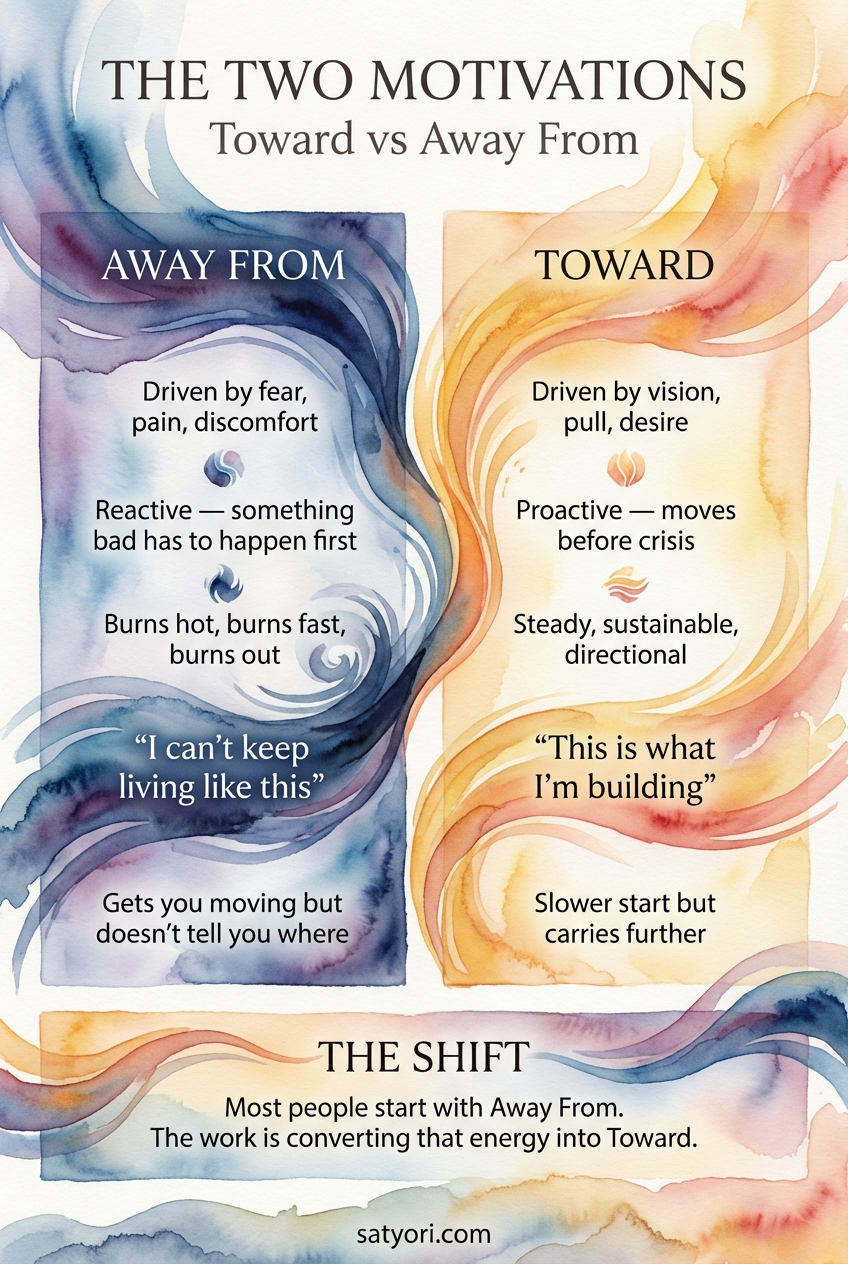
The Two Motivations
One drives you forward. The other drives you away from where you are. They feel the same but work completely differently.
Something bad happens and you change. You get the diagnosis and start eating clean. The relationship implodes and you start journaling. The bank account hits zero and you get serious about money. The pain is real, the change is real, and for a while everything is different.
Then the pain fades. The urgency dissolves. The new eating pattern drifts back toward the old one. The journal collects dust. The spending creeps back up. Six months later you’re roughly where you started, waiting for the next crisis to move you again.
This is not a willpower problem. This is a motivation-type problem. And until you can see the difference between the two types, the cycle will keep repeating with mechanical precision.
Away-from motivation
The first type is reactive. Something hurts, threatens, or disturbs you, and you move. The direction of movement is away from the pain. Away from the weight. Away from the loneliness. Away from the financial stress. The energy is real and often intense — fear and discomfort are powerful fuel. This is what most people call “hitting rock bottom” or “getting a wake-up call.”
Away-from motivation has a structural problem: it has no destination. It knows what it’s leaving but not where it’s going. It’s a person running from a burning building — fast, urgent, completely without a plan for what happens after they clear the flames.
And because it has no destination, it has no way to know when to stop. Or more precisely, it does stop — the moment the pain decreases enough to feel tolerable. The person running from the building stops running when the heat fades. They don’t keep going to a better neighborhood. They stop in the first place that isn’t on fire.
This is why away-from motivation produces temporary change. The change lasts exactly as long as the pain lasts. Lose enough weight to stop feeling bad about your body, and the motivation evaporates. Fix the finances enough to stop the panic, and the discipline relaxes. Get far enough from the breakup to stop hurting, and the self-examination ends.
The thermostat is involved here too. Your system has a set point for how much discomfort it considers normal. When pain exceeds that set point, away-from motivation fires. When pain drops back below it, the motivation turns off. You didn’t choose to stop. The thermostat turned off the engine because conditions returned to the familiar range.
The borrowed-energy problem
Away-from motivation runs on intensity, and intensity is a loan.
When the crisis hits, you borrow energy from your system — adrenaline, cortisol, the hypervigilant focus that comes from genuine threat. This energy is fast and powerful. It gets things done. But the body keeps an honest ledger, and borrowed energy comes with interest.
The crash after the burst of change is not laziness. It’s the loan coming due. You pushed hard on fear-fuel, the fear faded, and now your system demands repayment in the form of exhaustion, apathy, or the dull flatness that follows sustained urgency. People interpret this crash as failure — “I lost my motivation.” You didn’t lose it. You spent it, and the account is empty.
This is the cycle that makes people believe they need periodic crises to function. They do, within this motivation type. Away-from motivation requires a fresh threat to generate fresh energy. Without the threat, there’s nothing to run from, and the system returns to idle. Some people unconsciously create crises for this reason — sabotaging their own progress to regenerate the urgency they need to move. The burning building becomes a renewable resource.
Toward motivation
The second type is different in structure, not just degree.
Toward motivation is pulled, not pushed. It has a direction — something you’re moving toward that exists independently of whatever you’re leaving behind. A vision for what you want to build. A sense of who you want to become. A purpose that generates its own energy rather than borrowing it from pain.
The difference is mechanical. Away-from motivation diminishes as you move away from the pain source — every step reduces the urgency. Toward motivation increases as you move toward the vision — every step brings it into clearer focus, makes it more real, generates more pull. One decays with progress. The other compounds.
Toward motivation doesn’t require crisis. It doesn’t require urgency. It works on a Tuesday afternoon when nothing is wrong. It operates when life is comfortable, which is exactly when away-from motivation goes silent. The person running toward something keeps moving even when there’s no fire, because the destination matters more than what they left behind.
This is why toward motivation produces durable change. The energy source doesn’t deplete as you move. It isn’t borrowed from fear. The body doesn’t present a bill. The direction holds because it was chosen, not reactive.
The trap of compulsive desire
Here’s where it gets subtle, and where most motivation advice goes wrong.
Toward motivation is not the same as wanting something badly. Compulsive desire — the desperate need for the relationship, the obsessive chase of the goal, the white-knuckle pursuit of the outcome — looks like toward motivation but operates on away-from logic. Underneath the desperate wanting is usually a fear: fear of being alone, fear of being worthless without the achievement, fear that you’re nothing without the thing you’re chasing.
The test is what happens when the thing is delayed or denied. If losing the goal produces panic, rage, or collapse, the motivation was away-from wearing a toward-motivation mask. You weren’t moving toward something you wanted. You were fleeing something you couldn’t face — using the goal as a shield against a deeper fear.
Compulsive aversion and compulsive desire are the same mechanism. One grabs, one pushes away, and both are reactive. Both are driven by stored charge rather than present choice. Both burn out, because both are running on borrowed energy — the energy of unresolved fear.
True toward motivation is quieter than compulsive desire. Less frantic. It doesn’t grip. Working toward it generates energy rather than consuming it. There’s a steadiness to it that compulsive desire never has, because compulsive desire is always afraid the thing will be taken away. Toward motivation isn’t afraid of anything. It’s just moving.
The identity shift
Away-from motivation targets behavior. “I will stop eating junk food.” “I will stop procrastinating.” “I will stop choosing the wrong people.” The focus is on what you’re doing wrong, and the goal is to do less of it.
Toward motivation operates at the level of identity. “I am someone who takes care of their body.” “I am someone who builds things.” “I am someone who chooses well.” The focus is on who you are, and behavior follows from that.
This matters because identity always wins over behavior in a conflict. You can force yourself to eat well for weeks while your identity says “I’m not a health person.” The moment willpower wavers, the identity snaps you back. But shift the identity — genuinely shift it, not just paste an affirmation over the old one — and the eating changes without willpower, because “someone who takes care of their body” doesn’t eat garbage on autopilot.
The thermostat is the mechanism here. Away-from motivation pushes you away from the set point temporarily. The thermostat corrects, and you bounce back. Toward motivation recalibrates the set point itself. The thermostat starts maintaining the new position instead of fighting it.
Recalibrating the set point is slower than overriding it. A behavioral push through willpower can happen today. An identity shift takes time — it requires repeated experience of being the new person until the system accepts that this is who you are now. But the behavioral push reverses the moment force is removed. The identity shift, once it takes hold, runs itself.
The conversion
Most people start with away-from motivation. That’s fine. Pain is a legitimate signal. The mistake is staying there — using the pain as the permanent fuel source and wondering why you keep stalling out.
The real work is converting away-from energy into toward energy. Using the crisis as a starting point but not a destination. Letting the pain get you moving, then finding something worth moving toward before the pain fades and takes your momentum with it.
This conversion requires a specific move: release before choose.
Fighting the old pattern is still away-from. “I will NOT eat junk food” keeps the junk food at the center of your attention. The pattern stays alive through your opposition to it. You’re locked in a war with it, and wars sustain the thing they fight.
Release means dropping the war. Not surrendering to the behavior — surrendering the war against it. Letting go of the righteous battle, the identity as someone fighting their demons, the energy that comes from opposition. The war was keeping you attached to the thing you were trying to leave.
Once the war is released, there’s space. And in that space, you can choose. Not react — choose. What do you want to move toward? Not “away from fat” but toward what? Not “away from loneliness” but toward what kind of connection? Not “away from broke” but toward what relationship with money?
The toward-direction has to be real. You have to feel it in your body, not just think it in your mind. A toward-goal that lives only in your head is just an idea, and ideas don’t move nervous systems. The goal that works is the one that produces a physical pull — a warmth, an expansion, a sense of aliveness when you consider it.
If nothing produces that pull, you haven’t found it yet. That’s not a failure. It means the away-from energy is still too loud for the toward signal to come through. Release more. Get quieter. The signal is there. It’s just quieter than the noise.
The emotional wave
There’s a practical tool for the release step, and it’s worth understanding mechanically.
When an old pattern activates — the craving, the fear, the urge to run — it produces a wave of sensation in the body. This wave has a lifespan. Measured in controlled conditions, the chemical cascade that produces an emotional response runs its course in about ninety seconds. Ninety seconds from activation to completion, if the wave is allowed to move without being fed.
The wave gets fed by thinking. By narrating. By arguing with it, analyzing it, justifying it, or using it as evidence for a story. Each thought reactivates the chemical cascade and resets the clock. This is why some emotions seem to last for hours or days — the wave itself is ninety seconds, but the thoughts about the wave keep relaunching it.
If you can feel the wave — the tightness, the heat, the pull — without thinking about it, without narrating it, without doing anything about it — it peaks and passes in about the time it takes to wait for a traffic light. What remains after the wave is clarity. The away-from urgency has spent itself. The fear-fuel has burned off. And in that cleared space, toward motivation can be heard.
This is the conversion mechanism. Feel the away-from charge fully. Let it complete its cycle without acting on it. In the space that opens, choose a direction. Not from pain. From the clarity that remains when the pain has finished passing through.
Try this
Right now, think about an area of your life where you’ve been trying to change. Weight, money, relationships, work — whatever has the most charge.
Ask yourself: am I running from something or running toward something?
Be honest. “I want to be healthy” sounds like toward, but if the fuel underneath is “I hate how I look,” that’s away-from wearing better language. The test is the fuel source, not the words. What drives the motion on the days when you follow through? Fear, disgust, panic? Or pull, purpose, aliveness?
If the answer is away-from — and for most people, in most areas, it is — don’t judge it. Just see it. Seeing it is the first move. You can’t convert what you can’t identify.
Then ask the harder question: if I took away the pain entirely — if the thing I’m running from just vanished — would I still move? Would I still want this change? Or would I stop, the way you stop running when the building isn’t burning anymore?
If you’d stop, the toward motivation hasn’t been found yet. The goal you’re chasing is a pain-avoidance strategy, not a direction. That’s worth knowing, because it predicts exactly how the next attempt will go: intense start, gradual fade, eventual return to baseline.
The toward version of the same goal exists. It just hasn’t been uncovered yet. And uncovering it starts with acknowledging that the current version is away-from — not wrong, not weak, just incomplete.
The real answer
There are two fundamental types of motivation. Away-from motivation is driven by pain, fear, and discomfort. It’s reactive, intense, and self-limiting — it burns hot and extinguishes the moment conditions become tolerable. Toward motivation is driven by vision, purpose, and intrinsic pull. It’s chosen, directional, and self-sustaining — it generates energy rather than borrowing it from crisis.
Most people operate almost entirely on away-from motivation and don’t know it. They interpret the cycle of intense effort followed by collapse as a discipline problem. It’s a fuel problem. Away-from fuel runs out. Toward fuel doesn’t.
The conversion from away-from to toward is the real work. It requires releasing the war against the old pattern — not surrendering to it, but dropping the opposition that keeps you attached to it. It requires feeling the emotional wave fully and letting it pass without feeding it with narrative. And it requires finding a direction that produces pull in your body, not just logic in your mind.
The toward-direction is quieter than the away-from urgency. It doesn’t grip or panic. It doesn’t need a crisis to activate. It works on ordinary days, in ordinary conditions, without borrowed intensity. It recalibrates the thermostat instead of fighting it. And it compounds — every step toward it makes the next step easier, which is the opposite of how away-from motivation works, where every step away from the pain makes the next step harder to justify.
You don’t need to stop using away-from motivation. Pain is a legitimate signal, and ignoring it is its own trap. But if away-from is all you have, the cycle will keep repeating — crisis, change, fade, return. The way out of the cycle is finding something worth moving toward that holds its pull when nothing is burning.