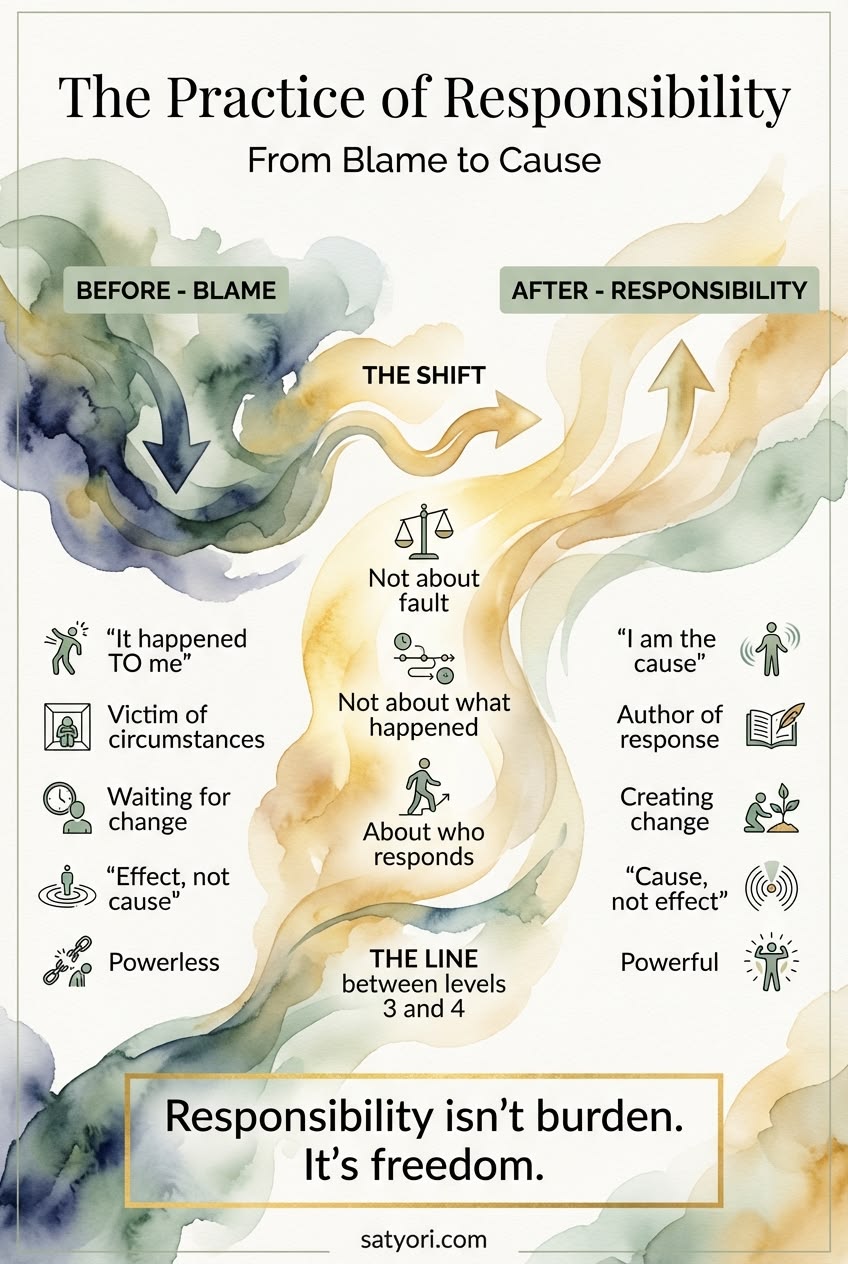
The Practice of Responsibility
There are two positions you can occupy in any situation.
As a victim: this happened to me. Someone did this. Circumstances landed it on me. I’m dealing with the fallout of forces I didn’t control.
As the creator: I see what’s here completely. I see my part in it. I see what I built around it. I’m free to act from what’s really there, not from what I wish were there.
Most people are stuck as a victim in the areas where their life isn’t working — and the position itself is what keeps it that way. The position decides what’s possible. Until that shifts, nothing downstream of it can.
What responsibility isn’t
The word has been ruined.
In most of the culture, “responsibility” is a weapon. “Take responsibility for your actions.” “Be more responsible.” “Stop making this someone else’s problem.” It’s pressure dressed up as adulthood. By the time most adults hear the word, the body braces.
Kids grow up under it like a mountain. You broke the lamp. You didn’t do your homework. You’re the reason this is hard. Take responsibility. Which really means: feel bad about it. Carry the fault. Absorb the verdict.
That isn’t what responsibility is. That’s blame in a grown-up word.
What we mean here has no punishment in it. No shame. No demand that you feel bad. Nobody can put it on you or take it off you. It’s a capacity — a perceptual capacity — and the only person who can develop it is you.
Responsibility, in this sense, is freedom. The opposite of the mountain you grew up under.
What responsibility really is
Responsibility is the capacity to see a situation completely — every facet of it — until the situation no longer produces any reaction in you.
Complete seeing. No editing. No flinching. No pieces missing. When you’ve seen it all the way through, the anger is gone. The fear is gone. The blame is gone. What remains is you, looking at what is, undisturbed.
That undisturbed state isn’t detachment, and it isn’t numbness. It’s the working state on the other side of seeing — where the situation simply is, and you can meet it, and none of it grips you anymore.
The capacity has a name: confront. Not confrontation as in fighting. Confront as in: you can look at a situation without your attention sliding off. You don’t need any of it to be different before you can face it. And you can keep looking — from every angle, in increasing detail — until the whole comes into view.
Responsibility equals complete confront. That’s the equation. Everything else on this page follows from it. (For the full mechanism — the components, the recounting process, the staged work that builds the capacity — see the responsibility teaching page.)
The trade nobody states plainly
Living as a victim is comfortable. When something goes wrong and it’s not your fault, you’re off the hook. You don’t have to do anything about it. You can be angry, or sad, or righteous, and the feelings are all justified because you didn’t cause this. Someone else did. The world did. Your childhood did. Your boss, your partner, the economy, your genetics.
As a victim, you’re right. And you’re powerless.
Living as the creator, you might be wrong — the situation might genuinely not be your doing in any obvious sense. But you have options. You can act. You can change something. You can respond instead of react.
This is the trade: comfort versus power. The victim position gives you the comfort of innocence and the suffering of helplessness. The creator position gives you the discomfort of ownership and the freedom to change things.
Most people choose comfort. Then they wonder why nothing changes.
Creator is not blame
Most people hear “creator” and brace. They assume it’s a sneakier way of saying “your fault.”
It isn’t. The two words are doing different jobs.
Blame looks backward and assigns fault. It asks: whose hand was on the act? That’s a real question — the legal system answers it, the moral one does, and they’re doing their own work. A child who was harmed didn’t put the hand on the act. A person who got sick didn’t author the cell. The person whose hand was on the act is the one whose hand was on the act.
Creator looks at a different question: whose life is this?
That question doesn’t ask who pulled the trigger. It asks who built the conditions of the life the trigger landed inside. The patterns, the choices, the meanings, the story carried since the event — these belong to you. They were made by you. And they’re what’s running the moment now, more than the original event is.
The original event happened once. The version you’ve been carrying — your interpretation of what it meant, the conclusions you drew, the story you tell yourself when it comes up — has been running on loop for years. The first happened to you. The second was built by you.
Confront usually reveals that most of the suffering attached to an event was carried by the second layer, not the first. You can confront an event in real detail and have it stop hurting — not because the event was less than it was, but because the story you were carrying about it was the thing producing most of the weight.
That’s the work the word creator is naming. Not “you caused the harm.” This: you are the one who is now in charge of how that event lives in you. Until you take that, nothing else can move.
The assessment shows where you're living as the creator and where you're still living as a victim — across all 12 life areas.
Take the Free AssessmentHow victim sounds
The victim position has a vocabulary. Once you hear it, you can’t unhear it.
“They did this to me.” “I didn’t have a choice.” “That’s just how I am.” “It runs in my family.” “I can’t help it.” “If they hadn’t done that, I wouldn’t have had to…” “I was going to, but then…”
Every one of these does the same thing: it removes you from the equation. It takes a situation you’re in and edits you out of it. The event happened. Other forces were responsible. You were just there.
The creator position sounds different. “I see what happened.” “I see what I built around it.” “I see what I keep choosing in response to it.” “I see why I keep ending up here.”
Creator language puts you back in. Not as the villain of the story — as the one who can now see, and from seeing, act.
The energy equation
There’s a direct relationship between how much you can confront in your life and how much energy you have.
Every area you can’t bear to look at drains energy. Not because the situation is bad — because the holding-away is bad. To not look at what’s in front of you, you have to keep your attention pointed elsewhere. Maintain the cover story. Route around the reminders. Change the subject when it comes up. Your system pays for all of it, whether or not you notice.
This is a significant chunk of why you’re tired. Your life isn’t objectively harder than it used to be. You’re carrying the weight of everything you won’t see, and that weight has to live somewhere. It lives in your body, your mood, your available attention.
Every area you can look at completely returns energy. When you’ve seen something all the way through, the energy that was tied up in avoiding it comes back to you. You can act. You can solve. You can choose. The experience of being responsible in an area feels completely different from the experience of avoiding it. Even when the situation is objectively harder, you’re engaged with it, not enduring it.
Someone who takes responsibility for everything in their life — not compulsively, not as a performance, but genuinely — usually appears energized. Clear. Moving. Someone who’s living as a victim in most areas appears tired. Stuck. Heavy.
That isn’t personality. It’s mechanics.
The four exits from seeing
Four moves take you out of confront. They happen in milliseconds. Once you can spot them, you can stop taking them.
Explanation. “The reason this happened is…” The moment you reach for the reason, you’ve left the scene. You’re now in a story about what happened. The story might even be correct. It’s not what happened. Most “understanding why” is an exit from looking at what.
Blame. “They did this.” “I did this.” Either direction. The moment you pick fault, you’ve collapsed the situation into a character, and you start prosecuting the character instead of looking at the situation. Blame is the fastest exit because it feels like engagement. You can stay angry for hours. You haven’t looked once.
Justification. “Given what was happening, it makes sense that…” The sophisticated form of blame. You’re not assigning fault — you’re explaining why fault couldn’t apply. Same move. The situation as it is gets replaced by the situation as explained. Of the four, justification is the most dangerous. It looks like reasoning.
Preference. “It shouldn’t be this way.” “I wish they were different.” “This isn’t fair.” Wishing the situation were different isn’t seeing the situation. You’re in relationship with an imaginary version of it. Whatever you do from the imaginary version won’t touch the real one.
Watch yourself for a day. Every time you hit a moment of discomfort, notice which exit your mind reaches for. The reach is faster than thought. The skill is catching the reach, and choosing not to take the exit.
Justifications: the invisible shield
The mechanism that keeps people stuck as a victim is justification. Everyone does it. Almost nobody sees themselves doing it.
A justification takes something you did and repositions it so the responsibility lives somewhere else. “I yelled at my kid because I was stressed from work.” The responsibility moved from you to your job. “I haven’t exercised in months because I don’t have time.” It moved from you to your schedule. “I lied because the truth would have hurt them.” It moved from you to the other person’s feelings.
Each justification is a small exit from the creator position. They accumulate. Enough justifications and you’re living entirely as a victim — not because you chose to, but because you justified your way there one small step at a time.
Here’s the part that stings: everyone else’s justifications are obvious. You can see them clearly. The friend who keeps blaming their partner. The colleague who always has an excuse. The family member who won’t take responsibility for anything.
Yours are airtight.
They have to be. If they weren’t convincing, they wouldn’t work. Your own justifications are the ones you can’t see because they’re the ones you’ve built the best case for. They feel like facts, not stories. They feel like reality, not position.
Your own justifications are invisible to you — but their effects aren't. The assessment shows where they're running.
See Where You're StuckWhy your true level is your lowest area
This part will irritate people.
Responsibility doesn’t have one level. It moves differently in different areas of your life. You can be a millionaire whose body is quietly killing him. You can have a beautiful house and a marriage that’s been dead for six years. You can be the person everyone goes to for advice and come home to nobody.
Your true level is not your highest area. It’s your lowest.
Your lowest area is the one running your life from underneath. Eleven domains can be in order, but the one you won’t look at generates circumstances you don’t understand, shapes your moods, bleeds your energy, and drops you into positions you can’t find your way out of. That domain sets the floor.
This is why being advanced in one area is a trap if the rest of your life hasn’t come along. The person who’s done brilliant work on their trauma but has never looked at their finances isn’t a responsible person with one weak area. They’ve done excellent work in one place and left the rest of their life uninhabited.
The uninhabited places are where your life is being lived from.
Find your lowest area. That’s your real work.
The signal you’ve completed it
Here’s how you know whether you’ve really seen a situation — or whether you’ve just built a cover story you can live with.
Can you talk about it the way you’d describe a recipe for an omelette?
Neutral. Factual. Unreactive. Curious if it comes up. No tightening in the chest. No rising pulse. No urge to change the subject, defend yourself, or explain. You could talk about it with a stranger at a bus stop and your voice wouldn’t shift.
That’s confront. That’s what living as the creator looks like from the inside.
If mentioning it produces a lash-out, a shutdown, tears that surprise you, weird physical symptoms, a meltdown, or a sudden urgent need to avoid the topic — you haven’t seen it yet. That’s suppression, not resolution. Suppression walls the situation off. Confront sees it through.
The test isn’t how insightful you sound about the topic. Not what conclusions you’ve drawn. It’s how the topic feels in your body when it comes up.
Anger. Fear. Dismissiveness. Sadness. Shame. Defensiveness. Each of these is a signal that there are facets you haven’t seen yet. If you’re blaming anyone — them, yourself, circumstance, God — you haven’t reached the floor. Blame is a marker that seeing is still incomplete.
The emotional signal is reliable. Trust it. If there’s weight, there’s more to see.
Try this
Pick one moment in your life that still carries weight.
Not a whole area. A specific incident. A fight, a conversation, a time you felt an intense emotion you’d rather not revisit. Your system already surfaced it the moment you read this — that’s the one.
Start small. Not the worst of the worst. An incident you can approach without being flattened.
Run through the whole incident, beginning to end, in as much detail as you can pull up. Where were you. What did the room look like. What were you wearing. What was their face doing. What did they say, exactly. What did your body do while they said it. What did you hear, smell, taste.
When you get to the end, start over. Run through it again. More detail will come.
A third time. A fourth.
Feelings will come up. Don’t try to fix them. Keep running through the event.
At some point, it shifts. A realization arrives. You see the whole incident differently than you did five minutes ago. The weight comes off. Maybe you laugh. Maybe you cry. The weight moves.
If it doesn’t happen — if you’ve run through it ten times and nothing is shifting — pay attention to what else comes to mind. A different incident, probably. A similar one, or an earlier one. Run the same process on that one. Either the realization arrives there, or on the next one it leads you to.
You’re not trying to work anything out. You’re not looking for any particular insight. You’re looking, in detail, at what happened. The rest takes care of itself.
What changes
People who make this shift report something consistent: the world doesn’t change, but their experience of it transforms completely.
The same job. The same relationship. The same body. The same circumstances. But living as the creator instead of as a victim. And from that position, everything looks different. Problems become projects. Obstacles become information. Stuck places become choice points.
This isn’t positive thinking. It’s positional. You’re not telling yourself a better story — you’re standing in a different place. From this place, you can see options that were invisible before. Not because they’re new. Because you couldn’t see them from the victim position.
Responsibility isn’t burden. It’s freedom. The practice is simple, the resistance is enormous, and the shift — when it happens — changes everything that follows.
For the full mechanism behind this — the components of confront, the recounting process, the staged path that builds the capacity, and the state on the other side — see the responsibility teaching page.