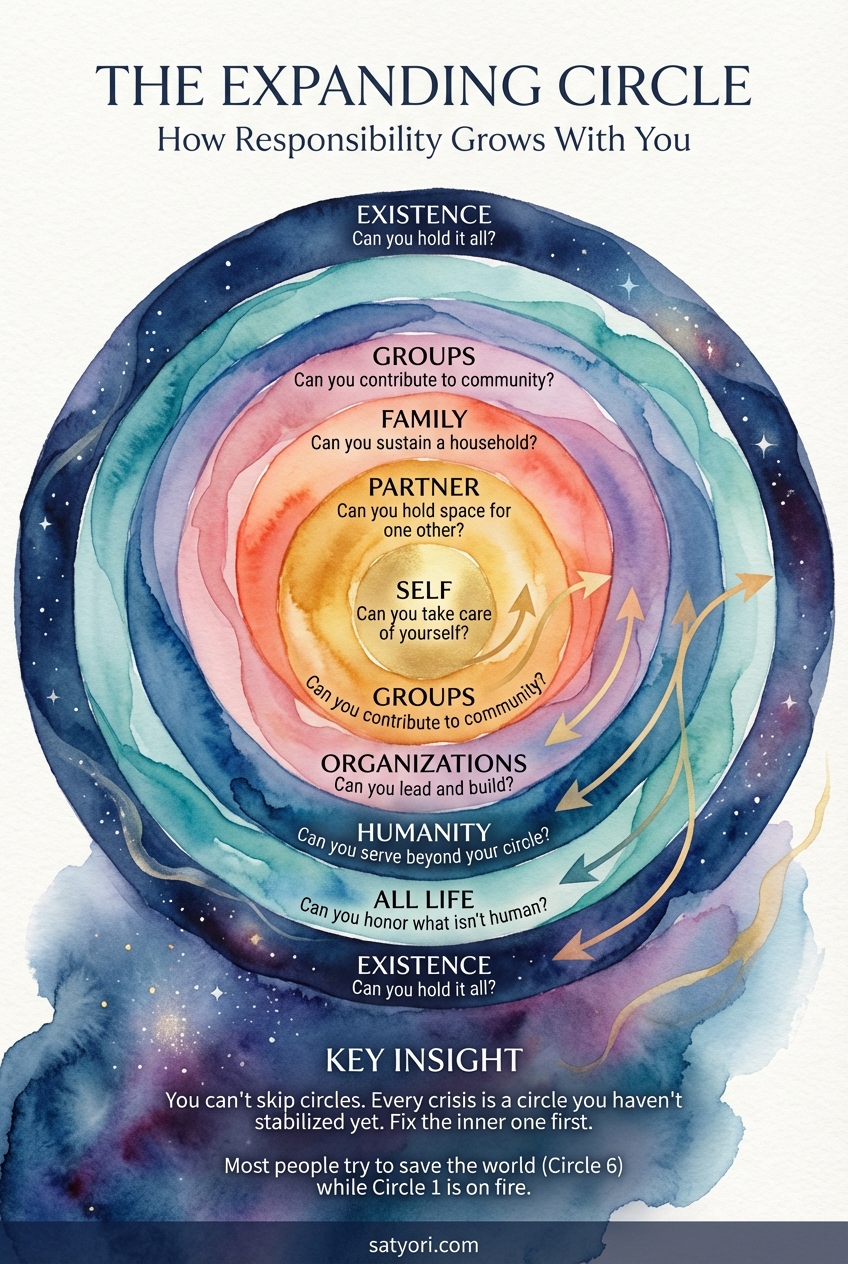
Eight Circles of Responsibility
From self to existence — how the scope of what you can be responsible for determines how much power and freedom you have.
There is a way to look at someone’s life and know, within minutes, how much of it is working.
You don’t need to see their bank account or their relationships or their health records. You just need to notice the size of their concern. How wide is the circle of things they’re willing to be responsible for? A person who only thinks about themselves — their comfort, their survival, their feelings — lives in a very small world. A person whose concern extends to family, community, all of life — that person inhabits a different reality. Not because they’re morally superior, but because they have access to more of what existence offers.
This is not a metaphor. It’s a description of a mechanism that operates in every life, whether the person is aware of it or not.
The eight circles
Picture concentric circles, like ripples expanding outward from a stone dropped in water. Each ring is a sphere of responsibility — a domain where you either operate as cause or get pushed around as effect.
Circle one: Self. Your body, your mind, your survival, your internal state. This is where everyone starts. A baby operates entirely within circle one. So does anyone in crisis — when the house is on fire, the circle contracts to “get me out alive.”
Circle two: Family and intimate partnerships. The people closest to you. Your household. The relationships where what you do directly shapes another person’s daily experience, and vice versa.
Circle three: Groups. The teams, organizations, communities, and networks you belong to. Work, friendships, social circles, creative collaborations — any collection of people organized around something shared.
Circle four: Humanity. The species. All people, not just the ones you know or like. The stranger on the other side of the world whose life you’ll never touch directly but whose existence is part of the same system yours is.
Circle five: All life. Animals, plants, ecosystems — the living world beyond human boundaries. Everything that breathes and grows and reproduces and dies.
Circle six: The physical world. Matter, energy, the planet itself, the environments and structures that make life possible. Not just “nature” as a concept to appreciate, but the material universe as something you interact with and shape.
Circle seven: The spiritual. Whatever word you use for the dimension that isn’t physical. Awareness itself, the underlying field, the territory that contemplative traditions point toward. Not belief — direct engagement with what exists beyond material perception.
Circle eight: Everything. Infinity. Existence as a whole. The biggest possible game. The circle that contains all the others and extends beyond any boundary you can conceive.
These aren’t moral categories. They’re operational ones. Each circle is a domain where you’re either participating as a responsible agent or where forces are acting on you without your input. And the distinction between those two states — cause versus effect — is the distinction between power and powerlessness.
The equation
Here is the thing most people never see, because nobody states it this plainly:
Responsibility equals power equals freedom.
These three things are not related. They are the same thing, viewed from different angles. The person who takes responsibility for their health has power over their physical state and freedom from the limitations that poor health imposes. The person who takes responsibility for their family relationships has power within that sphere and freedom from the chaos that unmanaged relationships create.
This works identically at every scale. Take responsibility for a group and you gain the power to shape it and the freedom that comes from a functioning community. Refuse responsibility for a group and you become subject to whatever the group does — its dysfunction becomes your constraint.
Freedom is not the absence of responsibility. That is the great lie. The person with no responsibilities has no power, no influence, no leverage, and no capacity to change anything about their situation. They are free the way a leaf is free — blown wherever the wind decides.
Freedom is the presence of responsibility, fully accepted, across the widest sphere you can genuinely hold.
The trap of one circle
A person operating only in circle one — concerned exclusively with their own comfort, their own survival, their own feelings — has made a strategic error so severe that it looks, from the outside, like a form of insanity.
They have seven remaining spheres of existence operating without their input. Seven domains where forces are acting on them that they have no influence over and no ability to direct. Their family is doing whatever it does. Their communities are shaping conditions they live in. Humanity is making decisions that determine their future. The physical world is operating on its own terms. And every one of these spheres is generating effects that arrive in their life as circumstances they didn’t choose and can’t control.
Selfishness is not a moral failure. It is a strategic catastrophe. The selfish person has made enemies of every sphere larger than themselves — not through malice, but through neglect. A family unattended becomes a source of conflict. A community ignored becomes a system that works against you. Humanity disregarded becomes a species making decisions you’ll suffer from.
The person who cares only about themselves is the person with the least control over their own life. That is the irony, and it is exact.
The serving hierarchy
Each circle serves the one above it. Not through sacrifice — through function.
You take care of yourself so that you have the capacity to show up for your family. You handle your family well so that you have the stability to contribute to groups. You participate in groups so that larger structures work, and those larger structures create conditions where individual and family life can flourish. The energy moves outward and the benefit flows back inward. It’s a circuit, not a drain.
This is why self-care is not selfish. It is the first circle, the foundation. A person who neglects their own health, their own clarity, their own basic needs has nothing to offer the second circle or the third. Burnout is what happens when someone tries to serve wider circles from a collapsed foundation.
But here’s the part that wellness culture gets wrong: self-care that never extends outward becomes a prison. The person who is endlessly optimizing their own state — their diet, their sleep, their emotional regulation, their personal growth — without any of that capacity flowing outward to serve something beyond themselves eventually hits a wall. The optimization stops producing results. The self-focus starts generating anxiety instead of stability. The first circle, cut off from the rest, begins to collapse under the weight of its own attention.
A circle that doesn’t serve the next circle up dies. Not dramatically. It just stops working. You’ve seen this — the person whose entire life is about their own development, who reads all the books and does all the practices and still feels stuck. They’re stuck because the energy has nowhere to go. The circuit is broken. The current flows out and doesn’t return.
What narrows the circles
Nobody starts life trying to be small. The contraction happens through injury.
You extend yourself into circle two — family — and get hurt. A parent betrays your trust. A partner leaves. A sibling turns hostile. The pain is real. And the nervous system draws a conclusion: that sphere is dangerous. Pull back. The circle contracts.
You try circle three — a group, a team, a community — and get burned. Betrayal, rejection, the experience of giving yourself to something collective and watching it turn on you. The system logs the data and narrows further. Groups are unsafe. Don’t extend.
Each negative experience in a sphere tends to produce withdrawal from that sphere. The withdrawal feels like wisdom. “I learned my lesson.” But what you learned was not a universal truth about that sphere. You learned that one specific experience in that sphere was painful. The generalization — all families hurt, all groups betray — is the nervous system’s survival mechanism, not an accurate assessment of reality.
There is a deeper mechanism that accelerates the contraction. When someone is hurt, they often respond in kind — doing something harmful back, or to someone else. Then comes concealment. The harmful act gets hidden, rationalized, buried. The concealment creates a withdrawal — you can’t be fully present in a sphere where you’re hiding something. The withdrawal narrows the circle further, which creates more isolation, which creates more reactive behavior, which creates more concealment. The spiral tightens. The world gets smaller.
This sequence — injury, reaction, concealment, withdrawal — is the engine of contraction. Every collapsed circle in your life was narrowed by some version of this sequence. Not always dramatic. Sometimes the injury was subtle and the concealment was just a decision never to talk about it.
What expands them
The expansion mechanism is the contraction mechanism in reverse.
What you’ve been avoiding is what you need to confront. The sphere you pulled back from is the sphere that holds your next level of power. The family relationship you’ve been managing at arm’s length. The group participation you’ve been dodging. The concern for wider humanity that feels naive or overwhelming. Whatever you flinch away from is where the circuit is broken.
Expansion doesn’t require becoming a saint. It requires becoming honest.
The concealment is the lock. What you did that you haven’t owned. What happened to you that you’ve refused to look at fully. The withdrawal that you’ve repackaged as preference or philosophy. Wherever there is a hidden thing, there is a contracted circle. And wherever someone finds the willingness to bring the hidden thing into the open — even to themselves, even privately — the circle begins to re-expand.
This is not comfortable. Expanding into a sphere where you were hurt means feeling the pain you withdrew from. It means discovering that the withdrawal didn’t protect you — it just froze the injury in place, unprocessed, continuing to shape your behavior from below awareness. The processing is what frees you. Not the avoidance.
People who have done this report a consistent experience: the sphere they were avoiding was not as dangerous as they had decided it was. The danger was real once. It is usually not real now. The nervous system’s threat assessment was based on data from a different time, often from childhood, often from a single devastating experience that was treated as a permanent truth about reality.
Pan-determination
There is a concept that illuminates why wider responsibility creates more power, and it has to do with the difference between playing a game and seeing the whole game.
When you are inside a game — competing within a sphere — you are determined by the rules and forces of that sphere. You’re a player. You can win or lose, but the game itself is running you as much as you’re running it. Your moves are reactions to other moves. Your strategy is shaped by what the other players do. You have self-determination — the ability to choose your moves — but you’re still junior to the game.
When you step up to the sphere above — when you can see the whole game rather than just your position in it — something shifts. You’re no longer moved by the game’s forces the same way. You can see the other players’ positions, understand the dynamics that are driving the conflicts, and make choices that account for the whole field rather than just your corner of it.
This is why a parent who can hold the perspectives of all their children makes better decisions than a parent who identifies with one child against another. This is why a leader who understands all the factions in a group creates better outcomes than a leader who belongs to one faction. Wider responsibility creates wider perception, and wider perception creates better choices, and better choices create more freedom.
You don’t become more powerful by fighting harder within your current circle. You become more powerful by expanding to the circle above it. From there, the problems of the lower circle look different — simpler, more workable, less personal. The fights that consumed all your energy turn out to be symptoms of a larger dynamic that is obvious from one level up.
Try this
Take the eight circles and run a quick assessment. Not a deep meditation — a simple honest scan.
Circle one — self: Are you taking care of yourself? Body, mind, basic needs? Or have you abandoned the foundation?
Circle two — family and intimate partnerships: Are these relationships alive and flowing, or managed at a distance? Is there someone close to you that you’ve withdrawn from?
Circle three — groups: Do you participate in something collective? Or have you pulled back from groups entirely? If you’ve pulled back, do you know when that started and what happened?
Circle four through eight — the wider spheres: Do you extend concern past your immediate world? Does humanity matter to you as something you’re part of, or is it an abstraction? Do you engage with life beyond the human sphere? With the physical world as something you’re responsible for? With any dimension beyond the material?
Notice which circles are alive — where you feel engaged, responsible, willing to be cause — and which have gone dark. The dark ones aren’t failures. They’re contractions, and contractions happened for reasons. But the reasons are usually in the past, and the contraction is costing you power in the present.
One contracted circle is all it takes to create the feeling of being stuck, overwhelmed, or trapped. Because that circle isn’t neutral. It’s a sphere of existence that’s operating without your input, generating effects you can’t control, creating conditions you have to live with but didn’t choose. Every dark circle is a domain where you’re at effect instead of cause.
The size of your game
You choose the size of your game. Not once, in some grand declaration, but continuously, in the small decisions about what you’re willing to be responsible for.
Every time you extend concern one circle further than is comfortable, you gain power you didn’t have before. Every time you pull back, you lose it. The math is that simple and that consistent.
The circles don’t require perfection. You don’t need to have circle one fully handled before you engage with circle two. The circles develop in parallel — working on one strengthens the others, because the circuit is connected. Taking responsibility for a group often clarifies what you need to handle in yourself. Engaging with something larger than your personal world often resolves problems at the personal level that seemed intractable when the personal level was all you were looking at.
The person who lives in one circle is at the mercy of seven forces they don’t control. The person who lives in all eight has made existence itself their playing field. Between those two positions is every degree of power, freedom, and aliveness available to a human being.
The question is not whether you should expand. The physics of the situation make the answer obvious. The question is which circle you’ve been avoiding — and what you’re willing to feel in order to step back into it.