Have you ever tried to talk to someone who is angry at you?
You came in with something reasonable to say. Maybe even something kind. You thought, this will fix it, if I just say it the right way.
You said it. They were angrier. Or they went quiet. Or the conversation turned into a fight about something else, something you didn't even bring up.
You walked away thinking: what is wrong with this person. Or: what is wrong with me.
Neither is the right question.
What was wrong wasn't in either of you. It was in the space between you. Three things have to be present for two people to reach each other, and one of them had collapsed, which dropped the other two, which is why nothing you said would be heard no matter how carefully you said it.
This is the triangle of understanding. Once you can see it, you can finally stop the fighting.
The three corners
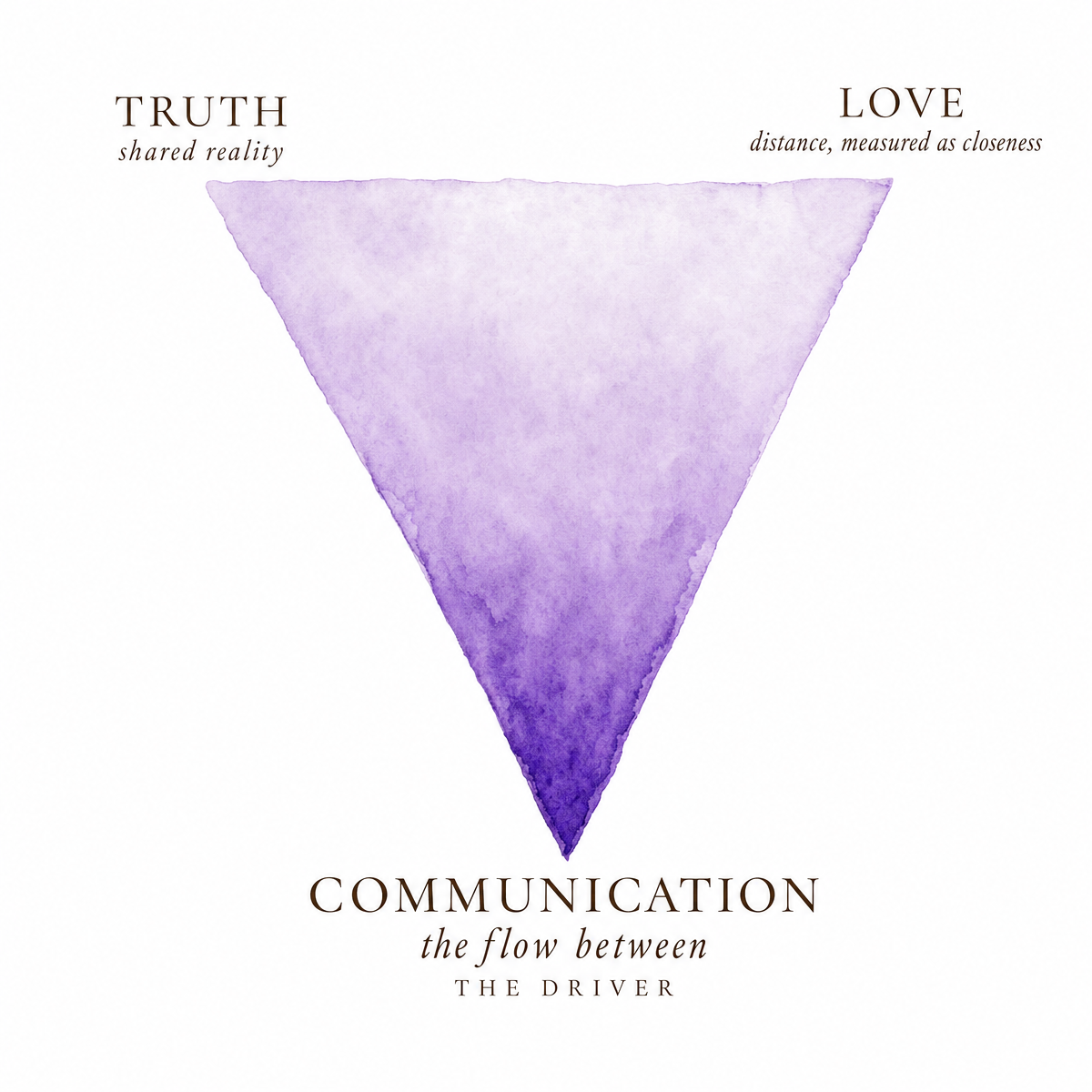
Understanding between two people — or between a person and a situation — is built from three things working together.
Truth. A shared picture of what's real. You see the orange as an orange. I see the orange as an orange. We're in the same room with the same thing.
Communication. The flow between us. A thought moves from me to you and arrives intact. A thought moves from you to me and arrives intact. Something is actually crossing the space between.
Love. The closeness we can hold. How near you can stand to be to me, and me to you, without having to pull away. The affection we feel for each other.
When all three are present, understanding happens. Naturally.
When one drops, the other two drop with it. This is an observable mechanism. Stop communicating with your partner for a month and watch what happens to how close you feel. Keep one small secret from a friend and notice the way the reality between you starts to tilt. It is immediate, and it is symmetric. The triangle moves as a unit.
Truth
Truth is shared reality. You see the thing that's there, and I see the thing that's there, and the things we see are close enough to the same thing that we can talk about it.
Most fights are not about the thing. They are about a version of the thing that one of you built and the other never agreed to or knew existed. You had an argument with your mother and carried away a story about what she said. She had the same argument and carried away a different story. You are fighting, ten years later, about a Tuesday evening that never actually happened the way either of you remembers it.
Reality is partly consensual. What we agree on becomes more real between us. What we disagree on thins. Try this one yourself: watch two friends agree enthusiastically about a third person who is present but not part of the conversation. The third person will visibly drop in mood, in presence, in how real they are to the other two. Agreement casts a kind of vote, and votes have weight.
The physical world holds steady because enormous numbers of beings agree on it. Matter, gravity, seasons, distance. The agreement is old and wide, which is why it feels fixed. Your personal reality is the arena you have influence over: what you rehearse inwardly, what you treat as true, what you bring into shared space through repetition.
When Truth collapses, nothing else in the triangle works. You cannot communicate a version of events that isn't there. You cannot close the distance to a situation you're seeing incorrectly. You will pour effort into Love and into Communication and nothing will stick, because the ground under both is off.
The first move when something feels stuck is almost always: check whether we're even talking about the same thing. You'd be shocked how often the answer is no.
Communication
Communication is the flow of information between two points. A thought leaves you. It crosses a distance. It arrives somewhere else. The thing you're holding in your mind makes it to the destination — a person, a page, a recording — intact.
It sounds simple. It is rare.
Most attempts at communication distort somewhere along the line. You have the idea clear in your head, but the words don't quite fit it. Or the words fit it for you but feel different to the other person. Or the other person hears their own version of what you said instead of yours.
Have you ever played the game of telephone? You whisper a word or sentence into someone's ear. Then they whisper what they heard into the next person's ear. And on down the line. At the end the last person says out loud what was said to them. Usually what started as "Three spotted elephants" somehow morphs into "Free the clotted plants" or something similarly ridiculous. What makes the game of telephone fun is the cause of countless fights, breakups and wars throughout human history.
There's a requirement for communication that most people miss: both sides have to intend it. The sender has to mean to send. The receiver has to mean to receive. If either intention is absent, words can pass and no communication has happened. You've had plenty of conversations like this — words in the air, nothing actually crossed.
Communication is the most active of the three corners. It is the one you can directly do something about, right now, no matter how stuck the triangle is. You can't make yourself feel closer to a person you've pushed away. You can't make yourself see the truth of something you haven't looked at. But you can speak one honest line. And you can listen to one.
This is why communication is the lever. Open a line — even a small one — and the other two corners begin to come back.
One rule: a communication has to meet the other person where they are. Reasoning bounces off someone in rage. Kindness reads as a threat to someone in fear. The form of what you say has to match the tone of who's receiving it, or it doesn't get through, no matter how true or well-meant it is.
Love
This one is the stretched word. Love in this teaching does not mean what it usually means. Pay attention to the definition before you bring in what you already believe love is.
Love is distance, measured as closeness.
How small can the distance between you and the situation become before you have to flinch away?
Someone you can't bear to think about is someone you've pushed far away in your inner space — across the room, out of the house, out of mind. Someone you're genuinely close to is someone you can stand to have right up against your attention, intimate, unflinching. That distance is the measure of love.
Complete love means zero distance — you can occupy the same space as what you're near, with nothing to defend against. The opposite end is apathy: the thing has been pushed so far it doesn't even register for you anymore. Hate sits between, as a form of low love — the thing still exists in your world, and you're using all your effort to keep it at maximum distance because being near it is unbearable.
This means the full emotional range lives inside this one corner. At the bottom is apathy. The thing no longer exists for you. Hate sits just above — the thing still exists, and you're using everything you have to hold it at maximum distance. Grief, fear, anger, antagonism, boredom, enthusiasm — these are all settings of the same instrument, climbing toward closeness. The question at every rung is the same: how close can you stand to be?
Serenity or real peace is the top. Not because it is a peak state. Because it is the state where you can be close to anything — joy, grief, your worst memory, a stranger's suffering, your own mortality — without needing to pull back.
When people talk about love opening you up, this is what they're pointing at. You can be near more things. The ones who can't stand to be near much of anything are at the bottom of the dial, and they tend to describe the world as full of things they can't deal with — because they can't.
Love, in this sense, is a capacity. It's the one we work on for the rest of our lives.
How the three move together
The corners are interdependent. Drop one and the other two drop. Raise one and the other two rise.
This is why a marriage going cold is not a single failure. It's three things happening at once. Communication stops. Small secrets accumulate, the small things that used to be said out loud stay inside. Truth thins. You start carrying a different version of your shared life than they are, and neither of you notices because nobody's checking. Love collapses. You pull back into separate rooms of the mind. Same triangle, three corners moving together.
The practical consequence: when you raise one corner, you raise the others. They are mechanically linked.
Work on communication, and truth and love follow. Work on truth, and communication and love follow. Work on love — close the distance toward something you've pushed away — and the other two follow. The triangle moves as a unit.
The practical move: pick whichever corner you can actually move right now, and start. The other two come along.
A parallel from another tradition
The Stoics worked with a similar three-part structure they called the disciplines: desire (what you orient toward as good), action (what you do with what's in front of you), and assent (what you agree to take as true when an impression arrives). Different vocabulary, same load. Truth maps onto assent. Communication and action share the same corner. Love sits where desire is — what you can move toward without flinching.
The mechanism is older and wider than any one teacher. See Stoicism and Buddhism for the closest version — the impressions-pause that sits exactly where assent does, and is the move that lets the triangle stay whole under pressure.
The triangle is not equal-sided
Communication is the driver.
Truth and Love are not less real or important. They are less directly actionable. You can't make yourself suddenly see clearly what you've been avoiding. You can't force yourself to love someone you hate. You can, at any moment, speak a truth. You can, at any moment, listen.
This is why "have you tried talking about it" — which sounds glib — is the single most powerful starting move you have. Not because talking fixes things. Because communication is the corner that moves first, and when it moves, the other two follow.
If you don't know where to start in a stuck situation, start here: say one true thing out loud, to the person or the page or the recording. Keep it small. Keep it honest. That's your entry point.
The triangle has a size
At high emotional tone — when you're steady, curious, enthusiastic — your triangle is wide. There's room for complexity. You can hold contradictions and nuance. You can see a situation from more than one angle without being overcome.
At low emotional tone — tired, scared, sad, angry — your triangle is small. Narrow view. Narrow feelings. Narrow exchange. You can only see one side, and you can only say one kind of thing, and you can only bear the distance that matches your state.
At the very bottom — below apathy — the triangle collapses to a point. No flow. No agreement. No closeness. Just a knot that's tight and stuck.
The triangle you can work with at 3pm on a Wednesday when you're exhausted is smaller than the triangle you can work with on a morning you slept well. Same person, same relationship, smaller triangle.
The work of Satyori is not to force a big triangle in a low-tone state. It's to raise the emotional tone — through whatever corner can move — until the triangle widens on its own. Then handle the hard thing.
The triangle is understanding
When the three corners are present, what's created is understanding.
Understanding is not a conclusion you arrive at. It is a state you are in. You see what's there. You are in flow with it. You can be near it. That combination is understanding, by definition.
And understanding is the foundation of responsibility — of being able to face a situation in your life completely enough that it no longer runs you. The Responsibility teaching describes this realized state. This teaching describes the mechanism beneath it. Complete responsibility is all three corners present on whatever you're facing.
Gratitude as a tool
When all three corners arrive at once — truth seen, communication open, distance closed — what the body reports is gratitude. Real gratitude, not performed. Gratitude is not a path to this state. It is this state. When you can feel real gratitude for a situation you've struggled with, you have completed the triangle on it. When you can't, one of the corners is still incomplete, and you can use gratitude's absence as a diagnostic: which corner is missing here?
This is why the gratitude practice works. You're not talking yourself into feeling better. You're actively building the three corners toward whatever you're writing about, one at a time, until the triangle completes and the state arrives on its own.
Pick a relationship or situation in your life that feels stuck. Not the worst one. One that is clearly off but still approachable.
For each of the three corners, ask yourself honestly:
Truth. Are you and the other person (or you and the situation) looking at the same thing? Or are you carrying a version of events they would not recognize — and they are carrying a version you would not recognize? Write down what you think is true. Imagine them writing theirs. Where's the gap?
Communication. Is anything actually crossing the space between you? Or are you having the conversation in your head only, and they are having theirs in their head only? When did you last speak something real that they actually heard? When did they?
Love. How close can you stand to be to this situation right now? Can you sit with it, or do you have to change the subject? Is there a distance between you and them that you would have to cross for any repair to take hold — and are you willing to cross it?
One of the three will feel most clearly collapsed. Start there.
If you picked Communication, speak one small honest line this week. "I've been thinking about something and I want to mention it." Or: "I miss this." Or: "I don't know what to say but I wanted to say that."
If you picked Truth, find one small thing you can both agree is true today. Weather, meal, something either of you saw. Start there. Build up.
If you picked Love, the practice is reach and release — short, unpressured contact with what you've pushed away, repeated until the distance starts to close. Spend small amounts of time in the same room, on the phone, near the thing, with no agenda. Each round resets the relationship. More on this practice: Learning Reach and Release.
Watch what happens to the other two corners over the next week. Notice whether they move on their own, which they will.
What to do when the triangle collapses
You will hit moments where all three corners drop at once. A fight. A loss. A day that goes sideways.
Don't try to rebuild the whole triangle immediately. The triangle at that state is small.
Your first move is to raise your emotional tone. Walk. Breathe. Eat. Sleep. Touch things. Move the body. Get outside. Do the physical things that restore your state, regardless of whether they address the problem. The problem cannot be addressed at your current triangle size.
Then, once your tone has risen, look at the corners again. They'll be bigger. What was impossible an hour ago is possible now. Not because the situation changed. Because your triangle did.
The most important skill is recognizing when you are in a small triangle and refusing to do the work of a big triangle from inside it. Raise your tone first. Handle the hard thing second.
Three corners. All three, or none.
Every relationship that works is doing the same three things. Every relationship that fails has dropped one of them, which has dragged the other two down with it.
Once you can see the triangle, you have something practical to work with. You stop trying to force love when the ground truth isn't shared. You stop trying to communicate the hard thing when the triangle is collapsed. You stop taking anger as evidence of failure when it's really a sign of progress.
Three corners. All three, or none. Move one, and the others come.
That's the mechanism. Learn to read it and the rest of your life gets easier.
Take the assessment
If you want to see where your triangle is collapsed across the twelve life areas — which corner is missing where — the assessment is a good next step. 120 questions, about 15 minutes, free.