Yin-Yang
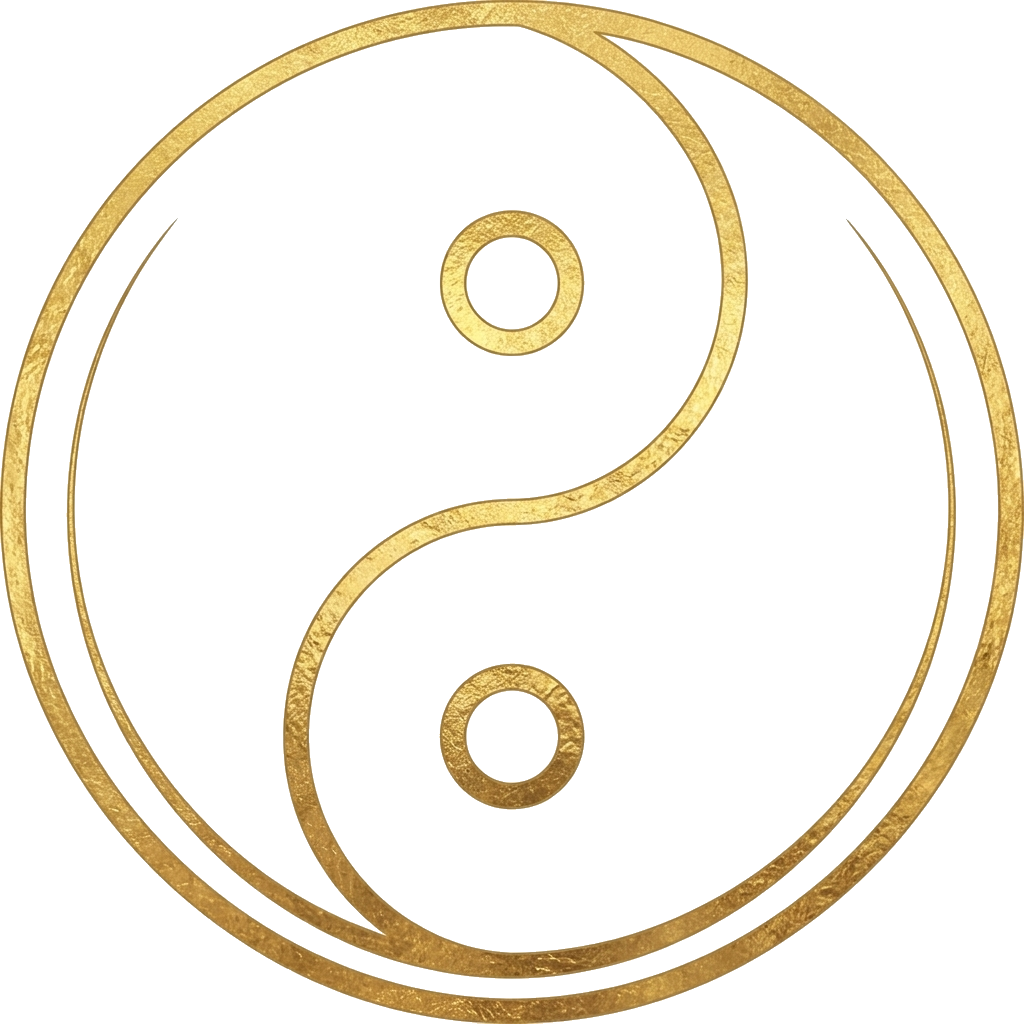
The Taijitu — the supreme symbol of Chinese philosophy, depicting the dynamic interplay of complementary opposites that generates and sustains all phenomena.
About Yin-Yang
The Yin-Yang symbol, known formally as the Taijitu (diagram of the supreme ultimate), distills 2,500 years of Chinese cosmological thought into a circle divided by an S-curve, each half containing the seed of its opposite. It depicts two interlocking teardrops — one black, one white — curving into each other within a circle, each containing a small dot of the opposite color. The image encodes an entire metaphysics: that reality is not composed of static, isolated substances but of dynamic, interdependent, mutually arising polarities whose ceaseless interplay generates the phenomenal world.
The concept of yin and yang far predates its iconic visual representation. References to yin (the shaded side of a hill) and yang (the sunlit side) appear in the earliest Chinese texts, including the Shijing (Book of Songs) and the Yijing (I Ching), where the broken and unbroken lines of the trigrams encode the binary logic of receptive and creative forces. The philosophical elaboration of yin-yang as a cosmological principle reached maturity during the Warring States period (475-221 BCE), particularly through the Yin-Yang School (Yinyang jia) associated with Zou Yan, and through the naturalist currents that infused both Taoist and Confucian thought. By the Han dynasty (206 BCE-220 CE), yin-yang theory had become the underlying grammar of Chinese civilization — woven into medicine, divination, statecraft, architecture, music, and martial practice.
The modern circular diagram that the world recognizes today, however, is a relatively late invention. The version most commonly reproduced traces to the Taijitu shuo (Explanation of the Diagram of the Supreme Ultimate) by the Neo-Confucian philosopher Zhou Dunyi (1017-1073 CE), though Zhou's original diagram was more layered and cosmological than the simple black-and-white circle now associated with it. The streamlined version with the S-curve and embedded dots crystallized over subsequent centuries, becoming the dominant visual shorthand for the yin-yang principle. Its elegant simplicity — encoding motion, balance, mutual arising, and transformation in a single image — explains why it has transcended its Chinese origins to become a global icon of complementary wholeness.
Visual Description
The Taijitu consists of a circle divided into two equal halves by an S-shaped curve (sometimes called the sinuous line or sigmoid line). One half is black (yin), the other white (yang). The S-curve creates two interlocking comma-shaped or paisley-shaped sections that nestle perfectly into each other, giving the image its characteristic sense of rotational movement and dynamic equilibrium. Within the black section sits a small white dot, and within the white section sits a small black dot.
Every element of the design carries meaning. The outer circle represents the totality — the Tao itself, or wuji (the limitless), the undifferentiated wholeness that precedes and contains all polarity. The division into two halves represents taiji (the supreme ultimate), the moment when unity differentiates into complementary opposites. The S-curve, rather than a straight line, communicates that the boundary between yin and yang is not rigid but fluid, wave-like, and constantly shifting — yin flows into yang and yang into yin in an unbroken cycle. The two halves are perfectly equal in area, encoding the principle that neither force dominates the other in the grand pattern; their relationship is one of perfect reciprocity.
The small dots are perhaps the most philosophically profound element. The white dot within the black field indicates that even at the zenith of yin, the seed of yang is already present. The black dot within the white field indicates that at the peak of yang, yin has already begun its return. There is no pure yin and no pure yang — each contains the embryo of its opposite. This detail transforms the symbol from a simple diagram of duality into a diagram of perpetual transformation, where every state carries within it the inevitability of its own reversal. The overall impression is of rotation — the eye follows the S-curve in a clockwise or counterclockwise sweep, reinforcing the sense that yin-yang is not a static balance but a living, breathing cycle.
Esoteric Meaning
The Yin-Yang symbol maps the cosmogonic process by which the undifferentiated Tao gives rise to the manifest universe. The sequence runs: wuji (the limitless, without polarity) gives birth to taiji (the supreme ultimate, polarity itself), which differentiates into yin and yang, whose interaction produces the five phases (wuxing), which generate the ten thousand things (wanwu) — all phenomena. This is the cosmology encoded in Chapter 42 of the Tao Te Ching: 'The Tao produces one; one produces two; two produces three; three produces the ten thousand things.' The Taijitu is a visual rendering of this ontological cascade. To meditate on it is to contemplate the structure of reality itself — how unity becomes multiplicity without ever ceasing to be unity, how the many are always the one in disguise.
The esoteric dimension of the symbol lies in its teaching on the nature of transformation. The dots within each half reveal that change is not imposed from outside but arises from within. Yin does not become yang because an external force acts upon it; yin becomes yang because yang was always already latent within it. This principle — that every state contains the seed of its own transformation — is the engine of the cosmos. In internal alchemy (neidan), the Taoist practitioner works with the yin and yang energies of the body (jing, qi, shen) to reverse the cosmogonic process, returning multiplicity to unity, restoring the original nature (xing) to its state of undifferentiated wholeness. The Taijitu thus functions as both a map of cosmic emanation and a map of spiritual return.
The symbol also encodes the principle that genuine balance is dynamic, not static. A perfect yin-yang equilibrium is not a frozen state where nothing moves; it is the condition of maximum aliveness, where both polarities flow freely and neither is suppressed. In Chinese medicine, health is precisely this: not the absence of yin or yang, but their harmonious circulation. In martial arts, mastery is the ability to yield (yin) and advance (yang) with perfect timing, each movement containing its opposite. In meditation, stillness (yin) and awareness (yang) are discovered to be inseparable. The Taijitu teaches that duality is not a problem to be solved but a dance to be entered. The sage does not transcend yin and yang by eliminating one in favor of the other; the sage transcends them by embodying their unity.
Exoteric Meaning
In its most accessible interpretation, the Yin-Yang symbol represents the complementary nature of opposites in everyday life. Yin corresponds to qualities such as darkness, receptivity, coolness, stillness, interiority, the feminine principle, night, winter, water, and earth. Yang corresponds to light, activity, warmth, movement, exteriority, the masculine principle, day, summer, fire, and heaven. The symbol communicates that these are not adversaries locked in conflict but partners in a relationship of mutual dependence — neither can exist without the other, and each defines itself in relation to the other. Day has no meaning without night; warmth is unintelligible without coolness; activity requires rest to sustain it.
For the general observer, the Yin-Yang symbol carries an immediate, intuitive message about balance and wholeness. It suggests that extremes are unstable — that anything pushed too far in one direction will inevitably reverse. A person who works without rest (excess yang) will eventually collapse into exhaustion (forced yin). A period of stillness and withdrawal (yin) naturally builds the energy that erupts into creativity and action (yang). The symbol encodes the wisdom of moderation, of recognizing that the healthiest life is one that honors both poles: effort and ease, engagement and solitude, giving and receiving. It has become a universal shorthand for harmony precisely because this insight resonates across all cultures and contexts.
The Yin-Yang symbol also communicates the idea that appearances can be deceiving — that what looks like one thing always contains the seed of something else. The dots within each half remind the viewer that strength contains vulnerability, that endings contain beginnings, that what seems darkest is already turning toward light. This is a profoundly optimistic teaching embedded in an elegantly simple image, which explains its enduring appeal as a symbol of hope, resilience, and the trustworthiness of the natural order.
Usage
In Traditional Chinese Medicine (TCM), yin-yang theory is the foundational diagnostic and therapeutic framework. Every organ is classified as yin or yang (the heart is yin within yang; the kidneys are yin within yin). Every pathological condition is analyzed as an excess or deficiency of yin or yang. Herbal formulas, acupuncture point selections, and dietary recommendations all aim to restore the dynamic equilibrium of yin and yang within the patient. The pulse, the tongue, the complexion, the voice — all are read through the lens of yin-yang balance. A practitioner of TCM is, in essence, a practitioner of yin-yang harmonization.
In martial arts — particularly Tai Chi Chuan (Taijiquan), which takes its name directly from the Taijitu — the symbol represents the core principle of combat and movement. The practitioner learns to yield when pressed (yin responding to yang), to advance when the opponent retreats (yang filling yin's vacancy), and to redirect force rather than oppose it. The circular, flowing movements of Tai Chi are a physical embodiment of the S-curve in the symbol. In other internal martial arts such as Baguazhang (Eight Trigram Palm) and Xingyiquan, yin-yang dynamics similarly govern the alternation between hard and soft, fast and slow, advancing and retreating. The martial artist who masters yin-yang becomes unpredictable and efficient, using the opponent's own energy to create advantage.
In feng shui, the arrangement of spaces, objects, and elements follows yin-yang principles to promote the harmonious flow of qi. Yin environments (quiet, dark, cool) suit rest and contemplation; yang environments (bright, active, warm) suit work and socialization. The art lies in creating the right balance for the right purpose. In architecture, garden design, and urban planning throughout East Asia, yin-yang considerations have shaped the built environment for millennia.
The Yin-Yang symbol appears prominently on the flag of South Korea (the Taegeuk), where it represents the cosmic balance at the heart of the nation's philosophy, surrounded by four of the eight trigrams from the I Ching. This is perhaps the most visible political and national use of the symbol in the modern world.
In contemporary global culture, the Yin-Yang has become one of the most widely reproduced symbols on Earth — appearing in jewelry, tattoos, logos, clothing, wellness branding, and interior design. While this ubiquity has sometimes flattened its meaning into a vague notion of 'balance,' the symbol's philosophical depth ensures that serious engagement with it always rewards with deeper insight. It has been adopted across traditions and subcultures — from New Age spirituality to hip-hop culture, from corporate wellness programs to psychedelic art — as a universal emblem of complementary wholeness.
In Architecture
The Yin-Yang principle has profoundly shaped sacred and secular architecture across East Asia for over two millennia, even where the symbol itself is not literally depicted. The siting of temples, palaces, cities, and tombs in China has traditionally followed feng shui principles rooted in yin-yang cosmology. Mountains (yin — still, solid, enduring) and water (yang — moving, fluid, changing) must be in proper relationship for a site to be auspicious. The ideal configuration — mountains behind, water before, hills flanking — creates a yin-yang embrace that channels and holds beneficial qi.
The Forbidden City in Beijing exemplifies yin-yang architectural thinking at the grandest scale. The southern-facing orientation maximizes yang (sunlight), while the progressive deepening of the compound from public (yang) spaces to private (yin) quarters mirrors the cosmological hierarchy. The imperial garden at the northern (yin) end balances the ceremonial halls at the southern (yang) end. Courtyards alternate with enclosed buildings in a rhythm of open (yang) and closed (yin) spaces.
Korean traditional architecture (hanok) explicitly incorporates yin-yang principles in the placement of ondol (heated floor, yang) rooms and maru (cool wooden floor, yin) rooms within the same dwelling. Japanese temple gardens, influenced by Chinese Taoist and Buddhist aesthetics, arrange stones (yang — hard, enduring) and water or raked gravel (yin — soft, flowing) to create microcosmic landscapes of dynamic balance.
The Taijitu symbol itself appears in temple decorations, martial arts training halls, meditation spaces, and traditional medicine clinics throughout China, Korea, Japan, Vietnam, and the broader Sinosphere. It often marks the threshold of spaces dedicated to the cultivation of harmony — a visual reminder that one is entering a domain where the principles of complementary balance are honored and practiced.
Significance
No philosophical system has ever been so successfully compressed into a single image. The Yin-Yang encodes the entire Taoist understanding of reality — polarity, interdependence, transformation, and the presence of each force within its opposite — in a diagram a child can draw. Where most symbols point to a concept or a deity, the Taijitu contains a complete cosmology, a complete ethics, a complete theory of change, and a complete guide to practice — all in a design that can be drawn in seconds and understood intuitively by a child. Its philosophical density per square inch is unmatched in the world's symbolic traditions.
As a contribution to human understanding, the yin-yang framework represents one of the earliest and most sophisticated expressions of process philosophy — the view that reality is constituted not by static substances but by dynamic relationships and patterns of change. This insight, arrived at independently in China over two and a half millennia ago, anticipates developments in Western thought that did not emerge until the 19th and 20th centuries: Hegel's dialectic, Whitehead's process philosophy, systems theory, and complexity science all grapple with truths that the yin-yang framework articulated with remarkable elegance thousands of years earlier.
The symbol's global adoption in the modern era speaks to its universality. It has crossed every cultural boundary — not through conquest or missionary effort, but through the sheer recognizability of the truth it encodes. Every human being lives the yin-yang dynamic: sleeping and waking, inhaling and exhaling, working and resting, grieving and celebrating. The Taijitu gives this universal experience a name and a face, and in doing so, it offers a framework for living wisely within the rhythms that govern all life.
For practitioners of the Way, the Yin-Yang symbol is not merely an object of intellectual admiration but a daily tool for discernment. It trains the eye to see complementarity where the untrained mind sees opposition, to recognize the seed of transformation within every situation, and to trust the intelligence of the natural order. It is a reminder that wholeness does not mean the absence of tension but the creative embrace of it.
Connections
The I Ching (Book of Changes) is the foundational text of yin-yang philosophy, where the broken line (yin) and unbroken line (yang) combine into 64 hexagrams mapping every possible configuration of change. The Taijitu is, in effect, a visual distillation of the I Ching's entire system — the binary logic of yin and yang, their combination, recombination, and ceaseless transformation. To study the Yin-Yang symbol deeply is to be drawn inevitably toward the I Ching, and vice versa.
The Tao Te Ching provides the philosophical and mystical context for understanding yin-yang as an expression of the Tao. Chapter 42's cosmogonic sequence (Tao produces one, one produces two, two produces three, three produces ten thousand things) is the textual equivalent of the Taijitu's visual logic. The Tao Te Ching's persistent emphasis on the strength of yielding, the power of emptiness, and the wisdom of the feminine (yin) offers a counterweight to cultures that habitually privilege yang qualities — and the Yin-Yang symbol encodes this teaching visually.
Traditional Chinese Medicine is the most extensive practical application of yin-yang theory, extending it into diagnosis, pathology, pharmacology, and therapeutics with extraordinary rigor and detail. The Five Phases (wuxing) theory, which elaborates yin-yang into the five elemental interactions of wood, fire, earth, metal, and water, provides the finer-grained framework that TCM practitioners use daily.
The parallel to the Shiva-Shakti polarity in Hindu and Tantric traditions is striking and substantive. Shiva (pure consciousness, stillness, the unmanifest) corresponds to yang in its transcendent aspect and yin in its quality of stillness; Shakti (creative energy, movement, manifestation) corresponds to yin in its receptive fecundity and yang in its dynamic power. Both systems teach that the cosmos arises from the interplay of these two principles and that liberation or wholeness comes not from choosing one over the other but from realizing their unity. The Ardhanarishvara image — Shiva and Shakti as one body, half male and half female — is the Hindu equivalent of the Taijitu.
The Western alchemical principle of solve et coagula (dissolve and coagulate) encodes a similar binary dynamic: the alternation between breaking down (yin/solve) and building up (yang/coagula) as the engine of transmutation. The alchemical marriage (coniunctio oppositorum) — the union of Sol and Luna, King and Queen, sulfur and mercury — is the Western esoteric tradition's version of yin-yang integration, and Carl Jung recognized this explicitly in his studies of both traditions.
In Hermetic philosophy, the Principle of Polarity ('Everything is dual; everything has poles; everything has its pair of opposites') as articulated in the Kybalion and traceable to the Corpus Hermeticum, describes the same reality that the Yin-Yang symbol depicts. The Hermetic teaching that opposites are identical in nature but different in degree — that heat and cold are the same thing at different points on a spectrum — resonates deeply with the yin-yang understanding that the two forces are not truly separate but are aspects of a single continuum.
Further Reading
- Robin R. Wang, Yinyang: The Way of Heaven and Earth in Chinese Thought and Culture (Cambridge University Press, 2012) — the most comprehensive scholarly treatment of yin-yang as a philosophical framework, tracing its development from the earliest oracle bones through Neo-Confucian synthesis and into modern applications.
- Marcel Granet, La Pensee Chinoise (1934) — a foundational work on Chinese thought that situates yin-yang within the broader context of correlative cosmology, showing how Chinese civilization organized knowledge through systems of correspondence rather than causal chains.
- Joseph Needham, Science and Civilisation in China, Vol. 2 (Cambridge University Press, 1956) — the monumental survey that documents yin-yang's role in the development of Chinese science, medicine, and technology, with extensive analysis of how it functioned as a proto-scientific explanatory framework.
- Ted Kaptchuk, The Web That Has No Weaver: Understanding Chinese Medicine (McGraw-Hill, 2000) — the best introduction to yin-yang as a living clinical framework within TCM, accessible to the general reader while maintaining scholarly rigor.
- Francois Jullien, A Treatise on Efficacy: Between Western and Chinese Thinking (University of Hawai'i Press, 2004) — a philosopher's exploration of how yin-yang thinking produces a fundamentally different model of effective action than Western strategic thought, illuminating the practical implications of complementary polarity.
- Zhou Dunyi, Taijitu shuo (Explanation of the Diagram of the Supreme Ultimate, 1070 CE) — the seminal Neo-Confucian text that established the Taijitu as a cosmological diagram and sparked centuries of philosophical commentary. Available in Joseph Adler's translation, Reconstructing the Confucian Dao: Zhu Xi's Appropriation of Zhou Dunyi (SUNY Press, 2014).
Frequently Asked Questions
What does the Yin-Yang symbolize?
The Yin-Yang symbol maps the cosmogonic process by which the undifferentiated Tao gives rise to the manifest universe. The sequence runs: wuji (the limitless, without polarity) gives birth to taiji (the supreme ultimate, polarity itself), which differentiates into yin and yang, whose interaction produces the five phases (wuxing), which generate the ten thousand things (wanwu) — all phenomena. This is the cosmology encoded in Chapter 42 of the Tao Te Ching: 'The Tao produces one; one produces two; two produces three; three produces the ten thousand things.' The Taijitu is a visual rendering of this ontological cascade. To meditate on it is to contemplate the structure of reality itself — how unity becomes multiplicity without ever ceasing to be unity, how the many are always the one in disguise.
Where does the Yin-Yang originate?
The Yin-Yang originates from the Chinese philosophical (concept predates Taoism; modern symbol attributed to Zhou Dunyi, 11th century CE) tradition. It dates to c. 1000 BCE (concept); 11th century CE (modern diagram). It first appeared in China.
How is the Yin-Yang used today?
In Traditional Chinese Medicine (TCM), yin-yang theory is the foundational diagnostic and therapeutic framework. Every organ is classified as yin or yang (the heart is yin within yang; the kidneys are yin within yin). Every pathological condition is analyzed as an excess or deficiency of yin or yang. Herbal formulas, acupuncture point selections, and dietary recommendations all aim to restore the dynamic equilibrium of yin and yang within the patient. The pulse, the tongue, the complexion, the voice — all are read through the lens of yin-yang balance. A practitioner of TCM is, in essence, a practitioner of yin-yang harmonization.