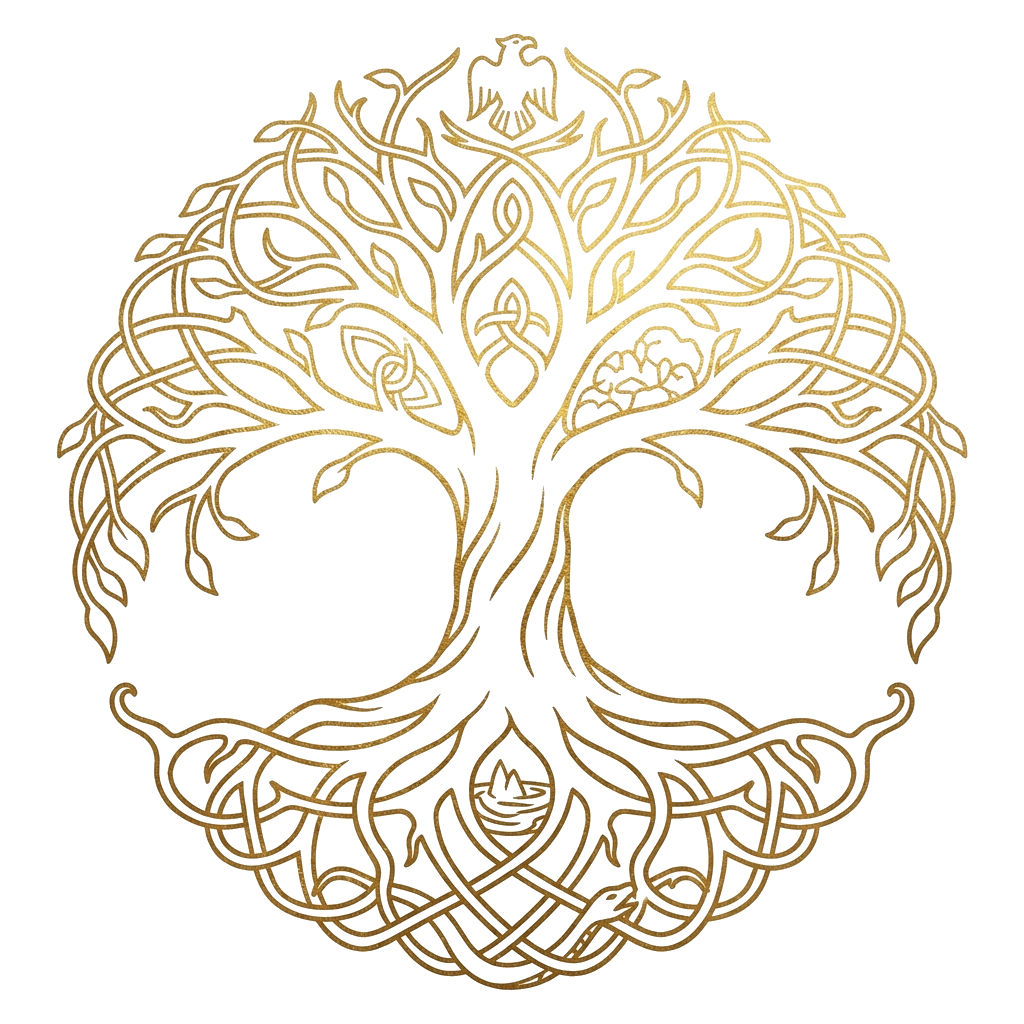
Yggdrasil
The World Tree of Norse cosmology — an immense ash tree connecting the nine worlds, sustained by three roots and three wells, housing an eagle, a serpent, and a squirrel who carries messages between them.
About Yggdrasil
Yggdrasil is the colossal cosmic ash tree (askr) that stands at the center of Norse cosmology, binding together the nine worlds in its branches, trunk, and roots. Its name is generally interpreted as 'Odin's horse' — from Yggr (a name for Odin meaning 'the terrible one') and drasill (horse or gallows) — referencing the myth of Odin's self-sacrifice, in which he hung upon the tree for nine nights to obtain the runes. The image is at once literal and metaphorical: the gallows-tree becomes the steed that carries the god between worlds, and the act of hanging becomes a voluntary death-and-rebirth that unlocks hidden knowledge.
The primary literary sources for Yggdrasil are the Voluspa (the seeress's prophecy) and the Gylfaginning section of Snorri Sturluson's Prose Edda, both composed in Iceland between the 10th and 13th centuries. In the Voluspa, the tree is described as an ash 'drenched with white mud' that 'stands ever green over the well of Urd,' while Snorri provides a more systematic cosmography in which three roots descend to three separate wells. Scholars debate whether Snorri faithfully recorded oral tradition or imposed classical order on looser mythic material, but the broad consensus is that a world-tree concept was central to pre-Christian Scandinavian religion and likely extends back into Proto-Germanic and even Proto-Indo-European cosmology.
Yggdrasil is not a static structure. It is alive, besieged, and constantly renewed. Four stags gnaw its shoots, the serpent Nidhogg devours its roots, and the squirrel Ratatoskr runs up and down its trunk carrying insults between the eagle perched in its crown and the serpent coiled below. The Norns — Urd, Verdandi, and Skuld — tend the tree daily, drawing water from the Well of Urd and pouring it over its branches to keep it from rotting. This cycle of destruction and restoration makes Yggdrasil one of the most dynamic symbols in world mythology: it embodies the idea that the cosmos is not a finished creation but an ongoing process, held together by vigilance, sacrifice, and the tension of opposites.
The tree survives Ragnarok. Even as the world burns and the gods fall, Yggdrasil trembles but does not collapse. Within its shelter, the human pair Lif and Lifthrasir endure, nourished by the tree's morning dew, ready to repopulate a renewed earth. This detail elevates Yggdrasil beyond a mere cosmological diagram into a symbol of indestructible life — the axis around which destruction and renewal perpetually revolve.
Visual Description
Yggdrasil is depicted as an immense ash tree whose canopy extends over all of existence. Its trunk rises from the center of the cosmos, impossibly tall, its bark scored by the teeth of stags and the claws of the squirrel Ratatoskr. Three great roots spread outward and downward: one reaches to Urd's Well, where the Norns dwell and hold their daily council; one descends to Mimir's Well, the source of cosmic wisdom; and one plunges to the icy realm of Niflheim, where the spring Hvergelmir bubbles and the dragon Nidhogg gnaws ceaselessly.
In the crown sits an unnamed eagle with a hawk called Vedrfolnir perched between its eyes — a watcher surveying all nine worlds. Below, among the tangled roots, Nidhogg and a host of lesser serpents tear at the wood. Between these two poles runs Ratatoskr, the squirrel, ferrying provocations back and forth, a perpetual messenger of discord that paradoxically keeps the system in motion.
Four stags — Dainn, Dvalinn, Duneyrr, and Durathror — browse on the upper branches, consuming new growth. Meanwhile, the three Norns tend the tree from below, drawing white water and clay from the Well of Urd and pouring it over the trunk and limbs. Dew drips from the tree's leaves into the valleys below — the Voluspa calls this honeydew, and it is said to nourish the bees of the world.
In Viking Age art, Yggdrasil appears on runestones, wood carvings, and metalwork as a stylized tree flanked by animals. The Urnes stave church in Norway preserves interlaced serpent-and-vine carvings widely interpreted as depictions of Nidhogg and the world tree. Manuscript illustrations from the Icelandic sagas show a more literal great tree with roots and branches symmetrically arranged, reflecting the medieval urge to systematize the myth into a visual cosmological map.
Esoteric Meaning
Yggdrasil is the axis mundi — the vertical axis connecting the underworld, the middle world, and the heavens. This motif appears across nearly every ancient tradition: the pillar of Djed in Egypt, the bodhi tree in Buddhism, the kabbalistic Tree of Life, the Mesoamerican ceiba, the Siberian shaman's birch pole. What distinguishes Yggdrasil is that it is not merely a ladder or passageway — it is an organism under constant threat that must be actively maintained. The cosmos it represents is not guaranteed; it requires effort, sacrifice, and tending.
Odin's self-sacrifice on Yggdrasil — hanging nine nights, pierced by his own spear, refusing food and drink — is the central initiatory event of Norse esotericism. It is a voluntary descent into death for the sake of knowledge: the runes, which are not simply letters but cosmic forces (mysteries, from the Proto-Germanic *runo meaning 'secret'). The parallel to shamanic death-and-rebirth initiations across Siberian, Central Asian, and indigenous American traditions is well documented. The shaman ascends or descends the world tree, dies symbolically, and returns with power and vision. Odin's ordeal codifies this universal pattern in Norse mythic terms.
The nine worlds arranged within Yggdrasil's structure can be read as states of consciousness or domains of experience rather than physical locations. Asgard (the realm of the Aesir) represents higher consciousness, order, and the aspiration toward wisdom. Midgard (the human realm) is waking consciousness, the middle ground of ordinary experience. Hel (the underworld) is the subconscious, the repository of memory, ancestral knowledge, and unprocessed experience. Jotunheim (the realm of giants) is raw, chaotic power — the forces of nature and the unconscious that perpetually threaten to overwhelm ordered existence. Muspelheim and Niflheim, fire and ice, are the primordial polarities from which creation arises and into which it periodically dissolves.
The three wells at Yggdrasil's roots map onto three fundamental modes of knowing. The Well of Urd (fate, what has become) holds the accumulated weight of all past action — analogous to karma or the Akashic record. Mimir's Well (wisdom) is the source of deep understanding, accessible only through sacrifice — Odin pledged an eye for a single drink. Hvergelmir (the roaring cauldron) is the primal spring from which all rivers flow and to which they return — the generative chaos at the base of existence, comparable to the alchemical prima materia or the Vedic concept of the unmanifest (avyakta).
The creatures of the tree represent psychological and cosmological forces in perpetual tension. The eagle in the crown symbolizes far-seeing awareness, sovereign perspective, spirit. Nidhogg at the roots represents entropy, dissolution, the forces that break down form and return it to raw material. Ratatoskr running between them is the messenger function — the mind's tendency to amplify conflict between higher aspiration and lower drives, or alternately, the necessary communication between conscious and unconscious realms. The four stags devouring new growth represent the relentless consumption of time, the way each moment of becoming is immediately consumed by the next. The Norns who tend the tree represent the principle of conscious maintenance — that awareness and effort are required to sustain the cosmic order against entropy.
In the runic tradition, Yggdrasil is intimately connected to the rune Eihwaz (the yew tree), which signifies endurance, the axis between worlds, and the capacity to move between realms. Some practitioners also associate it with Algiz (protection, the elk-sedge) in its upward-reaching form, and with Jera (the year, cyclical time) in its quality of perpetual renewal. The tree is, in essence, the living substrate of the runic system — the structure within which the runes were discovered and from which they derive their power.
Exoteric Meaning
In its most straightforward cultural sense, Yggdrasil served as the Norse peoples' map of reality — a cosmological model that organized the known and unknown into a coherent, navigable structure. It answered fundamental questions: where do the gods live? Where do we go when we die? What holds the world together? Why does winter come? The tree made the cosmos legible and placed human beings within a meaningful framework, situated in Midgard at the center, with gods above, the dead below, and vast wild forces on every side.
For the pre-Christian Scandinavians, sacred trees and groves were central to religious practice. Adam of Bremen, writing in the 11th century, describes a great tree at the temple of Uppsala in Sweden — an evergreen of unknown species — near which sacrifices were performed. Whether this was understood as Yggdrasil itself or simply as a sacred tree reflecting the mythic archetype, the account confirms that the world-tree concept was not merely literary but had concrete ritual expression. Trees were gathering places, judgment seats, and sites of sacrifice throughout the Germanic world; the mythic Yggdrasil was the ultimate version of this deeply rooted cultural practice.
The tree also provided a framework for understanding fate and time. The Norns at the Well of Urd did not merely foretell the future — they actively shaped it by carving runes and tending the tree. This placed fate not as a distant decree but as something intimately woven into the fabric of the living cosmos, something that required maintenance and could, perhaps, be influenced. The Norse understanding of fate (orlog, primal law) was not fatalistic in the passive sense; it was the accumulated weight of all past actions that shaped but did not absolutely determine the future.
Yggdrasil also served as a model of ecological interconnection. The tree feeds the stags, the stags prune the tree, the Norns water it, the serpent gnaws it, the dew from its leaves feeds the valleys. Nothing exists in isolation. This vision of mutual dependence — every creature simultaneously sustaining and threatening the whole — resonates strongly with modern ecological awareness and has made Yggdrasil a powerful symbol in contemporary environmentalism and systems thinking.
Usage
In historical Norse practice, Yggdrasil was central to the cosmological understanding that informed ritual, poetry, and daily life. Skalds (court poets) referenced the tree in kennings and mythic allusions. Volvas (seeresses) and practitioners of seidr used the nine-worlds framework in their trance journeys, moving along the tree's axis to access other realms for divination and healing. Odin's self-sacrifice on the tree served as the mythic prototype for runic divination and initiation practices.
In modern Heathenry (Asatru and related traditions), Yggdrasil remains the central cosmological symbol. Practitioners use the nine-worlds model in meditation, pathworking, and ritual cosmology. Blots (offerings) and sumbels (ritual toasting) are often performed with awareness of the tree as the connecting structure between human and divine realms. Some groups erect a physical pole or pillar — the Irminsul, a related concept from Continental Germanic tradition — as a ritual axis mundi.
In contemporary runic practice, the tree is both backdrop and active presence. Rune-workers may visualize Yggdrasil during casting or meditation, using the tree as a framework for understanding how runic forces interact. The nine-worlds model provides context for interpreting rune positions: a rune associated with Hel speaks to ancestral patterns or subconscious forces, while one associated with Asgard speaks to higher purpose and aspiration.
Yggdrasil has also been widely adopted in secular and artistic contexts. It appears in jewelry, tattoo art, logos, and decorative design — often as a stylized tree within a circle, with visible roots mirroring the branches. In fantasy literature, gaming, and popular culture, the world-tree concept has become one of the most recognizable motifs from Norse mythology, appearing in works from Tolkien's writings (the White Tree of Gondor draws on similar symbolism) to the Marvel Cinematic Universe to major video game franchises.
In depth psychology and Jungian practice, the world-tree archetype is recognized as a symbol of the Self — the totality of the psyche including conscious and unconscious dimensions. The tree's vertical structure (roots in the unconscious, trunk in waking life, crown in transpersonal awareness) maps naturally onto models of psychological integration. Yggdrasil's particular version — besieged, tended, surviving destruction — offers a psychologically rich image of wholeness as an active, ongoing process rather than a static achievement.
In Architecture
The most celebrated architectural expression of Yggdrasil is the Urnes stave church in Sognefjord, Norway, a UNESCO World Heritage Site dating to approximately 1130 CE. Its north portal features deeply carved interlacing patterns of serpents and vine-like tendrils widely interpreted as depictions of Nidhogg and Yggdrasil — a striking example of pre-Christian mythic imagery surviving into the Christian period. The 'Urnes style' of animal interlace that takes its name from this church became one of the defining decorative vocabularies of late Viking Age art.
Stave churches more broadly may encode the world-tree concept in their very construction. These wooden churches, unique to Scandinavia, are built around massive vertical timbers (staver) that rise from ground to roof — a structural axis that some scholars read as a Christianized echo of the cosmic pillar. The dragon-head finials on stave church rooflines and the serpentine carvings on their portals further reinforce the connection to the Norse mythic cosmos.
The Irminsul — the great pillar sacred to the Continental Saxons, destroyed by Charlemagne in 772 CE during his campaign to Christianize the Saxons — was likely a physical representation of the world-tree concept. Historical sources describe it as a great wooden column in the open air. The Externsteine rock formation in the Teutoburg Forest has been speculatively linked to the Irminsul site, though this connection is not established by mainstream archaeology.
Runestones across Scandinavia frequently depict stylized trees, often flanked by serpents or animals, that scholars interpret as Yggdrasil references. The Jelling stones in Denmark, erected by King Harald Bluetooth in the 10th century, include interlaced beast-and-vine motifs that may reference the world tree. The Ramsund carving in Sweden, though primarily depicting the Sigurd legend, includes a tree motif that connects to the broader cosmological framework.
In modern architecture and design, Yggdrasil-inspired motifs appear in Scandinavian public art, memorial designs, and cultural institutions. The concept has been adapted into contemporary landscape architecture, garden design, and environmental art installations that draw on the tree-as-cosmos metaphor to frame ecological themes.
Significance
Yggdrasil occupies a position of supreme importance in Norse mythology — it is not merely one symbol among many but the structural foundation of the entire cosmological system. Every myth, every god, every realm exists within or in relation to the tree. Without Yggdrasil, the nine worlds have no connection, the gods have no council place, the Norns have no station, and the runic mysteries have no source. It is the sine qua non of Norse cosmic order.
As an archetype, Yggdrasil belongs to the nearly universal class of world-tree and axis mundi symbols found across cultures from Siberia to Mesoamerica, from the Near East to the Celtic lands. Its particular Norse inflection — the emphasis on active maintenance, ongoing threat, the tension between creation and destruction — gives it a distinctive character that sets it apart from more serene or purely geometric cosmic models. The tree does not simply exist; it endures. It requires the Norns' daily tending against the relentless gnawing of Nidhogg and the browsing of the stags. This vision of a cosmos sustained by effort rather than guaranteed by divine fiat resonates with existentialist and process-philosophical perspectives and has made Yggdrasil an enduringly powerful symbol in modern thought.
The tree's survival through Ragnarok — the cataclysmic destruction of the world — positions it as a symbol of resilience and renewal that transcends any single cycle of creation. While the gods die and the world burns, the tree stands. Life shelters within it. A new world rises from the sea. This makes Yggdrasil not just a cosmological structure but a statement about the nature of existence itself: that life is more fundamental than any particular form it takes, and that destruction is always followed by renewal.
In the contemporary revival of interest in Norse mythology and spirituality, Yggdrasil has become perhaps the single most recognizable symbol of the tradition — surpassing even Thor's hammer Mjolnir in its capacity to represent the entire worldview. It appears on flags, pendants, book covers, and tattoos as a shorthand for Norse identity, spiritual depth, and connection to the ancestral past. Its resonance extends well beyond Heathen religious practice into broader cultural, artistic, and philosophical discourse.
Connections
Tree of Life — The Kabbalistic Tree of Life and Yggdrasil are the two most fully developed world-tree systems in Western esoteric tradition. Both organize reality into distinct realms connected by a vertical axis, both feature paths or passages between realms, and both serve as maps for spiritual practice and initiatory ascent. The Tree of Life's ten sefirot and twenty-two paths create a more abstract, geometric structure, while Yggdrasil's nine worlds and three roots create a more organic, narrative one. Comparative study reveals deep structural parallels — the three pillars of the Tree of Life (Severity, Mercy, Balance) may correspond to the three roots and three wells of Yggdrasil; the descent into Malkuth mirrors the descent to Hel; the crown of Kether mirrors the eagle atop the tree. Whether these parallels reflect shared Indo-European roots, independent development from universal human cognitive structures, or later cross-pollination remains a productive area of scholarly inquiry.
Valknut — The valknut (knot of the slain) is intimately connected to Yggdrasil through the figure of Odin. The valknut appears on Viking Age artifacts consistently in contexts associated with death, transition between worlds, and Odinic symbolism. Odin's self-sacrifice on Yggdrasil — the paradigmatic act of voluntary death for knowledge — is the mythic event that most directly links the two symbols. Some runic practitioners understand the valknut's three interlocked triangles as representing the three roots of Yggdrasil, the three wells, or the threefold division of the nine worlds into upper, middle, and lower realms.
The Norns and the concept of Wyrd — Yggdrasil cannot be understood apart from the Norns who tend it and the Well of Urd at which they sit. The Norse concept of orlog (primal law, or fate as accumulated action) is woven into the tree itself. The Norns do not merely predict the future; they actively shape it by carving runes and watering the tree. This connects Yggdrasil to every tradition that grapples with fate, free will, and the relationship between past action and future possibility — from the Greek Moirai to the Hindu concept of karma to the Buddhist teaching on dependent origination.
Shamanic world-tree traditions — Yggdrasil sits within a vast circumpolar tradition of shamanic cosmology in which a central tree, pole, or mountain connects the three cosmic zones. Siberian shamans climb a birch pole to access the upper world; Sami noaidi use a similar vertical cosmology. Odin's ordeal on the tree — fasting, self-wounding, hanging in trance — follows the classic pattern of shamanic initiation documented by Mircea Eliade. This places Yggdrasil not as an isolated Norse invention but as the Scandinavian expression of one of humanity's oldest cosmological and spiritual frameworks.
Further Reading
- The Poetic Edda, trans. Carolyne Larrington (Oxford World's Classics) — Primary source containing the Voluspa, Havamal, and Grimnismal, the three poems most essential for understanding Yggdrasil.
- The Prose Edda by Snorri Sturluson, trans. Jesse Byock (Penguin Classics) — The Gylfaginning section provides the most systematic description of the tree and its nine worlds.
- Myth and Religion of the North by E.O.G. Turville-Petre — Scholarly treatment of Norse religion including extensive analysis of the world-tree complex.
- The Well and the Tree: World and Time in Early Germanic Culture by Paul C. Bauschatz — Deep study of the relationship between Yggdrasil, the wells, and the Norse concept of time and fate.
- Shamanism: Archaic Techniques of Ecstasy by Mircea Eliade — Foundational comparative study placing the Norse world-tree within the global shamanic tradition.
- Norse Mythology: A Guide to the Gods, Heroes, Rituals, and Beliefs by John Lindow — Accessible scholarly reference with entries on Yggdrasil, the Norns, and related concepts.
- The Road to Hel by Hilda Roderick Ellis Davidson — Study of Norse death beliefs and the underworld, with detailed analysis of the tree's role in the journey of the dead.
Frequently Asked Questions
What does the Yggdrasil symbolize?
Yggdrasil is the axis mundi — the vertical axis connecting the underworld, the middle world, and the heavens. This motif appears across nearly every ancient tradition: the pillar of Djed in Egypt, the bodhi tree in Buddhism, the kabbalistic Tree of Life, the Mesoamerican ceiba, the Siberian shaman's birch pole. What distinguishes Yggdrasil is that it is not merely a ladder or passageway — it is an organism under constant threat that must be actively maintained. The cosmos it represents is not guaranteed; it requires effort, sacrifice, and tending.
Where does the Yggdrasil originate?
The Yggdrasil originates from the Norse (attested in Poetic Edda and Prose Edda) tradition. It dates to c. 9th — 13th century CE (literary attestation); older oral traditions. It first appeared in Scandinavia, Germanic Europe.
How is the Yggdrasil used today?
In historical Norse practice, Yggdrasil was central to the cosmological understanding that informed ritual, poetry, and daily life. Skalds (court poets) referenced the tree in kennings and mythic allusions. Volvas (seeresses) and practitioners of seidr used the nine-worlds framework in their trance journeys, moving along the tree's axis to access other realms for divination and healing. Odin's self-sacrifice on the tree served as the mythic prototype for runic divination and initiation practices.