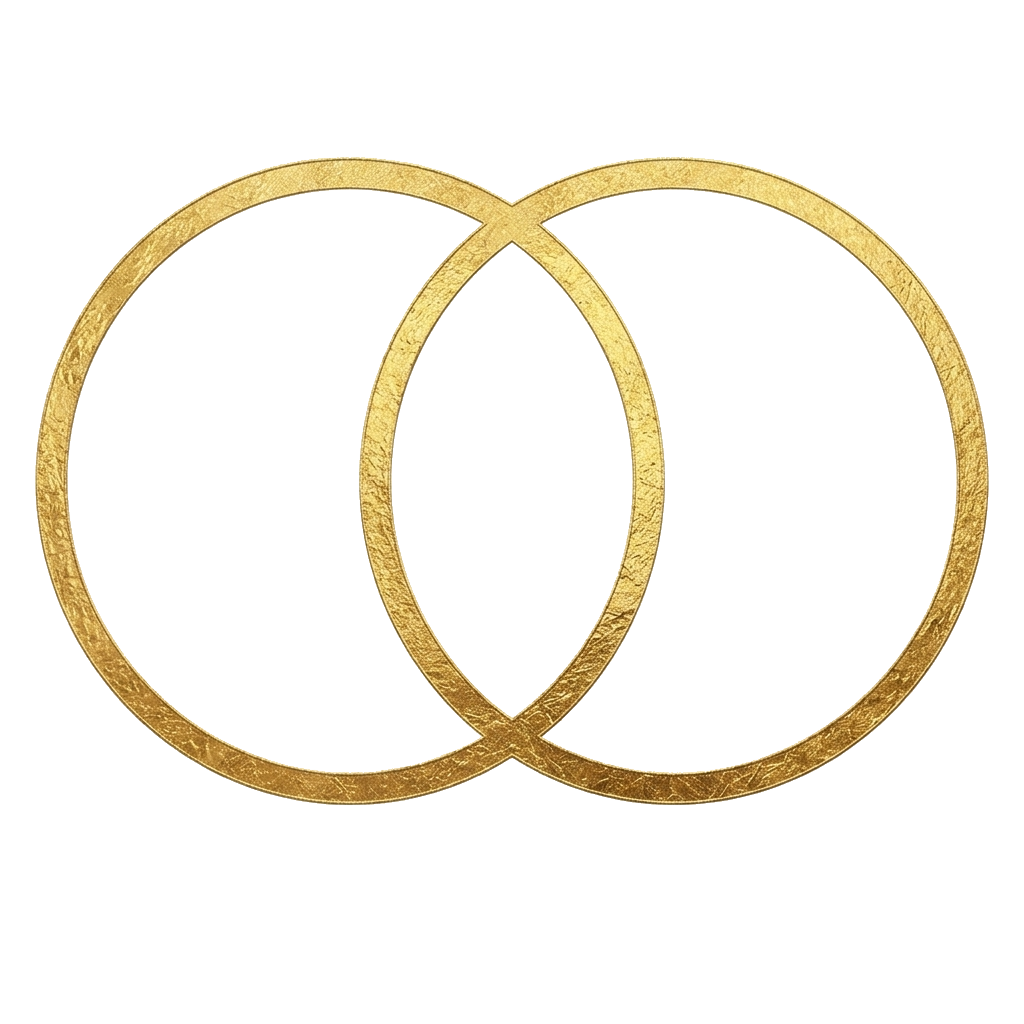
Vesica Piscis
The almond-shaped intersection of two equal circles — the geometric womb from which all sacred proportions emerge, encoding the square roots of 2, 3, and 5, and the mathematical foundation of Gothic cathedral design.
About Vesica Piscis
The Vesica Piscis is formed when two circles of equal radius overlap so that the center of each lies on the circumference of the other. The resulting almond-shaped intersection — the vesica — is one of the most fundamental figures in sacred geometry, serving as the generative matrix from which an extraordinary number of geometric and harmonic relationships can be derived.
The name itself is Latin: vesica meaning bladder or vessel, and piscis meaning fish. The 'vessel of the fish' refers to the shape's resemblance to a fish bladder and, later, to the Christian ichthys symbol. But the figure's importance far predates Christianity. Pythagorean mathematicians recognized the vesica as a gateway to irrational numbers — it contains within its proportions the square roots of 2, 3, and 5, the three irrational constants that underpin nearly all harmonic and geometric systems known to the ancient world.
In practice, the Vesica Piscis is the first step in constructing the Seed of Life and the Flower of Life. When a compass is set to a fixed radius and the first circle is drawn, the second circle is placed with its center on the edge of the first. This single operation — requiring no measurement, only a compass — produces the vesica and, by extension, the equilateral triangle, the hexagon, and ultimately the entire lattice of sacred geometry. It is, in the most literal sense, the shape from which all other shapes are born.
Across cultures and centuries, the Vesica Piscis has appeared in temple floors, manuscript illuminations, cathedral portals, stained glass windows, and cosmological diagrams. Its persistence reflects something deeper than aesthetic preference: the figure encodes a set of mathematical truths that different civilizations independently recognized as fundamental to the structure of reality.
Visual Description
Two circles of identical radius overlap so that each circle's center sits exactly on the other's circumference. The overlapping region — the vesica — forms a pointed oval or almond shape, taller than it is wide, with its long axis running vertically. The ratio of the vesica's height to its width is the square root of 3, approximately 1.732 to 1. This gives the shape its characteristic elongated, leaf-like proportion.
The two outer arcs of the vesica curve symmetrically away from a shared vertical axis, meeting in sharp points at the top and bottom. When drawn with precise compass work, the figure has an austere elegance — nothing is arbitrary, every line determined by the initial radius alone. The inner space of the vesica is often depicted as a luminous or sacred zone, emphasized through shading, gold leaf, or color in medieval manuscripts.
If the two circles are drawn with their centers on a horizontal line, the vesica stands upright between them like a doorway or portal. In many traditions this is exactly how it was understood: the threshold between two worlds, two states, or two principles. The pointed ends suggest both a flame and a seed — the shape carries an inherent sense of emergence, of something pressing outward from a concentrated origin.
When the construction is extended — a third circle placed at the intersection point, then a fourth, a fifth, a sixth — the Vesica Piscis replicates across the plane to generate the Seed of Life pattern and eventually the Flower of Life. Every subsequent figure in sacred geometry traces its lineage back to this single overlap of two equal circles.
Esoteric Meaning
The Vesica Piscis represents the birth of form from the union of two unities. In the Pythagorean tradition, the Monad — the single point, the undivided One — cannot generate diversity on its own. It is only when the One reflects itself, producing a second equal circle, that relationship becomes possible. The vesica is that relationship made visible: the shared space where two complete wholes overlap and, through their intersection, produce something neither could produce alone.
This is why the vesica has been called the 'womb of creation' and the 'matrix of geometry.' From within its proportions, the geometer can extract the square root of 2 (the diagonal of a unit square, the basis of octagonal symmetry), the square root of 3 (the height of the equilateral triangle, the basis of hexagonal symmetry), and the square root of 5 (the diagonal of a 1-by-2 rectangle, the gateway to the Golden Ratio and pentagonal symmetry). These three irrational numbers are not curiosities — they are the mathematical DNA of virtually every proportional system in sacred architecture, music theory, and natural growth patterns.
In Christian esotericism, the vesica became the mandorla — the almond-shaped aureole of light surrounding Christ, the Virgin Mary, and the saints in medieval iconography. The mandorla signifies the intersection of heaven and earth, the divine breaking through into the material plane. Christ depicted within the mandorla is Christ as mediator, standing in the overlap between two realms. The ichthys — the 'Jesus fish' of early Christianity — is directly derived from the vesica shape, its pointed oval serving as a secret recognition sign among persecuted believers in the Roman Empire.
Hermetic philosophy interprets the vesica as the resolution of duality. The two circles represent any pair of complementary opposites — spirit and matter, masculine and feminine, the known and the unknown, the above and the below. The vesica is not a compromise between them but a third thing, a generative field that contains properties of both circles while transcending either one. This maps directly onto the Hermetic principle of reconciliation: the idea that every apparent duality conceals a hidden unity, accessible through the right kind of contemplation or practice.
In alchemical symbolism, the vesica appears in diagrams of the coniunctio — the mystical marriage of opposites that produces the Philosopher's Stone. The overlapping circles represent Sol and Luna, sulfur and mercury, the fixed and the volatile. Their intersection is the alchemical child, the tertium quid, the substance that partakes of both natures and is reducible to neither.
The Pythagorean school treated the vesica with particular reverence because it demonstrated that the irrational — the alogos, that which cannot be expressed as a ratio of whole numbers — emerges naturally from the simplest possible operation on the rational. Two unit circles, a rational construction, produce irrational magnitudes. For the Pythagoreans, this was not a flaw in mathematics but a revelation about the nature of reality: that the incommensurable and the mysterious are woven into the fabric of even the most elementary structures.
Exoteric Meaning
At its most accessible level, the Vesica Piscis is a basic geometric construction taught in compass-and-straightedge geometry. It demonstrates how complex shapes and proportions can be generated from the simplest possible starting point: two equal circles whose centers lie on each other's edges. From this single figure, a student can derive equilateral triangles, regular hexagons, and the proportional relationships that underlie architectural design.
In Christian popular culture, the vesica is most recognizable as the origin of the ichthys or 'Jesus fish' — the outline of a fish formed by two intersecting arcs. Early Christians used this symbol as a covert sign of their faith, and it remains one of the most widely recognized religious symbols in the Western world today. The connection between the fish symbol and the deeper geometry of the vesica is rarely understood by those who display it, but the mathematical lineage is direct and unambiguous.
In art and design, the vesica provides a natural framing shape. The pointed oval creates a sense of focus and containment that rectangles and circles do not, which is why it appears so frequently in medieval manuscript borders, church window tracery, and decorative motifs. Designers and architects continue to use the vesica proportion — whether consciously or intuitively — because its height-to-width ratio produces a shape that the human eye finds inherently balanced and compelling.
The Vesica Piscis also appears in corporate logos, currency design, and civic heraldry, often without any intended esoteric reference. The Mastercard logo, for instance, uses two overlapping circles whose intersection evokes the vesica, though the design intention is commercial rather than mystical. The shape's enduring presence in secular contexts reflects its deep aesthetic resonance — it simply looks right, a fact that sacred geometers would attribute to its encoding of universal mathematical harmonies.
Usage
In sacred geometry practice, the Vesica Piscis is the essential first construction. Students learn to draw it before any other figure, using compass alone, as the generative step from which all subsequent patterns follow. The construction sequence — single circle, reflected circle, vesica, equilateral triangle, hexagon, Seed of Life, Flower of Life — forms the backbone of most sacred geometry curricula.
Meditation practitioners use the Vesica Piscis as a contemplative focus. The two circles are visualized as representing any pair of apparent opposites in the practitioner's experience — thought and feeling, self and other, stillness and movement — and the vesica is held in awareness as the living intersection where both are simultaneously present. This practice is related to non-dual meditation techniques across traditions, though it gives the practitioner a geometric anchor for the experience.
In architectural and design applications, the vesica proportion (height-to-width ratio of the square root of 3 to 1) is used to determine the proportions of doorways, windows, altars, and decorative panels. Gothic architects used the vesica as a module — a repeating proportional unit that could be scaled up or down while maintaining harmonic consistency across an entire building.
In healing and energy work, some practitioners use the Vesica Piscis as a template for understanding the intersection of energy fields. When two people stand close together, or when a practitioner places their hands near a client's body, the overlapping auras or biofields are sometimes visualized as forming a vesica — a shared space of heightened energetic exchange.
The symbol also appears in divination and ritual contexts. It is inscribed on altars, drawn in ceremonial spaces, and used as a frame for sacred images. In the Western magical tradition, the vesica has been employed as a protective and generative symbol — a doorway through which intention passes from the mental plane into manifestation.
In Architecture
The Vesica Piscis is one of the most consequential geometric figures in the history of Western architecture. Its proportions — particularly the square root of 3 ratio — served as the invisible scaffolding for Gothic cathedral design from the 12th through 16th centuries.
The most celebrated architectural example is the pointed arch itself. The Gothic pointed arch is not an arbitrary stylistic choice but a direct application of vesica geometry: two circular arcs struck from centers on a horizontal baseline, intersecting at a point above. The resulting arch form distributes weight more efficiently than the semicircular Roman arch, allowing for taller, thinner walls and the vast stained glass windows that define the Gothic style. Chartres, Notre-Dame de Paris, Reims, Amiens, Cologne, and Salisbury cathedrals all employ vesica-based arches as their primary structural and aesthetic element.
The rose windows of Gothic cathedrals are constructed by radiating vesica-derived geometry outward from a center point. The trefoil, quatrefoil, and cinquefoil tracery patterns that fill these windows are all generated through systematic application of the overlapping-circles principle. The north rose window of Notre-Dame de Paris is a masterwork of vesica-based design, every petal and subdivision traceable to compass-and-straightedge operations rooted in the vesica.
At Glastonbury, England, the Chalice Well cover designed by Frederick Bligh Bond in 1919 is perhaps the most famous modern rendering of the Vesica Piscis in an architectural context. The wrought-iron well cover features two interlocking circles forming a vesica, pierced by a lance or staff — a symbol Bond associated with the Grail legends and the intersection of the material and spiritual worlds. The well itself, at the foot of Glastonbury Tor, has been a pilgrimage site for centuries, and the vesica design has become inseparable from the site's identity.
Beyond the Gothic tradition, vesica proportions appear in Romanesque church portals, Byzantine mosaics, Islamic geometric tilework (where the two-circle overlap generates the six-pointed star pattern), and Renaissance architectural treatises. Sebastiano Serlio, Leon Battista Alberti, and Andrea Palladio all referenced the vesica in their proportional systems, though they often absorbed it into broader frameworks of harmonic design rather than treating it as a standalone motif.
In modern architecture, the vesica appears in the work of designers influenced by sacred geometry — notably in the plan of the Chapel of Reconciliation in Berlin (2000), the Lotus Temple in New Delhi (1986), and various works by architects working within the organic or biomorphic tradition who draw on natural proportional systems.
Significance
The Vesica Piscis is the first shape that emerges from the act of geometric creation, and it contains within itself the proportional seeds of every subsequent construction. If the point is the origin and the circle is the first act of manifestation, the vesica is the first act of relationship — the moment when unity recognizes itself and, through that recognition, generates multiplicity.
Mathematically, the vesica's significance is difficult to overstate. The three principal irrational roots — the square root of 2, the square root of 3, and the square root of 5 — can all be extracted from the vesica construction using only compass and straightedge. The square root of 2 governs the geometry of the square and octagon. The square root of 3 governs the equilateral triangle and hexagon. The square root of 5 leads directly to the Golden Ratio (phi, approximately 1.618) and thereby to the pentagon, the dodecahedron, the Fibonacci sequence, and the logarithmic spiral found throughout nature. That a single, elementary construction contains all three of these constants is the reason the Vesica Piscis was regarded by ancient mathematicians not merely as a useful figure but as a profound statement about the structure of reality.
Philosophically, the vesica embodies the principle that creation requires duality and that duality, rightly understood, is not division but relationship. The two circles do not compete or exclude each other; they overlap, and from their overlap something new is born. This is the template for every creative process — biological reproduction, artistic inspiration, intellectual synthesis, spiritual awakening. The vesica says: where two complete things meet, a third thing becomes possible that neither could have produced in isolation.
Historically, the vesica has served as a bridge between traditions. Pythagorean geometers, Christian mystics, Hermetic philosophers, Islamic tilework designers, Gothic master builders, Renaissance theorists, and modern sacred geometry practitioners have all found in the vesica a figure that confirms their own deepest intuitions about order, beauty, and meaning. Its capacity to speak across traditions and centuries without losing coherence suggests that it touches something genuinely universal — not merely a cultural artifact, but a mathematical truth expressed as form.
For the student of sacred geometry, the Vesica Piscis is where the work begins. Every construction that follows — the Seed of Life, the Flower of Life, Metatron's Cube, the Platonic solids — traces its origin to this single, elegant intersection of two equal circles. To understand the vesica deeply is to hold the seed of the entire geometric tradition in one's mind.
Connections
The Vesica Piscis is the foundational figure in the progression of sacred geometry constructions. From the vesica, one derives the Seed of Life (seven circles), the Flower of Life (nineteen circles), and ultimately the full lattice from which Metatron's Cube and the Platonic solids can be extracted.
The figure connects directly to the Pythagorean tradition and its emphasis on number as the foundation of reality. The Pythagorean Tetraktys — the triangular arrangement of ten points that the school considered the most sacred symbol — is itself constructable from vesica-derived equilateral triangles. The musical harmonies that Pythagoras codified (the octave, the fifth, the fourth) correspond to ratios that can be demonstrated geometrically using vesica proportions.
In the Christian tradition, the vesica links to the iconography of the mandorla, the ichthys, and the symbolism of Christ as mediator between divine and human natures. The architectural legacy of the vesica in Gothic cathedral design connects it to the medieval building guilds and their transmission of geometric knowledge from classical and Islamic sources.
The Hermetic tradition draws on the vesica in its formulations of the coincidence of opposites (coincidentia oppositorum), a concept that runs from Nicholas of Cusa through the Western esoteric tradition and into Carl Jung's analytical psychology, where the union of opposites is central to the individuation process.
In the natural world, vesica proportions appear in the cross-sections of seeds, the shapes of leaves, the geometry of cell division (where two daughter cells form a vesica at the moment of separation), and the interference patterns of overlapping waves. These natural occurrences are often cited by sacred geometry practitioners as evidence that the vesica is not an arbitrary human invention but a pattern inherent in the fabric of nature itself.
Further Reading
- Sacred Geometry: Philosophy and Practice by Robert Lawlor — the definitive introduction to vesica geometry and its applications
- A Beginner's Guide to Constructing the Universe by Michael S. Schneider — accessible exploration of the vesica and its role in natural and mathematical patterns
- The Geometry of Art and Life by Matila Ghyka — classical treatment of proportional systems derived from the vesica
- The Ancient Secret of the Flower of Life by Drunvalo Melchizedek — esoteric perspective on vesica-based sacred geometry
- Geometry of the Gothic Cathedra by James Addiss — analysis of vesica proportions in medieval architecture
- The Power of Limits: Proportional Harmonies in Nature, Art, and Architecture by Gyorgy Doczi — visual exploration of how vesica proportions appear across domains
Frequently Asked Questions
What does the Vesica Piscis symbolize?
The Vesica Piscis represents the birth of form from the union of two unities. In the Pythagorean tradition, the Monad — the single point, the undivided One — cannot generate diversity on its own. It is only when the One reflects itself, producing a second equal circle, that relationship becomes possible. The vesica is that relationship made visible: the shared space where two complete wholes overlap and, through their intersection, produce something neither could produce alone.
Where does the Vesica Piscis originate?
The Vesica Piscis originates from the Pythagorean mathematics and sacred geometry tradition. It dates to c. 6th century BCE (Pythagorean) — present. It first appeared in Greece, Europe, worldwide.
How is the Vesica Piscis used today?
In sacred geometry practice, the Vesica Piscis is the essential first construction. Students learn to draw it before any other figure, using compass alone, as the generative step from which all subsequent patterns follow. The construction sequence — single circle, reflected circle, vesica, equilateral triangle, hexagon, Seed of Life, Flower of Life — forms the backbone of most sacred geometry curricula.