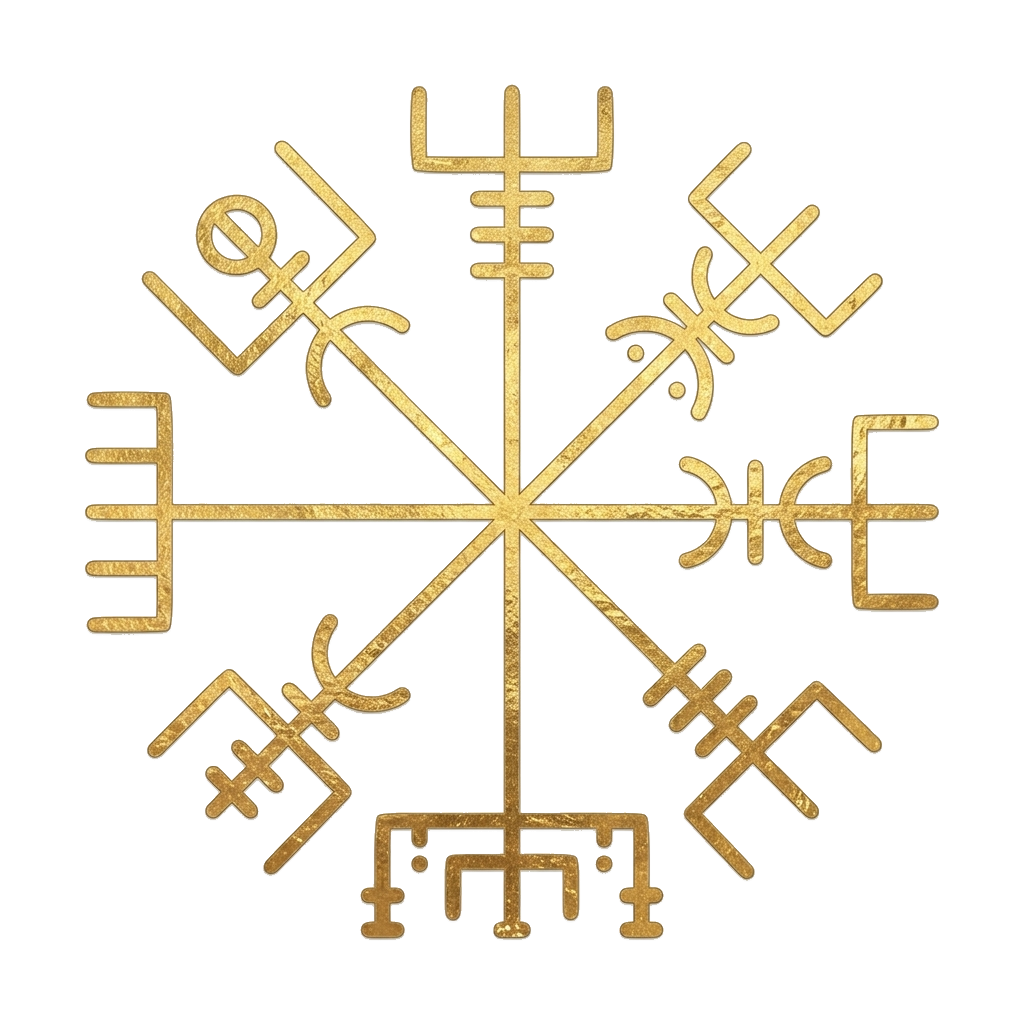
Vegvisir
The Norse 'wayfinder' or 'signpost' — an Icelandic magical stave believed to help the bearer find their way through rough weather and unknown paths, even when the way is lost.
About Vegvisir
The Vegvisir (pronounced roughly VEGG-vee-seer, from Old Norse vegr, 'way' or 'path,' and visir, 'pointer' or 'guide') is an Icelandic magical stave — a type of sigil composed of intersecting lines radiating from a central point, each terminating in a unique rune-like glyph. It belongs to the galdrastafir tradition, the system of magical signs that developed in Iceland during the late medieval and early modern periods, blending remnants of the elder runic tradition with Christian mysticism, continental European grimoire magic, and indigenous Icelandic folk practice. The Vegvisir's function, according to the manuscripts that preserve it, is navigational protection: the bearer who carries this sign will never lose their way, even in storms, even when the path ahead is unknown.
The primary source for the Vegvisir is the Huld Manuscript (Icelandic: Hulduskrift), compiled around 1860 by Geir Vigfusson, a collector of Icelandic folk magic and esoteric lore. The entry in the Huld Manuscript is brief and pragmatic: 'If this sign is carried, one will never lose one's way in storms or bad weather, even when the way is not known.' This is the only historical description that specifically names the symbol 'Vegvisir' and assigns it this wayfinding function. A visually similar but not identical eight-armed stave appears in the much earlier Galdrabok (also known as the Icelandic Book of Magic), a grimoire dated to the late 16th or early 17th century, though that manuscript does not use the name Vegvisir for the figure. The relationship between the two staves — whether the Huld Manuscript preserves an older oral tradition or represents a later elaboration — remains a matter of scholarly debate.
This distinction matters because popular culture has overwhelmingly associated the Vegvisir with the Viking Age (c. 793–1066 CE), treating it as an ancient Norse navigational compass carried by seafaring warriors across the North Atlantic. This attribution has no historical basis. No Vegvisir has been found in any Viking Age archaeological context — no runestones, no ship burials, no carved amulets, no saga illustrations. The symbol belongs firmly to post-Reformation Iceland, a period when literate Icelanders were actively synthesizing runic tradition with imported Solomonic magic, Kabbalistic letter mysticism, and Christian folk practice. Acknowledging this late dating does not diminish the symbol's genuine power or meaning within the galdrastafir tradition; it simply places it accurately within the cultural continuum that produced it. The Vegvisir is not a Viking compass. It is something arguably more interesting: a product of Iceland's unique magical tradition, which preserved and transformed fragments of the old Northern European esoteric worldview long after the rest of Scandinavia had abandoned them.
The broader context of Icelandic magical staves is essential for understanding the Vegvisir. Iceland's geographic isolation, its high literacy rate (unique in medieval Europe), and its cultural memory of the pre-Christian past created conditions in which magical practice survived and evolved in ways impossible elsewhere in Scandinavia. The sagas record the use of runic magic in the Viking Age, but by the time the galdrastafir tradition crystallized in manuscript form, the operative system had changed fundamentally. The staves are not runes in any strict sense — they do not correspond to the Elder or Younger Futhark — but they carry forward the principle that inscribed marks possess inherent power to shape reality. The Vegvisir sits within a collection of hundreds of such staves, each designed for a specific practical purpose: protection from enemies, success in legal disputes, catching thieves, winning love, calming seas, or — in the Vegvisir's case — finding the way home.
Visual Description
The Vegvisir consists of eight arms or staves radiating outward from a single central point, arranged in a symmetrical pattern reminiscent of a compass rose. Each arm extends the same distance from the center, creating a regular eight-pointed structure, but the critical detail — the feature that distinguishes the Vegvisir from a simple asterisk or wheel — is that every arm terminates in a unique glyph. No two endings are alike. Some terminate in trident-like forks, others in half-circles or hooks, others in perpendicular crossbars, still others in more complex constructions resembling partial bind-runes. This asymmetry of the termini within the overall symmetry of the radial structure is the Vegvisir's most distinctive visual characteristic and the source of much of its aesthetic power.
The central point from which all arms radiate is sometimes rendered as a simple intersection and sometimes as a small circle or dot, depending on the manuscript and the individual copyist's style. The arms themselves are straight lines of uniform thickness in most traditional renderings, though modern interpretations frequently add decorative weight, shading, or three-dimensional effects. In the Huld Manuscript, the drawing is relatively spare and utilitarian — a working diagram rather than an ornamental illustration. The overall impression is of a navigational instrument or directional finder, which aligns with its stated function: each arm points outward into the unknown, and the unique terminus on each arm suggests that each direction holds its own particular quality or challenge, yet all are unified at the center.
The eight-fold structure invites comparison with the compass rose, the eight-spoked wheel of dharma, the Helm of Awe (Aegishjalmur), and other octagonal sacred geometries. The Vegvisir is most frequently confused with the Aegishjalmur, another Icelandic magical stave with eight radiating arms, but the two are visually and functionally distinct. The Aegishjalmur's arms are identical — each one a trident-like fork — creating a perfectly symmetrical figure designed for terror and dominance. The Vegvisir's arms are deliberately different from one another, suggesting not domination of all directions but navigation through them, the ability to read and respond to the unique character of each path. This visual distinction encodes the fundamental difference in intent between the two staves: the Aegishjalmur imposes the bearer's will on the environment; the Vegvisir helps the bearer find alignment with the environment's own hidden order.
Esoteric Meaning
The Vegvisir encodes a teaching about orientation that goes far beyond physical navigation. The symbol addresses the fundamental human experience of being lost — not merely geographically, but spiritually, psychologically, and existentially. To carry the Vegvisir is to carry the reminder that within the self there exists an innate capacity for orientation that does not depend on external landmarks, familiar paths, or prior knowledge of the terrain. The way can be found even when — especially when — it is not known in advance. This is not passive reassurance but an active magical claim: that consciousness itself, properly attuned, functions as a compass.
The eight unique termini on the Vegvisir's arms can be read as an esoteric map of the different qualities of directionality that the wayfinder must learn to navigate. Unlike a compass, which reduces all directions to interchangeable degrees on a uniform circle, the Vegvisir insists that each direction has its own character, its own challenge, its own form of resistance and revelation. North is not south turned around; east is not west reversed. Each path into the unknown presents unique obstacles, and the stave's asymmetric design teaches that genuine navigation requires sensitivity to difference, not the imposition of a single uniform method onto every situation. This resonates with the broader Northern European concept of wyrd — the web of fate that is not predetermined but continuously woven by the interaction between individual will and the patterns already laid down. The Vegvisir helps its bearer read the warp and weft of wyrd in real time.
In the deeper magical framework of the galdrastafir tradition, staves like the Vegvisir were understood to work not through symbolic representation but through direct sympathetic resonance. The inscribed lines were not pictures of something — they were operative structures that shaped the flow of orlog (primal law, cosmic pattern) around the bearer. Carrying the Vegvisir did not merely remind you to stay oriented; it restructured the relationship between your intentionality and the landscape you moved through, creating a kind of channel or groove along which right action could flow. This understanding places the Vegvisir within the same operative framework as runic galdr (chanting) and seidr (trance work) — technologies of consciousness that the Northern tradition developed for interacting with the hidden structure of reality.
The Vegvisir also carries a teaching about the relationship between chaos and order that connects it to the deepest currents of Norse cosmology. In the Norse creation myth, the world arises from the meeting of fire (Muspelheim) and ice (Niflheim) in the void of Ginnungagap — from precisely the kind of formless, directionless chaos that the Vegvisir is designed to navigate. The stave does not eliminate chaos or impose artificial order upon it; it finds the path that already exists within the apparent formlessness. This is the wayfinder's art: not the cartographer's art of mapping known territory, but the navigator's art of reading signs in an unmapped sea. The Vegvisir teaches that every situation, no matter how disorienting, contains within it the information needed to find the way through — if one has the eyes to see and the stillness to read.
Exoteric Meaning
At the most accessible level, the Vegvisir is a protection symbol for travelers and anyone facing uncertainty. Its basic meaning is straightforward and practical: carry this sign, and you will find your way, even in terrible weather, even on unfamiliar roads, even when all landmarks have been swallowed by fog or storm. In Icelandic folk tradition, this was understood quite literally — the stave was drawn or carved on objects a traveler would carry, and its power was expected to manifest as the concrete ability to avoid getting lost in Iceland's famously treacherous weather and trackless highland interior. Iceland's geography makes this concern viscerally real: sudden whiteouts, volcanic fog, unmarked lava fields, and the absence of trees or other landmarks could turn a routine journey into a life-threatening ordeal.
In contemporary usage, the Vegvisir has become one of the most popular Norse-inspired symbols worldwide, adopted as a tattoo, pendant, and decorative motif by millions of people who understand it broadly as a symbol of guidance, protection during life's storms, and the ability to find one's path even in times of confusion and difficulty. It carries a message of resilient self-trust — the confidence that you can navigate through whatever comes, that being temporarily lost is not the same as being permanently without direction. For many people, especially those drawn to Northern European spiritual traditions, the Vegvisir functions as a personal talisman of empowerment: a reminder that the capacity for finding the right path lives within, not in any external map or authority.
Usage
The Vegvisir's historical usage is documented primarily through the Icelandic manuscript tradition, where instructions for its application are characteristically terse and practical. The Huld Manuscript specifies simply that the sign should be 'carried' — the Icelandic term bera (to bear, to carry) implies physical presence on the person, whether inscribed on an object, drawn on parchment, or marked directly on the body. Other galdrastafir in the same manuscripts give more specific instructions: some staves were to be carved on wood and placed under a threshold, others drawn in blood on specific body parts, others inscribed on food and consumed. The Vegvisir's instruction is relatively open-ended, suggesting that the medium mattered less than the fact of carrying the symbol.
Historical uses within Iceland's folk magic tradition would have included inscription on walking sticks, carving into the inside of shoes or boots, drawing on leather travel pouches, scratching into the wax of a candle carried on a journey, or marking on the forehead with water or ash before setting out. The galdrastafir tradition was deeply pragmatic — these were working tools, not objects of contemplation — and the context of use was typically a specific journey or situation rather than permanent wear. A farmer crossing the highland interior to reach seasonal grazing would activate the stave for that crossing; a fisherman heading out into uncertain weather would mark it before departure. The magic was situational and intentional, not passive.
In the modern period, the Vegvisir's usage has expanded enormously beyond its original folk-magical context. It is now one of the most frequently tattooed symbols in the world, with Bjork's famous upper-back Vegvisir tattoo (sometimes attributed to her Icelandic heritage) bringing the symbol to widespread international attention. Contemporary practitioners of Asatru, Heathenry, and Northern Tradition Paganism use the Vegvisir as a devotional and protective symbol, incorporating it into altar setups, ritual tools, jewelry, and meditation practice. It appears on pendants, rings, patches, shields, drinking horns, and book covers. Some modern practitioners carve it into candles for directional magic or draw it on paper as part of journey-work or pathfinding rituals.
The Vegvisir has also entered mainstream design culture, appearing on clothing, home decor, album covers, and commercial branding far removed from any magical or spiritual context. This commercial diffusion has sparked ongoing debate within Norse Pagan communities about cultural commodification and the flattening of sacred symbols into aesthetic trends. Within Iceland itself, the Vegvisir (along with the Aegishjalmur) has become something of a national cultural emblem, appearing in tourist shops, on souvenir items, and as a marker of Icelandic identity — a function that would have been entirely foreign to the anonymous folk magicians who first drew it in their manuscript collections.
In Architecture
The Vegvisir's presence in architecture is considerably more limited than that of older and more widespread symbols, reflecting its relatively late attestation and its origins in a private, manuscript-based folk tradition rather than a public monumental one. In historical Iceland, the galdrastafir were not architectural elements — they belonged to the portable, personal scale of magic rather than the built environment. There are no known medieval or early modern buildings in Iceland that incorporate the Vegvisir into their structural design or decorative programs. The staves lived in books and on bodies, not on buildings.
In the modern period, however, the Vegvisir has begun to appear in architectural and monumental contexts as Icelandic cultural identity has become increasingly self-conscious and as Norse Pagan traditions have established physical gathering spaces. The symbol appears in decorative metalwork, carved door panels, and painted murals in Asatru and Heathen hof (temples) and meeting halls, particularly in Scandinavia, Germany, and North America. The Asatru congregation in Reykjavik — which completed construction of its long-planned hof in recent years — incorporates various galdrastafir and runic motifs into its architectural design, though the specific inclusion of the Vegvisir varies by account.
Outside of specifically religious architecture, the Vegvisir has found its way into Icelandic public art and design. It appears in street art in Reykjavik and Akureyri, on the facades of shops and cultural venues, and in the design of monuments and memorial markers. The Hallgrimskirkja church in Reykjavik, while not featuring the Vegvisir itself, exemplifies the broader Icelandic tendency to incorporate Norse-inspired geometric forms into modern architecture — a cultural context within which the Vegvisir's octagonal geometry feels native. In the international context, the Vegvisir appears primarily in the interior design of businesses, homes, and studios owned by people with personal connections to Norse tradition — carved into mantels, incorporated into tile work, etched into glass doors, or rendered in large-scale wall art. Its architectural presence is growing but remains largely decorative and personal rather than monumental or institutional.
Significance
The Vegvisir's significance operates on two distinct levels that are frequently and problematically conflated: its genuine historical importance within the Icelandic magical stave tradition, and its adopted importance within the modern Norse revivalist movement. Addressing both honestly requires confronting the uncomfortable gap between what the symbol actually is and what many people want it to be.
Historically, the Vegvisir is significant as one of the most evocative products of Iceland's unique galdrastafir tradition — a system of operative magic that developed in isolation over several centuries, blending indigenous Northern European magical concepts with imported Christian, Solomonic, and Kabbalistic influences. The stave tradition is genuinely remarkable: nowhere else in Europe did a literate population maintain and develop a working magical system that preserved fragments of the pre-Christian runic worldview while freely incorporating elements from the wider European occult tradition. The Vegvisir, with its elegant eight-armed structure and its practical navigational purpose, is one of the most aesthetically accomplished and philosophically resonant products of this tradition. It deserves serious attention as a masterwork of Icelandic folk magic.
What the Vegvisir is NOT is a Viking Age symbol. This must be stated plainly because the popular identification of the Vegvisir as a 'Viking compass' has become so widespread that it functions as received truth in tattoo parlors, gift shops, and casual internet discourse worldwide. No evidence — none — places the Vegvisir before the early modern period. The earliest manuscript that could contain a related design is the Galdrabok (late 16th-early 17th century), and the specific symbol called 'Vegvisir' appears only in the Huld Manuscript of c. 1860. This places its documented existence firmly in the post-Reformation, post-medieval period — roughly 800 years after the end of the Viking Age. The desire to project it backward into the age of longships and rune-carved swords is understandable but historically unfounded.
This matters not to diminish the Vegvisir but to locate its real significance accurately. The symbol is genuinely powerful precisely because of what it actually represents: the persistence of magical thinking in a European society long after the supposed triumph of rationalism, the creative synthesis of diverse esoteric streams into a uniquely Icelandic magical art, and the enduring human need for symbolic technologies of orientation in a disorienting world. The Vegvisir does not need to be ancient to be meaningful. Its real story — a story of cultural survival, esoteric syncretism, and the unkillable human impulse to inscribe protective power into portable form — is more interesting than the fantasy of Viking warriors carving it into their shields.
In the contemporary context, the Vegvisir's significance has expanded far beyond its origins to become one of the most recognized symbols in the global spiritual marketplace. It serves as a gateway symbol for people exploring Norse and Northern European spiritual traditions, a personal talisman for millions who find meaning in its message of inner guidance, and a cultural touchstone for Icelandic identity and pride. Its extraordinary popularity also raises important questions about authenticity, cultural ownership, and the ethics of adopting sacred symbols from traditions one does not practice — questions that the Norse Pagan community continues to wrestle with in thoughtful and sometimes contentious ways.
Connections
The Vegvisir connects most directly to the broader tradition of Icelandic galdrastafir — magical staves preserved in manuscripts from the 16th through 19th centuries. This tradition includes hundreds of sigils designed for specific purposes, from the Aegishjalmur (Helm of Awe) for invincibility to the Draumstafir for dream control to the Angurgapi for preventing fishing-line tangles. The Vegvisir is the most famous member of this family, but understanding it in isolation distorts its meaning; it was one tool in a comprehensive magical toolkit, not a standalone artifact.
The galdrastafir tradition itself connects backward to the runic tradition of the Viking Age and the Migration Period. The Elder Futhark (c. 150–800 CE) and Younger Futhark (c. 800–1100 CE) were understood by their users not merely as alphabets but as repositories of cosmic power — each rune embodied a force or principle that could be invoked through inscription, chanting (galdr), and ritual application. When Christianity replaced the old religion in Iceland (officially in 1000 CE), the operative use of runes gradually transformed rather than disappeared. The galdrastafir represent the mature form of this transformation: the principle of inscribed magical power survived, but the specific characters and their associated cosmology evolved into something new, incorporating Christian names of power (Jesus, Mary, the Apostles), Solomonic seals, and Hebrew letter mysticism alongside indigenous Northern forms.
This syncretism connects the Vegvisir to the broader European grimoire tradition — the network of magical manuscripts that circulated across Europe from the late medieval period onward, including the Key of Solomon, the Heptameron, Agrippa's Three Books of Occult Philosophy, and dozens of lesser-known texts. Icelandic magicians were literate, connected to continental book culture through trade and education, and actively incorporated foreign magical systems into their practice. The Vegvisir's visual structure — radiating lines with symbolic termini — bears formal resemblance to figures in the Solomonic tradition, and some scholars have argued that the galdrastafir represent a Nordic localization of broadly European ceremonial magic rather than a purely indigenous development.
The Vegvisir also connects to the concept of the sacred center — the axis mundi — that pervades Northern European and cross-cultural mythology. The central point from which the stave's arms radiate mirrors the cosmic center occupied by Yggdrasil, the Well of Urd, and the throne of the All-Father. In Norse cosmology, all navigation ultimately orients around this center, and the Vegvisir can be understood as a personal, portable axis mundi — a device for re-establishing one's relationship to the cosmic center when external orientation has been lost.
Finally, the Vegvisir connects to the universal human practice of creating protective marks and talismans for travel — a practice documented in every known culture from Paleolithic cave paintings (interpreted by some scholars as journey-magic) through Roman curse tablets, Jewish mezuzot, Christian pilgrimage badges, Islamic ta'wiz, Hindu yantras, and the protective charms of Indigenous traditions worldwide. The Vegvisir is Iceland's distinctive contribution to this global human impulse: a navigational talisman shaped by the specific conditions of North Atlantic island life, where getting lost in weather was not a metaphor but a concrete and recurring threat to survival.
Further Reading
- The Galdrabok: An Icelandic Grimoire — Stephen Flowers (Edred Thorsson), trans. (1989). The standard English translation of Iceland's most important magical manuscript, with extensive commentary on the galdrastafir tradition and its relationship to runic and continental magic.
- Icelandic Magic: Practical Secrets of the Northern Grimoires — Stephen Flowers (2016). Accessible introduction to the full range of Icelandic magical staves, including the Vegvisir and Aegishjalmur, with historical context and practical applications.
- The Huld Manuscript (IM 383 4to) — Geir Vigfusson, compiler (c. 1860). The primary source manuscript for the Vegvisir. Available in facsimile through the Icelandic National Library (Landsbokasafn Islands).
- Trolldom: Spells and Methods of the Norse Folk Magic Tradition — Johannes Gardback (2015). Places Icelandic stave magic within the broader Scandinavian folk-magic tradition, providing comparative context.
- Nordic Religions in the Viking Age — Thomas A. DuBois (2012). Academic treatment of pre-Christian Norse religion and its survival in post-conversion folk practice, essential for understanding the cultural substrate from which the galdrastafir tradition emerged.
- Runes and Magic: Formulaic Elements in the Older Runic Tradition — Mindy MacLeod and Bernard Mees (2006). Scholarly analysis of operative runic magic in the pre-Christian period, providing the historical backdrop against which the later stave tradition developed.
- Staves, Sigils, and Seals: A Study of Icelandic Magical Signs — Various contributors in Scripta Islandica and other academic journals. Ongoing scholarly discourse on the origins, development, and classification of the galdrastafir.
Frequently Asked Questions
What does the Vegvisir symbolize?
The Vegvisir encodes a teaching about orientation that goes far beyond physical navigation. The symbol addresses the fundamental human experience of being lost — not merely geographically, but spiritually, psychologically, and existentially. To carry the Vegvisir is to carry the reminder that within the self there exists an innate capacity for orientation that does not depend on external landmarks, familiar paths, or prior knowledge of the terrain. The way can be found even when — especially when — it is not known in advance. This is not passive reassurance but an active magical claim: that consciousness itself, properly attuned, functions as a compass.
Where does the Vegvisir originate?
The Vegvisir originates from the Icelandic magical stave tradition (Huld Manuscript, c. 1860; Galdrabok tradition) tradition. It dates to c. 17th — 19th century CE (manuscript attestation). It first appeared in Iceland.
How is the Vegvisir used today?
The Vegvisir's historical usage is documented primarily through the Icelandic manuscript tradition, where instructions for its application are characteristically terse and practical. The Huld Manuscript specifies simply that the sign should be 'carried' — the Icelandic term bera (to bear, to carry) implies physical presence on the person, whether inscribed on an object, drawn on parchment, or marked directly on the body. Other galdrastafir in the same manuscripts give more specific instructions: some staves were to be carved on wood and placed under a threshold, others drawn in blood on specific body parts, others inscribed on food and consumed. The Vegvisir's instruction is relatively open-ended, suggesting that the medium mattered less than the fact of carrying the symbol.