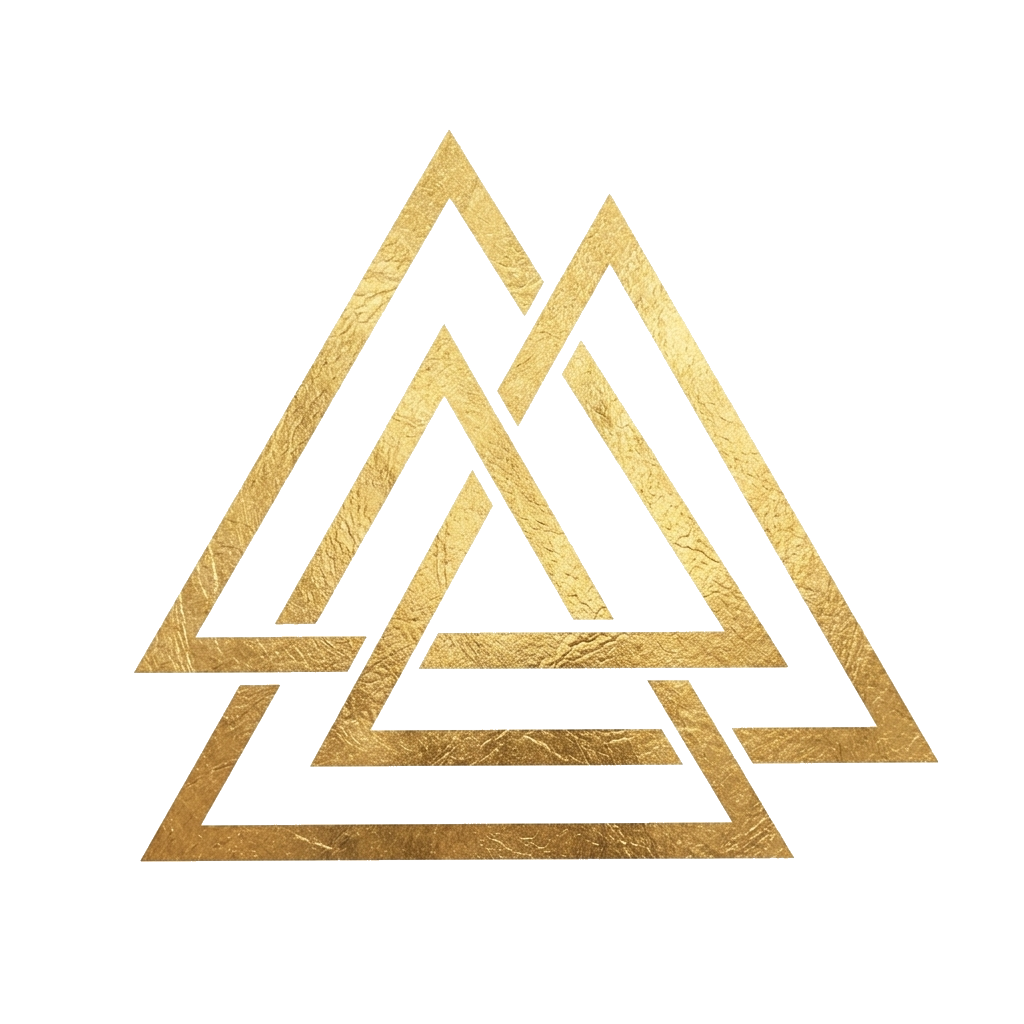
Valknut
Three interlocking triangles associated with the Norse god Odin — a symbol of the slain warriors, the transition between life and death, and the binding power of the Allfather.
About Valknut
Three interlocking triangles — nine points in total — carved on memorial stones beside images of the dead: the Valknut survives from the Norse world as an enigma wrapped in geometry. Composed of three interlocking triangles — nine points in total — it appears on carved memorial stones, funerary objects, and ritual artifacts from the Viking Age. The word itself is a modern coinage, derived from Old Norse valr ("the slain") and knut ("knot"), and was not used in any surviving medieval text. Scholars assigned the name retroactively to match the symbol's overwhelming association with death, sacrifice, and the god Odin.
The Valknut appears in two geometric variants. The Borromean form uses three separate triangles woven together so that removing any one releases the other two — a topological puzzle that mirrors the interdependence of the three realms (Asgard, Midgard, Hel) in Norse cosmology. The unicursal form is drawn as a single continuous line that loops through all nine points without lifting the pen, suggesting an unbroken thread of fate. Both versions have been found on Viking Age artifacts, and both carry the same funerary context.
The symbol's most famous appearances are on the Stora Hammars I stone from Gotland, Sweden (c. 8th century), where it is carved directly beside a scene of ritual sacrifice — a figure lying on an altar, an eagle overhead, a spear planted in the ground. This pairing is not decorative. The Valknut marks the threshold between the living and the dead, the moment when a warrior's spirit passes from the battlefield to Valhalla. On the Oseberg ship burial (c. 834 CE), one of the richest Norse burials ever discovered, a tapestry fragment shows a procession of figures alongside interlocking triangle patterns, reinforcing the symbol's role in funerary rites and the cult of the dead.
No runic inscription or Eddic poem names the Valknut directly. What we know of its meaning comes entirely from its context — where it appears, what surrounds it, and which deity it accompanies. In every surviving instance, the context is death, Odin, or both. This silence in the textual record has made the Valknut one of the most debated symbols in Norse studies, but the archaeological evidence is remarkably consistent.
Visual Description
The Valknut consists of three triangles interlocked in a tight, symmetrical arrangement. In the Borromean configuration, three distinct triangles are woven over-and-under one another so that no single triangle can be separated without breaking the other two — a property shared with the mathematical Borromean rings. The triangles are equilateral and typically rendered at equal size, creating a compact, balanced figure with a small open hexagonal space at the center where the overlapping edges converge.
In the unicursal variant, the entire figure is drawn as one continuous line that passes through all nine vertices and creates the three-triangle form without ever crossing itself or lifting from the surface. This gives the symbol a flowing, ribbon-like quality that emphasizes continuity and entanglement. Viking Age carvings tend to render both forms with bold, clean lines, often incised deeply into stone or carved into wood and bone.
The nine points of the Valknut have invited numerical interpretation since scholars first studied them. Nine is the most sacred number in Norse cosmology — nine worlds hang on Yggdrasil, Odin hung nine nights on the World Tree to win the runes, and the great Norse rituals at Uppsala involved sacrifices in multiples of nine. The three-times-three geometry of the Valknut may encode this sacred numerology in visual form, making the symbol a compact expression of the entire cosmic order.
On the Gotland picture stones, the Valknut is rendered at roughly the same scale as the human figures beside it — it is not a small decorative flourish but a prominent element of the composition. The Tangle stone from Gotland shows it hovering near a fallen warrior, while Stora Hammars I places it at the exact midpoint between a sacrificial scene and a ship carrying the dead. The placement is always deliberate, always liminal — at the boundary between life and death.
Esoteric Meaning
The Valknut is a symbol of the binding power of Odin — the god who governs fate, death, ecstasy, and the mysteries of consciousness. In the Norse esoteric tradition, Odin is not merely a war-god or sky-father. He is the seeker of hidden knowledge, the god who sacrifices himself to himself on Yggdrasil, who gives up an eye at Mimir's Well for the privilege of seeing what is concealed. The Valknut, appearing always in his context, represents the knot that binds a warrior's fate to the Allfather's will. To wear or invoke the Valknut was to declare oneself Odin's — to accept the possibility that one's death would come at his choosing, and that the soul's journey after death was in his hands.
The three interlocking triangles map onto the tripartite structure of the soul in Germanic belief. The Norse recognized multiple soul-components — the hugr (thought, mind), the fylgja (the fetch or guardian spirit), and the hamr (the shape, the body's astral form). These three aspects of the self are bound together during life and unbound at death. The Valknut may represent this binding — the knot that holds the self together across worlds, and whose loosening or tightening is governed by Odin and the Norns.
In the context of seidr (Norse shamanic practice) and runic magic, the Valknut has been interpreted as a symbol of Odin's power to bind and unbind the mind. The Ynglinga Saga describes Odin's ability to "bind" warriors in battle so that they become blind, deaf, and paralyzed with fear, or conversely to "loose" them into berserker fury. This binding and loosing of consciousness — the capacity to alter states of awareness — is the esoteric function that the Valknut encodes. It is, in this reading, a shamanic symbol: the knot of ecstasy, the tool by which the practitioner moves between worlds.
The nine points also correspond to the nine worlds of Norse cosmology, each connected to a different mode of being or realm of consciousness. The Valknut, as a single unified figure containing all nine, becomes a map of the cosmos held in the hand — a portable World Tree, a meditation object that encodes the entire structure of reality in geometric form. For the runic practitioner, tracing the Valknut's interlocking lines was a form of pathworking through the nine worlds, a visual mantra that organized the mind along the axes of the cosmic order.
Exoteric Meaning
In its most visible cultural role, the Valknut is a symbol of fallen warriors and their passage to the afterlife. The Norse warrior culture held that those who died bravely in battle were chosen by Odin's Valkyries and carried to Valhalla, the Hall of the Slain, where they would feast and fight until Ragnarok. The Valknut, appearing on memorial stones and funerary objects, marked this transition — it was the sign that the dead had been received by the Allfather, that their sacrifice was honored, and that they had joined the Einherjar, the elite army of the dead.
For the families and communities that raised these memorial stones, the Valknut communicated a clear message: this person died well. In a culture where the manner of one's death determined one's afterlife, the presence of the Valknut on a grave marker was the highest compliment — equivalent to a military honor or sainthood in other traditions. It declared that the person's death had cosmic significance, that they were not merely gone but gathered into Odin's host.
The symbol also carried a broader cultural meaning related to fate and destiny. The Norse concept of wyrd (fate) was not passive — it was an active, weaving force, like the work of the Norns at the foot of Yggdrasil. The interlocking form of the Valknut, where three shapes are bound together inseparably, echoed this understanding of fate as an interconnected web. To display the Valknut was to acknowledge that one's life, death, and afterlife were woven together by forces larger than the individual — and to accept that binding willingly.
In the public, communal context of Viking Age Scandinavia, the Valknut served as a marker of religious identity. Much as the cross identified Christians and the hammer of Thor (Mjolnir) identified followers of Thor, the Valknut identified those who had a particular devotion to Odin — the intellectuals, the skalds (poets), the runemasters, the practitioners of seidr. It was not a general-purpose Norse symbol but a specifically Odinic one, and its presence on an artifact tells archaeologists something specific about the beliefs and allegiances of the person who owned it.
Usage
In the Viking Age, the Valknut appeared primarily in funerary and ritual contexts. It was carved on runestones erected to honor the dead, incised on grave goods meant to accompany the deceased into the afterlife, and woven into tapestries placed in high-status burials like the Oseberg ship. Its use was deliberate and restricted — it does not appear on everyday domestic objects, trade goods, or casual ornamentation. This pattern of restricted, ritual use supports the interpretation that the Valknut carried serious religious weight and was not merely decorative.
In contemporary Heathenry and Asatru (modern Norse Pagan reconstructionism), the Valknut has become one of the most widely used devotional symbols. Practitioners wear it as jewelry — pendants, rings, arm-bands — to signify their dedication to Odin and their acceptance of the warrior's path. Some Heathen groups treat the Valknut with particular gravity, teaching that to wear it is to declare oneself willing to die when Odin calls, and that it should not be adopted casually. This reverence echoes the symbol's original funerary gravity.
The Valknut is also used in modern runic meditation and galdr (runic chanting) practice. Practitioners trace the interlocking triangles as a focus for meditation, using the nine-pointed geometry as a framework for journeying through the nine worlds. Some seidr practitioners incorporate the Valknut into ritual space, drawing or placing it at the center of the ve (sacred enclosure) as a gateway symbol during trance work and oracular practice.
Unfortunately, the Valknut has also been appropriated by white supremacist and ethno-nationalist groups, who have adopted various Norse symbols as identity markers. The Anti-Defamation League lists the Valknut as a symbol that appears in both legitimate Pagan and extremist contexts. Genuine Heathen practitioners and scholars of Norse religion have pushed back against this appropriation, emphasizing that the symbol belongs to a religious tradition that is open to people of all backgrounds and that its original meaning is spiritual, not ethnic.
In Architecture
The Valknut's presence in architecture and monumental art is concentrated in the Viking Age and the regions where Norse culture held sway. The most significant architectural contexts are the Gotland picture stones — large limestone slabs, some standing over two meters tall, that were erected as memorial monuments across the island of Gotland in the Baltic Sea. These stones functioned as both grave markers and public narrative art, depicting scenes from mythology, daily life, and the journey of the dead. The Stora Hammars I stone (c. 700-800 CE) is the most important for Valknut studies: it shows the symbol beside a figure being sacrificed on an altar, establishing the direct link between the Valknut and ritual death.
The Tangle stone, also from Gotland, places the Valknut near a warrior scene and a ship, reinforcing the funeral voyage motif. Several other Gotland stones include triangular interlocking motifs that may be Valknut variants, though weathering and damage make identification uncertain. Taken together, the Gotland stones represent the largest concentration of Valknut imagery in any architectural context.
The Oseberg ship burial (Vestfold, Norway, c. 834 CE) provides the other major architectural occurrence. The burial contained an elaborately carved wooden cart, several animal-head posts, and textile fragments — one of which shows interlocking triangles in a procession scene. The Oseberg burial was a high-status female interment (possibly a volva, a Norse seeress), and the presence of the Valknut motif in this context has led some scholars to connect it to women's ritual practice as well as male warrior cult.
In modern Heathen sacred spaces, the Valknut is sometimes carved into ritual poles (reginnaglar), altar stones, or the wooden frames of outdoor hofs (temples). Contemporary Asatru groups in Scandinavia and Iceland have incorporated the Valknut into the design of community gathering spaces, using it as an architectural motif on doorways, lintels, and hearth-stones to mark the space as sacred to Odin.
Significance
The Valknut presents a paradox: it is simultaneously the most widely reproduced Norse symbol in modern culture and one of the least documented in the historical record. Unlike the runes, which are documented in multiple Eddic poems and inscriptions, or Thor's hammer Mjolnir, which appears in countless sagas and myths, the Valknut has no surviving name in Old Norse and no direct description in any medieval text. Everything scholars know about it comes from visual context — where it appears, what accompanies it, and what it is associated with in archaeological deposits. This purely visual, non-textual transmission makes it a powerful case study in how symbols carry meaning independent of language.
The Valknut's significance also lies in what it reveals about Norse attitudes toward death. The Vikings are often caricatured as fearless warriors who sought death in battle, but the Valknut tells a more nuanced story. It is not a celebration of death but a symbol of the binding relationship between the individual and the divine — the understanding that Odin chooses who lives and who dies, and that the warrior's role is to accept that choice with dignity. The Valknut, placed on graves and sacrificial scenes, is an act of trust: trust that the Allfather's judgment is meaningful, that death in his service has purpose, and that the soul's journey continues beyond the body.
For modern practitioners of Norse spirituality, the Valknut has become a touchstone for the reconstruction of authentic Heathen practice. Because it is one of the few symbols that can be directly linked to specific religious contexts in the archaeological record (rather than being a later literary invention), it carries particular weight as evidence of what the pre-Christian Norse actually believed and practiced. The ongoing scholarly debate about its precise meaning — warrior cult, shamanic tool, cosmological diagram, or all three — reflects the richness and complexity of the Norse spiritual tradition itself.
The symbol's modern contested status — claimed by both genuine religious practitioners and by hate groups — makes it a case study in how ancient symbols are fought over in contemporary culture. The Valknut's significance today is inseparable from this contest, and its future meaning will be shaped by which communities succeed in defining its public perception.
Connections
The Valknut is most deeply connected to Yggdrasil, the World Tree, through the sacred number nine. Odin hung nine nights on Yggdrasil to win the runes; the Valknut's nine points encode this same numerological structure. Both symbols map the cosmic order — Yggdrasil as the vertical axis connecting the nine worlds, the Valknut as their geometric compression into a single portable figure. Where the World Tree is the cosmos seen from outside, the Valknut is the cosmos held in the hand.
The relationship with the Triquetra is both geometric and theological. Both symbols use three interlocking forms to express a unity-in-trinity. The Triquetra, found in Celtic and later Christian contexts, represents a similar theological structure — three-in-one — but from a different cultural matrix. The Valknut's triangles are more angular and martial where the Triquetra's arcs are flowing and organic, reflecting the different temperaments of Norse and Celtic spirituality. Some scholars have proposed that both derive from a common Proto-Indo-European symbolic vocabulary of sacred triads.
The Vegvisir (the Norse "wayfinder" or "runic compass") shares the Valknut's association with navigation between worlds, though the Vegvisir is oriented toward finding one's way through physical storms and spiritual confusion, while the Valknut marks the definitive crossing from life to death. Both are tools for transition, but the Vegvisir promises return while the Valknut implies departure.
Beyond the Norse tradition, the Valknut resonates with the broader cross-cultural pattern of sacred knots and interlocking geometries. The Endless Knot of Buddhism, the Celtic knotwork tradition, the Islamic geometric patterns of infinite interlace — all use the visual language of binding and interweaving to express the interconnectedness of reality. The Valknut belongs to this global family of knot symbols, each adapted to its own cosmological framework, each expressing the same fundamental insight: that the parts of reality are not separate but woven together in patterns that can be traced but never fully unraveled.
Further Reading
- Price, Neil. The Viking Way: Magic and Mind in Late Iron Age Scandinavia (2nd ed., Oxbow Books, 2019) — The definitive scholarly treatment of Norse magic, seidr, and Odin's cult. Essential context for understanding the Valknut's ritual function.
- Lindqvist, Sune. Gotlands Bildsteine (Wahlstrom and Widstrand, 1941-1942) — The foundational catalogue of Gotland picture stones, including detailed drawings and analysis of every known Valknut occurrence on the stones.
- Simek, Rudolf. Dictionary of Northern Mythology (D.S. Brewer, 2007) — Comprehensive reference for Norse mythological terms, including entries on the Valknut, Odin's attributes, and the Einherjar.
- Androshchuk, Fedir. Viking Swords: Swords and Social Aspects of Weaponry in Viking Age Societies (Swedish History Museum, 2014) — Covers the material culture of the Viking warrior class, including the funerary contexts where the Valknut appears.
- Turville-Petre, E.O.G. Myth and Religion of the North: The Religion of Ancient Scandinavia (Holt, Rinehart and Winston, 1964) — Classic study of Norse religion with detailed discussion of Odin's cult, sacrifice, and afterlife beliefs.
Frequently Asked Questions
What does the Valknut symbolize?
The Valknut is a symbol of the binding power of Odin — the god who governs fate, death, ecstasy, and the mysteries of consciousness. In the Norse esoteric tradition, Odin is not merely a war-god or sky-father. He is the seeker of hidden knowledge, the god who sacrifices himself to himself on Yggdrasil, who gives up an eye at Mimir's Well for the privilege of seeing what is concealed. The Valknut, appearing always in his context, represents the knot that binds a warrior's fate to the Allfather's will. To wear or invoke the Valknut was to declare oneself Odin's — to accept the possibility that one's death would come at his choosing, and that the soul's journey after death was in his hands.
Where does the Valknut originate?
The Valknut originates from the Norse/Germanic (found on Gotland picture stones and Oseberg ship burial) tradition. It dates to c. 7th — 11th century CE (Viking Age depictions). It first appeared in Scandinavia, Anglo-Saxon England.
How is the Valknut used today?
In the Viking Age, the Valknut appeared primarily in funerary and ritual contexts. It was carved on runestones erected to honor the dead, incised on grave goods meant to accompany the deceased into the afterlife, and woven into tapestries placed in high-status burials like the Oseberg ship. Its use was deliberate and restricted — it does not appear on everyday domestic objects, trade goods, or casual ornamentation. This pattern of restricted, ritual use supports the interpretation that the Valknut carried serious religious weight and was not merely decorative.