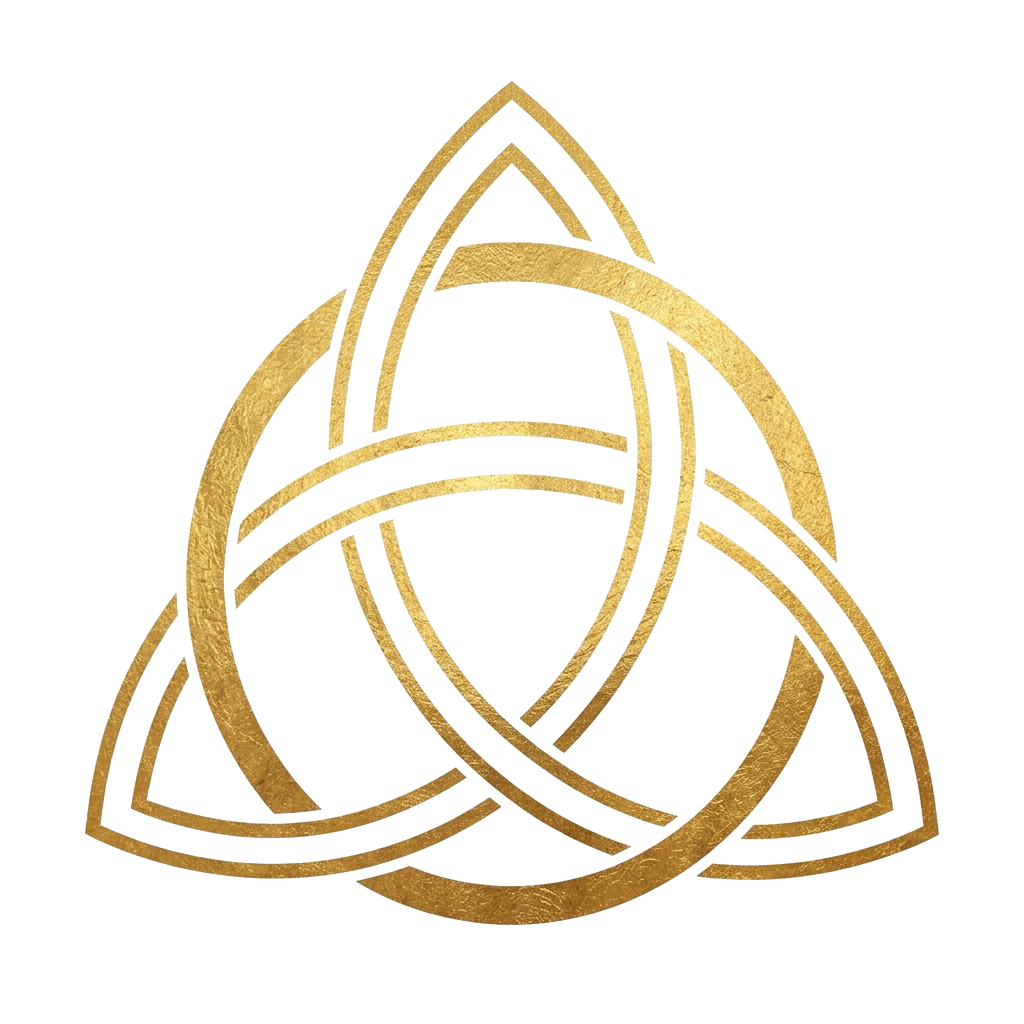
Triquetra
Three interlaced arcs forming a continuous knot — a Celtic and Christian symbol of threefold unity, from the triple goddess to the Holy Trinity, with no beginning and no end.
About Triquetra
The Triquetra — from the Latin triquetrus, meaning 'three-cornered' — is one of the oldest and most enduring symbols in the Western esoteric tradition. At its simplest it is three interlaced arcs, each shaped like a vesica piscis, woven so that they form one continuous, unbroken line. That single, looping strand has no starting point and no terminus; it turns back on itself eternally, making the Triquetra a figure of perpetual motion, infinite return, and the indissoluble unity of things that appear separate.
The earliest carved examples come from the La Tène culture of Celtic Europe (c. 500 BCE), where they appear on metalwork, standing stones, and bone fragments alongside spirals, triskeles, and knotwork borders. Celtic artisans used the form not as mere decoration but as a visual incantation — the interlace was believed to trap hostile spirits, channel protective energy along its loops, and mirror the ceaseless cycling of the natural world. From Ireland the symbol migrated to Pictish Scotland, Anglo-Saxon England, Norse Scandinavia, and the monasteries of early Christendom, adapting its meaning at every frontier without ever losing its fundamental geometry.
What gives the Triquetra its remarkable longevity is its capacity to absorb new theology. Pre-Christian Celts saw the threefold goddess — maiden, mother, crone — turning inside each loop. Norse runecasters linked it to the three roots of Yggdrasil and the Norns who spin fate beneath them. When Irish monks illuminated the Celtic Cross pages of the Book of Kells, they set the Triquetra at the heart of the Christological miniatures, reading its three equal arcs as Father, Son, and Holy Spirit, its single line as the unity of the Godhead. In every case the logic is the same: three distinct aspects, one indivisible reality.
Today the Triquetra appears on jewelry, tattoos, church windows, national emblems, and even pop-culture artifacts (it adorned the cover of the Book of Shadows in the television series Charmed). Its appeal endures because its visual grammar is universally legible — anyone who looks at the form perceives balance, movement, and wholeness before a single word of doctrine is spoken.
Visual Description
The Triquetra is constructed from three identical arcs, each describing the pointed-oval shape known as the vesica piscis. The arcs overlap one another in a strict threefold rotational symmetry, creating a central triangular space where all three intersect and six almond-shaped 'petals' radiating outward. Each arc passes alternately over and under its neighbours, producing a braided, interlace texture that is characteristic of Insular Celtic art. No line begins or ends; the eye can enter the form at any point and trace a continuous path through every arc without lifting.
In many historical and modern renditions a circle — sometimes called the ring of eternity — encloses the three arcs, threading through the outer loops so that the knot sits within an unbroken band. This circled variant is sometimes distinguished as the 'Trinity Knot,' though in common usage the terms Triquetra and Trinity Knot are interchangeable. The circle adds a further layer of meaning: wholeness, protection, the horizon of creation enclosing the creative principle.
The symbol is typically rendered in a single colour and a uniform line weight, though illuminated manuscript versions introduce polychrome interlace — ribbons of gold, crimson, and lapis lazuli winding through the knot, each colour denoting a theological virtue or cosmological element. Stone-carved Triquetras are often in low relief, their channels catching shadow in a way that makes the interlace appear to pulse with light as the sun moves across the face of the stone.
Esoteric Meaning
At the deepest level of esoteric interpretation, the Triquetra encodes the principle that all manifest reality arises from a threefold interaction and returns to a unity that transcends the three. This idea recurs with striking consistency across the traditions that have adopted the symbol.
In the Celtic triple-goddess tradition, the three arcs represent the Maiden (waxing moon, spring, potential), the Mother (full moon, summer, fruition), and the Crone (waning moon, autumn, wisdom and release). The goddess is not three beings but one being in three phases, and the looping continuity of the knot insists on her indivisibility. Initiation into her mysteries meant learning to perceive all three aspects simultaneously — youth, maturity, and dissolution — in every living thing.
In Norse cosmology, the three loops correspond to the three realms joined by Yggdrasil: Asgard (the gods), Midgard (humanity), and Hel (the underworld). The Norns — Urd (past), Verdandi (present), and Skuld (future) — sit at the Well of Fate beneath the World Tree, weaving the threads of destiny in a pattern not unlike the interlace of the Triquetra itself. The knot thus symbolises the woven fabric of time and the interconnection of all realms of being.
In Christian mysticism, the Triquetra became one of the earliest non-figurative images of the Trinity: Father, Son, and Holy Spirit, three persons sharing one divine substance (homoousios). The continuous line demonstrates that the three are co-eternal and co-equal — no arc is larger, no section of line is a beginning. The circled variant gained a further Christological reading: the ring as the unity of the Godhead enclosing the procession of persons within it. This made the Triquetra a tool of contemplation for monks who wished to meditate on the mystery of the Trinity without resorting to anthropomorphic imagery.
Across Neopagan and Wiccan practice, the Triquetra is mapped to the classical triad of mind, body, and spirit, or to the three realms of earth, sea, and sky that recur in Irish mythological geography. Some ceremonial practitioners use the symbol as a ward — inscribed on thresholds, altar tools, or ritual clothing to create a sealed circuit of protective energy. The logic is that an unbroken line offers no entry point for malign influence.
Beneath all these overlays lies the universal power of the number three. Three is the first number that creates a plane (a triangle), the minimum for a stable structure, the rhythm of beginning-middle-end. The Triquetra gives that arithmetic a visual body: three arcs, each incomplete on its own, combining into a form that is whole, balanced, and self-sustaining.
Exoteric Meaning
In its outward, public sense the Triquetra communicates unity, balance, and the harmony of complementary forces. It appears on civic and ecclesiastical heraldry across Northern Europe, where it typically signifies cultural heritage, continuity with the past, and spiritual integrity.
For Christian congregations, the Trinity Knot on a church window or vestment is a doctrinal shorthand: it teaches the central mystery of Trinitarian theology in a single glance. Many parish churches in Ireland, Scotland, and Wales set the Triquetra into carved stone baptismal fonts, connecting the rite of baptism — performed 'in the name of the Father, and of the Son, and of the Holy Spirit' — to the threefold geometry of the knot.
In secular culture the Triquetra signals Celtic identity and pride in a pre-Roman, pre-Saxon heritage. It is a common motif in Irish, Scottish, Breton, and Welsh national iconography. The Air Corps of Ireland (Aer Chór na hÉireann) uses a winged Triquetra as its insignia. It features on coins, stamps, and municipal crests across the Celtic nations, functioning as a marker of belonging rather than a statement of esoteric belief.
On a personal level, people choose Triquetra jewelry and tattoos to express a commitment to balance — between work and rest, giving and receiving, thought and feeling — or to honour a threefold relationship (often parent, partner, child). The symbol's clean geometry and deep historical resonance give it a gravitas that transcends fashion, which is why it has maintained its popularity in body art and fine jewelry for decades.
Usage
The Triquetra has been used continuously for over 2,500 years, and its applications span sacred, civic, decorative, and magical domains.
Sacred art and architecture. From the seventh century onward, Irish and Northumbrian monks wove the Triquetra into gospel manuscripts — most famously the Book of Kells (c. 800 CE) and the Lindisfarne Gospels (c. 715 CE). It appears on high crosses in Monasterboice, Clonmacnoise, and Iona, where it often fills the intersection of the cross arms. Scandinavian stave churches incorporated the knot into their carved doorposts and wall panels, blending Norse and Christian symbolism in a single motif.
Runestones and metalwork. Viking-age runestones in Sweden, Denmark, and Norway frequently feature the Triquetra alongside runic inscriptions and serpentine interlace. It appears on the Snoldelev runestone (c. 800 CE) in Denmark, one of the clearest early examples. Norse smiths cast it into brooches, belt buckles, and sword pommels, where it served both as decoration and as an apotropaic charm.
Liturgical objects and vestments. In the medieval Catholic and Anglican traditions, the Triquetra adorns chasubles, altar cloths, bishop's crosiers, and processional crosses. It remains standard in ecclesiastical heraldry and is recognised by the Vatican as a legitimate symbol of the Trinity.
Modern spiritual practice. Wiccans and Neopagans inscribe the Triquetra on altars, candles, athames, and Books of Shadows. It is used as a focus for triple-aspect meditations, invocations of the goddess, and seasonal rites at the equinoxes and solstices. Some practitioners draw it in the air as a banishing or sealing gesture, analogous to the pentagram in ceremonial magic.
Personal adornment. The Triquetra is one of the most requested Celtic symbols in jewelry design and tattooing. It is rendered in silver, gold, platinum, and carved bone, often combined with gemstones that correspond to the three aspects it represents (e.g., moonstone for the goddess, garnet for vitality, amethyst for spirit).
Pop culture. Beyond its traditional uses, the Triquetra has become an icon in fantasy literature, gaming, and television. Its appearance on the cover of the Book of Shadows in Charmed (1998-2006) introduced the symbol to a global audience, and it continues to appear in video games, album covers, and graphic novels as a visual shorthand for magic, mystery, and ancient power.
In Architecture
The Triquetra has been carved, painted, and inlaid into some of the most celebrated monuments of the Celtic, Norse, and Christian worlds.
The Book of Kells (c. 800 CE, Trinity College Dublin). Perhaps the most famous illuminated manuscript in existence, the Book of Kells deploys the Triquetra hundreds of times — in carpet pages, in the borders of evangelist portraits, and as filler ornaments within capital letters. The monks of Iona and Kells used it interchangeably with other knotwork forms, but gave it special prominence in Trinitarian compositions, particularly the Chi-Rho page (folio 34r), where Triquetra knots appear at the junctions of the great monogram.
Scandinavian runestones (c. 400–1100 CE). The Snoldelev runestone (DR 248) near Roskilde, Denmark, bears a large Triquetra intertwined with a pair of horns — one of the clearest early attestations of the symbol in a Norse context. The Funbo runestones (U 990) in Sweden combine Triquetra forms with runic memorial inscriptions, demonstrating that the knot functioned both as decoration and as a spiritual seal for the dead. Across southern Scandinavia, the Triquetra appears on dozens of memorial stones, sometimes paired with Valknut motifs to invoke Odin's protection over the deceased.
Irish high crosses (8th–12th centuries). The monumental stone crosses at Monasterboice (Muiredach's Cross), Clonmacnoise, Ahenny, and Kells incorporate Triquetra panels alongside biblical scenes, spiral bosses, and interlace borders. The knot typically fills the spaces between the cross arms and the enclosing ring, reinforcing the Trinitarian theology that the cross embodies.
Stave churches of Norway (12th–14th centuries). The carved portal of the Urnes Stave Church (a UNESCO World Heritage Site) features an elaborate programme of interlace that includes recognisable Triquetra forms woven into the serpentine animal style. The Borgund and Heddal stave churches also display Triquetra knotwork in their wall carvings and structural beams.
Modern ecclesiastical architecture. The Triquetra continues to appear in stained glass, floor mosaics, and carved stonework in churches across Ireland, Scotland, England, and Brittany. Notable modern examples include the west window of Christ Church Cathedral, Dublin, and the Trinity Chapel at Canterbury Cathedral, where contemporary artists have reinterpreted the knot in glass and steel.
Significance
The Triquetra holds a unique position among Western symbols because it has been continuously used and continuously reinterpreted for more than two millennia. Unlike many ancient signs that survived only in the archaeological record before being revived by Romantic-era scholars, the Triquetra never fell out of living use. It passed from La Tène metalworkers to Pictish stone carvers to Insular monks to Norse runecasters to medieval stonemasons to Victorian jewelers to contemporary tattoo artists — each generation reading its own deepest convictions into the same three arcs.
This unbroken transmission makes the Triquetra a rare case study in the life of a symbol. It demonstrates that the most durable symbols are those whose geometry is simple enough to be universally legible yet complex enough to sustain inexhaustible interpretation. Three interlocking arcs can hold the Celtic goddess, the Christian God, the Norse cosmos, and the Wiccan elements without contradiction, because the form does not dictate content — it provides a structure that content can inhabit.
For students of comparative religion, the Triquetra also illustrates how symbols migrate across cultural and theological boundaries. The same knot that adorned a pagan warrior's shield boss in 300 BCE adorned a Christian gospel book in 800 CE and a Neopagan altar cloth in 2000 CE. At each transition the symbol's 'meaning' shifted, but its visual power — the sense of wholeness, protection, and mystery that the interlace evokes — remained constant. The Triquetra thus teaches that symbolic meaning is not fixed but relational: it arises from the encounter between a form and the tradition that receives it.
Connections
The Triquetra sits at a crossroads of several major currents in the history of symbolism and spiritual thought.
Sacred geometry. The Triquetra is built from the vesica piscis, one of the fundamental forms of sacred geometry. The vesica — the almond-shaped overlap of two equal circles — generates the geometric ratios found in Gothic cathedrals, Renaissance paintings, and Platonic cosmology. By tripling the vesica and weaving the resulting arcs into an interlace, the Triquetra becomes a three-dimensional demonstration of how multiplicity arises from unity, a core principle of Neoplatonic and Pythagorean thought.
The theology of threes. Across traditions, threefold structures are used to model the deepest patterns of existence. Hinduism has Brahma-Vishnu-Shiva (creator, sustainer, destroyer). Buddhism has the Three Jewels (Buddha, Dharma, Sangha). Christianity has the Trinity. Taoism has the Three Treasures (jing, qi, shen). The Triquetra participates in this universal grammar of the sacred, providing a non-verbal, cross-cultural expression of the principle that reality has three co-equal aspects.
Celtic spirituality and its revival. The Triquetra is a gateway symbol for people exploring Celtic spirituality, whether through academic study, Druidic practice, or the Celtic Christian tradition. Its presence in the Book of Kells — the single most visited artifact in Ireland — makes it a cultural icon, and its adoption by Neopagan movements has given it a renewed ritual function. The Spiral and the Celtic Cross are its closest companions in this revival.
Protection symbolism. The unbroken line of the Triquetra places it in the family of 'endless knot' symbols found across Eurasia — from the Shrivatsa of Tibetan Buddhism to the Celtic lover's knot to the Islamic rub el hizb. All these forms share the principle that a continuous, interlocking line creates a sealed boundary that hostile forces cannot penetrate. The Triquetra's specific contribution is to combine this protective function with a theological statement about the nature of the divine.
Further Reading
- Bain, George. Celtic Art: The Methods of Construction. Constable, 1951.
- Meehan, Aidan. Celtic Design: Knotwork — The Secret Method of the Scribes. Thames & Hudson, 1991.
- Green, Miranda. Symbol and Image in Celtic Religious Art. Routledge, 1989.
- Owen, Morfydd E., and Brynley F. Roberts, eds. The Arthur of the Welsh. University of Wales Press, 1991.
- Pennick, Nigel. The Sacred World of the Celts. Inner Traditions, 1997.
- Bord, Janet. Mazes and Labyrinths of the World. Latimer New Dimensions, 1976.
- Hicks, Carola. The Book of Kells: An Illustrated Introduction. Thames & Hudson, 2018.
Frequently Asked Questions
What does the Triquetra symbolize?
At the deepest level of esoteric interpretation, the Triquetra encodes the principle that all manifest reality arises from a threefold interaction and returns to a unity that transcends the three. This idea recurs with striking consistency across the traditions that have adopted the symbol.
Where does the Triquetra originate?
The Triquetra originates from the Celtic (La Tène period); adopted by Norse and Christian traditions tradition. It dates to c. 500 BCE — present. It first appeared in Celtic Europe, Scandinavia, British Isles.
How is the Triquetra used today?
The Triquetra has been used continuously for over 2,500 years, and its applications span sacred, civic, decorative, and magical domains.