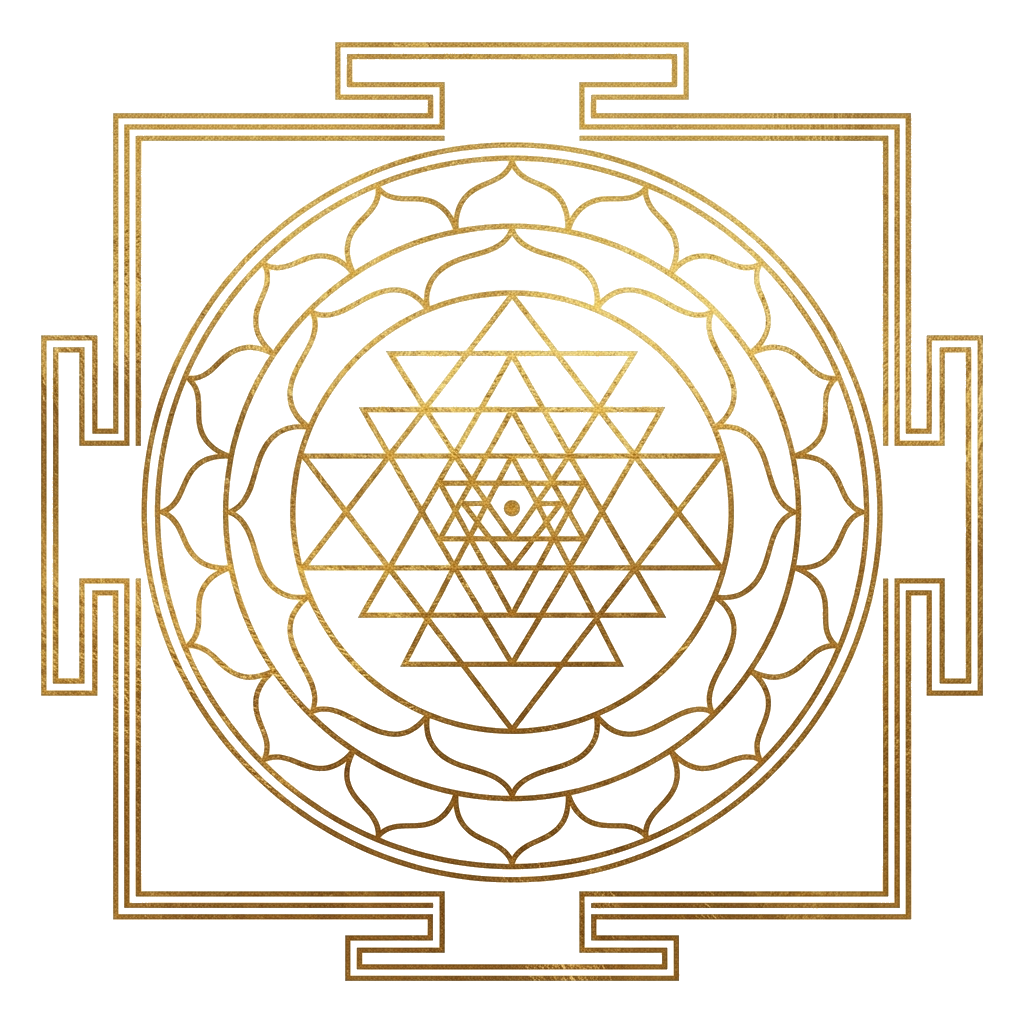
Sri Yantra
The queen of yantras — nine interlocking triangles forming 43 smaller triangles around a central bindu, mapping the entire process of cosmic creation and dissolution in sacred geometry.
About Sri Yantra
The Sri Yantra — also called Sri Chakra — consists of nine interlocking triangles radiating from a central point (bindu), generating 43 smaller triangles in a geometry so precise that its correct construction remains a challenge even for modern mathematicians. Its construction is a feat of sacred geometry: nine interlocking triangles, precisely positioned so that they create exactly 43 smaller triangles, all radiating from a single dimensionless point at the center called the bindu. Four triangles point upward, representing Shiva (consciousness, the masculine principle, the ascending force). Five triangles point downward, representing Shakti (creative power, the feminine principle, the descending force). Their interpenetration is the visual thesis of the entire tradition: that reality arises from the union of consciousness and energy, stillness and movement, the unmanifest and the manifest.
The Sri Yantra is not merely decorative or devotional. It is a complete cosmological map — a two-dimensional projection of the process by which the One becomes the many, and by which the many return to the One. Every element of its design encodes a teaching. The bindu is the source-point before creation. The innermost triangle is the first differentiation. The successive layers of triangles represent progressive stages of manifestation, each more complex than the last, until the outermost square boundary (the bhupura) represents the fully material world. To meditate on the Sri Yantra is to retrace this process — to move from the periphery of ordinary experience back toward the still center from which everything arose.
In the Shri Vidya lineage — the primary tradition that works with this yantra — the Sri Yantra is inseparable from the goddess Lalita Tripurasundari, the 'Beautiful One of the Three Cities.' She is not separate from the yantra; the yantra is her body. Each of its circuits corresponds to a group of her attendant deities (the avarana devatas), each governing a specific power, quality, or level of reality. The entire tradition of Shri Vidya worship — one of the most sophisticated systems of ritual, mantra, and meditation in Hinduism — centers on this single diagram.
The antiquity of the Sri Yantra is debated. Some scholars trace its origins to the Atharva Veda and the early Tantric period (c. 3000-1500 BCE). Others place its systematic codification later, in the medieval Tantric texts such as the Saundarya Lahari attributed to Adi Shankaracharya (8th century CE) and the Yogini Hridaya (c. 10th-13th century CE). What is not debated is its centrality: across centuries and lineages, the Sri Yantra has remained the supreme yantra, referenced, revered, and practiced from the Himalayan monasteries to the temples of Tamil Nadu.
Visual Description
At the center of the Sri Yantra lies the bindu — a single point, dimensionless and without extension, representing the seed of all creation, the place where Shiva and Shakti are undifferentiated. This is not merely a geometric starting point but the metaphysical origin: consciousness before it moves, potential before it manifests.
Surrounding the bindu are nine interlocking triangles. Four point upward (Shiva triangles), representing the masculine principle — pure consciousness, the ascending impulse, the witness. Five point downward (Shakti triangles), representing the feminine principle — creative energy, the descending impulse, manifestation. These nine triangles are not placed arbitrarily; they interlock with mathematical precision to produce exactly 43 smaller triangles arranged in five concentric rings (called chakras or circuits). The innermost ring contains a single triangle (the trikona), and successive rings contain 8, 10, 10, and 14 triangles respectively. This geometry is extraordinarily difficult to draw accurately by hand — the precise placement of the nine triangles such that all intersections are clean (no near-misses or overlaps) has been a subject of mathematical study for centuries.
Encircling the 43 triangles are two concentric rings of lotus petals. The inner ring contains 8 petals and the outer ring contains 16 petals. In the Shri Vidya tradition, these represent groups of presiding deities and specific creative powers (shaktis). The 8-petal lotus corresponds to the activities of speech, grasping, locomotion, excretion, enjoyment, repulsion, attraction, and equanimity. The 16-petal lotus corresponds to the fulfillment of desire and the 16 vowels of the Sanskrit alphabet — the matrikas, or mother-sounds from which all language and therefore all creation flows.
The outermost boundary is the bhupura — a square frame with four T-shaped gates (one on each side), oriented to the cardinal directions. The bhupura represents the earth plane, the material world, the outermost layer of manifestation. It is both a boundary and an invitation: the gates open inward, marking the thresholds through which the practitioner enters the yantra. The bhupura is where meditation begins — at the periphery of experience — and the bindu is where it ends, or rather, where all distinctions dissolve.
The Sri Yantra can be rendered as a flat two-dimensional diagram, but it also has a three-dimensional form called the Meru, in which the triangles rise in stepped pyramidal layers toward the bindu at the apex. Some temples house massive Meru yantras carved from stone or crystal. The three-dimensional form makes visible what the flat form encodes: the yantra is not flat — it is a mountain of consciousness, with the summit at the center.
Esoteric Meaning
The 43 triangles of the Sri Yantra are not merely geometric — they are a complete map of manifestation, a visual encoding of how the One becomes the many. In Shri Vidya theology, each of the five concentric rings of triangles (called chakras or avaranas, meaning 'enclosures') represents a distinct level of reality, governed by a specific group of deities and associated with particular powers, tattvas (principles of reality), and states of consciousness.
The outermost enclosure — the bhupura with its three concentric lines — is called Trailokya Mohana Chakra, the 'wheel that enchants the three worlds.' It governs the initial stages of attraction and delusion. The practitioner begins here, surrounded by the eight matrikas (mother-goddesses) and the ten mudra shaktis. This is the layer of ordinary experience — the world as it appears before spiritual practice reveals its deeper structure.
Moving inward through successive enclosures — the 16-petal lotus (Sarva Asha Paripuraka, 'fulfiller of all desires'), the 8-petal lotus (Sarva Sankshobhana, 'agitator of all'), the 14-triangle ring (Sarva Saubhagya Dayaka, 'bestower of all good fortune'), the outer 10-triangle ring (Sarva Artha Sadhaka, 'accomplisher of all aims'), the inner 10-triangle ring (Sarva Raksha Kara, 'protector of all'), and the 8-triangle ring (Sarva Rogahara, 'remover of all disease') — the practitioner encounters progressively subtler levels of reality. Each enclosure has its presiding deity, its yogini attendants, its associated mantras and ritual offerings.
The innermost triangle — Sarva Siddhi Prada, 'bestower of all attainments' — contains only the three primary goddesses of Shri Vidya: Kameshvari, Vajreshvari, and Bhagamalini. And within that triangle sits the bindu, ruled by Lalita Tripurasundari herself — the supreme goddess who is both the totality of the yantra and the point that transcends it.
The bindu is the crux of the entire esoteric system. It is para bindu — the supreme point, identical with turiya (the fourth state beyond waking, dreaming, and deep sleep), identical with Brahman, identical with the Self. The journey from the bhupura to the bindu is the journey from multiplicity to unity, from ignorance to knowledge, from the surface of experience to its source. This is not metaphor — in the Shri Vidya tradition, this journey is practiced daily through navavarana puja, a systematic ritual worship that moves through all nine enclosures, offering mantras, mudras, and visualization at each level.
The Sri Yantra also encodes the 36 tattvas (categories of reality) of Kashmir Shaivism and the Tantric cosmology — from Shiva and Shakti at the apex, through the principles of will (iccha), knowledge (jnana), and action (kriya), down through mind, senses, elements, and matter. The entire universe is contained in the yantra. To know the yantra fully is to know the structure of reality itself.
Exoteric Meaning
In popular Hindu culture, the Sri Yantra is recognized as the most auspicious and powerful of all geometric symbols. It is widely associated with Lakshmi, the goddess of abundance, prosperity, and spiritual wealth, and is commonly placed in homes, businesses, and temples as a magnet for good fortune and divine grace.
Beyond its association with material prosperity, the Sri Yantra represents harmony, completeness, and the fundamental order of the cosmos. Its perfect geometric balance — masculine and feminine, ascending and descending, center and periphery — communicates an ideal of wholeness that resonates across cultures and contexts. It is often described as a visual representation of the sacred sound Om, with the bindu corresponding to the silence that follows the syllable and the expanding triangles corresponding to the vibration that radiates outward.
For many practitioners who do not engage with the full Shri Vidya system, the Sri Yantra serves as a powerful focus for meditation and contemplation. Its intricate geometry naturally draws the eye inward toward the center, providing an organic support for the meditative process of turning attention from the outer world toward inner stillness. Even without knowledge of the specific deities and mantras associated with each enclosure, the yantra's visual structure communicates the teaching directly: reality has layers, and beneath all complexity lies a unified source.
The Sri Yantra has also gained recognition in the modern wellness, sacred geometry, and consciousness movements as a universal symbol of creation and interconnection. Researchers have noted its mathematical properties — including connections to the golden ratio, fractal geometry, and wave interference patterns — which have brought it attention from mathematicians, physicists, and designers alongside spiritual practitioners.
Usage
Meditation and Contemplation
The most traditional use of the Sri Yantra is as a support for meditation (dhyana). The practitioner gazes at the yantra (a practice called trataka when done with fixed, unblinking gaze) and allows the eye to be drawn naturally from the outer boundary toward the center. This visual journey mirrors the inner journey of withdrawing attention from sensory experience and directing it toward the source of consciousness. Advanced practitioners internalize the yantra, visualizing it within the body — often at the heart center or the ajna (third eye) — and perform the entire meditation with eyes closed.
Navavarana Puja (Nine-Enclosure Worship)
In the Shri Vidya tradition, the Sri Yantra is the central object of the most elaborate and comprehensive puja (worship ritual) in Hinduism. The navavarana puja systematically worships each of the nine enclosures, invoking the presiding deities of each level with specific mantras, mudras (hand gestures), and offerings. A complete navavarana puja can take several hours and requires initiation (diksha) from a qualified guru in the Shri Vidya lineage. This practice is considered the highest form of Shakta worship.
Mantra Practice
The Sri Yantra is the visual counterpart of the Panchadashi (15-syllable) and Shodashi (16-syllable) mantras — the central mantras of Shri Vidya. Practitioners who have received these mantras often meditate on the yantra while reciting them, or visualize the syllables of the mantra placed at specific locations within the yantra. The relationship between yantra, mantra, and deity (tantra) is considered inseparable — the three are different expressions of the same reality.
Vastu Shastra and Architecture
In Vastu Shastra (the Vedic science of architecture and spatial arrangement), the Sri Yantra is placed at the center or entrance of buildings to harmonize the energies of the space. Temples throughout India incorporate the Sri Yantra into their ground plans, with the garbhagriha (sanctum sanctorum) corresponding to the bindu. The layout of some temple complexes — with concentric enclosures, gateways, and a central shrine — directly mirrors the structure of the Sri Yantra.
Personal Practice and Daily Worship
Many Hindu households keep a Sri Yantra — typically engraved on a copper, silver, or gold plate, or carved from crystal — on their home altar. Regular offerings of flowers, incense, and kumkum (red turmeric) are made to the yantra as a form of goddess worship. During festivals associated with the Divine Feminine — particularly Navaratri, Diwali, and Fridays (sacred to Lakshmi and the goddess tradition) — the Sri Yantra receives special worship.
In Architecture
The Sri Yantra's influence on Indian temple architecture is profound and pervasive. The classic South Indian temple — with its concentric enclosures (prakaras), towering gateways (gopurams), and innermost sanctum (garbhagriha) — is a three-dimensional Sri Yantra built in stone. The devotee entering through the outermost gate and proceeding through successive enclosures toward the image in the innermost chamber is performing the same journey depicted in the yantra: from the bhupura to the bindu, from the manifest to the unmanifest, from the world to God.
Specific examples include the Kamakshi Amman Temple in Kanchipuram, one of the most important Shri Vidya centers in India, where the Sri Yantra is installed in the sanctum and the temple layout follows the yantra's geometry. The Sringeri Sharada Peetham, established by Adi Shankaracharya, houses an ancient Sri Yantra that remains a focus of daily worship. The Meru-form Sri Yantra — the three-dimensional stepped-pyramid version — has been installed in temples and sacred sites worldwide, including the Parashakthi Temple in Pontiac, Michigan, which houses one of the largest Sri Meru Yantras outside India.
Beyond specific temples, the Sri Yantra influenced the broader Vastu Shastra tradition of sacred architecture. The Vastu Purusha Mandala — the grid used to lay out buildings according to Vastu principles — shares the Sri Yantra's logic of concentric zones radiating from a sacred center. Even secular buildings designed according to Vastu principles echo the yantra's organization: the most private, sacred space at the center (the brahmasthan), surrounded by progressively more public zones, with gateways controlling transitions between levels.
The Sri Yantra has also appeared in contemporary architecture and design, from the layout of modern meditation halls to the design of public spaces intended to evoke contemplation and centeredness.
Significance
Within the Hindu and Tantric traditions, the Sri Yantra is not one yantra among many — it is the supreme geometric form, the visual equivalent of Om. Within the Hindu and Tantric traditions, it is not one yantra among many — it is the yantra, the supreme geometric form that contains all others. Every other yantra in the tradition can be understood as a simplified or specialized version of the Sri Yantra, focused on a particular deity or purpose. The Sri Yantra encompasses them all.
Its significance extends beyond the Shri Vidya lineage to virtually every branch of Hindu thought and practice. Adi Shankaracharya, the great Advaita Vedantin, is credited with composing the Saundarya Lahari — a 100-verse hymn to the Divine Feminine that describes the Sri Yantra in exquisite detail — demonstrating that even the most rigorous non-dualist philosophy found expression through this diagram. The tension between Shankara's Advaita philosophy (all is Brahman, without form or quality) and his Shri Vidya practice (elaborate worship of the goddess through form, mantra, and yantra) has been a rich subject of Indian philosophical discourse for over a millennium.
In the contemporary world, the Sri Yantra has become one of the most recognized symbols of Indian civilization, alongside Om and the lotus. Its mathematical properties have attracted serious attention from researchers: studies have explored its connections to the golden ratio, the Fibonacci sequence, standing wave patterns, and cymatics (the study of visible sound). Some researchers have noted that when certain frequencies are applied to a tonoscope, the resulting patterns resemble the Sri Yantra — a finding that resonates with the Tantric teaching that yantra (visual form) and mantra (sound) are expressions of the same underlying reality.
Perhaps most significantly, the Sri Yantra embodies a worldview in which the feminine is supreme. The five downward-pointing Shakti triangles outnumber the four upward-pointing Shiva triangles. The presiding deity is a goddess. The entire system privileges creative power (shakti) over static consciousness (shiva) — not by denying consciousness, but by recognizing that without energy, consciousness remains inert and unexpressed. This Shakta perspective, encoded in the geometry itself, represents one of humanity's most sophisticated theological statements about the relationship between being and becoming.
Connections
The Sri Yantra connects to multiple streams of knowledge within the Satyori Library:
Chakra System — The nine enclosures of the Sri Yantra correspond to the chakra system. Traditional commentaries map the outer enclosures to the lower chakras and the inner enclosures to the higher ones, with the bindu corresponding to Sahasrara (the crown) or the point beyond all chakras. The navavarana puja can be understood as a systematic activation of all energy centers.
Meditation Traditions — The Sri Yantra is one of the most powerful supports for meditation across traditions. Its use in trataka (fixed-gaze meditation), visualization, and internalization practices connects it to the broader family of concentration techniques found in yoga, Buddhism, and other contemplative paths.
Vedic Textual Tradition — The Sri Yantra is referenced and elaborated in numerous texts within the Upanishadic and Tantric traditions, including the Tripura Upanishad, the Yogini Hridaya, the Nityashodashikarnava, and the Saundarya Lahari.
Sacred Geometry Across Traditions — The Sri Yantra's geometric principles find remarkable parallels in other traditions. The Pythagorean tetraktys — 10 points arranged in a triangle, representing the generation of dimensions from point to line to plane to solid — encodes a similar cosmogonic sequence through geometry. The Kabbalistic Tree of Life maps 10 emanations (sefirot) in a pattern of descent from unity to multiplicity. The Flower of Life, found from ancient Egypt to medieval Europe, generates complex form from the repetition of a single circle, just as the Sri Yantra generates 43 triangles from 9. These are not cases of direct historical transmission (though that cannot be ruled out) but of independent discovery of universal geometric truths about the relationship between unity and multiplicity, simplicity and complexity.
Sound and Vibration — The inseparability of yantra and mantra in the Shri Vidya tradition anticipates modern discoveries in cymatics and acoustic resonance. The Panchadashi and Shodashi mantras are the 'sound body' of the Sri Yantra. This relationship between geometric form and vibratory frequency connects the yantra to the broader study of sound healing, mantra science, and the physics of resonance.
Further Reading
- Saundarya Lahari attributed to Adi Shankaracharya — the most celebrated hymn describing the Sri Yantra and the goddess Lalita Tripurasundari, with extensive commentaries by numerous scholars across centuries.
- Yogini Hridaya (c. 10th-13th century CE) — one of the primary Tantric texts of the Shri Vidya tradition, containing detailed instructions for Sri Yantra worship and the inner meaning of each enclosure.
- Nityashodashikarnava — a companion text to the Yogini Hridaya, detailing the ritual worship of the 16 nitya (eternal) goddesses associated with the Sri Yantra.
- Douglas Renfrew Brooks, The Secret of the Three Cities: An Introduction to Hindu Shakta Tantrism (1990) — an accessible scholarly introduction to the Shri Vidya tradition and its relationship to the Sri Yantra.
- Subhash Kak, 'The Great Goddess Lalita and the Sri Chakra' — explores the mathematical and astronomical dimensions of the Sri Yantra from the perspective of a physicist and historian of Indian science.
- Madhu Khanna, Yantra: The Tantric Symbol of Cosmic Unity (1979) — a comprehensive study of yantras in the Hindu and Buddhist traditions, with extensive treatment of the Sri Yantra.
Frequently Asked Questions
What does the Sri Yantra symbolize?
The 43 triangles of the Sri Yantra are not merely geometric — they are a complete map of manifestation, a visual encoding of how the One becomes the many. In Shri Vidya theology, each of the five concentric rings of triangles (called chakras or avaranas, meaning 'enclosures') represents a distinct level of reality, governed by a specific group of deities and associated with particular powers, tattvas (principles of reality), and states of consciousness.
Where does the Sri Yantra originate?
The Sri Yantra originates from the Hindu Tantric (Shri Vidya tradition, associated with the goddess Lalita Tripurasundari) tradition. It dates to c. 3000 BCE — present (debated). It first appeared in Indian subcontinent.
How is the Sri Yantra used today?
The most traditional use of the Sri Yantra is as a support for meditation (dhyana). The practitioner gazes at the yantra (a practice called trataka when done with fixed, unblinking gaze) and allows the eye to be drawn naturally from the outer boundary toward the center. This visual journey mirrors the inner journey of withdrawing attention from sensory experience and directing it toward the source of consciousness. Advanced practitioners internalize the yantra, visualizing it within the body — often at the heart center or the ajna (third eye) — and perform the entire meditation with eyes closed.