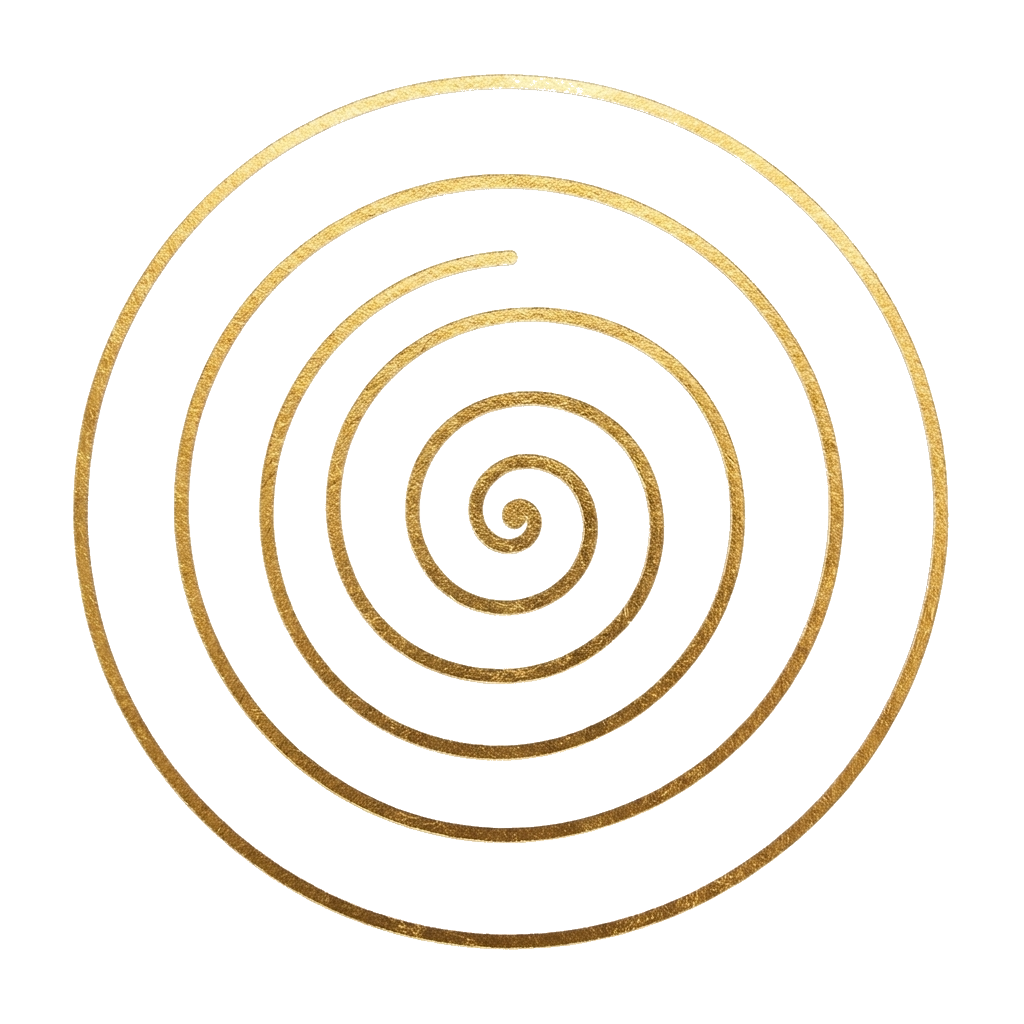
Spiral
The oldest and most universal decorative motif in human art — carved into Neolithic stones, encoded in galaxies and DNA, representing the fundamental pattern of growth, evolution, and return.
About Spiral
The spiral predates written language by tens of thousands of years. It appears carved into megalithic passage tombs in Ireland, painted on Aboriginal rock shelters in Australia, woven into Pueblo pottery in the American Southwest, and inscribed on temple walls from Malta to Mesopotamia. No culture had to borrow it from another — the spiral emerged independently wherever human beings looked at the world and tried to record what they saw.
This universality is not coincidental. The spiral is not an abstraction; it is an observation. It appears in the growth pattern of shells and ferns, in the structure of hurricanes and galaxies, in the cochlea of the inner ear, and in the double helix of DNA itself. When Neolithic humans carved spirals into stone, they were recording something they recognized as fundamental to the fabric of existence — a pattern that connects the infinitely small to the infinitely large.
Across every tradition that has used it, the spiral carries a consistent core meaning: growth that does not simply repeat, but evolves. A circle returns to where it began, but a spiral returns to the same point at a different level. This distinction — between mere repetition and genuine evolution — sits at the heart of the spiral's enduring power as a symbol of consciousness, transformation, and the unfolding of life itself.
The spiral has never fallen out of use. From the carved kerbstones of Newgrange (c. 3200 BCE) to the Fibonacci sequences studied by Renaissance mathematicians to the double helix discovered by Watson and Crick in 1953, this symbol continues to reveal new dimensions of meaning as human understanding deepens. It is one of the few symbols that belongs equally to art, science, mathematics, and spirituality.
Visual Description
The single spiral is the most basic form: a line that curves outward from a central point in an ever-widening arc, or inward from the periphery toward the center. Single spirals appear carved into Neolithic stones across Europe, scratched onto cave walls, and painted on pottery from every inhabited continent. They can wind clockwise (sunwise, associated with expansion and outward movement in many traditions) or counterclockwise (moonwise, associated with introspection and inward journeying). The direction of the winding often carried ritual significance — clockwise spirals at Newgrange face the winter solstice sunrise, suggesting deliberate solar alignment.
The double spiral (or S-spiral) connects two single spirals at their centers, creating a continuous line that flows outward in one direction and then reverses, flowing outward in the opposite direction. This form appears prominently in Minoan art, Chinese jade carvings, and Maori ta moko (facial tattoos). The double spiral represents the balance of opposing forces — expansion and contraction, birth and death, the inbreath and the outbreath. In Celtic tradition, it symbolized the equinoxes, when day and night stand in perfect balance before one overtakes the other.
The triple spiral (triskele or triskelion) is three interlocking spirals radiating from a shared center. The most famous example is carved into the entrance stone at Newgrange in Ireland, where it was positioned so that the winter solstice sunrise illuminates the chamber behind it. The triple spiral appears across Celtic, Mycenaean, and Sicilian art. Its three arms have been interpreted as land-sea-sky, birth-life-death, maiden-mother-crone, and the three realms of Celtic cosmology. The triskele later became one of the central symbols of Celtic Christianity, reinterpreted as the Trinity.
The Fibonacci spiral (or golden spiral) is a mathematically precise form in which each quarter-turn expands by the golden ratio (approximately 1.618). This spiral appears in the nautilus shell, the arrangement of sunflower seeds, the branching of trees, the curve of ocean waves, and the arm structure of spiral galaxies. First described mathematically by Leonardo of Pisa (Fibonacci) in 1202 CE, the pattern itself has been recognized aesthetically for millennia — Greek architects used golden ratio proportions in the Parthenon, and Hindu temple builders encoded related ratios into their sacred geometry long before the mathematics were formalized.
Esoteric Meaning
The deepest esoteric significance of the spiral lies in a single distinction: it is not a circle. A circle returns to its starting point unchanged. A spiral returns to the same angular position at a different radius — the same place, but at a higher or deeper level. This is the difference between repetition and evolution, between samsara as endless cycling and samsara as the field in which liberation unfolds. Every wisdom tradition that works with cycles — the Vedic yugas, the Buddhist wheel of becoming, the alchemical opus — encodes this spiral understanding: you will pass through the same territory again, but you are not the same being who passed through it before.
In Hindu and yogic tradition, the spiral is most powerfully expressed as kundalini — the coiled serpent energy said to rest at the base of the spine, wound three and a half times around the muladhara chakra. The awakening of kundalini is described as an uncoiling, a spiral ascent through progressively subtler energy centers. This is not linear progress — it is spiral progress. Practitioners routinely describe returning to issues they thought resolved, only to encounter them at a deeper, more refined level. The spiral path of kundalini teaches that genuine spiritual evolution is not about leaving things behind but about engaging with them more completely at each pass.
In the Western esoteric tradition, the spiral maps onto the ouroboros extended into three dimensions. The ouroboros — the serpent eating its own tail — represents the cycle of creation and destruction on a single plane. But pull that circle along a vertical axis and it becomes a spiral: the same process of self-consumption and self-renewal, now with a directional component. This is the alchemical understanding of transformation — the solve et coagula (dissolve and reconstitute) does not return you to the same state, but reconstitutes you at a higher order of integration.
The golden ratio embedded in the Fibonacci spiral has long been understood as evidence of a mathematical intelligence pervading nature. The Pythagoreans considered this ratio sacred — a signature of divine proportion in all created forms. In Islamic geometry, spiral patterns and golden ratio constructions were used to create art that reflected the infinite without depicting any finite form, honoring the prohibition against representational imagery while expressing the beauty of divine mathematics. The spiral, in this reading, is not merely a symbol of the sacred — it is a direct manifestation of the organizing principle underlying all form.
In Celtic esotericism, the triple spiral at Newgrange encodes a cosmological teaching about the three worlds (land, sea, sky) and the movement of consciousness between them. The winter solstice alignment suggests that the spiral was understood as a portal — a threshold between ordinary time and sacred time, between the manifest world and the source from which it continually emerges. To walk the spiral was to move between worlds, to access states of consciousness not available through linear movement.
Exoteric Meaning
In its most accessible meaning, the spiral represents growth, change, and the natural unfolding of life. It is the pattern people see when they watch a fern uncurl in spring, when they trace the whorls of a seashell picked up on a beach, when they notice the way water swirls down a drain. The spiral says: things do not stay still, they do not move in straight lines, and they do not simply go in circles. They expand, they develop, they return to familiar ground but always with something new.
Culturally, the spiral appears in contexts of journey and transformation. Aboriginal Australian peoples use spiral motifs to represent waterholes, journeys across country, and the movements of ancestral beings during the Dreamtime. In these contexts, the spiral is a map — both of physical space and of the sacred geography that underlies it. Greek decorative art used spirals extensively on pottery and architectural elements, where they represented the sea (the wave pattern being a series of connected spirals) and the continuity of natural cycles.
In modern popular culture, the spiral has become associated with creativity, meditation, and personal development. Labyrinth walking — which follows a spiral path to a center and back out — has been adopted by hospitals, retreat centers, and churches as a contemplative practice. The spiral is used in logos, architectural design, and visual art to suggest dynamism, organic growth, and forward movement. Its widespread use reflects an intuitive human recognition that growth is not linear — we circle back, we revisit, we deepen.
Usage
The spiral has been used as a sacred and ceremonial symbol across virtually every culture that has left artistic records. In Neolithic Europe, spirals were carved into the stones of megalithic tombs and passage graves — sites that marked the boundary between the living world and the world of the dead. At Newgrange in Ireland, spirals were carved on entrance stones, passage walls, and ceiling corbels, apparently to mark the site as a threshold between realms. At the Tarxien temples in Malta, spirals were carved into altar stones where animal sacrifice and ritual offerings took place.
Aboriginal Australians have used spiral motifs in rock art and body painting for at least 20,000 years. In this tradition, spirals represent waterholes, campsites, and the coiling movements of ancestral serpent beings who shaped the landscape during the Dreamtime. A spiral painted on the body during ceremony connects the wearer to these ancestral forces and to the specific places in the landscape where their energy is concentrated.
In Hindu and Buddhist temple architecture, spiral motifs appear in column capitals, ceiling decorations, and mandala designs. The conch shell (shankha) — which is a natural spiral — is one of the eight auspicious symbols of Buddhism and one of the emblems of Vishnu in Hindu iconography. Blowing the conch in ceremony is understood as sounding the spiral, calling energy to move from periphery to center.
In contemporary practice, the spiral is used in labyrinth walking, meditation visualization, and energy healing. Practitioners trace spiral patterns in the air over the body to move stagnant energy, or walk spiral paths as moving meditation. Artists, architects, and designers draw on spiral forms to create spaces and objects that feel organic, dynamic, and alive. The spiral appears in corporate logos, public art, and urban planning — wherever designers want to evoke natural growth and continuous development.
In Architecture
Newgrange, Ireland (c. 3200 BCE) — The most famous spiral carvings in the world adorn the entrance stone, passage walls, and inner chamber of this Neolithic passage tomb in the Boyne Valley. The entrance stone bears a striking arrangement of double and triple spirals that have resisted definitive interpretation for centuries. The fact that the inner chamber is illuminated by the winter solstice sunrise — a beam of light that travels 19 meters down the passage to strike the back wall — suggests that the spirals were placed in deliberate relationship to astronomical events. Newgrange predates the Egyptian pyramids by approximately 500 years and Stonehenge by roughly 1,000 years.
Tarxien Temples, Malta (c. 3150 BCE) — The megalithic temple complex at Tarxien contains some of the most elaborate spiral carvings in the Mediterranean. Spirals are carved into altar stones, threshold slabs, and the bases of large statuary. The Maltese temples are among the oldest freestanding stone structures in the world, and their spiral decorations appear to mark ritual spaces — altars, offering places, and transitions between different areas of the temple. The spirals at Tarxien are particularly notable for their precision and symmetry, suggesting the use of standardized tools and deliberate geometric planning.
Aboriginal Australian rock art (c. 20,000+ years) — Spiral engravings and paintings appear at rock art sites across the Australian continent, from Kakadu in the Northern Territory to the Burrup Peninsula in Western Australia. These are among the oldest spiral artworks in the world. In Aboriginal tradition, spiral rock art marks places of spiritual power — waterholes where ancestral beings reside, campsites along Dreamtime songlines, and ritual sites where ceremonies connect the present to the deep past. The age and continuity of these traditions makes Aboriginal spiral art the longest unbroken spiral-carving tradition on Earth.
Spiral Minaret of Samarra, Iraq (851 CE) — The Great Mosque of Samarra features a malwiya (spiral) minaret that rises 52 meters in a conical spiral ramp. This is the spiral made architectural — a building you climb by walking a spiral path. The physical experience of ascending the minaret enacts the symbolic meaning of the spiral: continuous upward movement through repeated circuits.
Guggenheim Museum, New York (1959) — Frank Lloyd Wright's design for the Solomon R. Guggenheim Museum is a modern spiral made habitable. Visitors ride an elevator to the top and descend along a continuous spiral ramp, viewing art as they go. Wright described the building as an 'optimistic ziggurat' — a reference to the ancient stepped pyramids of Mesopotamia, reimagined as a smooth, flowing spiral. The building demonstrates that the spiral remains a living architectural form, not merely an archaeological curiosity.
Significance
Carved into Neolithic passage tombs in Ireland, painted on Aboriginal rock shelters in Australia, woven into Navajo textiles, incised on Shang dynasty bronzes — the spiral appears independently in virtually every culture, on every inhabited continent, across every era of human history. Neither the cross, the circle, nor the triangle can claim this breadth. This universality demands explanation, and the most compelling one is also the simplest: the spiral is not an invention. It is a recognition.
Humans did not devise the spiral. They observed it — in the growth of shells and horns, in the movement of water and wind, in the structure of plants and the paths of celestial bodies. They then recorded what they saw. The fact that Neolithic Irish farmers, Aboriginal Australian custodians, ancient Maltese temple builders, and pre-Columbian Pueblo potters all independently chose to carve and paint the same pattern suggests that the spiral carries a meaning that transcends cultural context. It points to something about the structure of reality that human beings, regardless of their specific traditions, reliably perceive.
In the modern era, science has confirmed what these ancient observers intuited. The spiral is a fundamental pattern of organization in nature — from the molecular structure of DNA to the large-scale structure of galaxies. The golden ratio that governs the Fibonacci spiral appears in phyllotaxis (the arrangement of leaves), in the proportions of the human body, and in the mathematics of population growth. The spiral is not merely a pretty shape. It is one of nature's primary algorithms — a pattern that governs how things grow, how energy moves, and how complex systems self-organize.
For seekers and practitioners, the spiral offers a model of development that is both honest and encouraging. Linear models of growth — the idea that you should always be moving forward, always progressing, never revisiting old ground — set people up for disappointment and self-judgment when they inevitably circle back to familiar struggles. The spiral teaches a different lesson: returning to the same territory is not failure. It is the mechanism of deepening. Each pass through brings greater understanding, subtler perception, and more complete integration. The spiral does not promise escape from difficulty. It promises that difficulty, engaged with fully, transforms the one who engages.
Connections
The spiral connects to an extraordinary range of concepts across the Satyori library. In Ayurveda, the spiral appears in the concept of prakriti — one's constitutional nature, which does not change but unfolds in spiral patterns of expression across seasons and life stages. The doshas do not simply cycle; they evolve in their expression as a person ages and deepens in self-knowledge.
In yoga and tantra, the spiral is central to the understanding of kundalini shakti — the coiled creative energy that awakens and ascends through the chakra system. The three-and-a-half coils of the dormant kundalini are literally a spiral, and its awakening is described as an uncoiling — a release of compressed potential into active, ascending movement.
In astrology — both Jyotish and Western — planetary cycles are understood not as circles but as spirals. Saturn returns every 29.5 years, but each Saturn return encounters a person who has been transformed by the previous cycle. The same planetary position, engaged at a different level of maturity. This is spiral logic applied to celestial mechanics.
In the 9 Levels framework, the spiral is perhaps the most apt structural metaphor. The levels do not represent a ladder to be climbed once; they represent a spiral of deepening integration. A person at Level 5 may revisit Level 2 material — not because they have regressed, but because they are now capable of engaging with it at a depth that was previously inaccessible. Growth spirals. It does not simply ascend.
In sacred geometry, the spiral connects directly to the golden ratio, the Fibonacci sequence, and the mathematical foundations that underlie both natural forms and deliberate sacred architecture. In sound healing, the cochlea of the inner ear — a spiral structure — is the organ through which all sound enters consciousness, making the spiral literally the gateway of auditory perception.
Further Reading
- The Power of Limits: Proportional Harmonies in Nature, Art, and Architecture — Gyorgy Doczi
- Sacred Geometry: Philosophy and Practice — Robert Lawlor
- The Golden Ratio: The Story of Phi, the World's Most Astonishing Number — Mario Livio
- Newgrange: Archaeology, Art and Legend — Michael J. O'Kelly
- The Spiral Dance — Starhawk
- A Beginner's Guide to Constructing the Universe — Michael S. Schneider
Frequently Asked Questions
What does the Spiral symbolize?
The deepest esoteric significance of the spiral lies in a single distinction: it is not a circle. A circle returns to its starting point unchanged. A spiral returns to the same angular position at a different radius — the same place, but at a higher or deeper level. This is the difference between repetition and evolution, between samsara as endless cycling and samsara as the field in which liberation unfolds. Every wisdom tradition that works with cycles — the Vedic yugas, the Buddhist wheel of becoming, the alchemical opus — encodes this spiral understanding: you will pass through the same territory again, but you are not the same being who passed through it before.
Where does the Spiral originate?
The Spiral originates from the Pre-civilizational; appears independently in Neolithic art across every inhabited continent tradition. It dates to c. 10,000 BCE — present. It first appeared in Worldwide — one of the oldest known symbols.
How is the Spiral used today?
The spiral has been used as a sacred and ceremonial symbol across virtually every culture that has left artistic records. In Neolithic Europe, spirals were carved into the stones of megalithic tombs and passage graves — sites that marked the boundary between the living world and the world of the dead. At Newgrange in Ireland, spirals were carved on entrance stones, passage walls, and ceiling corbels, apparently to mark the site as a threshold between realms. At the Tarxien temples in Malta, spirals were carved into altar stones where animal sacrifice and ritual offerings took place.