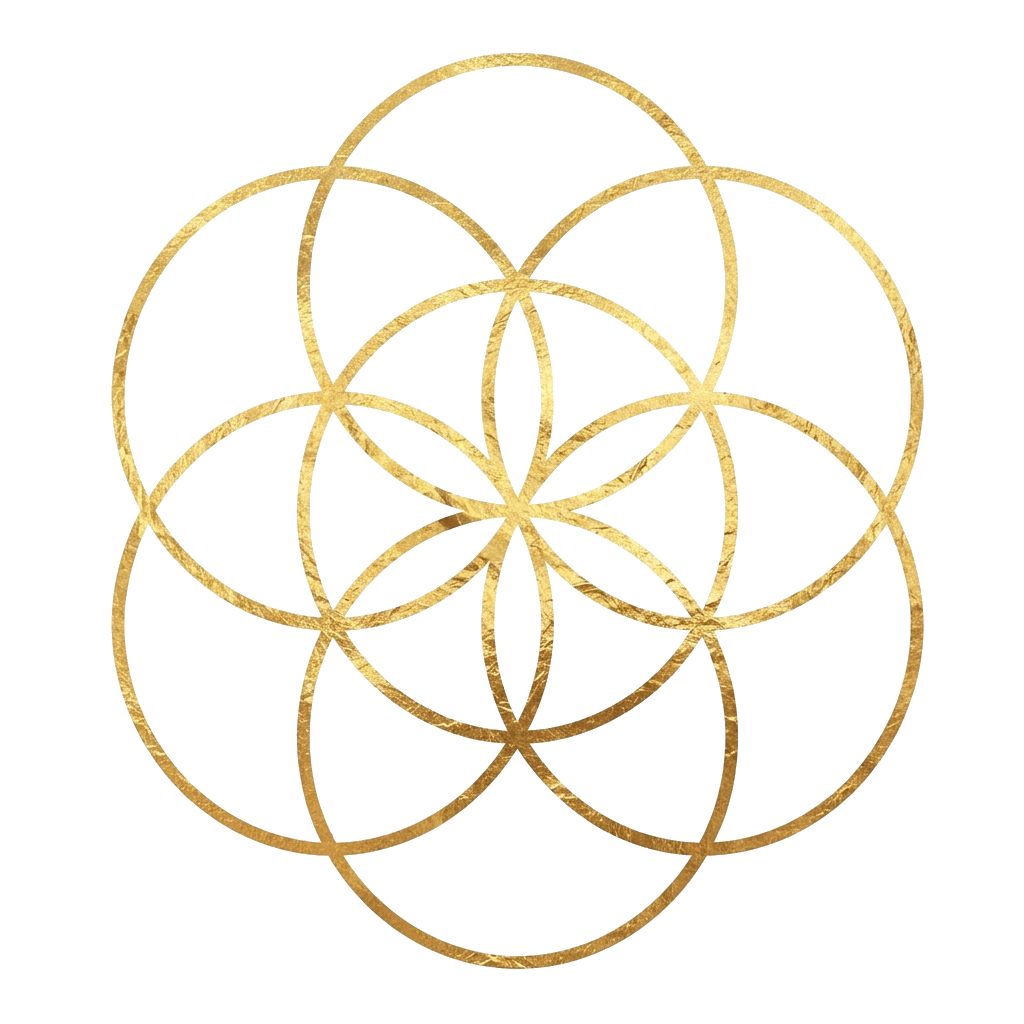
Seed of Life
Seven overlapping circles in sixfold symmetry — the genesis pattern from which the Flower of Life, Egg of Life, and all sacred geometric forms unfold, encoding the seven days of creation.
About Seed of Life
The Seed of Life is the foundational figure of sacred geometry — seven circles of identical radius arranged so that each outer circle's center rests on the circumference of the central circle, producing sixfold rotational symmetry and six perfectly formed vesicae piscis around the central point. It is the first complete geometric figure that emerges when a compass is used to systematically explore the relationships inherent in a single circle, and it carries the remarkable property of encoding, in embryonic form, every geometric relationship that the more complex Flower of Life and Metatron's Cube will later make explicit.
The pattern appears in sacred contexts across civilizations that had no known contact with one another — carved into temple walls in ancient Egypt, woven into Celtic knotwork, inscribed on synagogue floors, painted onto Chinese ceremonial objects, and embedded in Islamic geometric art. Its cross-cultural recurrence has generated enduring debate: some scholars attribute this to the pattern's mathematical inevitability (it is the natural result of compass-and-circle exploration), while others see evidence of a shared primordial geometric knowledge predating recorded history.
What distinguishes the Seed of Life from a mere geometric curiosity is its generative capacity. From this single figure of seven circles, the entire vocabulary of sacred geometry unfolds in a strict developmental sequence: the Seed generates the Flower of Life (19 circles), which generates the Fruit of Life (13 circles), which generates Metatron's Cube, which contains the two-dimensional projections of all five Platonic solids. The Seed is therefore not simply a symbol — it is the origin point of a geometric creation narrative, the first intelligible form to emerge from the act of drawing one circle and following where its geometry leads.
Visual Description
The construction begins with a single circle — the first act of geometry, the compass placed on a blank field and turned through 360 degrees. This central circle represents undifferentiated potential: a bounded space defined by a single radius, with no internal structure yet.
The second circle is drawn with its center on the circumference of the first, at any point, using the same radius. Where the two circles overlap, they create a vesica piscis — the almond-shaped lens that is the first derived form in all of sacred geometry. The vesica piscis is the womb shape, the generative space between two equal wholes, and its proportions encode the square roots of 2, 3, and 5, along with the foundations of the musical intervals.
The center of the third circle is placed at one of the two intersection points of the first two circles. This is not an arbitrary choice — it is the only geometrically determined position available, the point where the compass naturally finds purchase. The fourth, fifth, sixth, and seventh circles follow the same logic, each centered on an intersection of the central circle with the previous ring, moving around the circumference at 60-degree intervals until the ring closes.
The completed figure shows seven circles: one at the center and six surrounding it in perfect hexagonal arrangement. The visual effect is of a central rosette — six petals formed by the vesicae piscis, surrounding a perfect hexagonal space at the center. Twelve additional petal shapes radiate outward between the outer circles. The overall silhouette is a six-lobed form, reminiscent of a flower bud or an embryonic cell cluster at the morula stage.
The geometry is entirely self-referential: every measurement in the figure is derived from the single original radius. No new information has been introduced — only the consequences of that first circle have been systematically explored. This property of total self-derivation is central to the Seed's symbolic power.
Esoteric Meaning
In the Kabbalistic tradition, the seven circles of the Seed of Life correspond directly to the seven days of creation described in Genesis. The first circle is the primordial act — 'Let there be light' — the emergence of awareness from the void. Each subsequent circle represents a further day of differentiation: the separation of waters, the creation of land, the placement of celestial bodies, the emergence of living creatures, and the creation of humanity. The seventh circle closes the ring and inaugurates rest — Shabbat — the recognition that the creative act is complete and that the pattern has returned to its starting point.
This mapping is not merely metaphorical. In Kabbalistic geometry, the seven circles also correspond to the seven lower Sephiroth of the Tree of Life: Chesed (mercy), Gevurah (severity), Tiphereth (beauty), Netzach (victory), Hod (splendor), Yesod (foundation), and Malkuth (kingdom). The three upper Sephiroth — Kether, Chokmah, and Binah — exist prior to geometric manifestation, in the realm of pure potentiality. The Seed of Life therefore represents the moment when divine intention first takes spatial form, the bridge between the uncreated and the created.
In Hermetic philosophy, the Seed of Life encodes the principle of emanation — the Neoplatonic doctrine that reality proceeds from the One through successive stages of differentiation, each stage containing the whole while adding a new dimension of complexity. The single circle is the Monad; the vesica piscis of two circles is the Dyad (the birth of relationship and polarity); three circles introduce the Triad (the principle of mediation and harmony); and so on through the complete Heptad. Each stage is not a mere addition but a transformation — a new order of being emerging from the interactions of the previous stage.
The Egg of Life — a figure derived from the Seed by connecting the centers of the seven circles — produces a three-dimensional form identical to the eight-cell stage of embryonic cell division (the morula). This correspondence between geometric construction and biological development is one of the most striking features of the Seed of Life's esoteric significance. Initiatory traditions read this correspondence as evidence that the same creative intelligence that unfolds geometry also unfolds life — that the 'days of creation' are not historical events but ongoing processes, replicated every time a new organism begins to divide and differentiate.
In meditation practice, the Seed of Life serves as an object of contemplation for the creation sequence itself. The practitioner mentally constructs the figure circle by circle, attending to the moment when each new form emerges from the geometry of what already exists. The purpose is not intellectual understanding but direct perception: the meditator seeks to experience the creative principle as a living process rather than a finished product. Advanced practitioners report that sustained contemplation of the Seed of Life produces a felt sense of 'unfolding' — an intuitive grasp of how complexity arises from simplicity without any external intervention.
Exoteric Meaning
From a purely mathematical standpoint, the Seed of Life is the minimal figure that demonstrates hexagonal symmetry and circle packing — two of the most fundamental structures in geometry and physics. The hexagonal arrangement of equal circles is the densest possible packing in two dimensions, a fact with profound implications for crystallography, materials science, and molecular biology. When atoms, bubbles, cells, or any other roughly spherical objects are packed together under uniform pressure, they naturally settle into the hexagonal pattern that the Seed of Life illustrates.
The figure also serves as a gateway to the mathematics of ratio and proportion. The vesicae piscis formed by each pair of overlapping circles have a height-to-width ratio of the square root of 3 — one of the most important irrational numbers in geometry, governing the proportions of the equilateral triangle and the hexagon. The intersection points of the seven circles define the vertices of regular triangles, hexagons, and (with extension) all other regular polygons. A student who thoroughly understands the Seed of Life has, in effect, understood the generative grammar of plane geometry.
In biology, the Seed of Life pattern appears at the very beginning of multicellular life. After fertilization, a single cell (the zygote) divides into two, then four, then eight cells in a process called cleavage. At the eight-cell stage, the cells arrange themselves in a pattern geometrically identical to the Egg of Life (the three-dimensional form of the Seed's seven circles plus one). This is not a mystical claim but an observable fact of developmental biology, documented in embryology textbooks since the nineteenth century. The correspondence between the simplest geometric construction and the first moments of biological development remains one of the most thought-provoking intersections of mathematics and life science.
In design and ornamental art, the Seed of Life functions as a versatile compositional module. Its sixfold symmetry makes it naturally compatible with hexagonal tile patterns, rosette designs, and radial compositions. It has been used as a decorative element in every major artistic tradition, from the carved stone ornaments of Neolithic Europe to the geometric screens of Mughal architecture to the algorithmic pattern generation of contemporary digital design.
Usage
In contemporary spiritual and wellness practice, the Seed of Life is used as a meditation focus, energy grid template, and symbol of creative potential. Practitioners place it beneath crystals on healing grids, believing the pattern's geometry amplifies and organizes the stones' energetic properties. It appears on jewelry, tattoos, altar cloths, and wall hangings — often chosen by people at the beginning of a creative project or spiritual journey, as the symbol's association with genesis and origination makes it a natural emblem for new beginnings.
Crystal grid practitioners specifically favor the Seed of Life layout for intention-setting work. Seven stones are placed at the center and six outer positions, with additional stones sometimes placed at the vesica piscis intersection points. The geometry is believed to create a coherent field that supports manifestation, clarity of purpose, and the germination of ideas into form.
In sacred architecture and interior design, the Seed of Life appears as a floor medallion, ceiling rosette, door carving, and window tracery element. Its presence in a space is understood — in traditions from feng shui to Western geomancy — as establishing a harmonic geometric foundation. Some practitioners recommend placing Seed of Life images in creative workspaces, meditation rooms, or entryways where the energy of initiation and fresh potential is desired.
In art education and geometry instruction, the Seed of Life is one of the first constructions taught because it requires only a compass and demonstrates, in a single exercise, the principles of equal radius, intersection, rotational symmetry, and emergent form. Waldorf schools, Montessori programs, and classical liberal arts curricula all use the construction as an introduction to the beauty and logic of geometric relationships.
The symbol also features prominently in tattoo art and body adornment, where it is often chosen to represent wholeness, the interconnection of all things, or the creative power of the individual. Its clean, balanced geometry translates well to skin, and its layered circles offer opportunities for customization — practitioners sometimes embed personal symbols, initials, or elemental associations within the six outer circles.
In Architecture
The Seed of Life appears in some of humanity's oldest surviving sacred structures, though its specific instances are less individually famous than those of the Flower of Life — in part because the Seed, as a simpler figure, was more often used as a compositional element within larger decorative programs rather than displayed as a standalone symbol.
In ancient Egypt, Seed of Life motifs appear in tomb paintings and carved stone ornaments, particularly in contexts associated with creation, rebirth, and the afterlife. The figure's seven-circle structure resonated with Egyptian cosmology, which recognized seven souls or spiritual bodies (ba, ka, akh, etc.) and seven stages of the afterlife journey. At the Temple of Osiris at Abydos, where the famous Flower of Life is inscribed, the Seed of Life is implicitly present as the pattern's core — the first seven circles from which the larger figure was constructed.
In early Christian architecture, the six-petaled rosette form of the Seed of Life appears frequently in Romanesque and Byzantine church ornamentation — on baptismal fonts, tympana, column capitals, and floor mosaics. Its six-around-one structure was read as a symbol of the six days of creation surrounding the Sabbath, or of the six directions of space (up, down, north, south, east, west) centered on the divine presence. The rosette form of the Seed is one of the most common decorative motifs in European churches from the 6th through 12th centuries.
In Islamic geometric art, the Seed of Life serves as a starting scaffold for the construction of complex star-and-polygon tessellations. The six intersection points of the outer circles define the vertices of a regular hexagon, which is the foundational unit of many Islamic tiling patterns. Artisans working in the geometric tradition of the Islamic Golden Age used compass-and-straightedge constructions beginning with the Seed to generate the elaborate, infinitely repeating patterns that adorn mosques, madrasas, and palaces across the Muslim world — from the Alhambra in Granada to the Shah Mosque in Isfahan.
In Celtic art, the Seed of Life's interlocking circles appear as the basis for the characteristic knotwork and spiral designs of Insular art (c. 500-900 CE). The Book of Kells, the Lindisfarne Gospels, and carved stone crosses throughout Ireland and Scotland feature rosette patterns derived from the Seed's geometry. Celtic artisans exploited the pattern's property of continuous line flow — the way the circles weave over and under one another — to create the distinctive interlace patterns that symbolized eternity and the interconnection of all life.
In contemporary architecture, the Seed of Life has been incorporated into public art installations, building facades, and landscape design. Its clean mathematical structure makes it well-suited to parametric design and digital fabrication, and it appears in laser-cut screens, 3D-printed structural elements, and projected light installations in galleries and cultural centers worldwide.
Significance
The Seed of Life is simultaneously the simplest meaningful figure in sacred geometry and the source of all subsequent complexity. While the Flower of Life is more visually elaborate and Metatron's Cube more mathematically rich, neither can exist without the Seed. It is the irreducible starting point — the minimum number of circles required to establish hexagonal symmetry, generate the vesica piscis in all six orientations, and encode the proportional relationships that will unfold into the full geometric creation sequence.
This status as the 'first form' gives the Seed of Life its particular power as a symbol of origins, potential, and the creative act itself. In traditions from Kabbalah to Hermeticism to modern sacred geometry practice, the Seed represents the moment before manifestation becomes visible — the stage at which all possibilities are still contained in a single, coherent pattern. It is the blueprint before the building, the genome before the organism, the chord before the symphony.
Philosophically, the Seed of Life embodies one of the deepest questions in metaphysics: how does the many arise from the one? The construction process answers this question geometrically. Beginning with a single circle (unity, the One), the mere act of placing the compass on the circumference and drawing a second circle (creating relationship, the Two) initiates a chain of consequences that leads inevitably to the full complexity of the Flower, the Fruit, and the Platonic solids. No additional information is required — no new radius, no external template, no arbitrary decision. The complexity is wholly implicit in the original circle; the construction process merely makes it explicit.
This property of self-contained generativity has made the Seed of Life a symbol of profound importance for anyone engaged with questions of creativity, emergence, and the relationship between simplicity and complexity — whether they approach these questions through spiritual practice, mathematical inquiry, or artistic exploration. The Seed reminds us that the most fertile starting points are often the most minimal: not empty, but full of latent order waiting to unfold.
Connections
The Seed of Life is the entry point into the entire discipline of sacred geometry — the study of the mathematical relationships underlying natural forms, sacred architecture, and cosmological models. Every major figure in the sacred geometry canon can be derived from the Seed through systematic geometric extension, making it the conceptual root of the tradition.
In Kabbalistic thought, the Seed's seven circles map onto the seven lower Sephiroth of the Tree of Life and the seven days of creation. The pattern's geometry provides a spatial framework for understanding the Kabbalistic doctrine of emanation — the process by which the infinite (Ain Soph) contracts and differentiates to produce the ten Sephiroth and, through them, the manifest world. Scholars of Jewish mysticism have noted that the hexagonal geometry of the Seed also underlies the Star of David (Magen David), which can be constructed by connecting alternating intersection points of the six outer circles.
In Hermetic and Neoplatonic philosophy, the Seed of Life illustrates the principle that the cosmos proceeds from unity through successive stages of geometric elaboration. The Hermetic axiom 'as above, so below' finds geometric expression in the Seed's property of self-similarity: the same pattern appears at every scale of the construction, from the first vesica piscis to the completed figure. This fractal-like quality was understood by Renaissance Hermeticists as evidence that a single creative principle operates at all levels of reality.
In developmental biology, the Seed of Life's three-dimensional form (the Egg of Life) corresponds to the morula stage of embryonic cell division. This connection between geometric ideality and biological actuality fascinated early modern natural philosophers and continues to intrigue researchers working at the intersection of mathematics and biology. The implication — that living systems organize themselves according to the same geometric principles that govern abstract mathematical construction — remains one of the most suggestive and least fully explained phenomena in science.
In music theory, the proportional relationships encoded in the Seed's vesicae piscis correspond to the fundamental musical intervals. The ratio 1:2 (the octave), 2:3 (the perfect fifth), and 3:4 (the perfect fourth) can all be derived from the geometric relationships within the seven-circle figure. Pythagoras, who is credited with discovering the mathematical basis of musical harmony, reportedly studied these same geometric constructions — and the tradition of the 'music of the spheres' rests on the premise that the proportions governing geometric form and musical harmony are identical.
In modern physics and cosmology, hexagonal close-packing (the arrangement the Seed of Life illustrates) appears in contexts ranging from crystallography to the cosmic microwave background radiation. While the Seed itself is a mathematical abstraction, the packing geometry it represents is one of nature's most fundamental organizational strategies, appearing wherever efficiency and symmetry intersect.
Further Reading
- Sacred Geometry: Philosophy and Practice by Robert Lawlor — the standard academic introduction to the mathematical and philosophical foundations of sacred geometry. Covers the Seed of Life's construction, proportional relationships, and place in the geometric creation sequence with rigorous clarity.
- A Beginner's Guide to Constructing the Universe by Michael S. Schneider — an accessible, beautifully illustrated exploration of how numbers and geometric forms manifest in nature. Chapter 7 ('Seven: Enchanting Virgin') directly addresses the heptad and the Seed of Life's unique geometric properties.
- The Ancient Secret of the Flower of Life, Volumes 1 & 2 by Drunvalo Melchizedek — the most widely read esoteric treatment of the Flower of Life and its precursor patterns, including extensive discussion of the Seed of Life as the first stage of geometric creation. Popular and influential, though academically debated.
- Quadrivium: The Four Classical Liberal Arts of Number, Geometry, Music, & Cosmology (Wooden Books) — a compact visual guide to the mathematical arts, situating the Seed of Life within the broader tradition of geometric education from antiquity through the Renaissance.
- The Geometry of Art and Life by Matila Ghyka — a classic study of proportional geometry in art, architecture, and nature, with extensive analysis of the hexagonal symmetry and golden ratio relationships that the Seed of Life encodes.
Frequently Asked Questions
What does the Seed of Life symbolize?
In the Kabbalistic tradition, the seven circles of the Seed of Life correspond directly to the seven days of creation described in Genesis. The first circle is the primordial act — 'Let there be light' — the emergence of awareness from the void. Each subsequent circle represents a further day of differentiation: the separation of waters, the creation of land, the placement of celestial bodies, the emergence of living creatures, and the creation of humanity. The seventh circle closes the ring and inaugurates rest — Shabbat — the recognition that the creative act is complete and that the pattern has returned to its starting point.
Where does the Seed of Life originate?
The Seed of Life originates from the Sacred geometry tradition (no single cultural origin) tradition. It dates to Ancient (undated; found across civilizations). It first appeared in Worldwide.
How is the Seed of Life used today?
In contemporary spiritual and wellness practice, the Seed of Life is used as a meditation focus, energy grid template, and symbol of creative potential. Practitioners place it beneath crystals on healing grids, believing the pattern's geometry amplifies and organizes the stones' energetic properties. It appears on jewelry, tattoos, altar cloths, and wall hangings — often chosen by people at the beginning of a creative project or spiritual journey, as the symbol's association with genesis and origination makes it a natural emblem for new beginnings.