Scarab
The sacred dung beetle of ancient Egypt — embodiment of the sun god Khepri, symbol of spontaneous creation, transformation, and the daily renewal of existence.
About Scarab
The scarab derives from the Egyptians' close observation of the dung beetle (Scarabaeus sacer) — an insect that rolls balls of dung across the desert floor, deposits its eggs within them, and appears to generate new life from waste. Watching this beetle rolling its sphere across the sand, the Egyptians saw in this humble creature a living mirror of cosmic process — the sun god himself pushing the solar disc across the sky from east to west, dying at dusk, and being reborn at dawn. The beetle's habit of burying its egg-laden dung ball in the earth, from which new beetles later emerged as if from nothing, struck the Egyptian theological imagination as a perfect demonstration of spontaneous creation — life arising from inert matter without visible parentage.
From the earliest dynastic periods, the scarab became inseparable from the theology of Khepri, the self-created god of the rising sun. The very name Khepri derives from the Egyptian verb kheper, meaning "to come into being," "to transform," or "to create oneself" — the same root that gave the scarab beetle its sacred name, kheperer. This linguistic identity was not incidental. For the Egyptians, language and reality were co-emergent; to share a name was to share an essence. The scarab was Khepri, and Khepri was the principle of perpetual self-renewal that sustained the cosmos.
The scarab's ubiquity in Egyptian material culture is staggering. Scarab amulets have been recovered from virtually every archaeological context in Egypt — tombs, temples, homes, workshops, administrative centers, and foreign trade sites stretching from Nubia to Mesopotamia to the Aegean. Carved from steatite, lapis lazuli, carnelian, faience, gold, and dozens of other materials, scarabs served as seals, amulets, commemorative objects, jewelry, and funerary equipment. Their production spanned more than three thousand years without interruption, from the Old Kingdom through the Ptolemaic period and into Roman Egypt, making the scarab one of the longest-lived symbolic forms in human history.
Visual Description
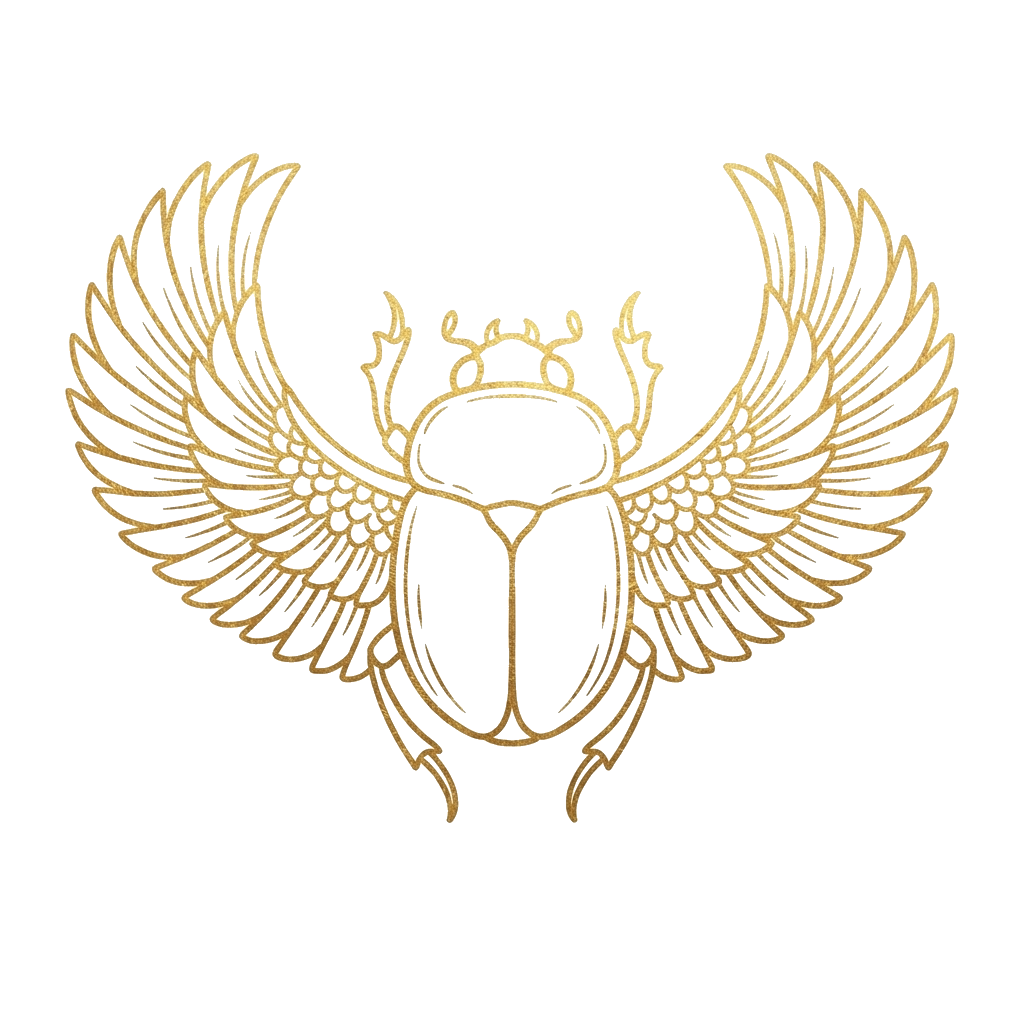
The scarab beetle in its naturalistic form has a compact, ovoid body with a broad, flat head bearing distinctive serrated projections that fan outward like a crown or crescent. Its six segmented legs extend from beneath a smooth, domed carapace marked by subtle longitudinal ridges. Egyptian artists stylized these features into a form that was instantly recognizable while remaining symbolically precise: the head's fan-shaped projections echoed the rays of the sun, the rounded body mirrored the solar disc, and the outstretched legs suggested both the beetle's earth-working labor and the god's cosmic reach.
In amuletic form, the scarab was typically carved with a flat base bearing inscriptions — royal names, protective formulae, decorative patterns, or administrative marks — while the upper surface displayed the beetle's anatomy with varying degrees of naturalism. The finest examples show exquisite detail: individually carved leg segments, wing cases (elytra) with incised veining, and head clypeus with precise denticulation. Larger ceremonial scarabs, such as the heart scarabs placed on mummies, often featured outstretched wings flanking the beetle body, transforming the image into a winged solar disc — merging the scarab with the behedeti symbol of Horus of Edfu.
Color carried meaning. Green and blue faience scarabs invoked regeneration and the heavenly realm. Black stone scarabs (basalt, obsidian) referenced the dark earth from which new life emerged. Red carnelian scarabs called upon the fiery power of Ra. Gold scarabs, reserved for royalty and high officials, proclaimed the wearer's identification with the imperishable solar body. Lapis lazuli, imported at great expense from Afghanistan, connected the scarab to the star-studded body of Nut and the cosmic dimension of rebirth.
Esoteric Meaning
The scarab encodes the Egyptian understanding of consciousness as self-generating. Kheper — "to become" — is not passive change but active self-creation, the universe knowing itself into existence moment by moment. The scarab rolling its ball is consciousness shaping matter, the formless giving rise to form, the unmanifest pressing itself into manifestation through sustained intentional effort. This is not metaphor; for the initiated Egyptian, it was ontological fact. The cosmos perpetuates itself through the same process the beetle enacts: gathering raw material, shaping it through labor, incubating it in darkness, and bringing forth new life.
The scarab's association with the dawn — specifically the liminal moment between darkness and light — places it at the threshold of transformation. In esoteric terms, this is the moment of kheperu, the "transformations" or "becomings" that the deceased must undergo in the Duat to achieve resurrection. The Book of the Dead contains multiple spells for "becoming" various divine forms — a falcon, a lotus, a phoenix — and each transformation is a kheper, a scarab-act of self-creation. Spell 30B, inscribed on the heart scarab, is the most critical of all: it commands the heart not to testify against the deceased during the weighing before Osiris, ensuring the continuity of the individual's being beyond death.
The threefold solar cycle — Khepri (dawn), Ra (noon), Atum (dusk) — maps to a universal pattern found across traditions: creation, sustenance, dissolution. The scarab governs the first phase, the moment of emergence, which the Egyptians understood as the most sacred because it is the hardest. Sustaining what exists requires power; dissolving what has ended requires surrender; but bringing something new into being from nothing requires the rarest capacity of all — what the Egyptians called heka, creative magic, the word-force that bridges nonbeing and being. The scarab is the embodiment of heka in visible form.
In the initiatory traditions of the Egyptian temples, the scarab represented the stage of spiritual practice where the aspirant ceases to be shaped by external forces and begins to shape themselves. This is the transition from kheperu imposed by fate to kheperu chosen by will — from unconscious transformation to conscious self-creation. The scarab amulet worn by a living person was not merely protective; it was a declaration of intent to participate actively in one's own becoming, to be the beetle and the ball simultaneously, the creator and the creation.
Exoteric Meaning
In its most accessible reading, the scarab symbolizes good luck, protection, and renewal. Across three millennia of Egyptian daily life, scarab amulets were worn by people of every social class as general-purpose protective charms. Mothers placed small scarabs on their children. Workers wore them as seal-rings. Soldiers carried them into battle. The scarab's association with the rising sun made it a natural symbol of hope, new beginnings, and the assurance that darkness — whether literal night or metaphorical hardship — would always give way to light.
For the ancient Egyptian public, the scarab was also a practical administrative tool. Scarab seals stamped into clay served the same function as signatures or notary stamps in later civilizations — they authenticated documents, secured containers, and marked property. The flat base of a scarab seal bore the owner's name, title, or a royal cartouche, making the scarab simultaneously sacred and bureaucratic, a religious symbol functioning in the machinery of daily commerce and governance.
The commemorative scarabs issued by pharaohs — particularly the famous series produced under Amenhotep III — functioned as something between royal proclamations and propaganda medals. These large scarabs, distributed across the empire, announced lion hunts, diplomatic marriages, temple dedications, and other events the king wished to memorialize. In this form, the scarab served as a medium of royal communication, its sacred associations lending divine authority to the pharaoh's words.
In the modern world, the scarab has become one of the most widely recognized symbols of ancient Egypt, appearing in jewelry, tattoo art, fashion, film, and popular culture. While much of this use is decorative, the scarab's core associations — transformation, resilience, the capacity to create something valuable from raw and unpromising material — continue to resonate with contemporary audiences seeking symbols of personal change and self-determination.
Usage
Heart Scarabs — The most ritually significant use of the scarab was the heart scarab, a large amulet (typically 7-12 cm) placed on the chest of the mummified deceased, directly over the heart. Carved from dark green or black stone — basalt, schist, serpentine, or obsidian — and often set in a gold frame with outstretched wings, the heart scarab bore Spell 30B from the Book of the Dead on its flat base. This spell addressed the heart directly, commanding it not to "stand against me" or "oppose me in the tribunal" during the weighing of the heart ceremony before Osiris. The heart scarab was, in effect, the deceased's legal counsel in the court of the afterlife — a theological insurance policy ensuring that one's own heart would not betray one's moral record.
Seal Scarabs — From the Middle Kingdom onward, scarabs served as personal seals and administrative stamps. The flat base was carved with the owner's name, title, or a decorative pattern, and the scarab was either mounted in a ring setting or pierced lengthwise so it could be worn on a cord and swiveled to press into clay or wax. Royal name scarabs bore the cartouche of the reigning pharaoh and functioned as markers of loyalty, administrative authority, or chronological reference. Thousands of these have been recovered from sites across Egypt and the broader Near East, providing archaeologists with invaluable dating evidence.
Commemorative Scarabs — The largest and most elaborate scarab type, commemorative scarabs were royal productions, most famously those of Amenhotep III (c. 1390-1352 BCE). Five distinct series survive: the Marriage Scarab (announcing his union with Queen Tiye), the Wild Bull Hunt Scarab, the Lion Hunt Scarab (recording 102 lions killed in ten years), the Gilukhepa Scarab (commemorating a diplomatic marriage with a Mitanni princess), and the Lake Scarab (recording the excavation of a pleasure lake for Tiye). These scarabs were distributed to officials and foreign courts, functioning as royal newsletters or press releases.
Amuletic and Decorative Scarabs — Everyday scarab amulets were produced in enormous quantities from faience, steatite, and semi-precious stones. Bases bore a wide variety of designs: geometric patterns, protective symbols (the Eye of Horus, ankh, djed pillar), divine figures, animal motifs, or short blessings. These were worn as rings, pendants, or bracelets. Some were purely decorative; others were explicitly magical, intended to invoke specific protections or blessings.
Winged Scarabs — A specialized form combining the scarab body with outstretched falcon or vulture wings, the winged scarab appeared in pectorals, coffin decorations, and tomb paintings. This composite form merged the solar symbolism of Khepri with the sky-spanning power of Horus or Nekhbet, creating an image of the sun being carried across the heavens. Winged scarabs were particularly prominent in New Kingdom royal tombs, where they adorned coffin lids, canopic chest decorations, and the walls of burial chambers.
In Architecture
The scarab's presence in Egyptian architecture spans the full range of sacred and royal building, from the most intimate funerary chambers to the most monumental temple facades. In the great mortuary temples of the New Kingdom — Medinet Habu, the Ramesseum, the temple of Hatshepsut at Deir el-Bahri — scarab motifs appear in ceiling decorations representing the passage of the sun through the sky, carved into column capitals alongside solar discs and cobras, and painted on the walls of inner sanctuaries where the daily solar liturgy was performed.
The most famous architectural scarab in Egypt is the massive granite scarab of Amenhotep III at Karnak Temple, situated beside the Sacred Lake. This monumental sculpture — one of the largest scarab carvings ever produced — originally stood at the funerary temple of Amenhotep III in western Thebes before being relocated. Today it serves as a focal point for visitors, and local tradition holds that walking around it seven times brings good luck, a folk practice that preserves, in debased form, the ancient association between the scarab and transformative power.
Within tombs, the scarab appears at architecturally significant transition points — above doorways between chambers, on the ceiling at the boundary between the antechamber and the burial vault, and on the underside of sarcophagus lids directly above the deceased's chest. These placements are theologically precise: the scarab guards the thresholds where the deceased transitions from one state of being to another, ensuring that each passage is a rebirth rather than an ending.
In Ptolemaic and Roman-period temples — Edfu, Dendera, Philae — the scarab appears in elaborate cosmographic ceiling reliefs showing the complete solar journey through the twelve hours of the day and twelve hours of the night. At Dendera, the famous zodiac ceiling incorporates scarab figures at the cardinal points where the sun crosses critical boundaries. At Edfu, the temple of Horus, scarabs flank the great winged sun disc over the main entrance, uniting Khepri's dawn power with Horus's sovereign protection.
Beyond Egypt, the scarab migrated into the architecture of cultures that traded with or were influenced by Egyptian civilization. Phoenician temples incorporated scarab motifs in ivory carvings and stone facades. Etruscan tombs contain scarab-decorated jewelry and wall paintings. The Nubian kingdoms of Kerma and Meroe produced their own monumental scarab forms, adapted to local theological frameworks while retaining the core symbolism of solar renewal.
Significance
The scarab's significance extends far beyond its role as one symbol among many in the Egyptian pantheon. It is, in a meaningful sense, the symbol that best captures the Egyptian worldview itself — the conviction that existence is not a static condition but a continuous act of self-creation, that the cosmos is not a machine running on momentum but a living being that must remake itself every moment to continue existing. The sun does not simply rise; it must be pushed into being by the effort of Khepri. The dead do not simply live again; they must transform themselves through knowledge, will, and divine assistance. Reality itself does not simply persist; it must be spoken, shaped, and labored into continuity by gods and humans working together.
This understanding makes the scarab a profoundly existentialist symbol, though the Egyptians would not have used that term. It places agency and effort at the center of cosmology. The universe is not given; it is made — and it is made by something that looks, to the uninitiated eye, like a dung beetle pushing a ball of waste across the sand. This is the scarab's deepest teaching: that the most sacred processes often wear the most humble disguises, that creation is labor, and that what emerges from darkness and raw material — if attended to with skill and devotion — can be a sun.
The scarab's three-thousand-year production history is itself significant. Scarab amulets were manufactured continuously for over three thousand years — a production run with few parallels in the history of material culture. This longevity speaks not only to cultural conservatism but to the symbol's genuine explanatory power — its ability to encode a complex theological truth in a form so compact, so visually memorable, and so connected to observable nature that it never lost its relevance, even as the civilization that created it transformed beyond recognition through successive waves of foreign rule, religious change, and cultural synthesis.
For the cross-traditional study that Satyori is dedicated to, the scarab offers a crucial reference point. The pattern it encodes — death, gestation in darkness, spontaneous rebirth, the identification of microcosm with macrocosm — appears in virtually every wisdom tradition. The ouroboros, the lotus, the phoenix, the chrysalis, the alchemical nigredo-to-rubedo sequence, the Christian resurrection, the Vedic cycle of srishti (creation) and pralaya (dissolution), the Buddhist concept of bardo as transformative passage — all share the scarab's structural logic. The Egyptian contribution is to have grounded this universal pattern in a specific, observable creature, creating a symbol so concrete and so alive that it bridges abstraction and experience with unique effectiveness.
Connections
Khepri and the Solar Theology — The scarab is inseparable from Khepri, the self-created god of the morning sun. Understanding the scarab requires understanding the Egyptian solar theology in which the sun is not one god but three — Khepri at dawn, Ra at noon, and Atum at dusk — representing creation, sovereignty, and completion. This trinitarian solar model influenced Hermetic thought and, through it, the entire Western esoteric tradition.
The Ankh and the Djed — The scarab, ankh, and djed pillar form a symbolic triad that maps onto the Egyptian understanding of existence: becoming (scarab), living (ankh), enduring (djed). This triad appears throughout funerary art and temple decoration, and its structural logic — transformation, vitality, stability — recurs in traditions from Hindu trimurti to Christian trinity to alchemical tria prima.
Transformation Across Traditions — The scarab's core principle of transformation through darkness finds precise parallels in multiple traditions. In alchemy, the nigredo (blackening) phase requires the material to decompose in sealed darkness before the albedo (whitening) can begin — the same logic as the beetle's egg incubating in buried dung. In Hermetic symbolism, the ouroboros enacts cyclical self-consumption and renewal. In Vedanta, the Self (Atman) is described as that which persists through all transformations — the unchanging witness of kheperu. In Buddhism, the bardo states between death and rebirth mirror the Duat passage where the scarab's power is most needed.
The Book of the Dead and Heart Scarab — The Egyptian Book of the Dead provides the ritual context for the scarab's most important function. Spell 30B, inscribed on the heart scarab, is one of the few spells that address the deceased's own body rather than external deities or demons. It reveals the Egyptian understanding that the greatest obstacle to rebirth is not external threat but internal contradiction — the heart that knows what the mouth denies. This psychological insight connects the scarab to traditions of self-examination found in Stoicism, the Pythagorean exetasis, Buddhist vipassana, and Sufi muhasaba.
Sacred Geometry and the Solar Disc — The scarab's round dung ball is a sphere — the most perfect geometric form, symbol of completeness and cosmic order. The Egyptians identified this sphere with the sun and, by extension, with the geometric principles underlying creation. This connects the scarab to sacred geometry traditions across cultures — the Pythagorean monad, the Hindu bindu, the Buddhist mandala center, and the Neoplatonic One.
Heka and Creative Speech — The scarab embodies heka, the Egyptian concept of creative magic — the power to bring things into being through word and will. This connects directly to the Hermetic principle ("as above, so below" — Emerald Tablet), the Vedic concept of Vak (divine speech), the Kabbalistic doctrine of creation through letters (Sefer Yetzirah), and the Logos theology of the Gospel of John. In all these traditions, creation is a speech-act, and the one who understands this acquires the scarab's power — the ability to create themselves anew.
Further Reading
- Erik Hornung, Conceptions of God in Ancient Egypt: The One and the Many (1982) — Foundational study of Egyptian theology including the Khepri/Ra/Atum solar trinity and the concept of kheper
- Carol Andrews, Amulets of Ancient Egypt (1994) — Comprehensive catalog of scarab types with analysis of their protective and magical functions
- Percy Newberry, Scarabs: An Introduction to the Study of Egyptian Seals and Signet Rings (1906) — Classic scholarly survey of scarab typology, still foundational for the field
- Olga Tufnell, Studies on Scarab Seals, 3 vols. (1984) — Definitive archaeological study of scarab seals in their Near Eastern context
- Jan Assmann, Death and Salvation in Ancient Egypt (2005) — Essential study of Egyptian afterlife theology, including the role of heart scarabs and the kheperu transformations
- Raymond Faulkner, The Ancient Egyptian Book of the Dead (1985) — Standard translation including Spell 30B and all transformation spells
- James Allen, Middle Egyptian: An Introduction to the Language and Culture of Hieroglyphs (3rd ed., 2014) — Includes detailed discussion of the kheper verb and its theological significance
- Erik Hornung, The Ancient Egyptian Books of the Afterlife (1999) — Survey of all major funerary texts with analysis of the scarab's role in each
Frequently Asked Questions
What does the Scarab symbolize?
The scarab encodes the Egyptian understanding of consciousness as self-generating. Kheper — "to become" — is not passive change but active self-creation, the universe knowing itself into existence moment by moment. The scarab rolling its ball is consciousness shaping matter, the formless giving rise to form, the unmanifest pressing itself into manifestation through sustained intentional effort. This is not metaphor; for the initiated Egyptian, it was ontological fact. The cosmos perpetuates itself through the same process the beetle enacts: gathering raw material, shaping it through labor, incubating it in darkness, and bringing forth new life.
Where does the Scarab originate?
The Scarab originates from the Ancient Egyptian (Khepri, the morning sun) tradition. It dates to c. 2700 BCE — present. It first appeared in Ancient Egypt.
How is the Scarab used today?
Heart Scarabs — The most ritually significant use of the scarab was the heart scarab, a large amulet (typically 7-12 cm) placed on the chest of the mummified deceased, directly over the heart. Carved from dark green or black stone — basalt, schist, serpentine, or obsidian — and often set in a gold frame with outstretched wings, the heart scarab bore Spell 30B from the Book of the Dead on its flat base. This spell addressed the heart directly, commanding it not to "stand against me" or "oppose me in the tribunal" during the weighing of the heart ceremony before Osiris. The heart scarab was, in effect, the deceased's legal counsel in the court of the afterlife — a theological insurance policy ensuring that one's own heart would not betray one's moral record.